

We Love Our Quilting Community
At High Country Quilts we care deeply about community. With our experiences in retail, we know that a store is not only a place to shop but also a place for the community to gather and share. During this busy...


When you’re searching for the best sewing machine for quilting, you're really looking for a partner in your craft. The perfect machine is a blend of generous throat space, rock-solid stitch quality, and features that actually help you with your specific projects. A few machines consistently rise to the top of the conversation: the Juki TL-2010Q for its straight-stitch speed, the Brother PQ1500SL for its sheer value, and the Bernina 770 QE for its incredible high-end features. These aren't just sewing machines; they're built to handle what quilters throw at them.
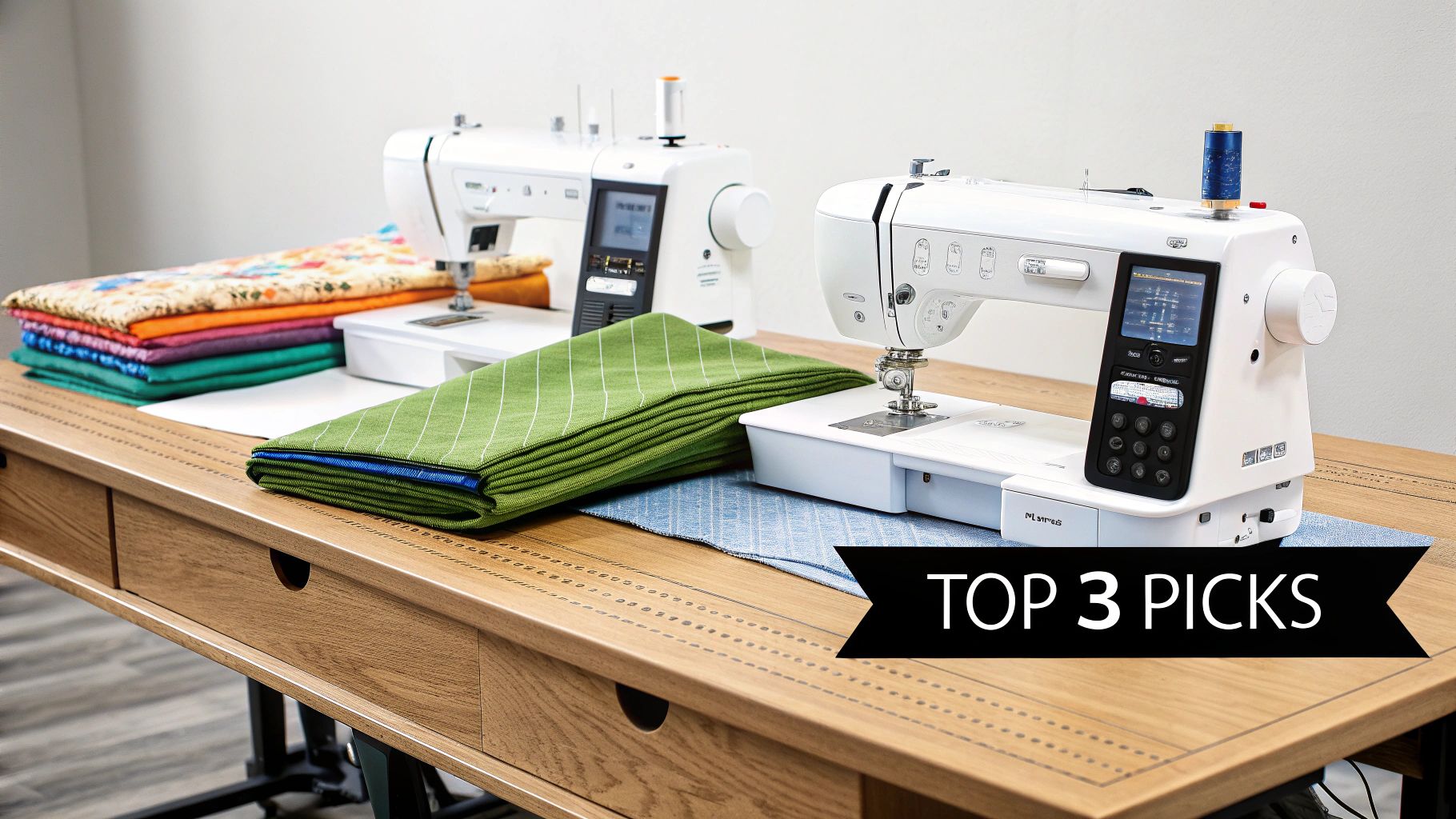
Picking a quilting machine is a big deal, whether it’s your first or an upgrade. The right one can either spark your creativity or become a source of frustration. With so many options out there, the trick is to ignore the fluff and focus on the features that solve the real challenges of quilting. My goal here is to help you do just that.
Quilting is a massive and passionate community. In the U.S. alone, there are 9-11 million active quilters. That passion has fueled a $4.5 billion industry, which is great news for us because it means companies are constantly innovating to build better machines.
To get you started, here’s a quick look at my top picks. This table breaks down the essentials: who each machine is really for, its standout feature, and that all-important throat space.
For a quick comparison, this table lays out our favorite quilting sewing machines, helping you see which one might fit your needs and budget at a glance.
| Model | Best For | Key Feature | Throat Space | Price Range |
|---|---|---|---|---|
| Juki TL-2010Q | Speed & Precision | High-Speed Straight Stitch | 8.5 inches | Mid-High |
| Brother PQ1500SL | Value & Reliability | Pin Feed System | 8.6 inches | Mid-Range |
| Bernina 770 QE | Advanced Features | Stitch Regulator | 10 inches | High-End |
Remember, the machine you choose should also be able to handle the different quilt materials you love to work with. The weight and texture of your fabrics will absolutely impact how a machine performs, so it’s something to keep in mind.
Making the right choice goes beyond just reading a spec sheet. It's about picturing how each feature will actually feel when you're working on your next quilt. If you want to go even deeper into the nuts and bolts of what to look for, our guide on https://hcquilts.com/blogs/tips-and-tricks/how-to-choose-sewing-machine has some great advice to help you narrow it down.
So, what really separates a basic sewing machine from one built for quilting? It's not about how many fancy decorative stitches it has or a flashy touchscreen. The best machines have a core set of features designed specifically to handle the bulk and precision that a quilt demands. Once you know what to look for, you can cut through the marketing fluff and find a machine that will actually help you, not hold you back.
The single most important feature, without a doubt, is the throat space (sometimes called harp space). This is the open area to the right of your needle. A cramped throat means you're constantly bunching, squishing, and fighting your quilt through the machine, which leads to wonky stitches and a whole lot of frustration. If you plan on making anything bigger than a lap quilt, you'll want a throat space of at least 8.5 inches. Period.
Picture yourself quilting a king-size project. With a generous throat space, the quilt just glides through. With a small one, that bunched-up fabric creates drag, pulling against the needle and messing up all your careful work.
Beyond just having enough room, you need features that help you control all those fabric layers. This is where a couple of key accessories become absolute must-haves for any serious quilter: the walking foot and the knee lift.
A walking foot (or even-feed foot) is a brilliant little piece of engineering. It works in sync with your machine's built-in feed dogs to grab the top layer of your quilt sandwich and pull it through at the exact same speed as the bottom layer. This simple action is what prevents the shifting, stretching, and puckering that can otherwise ruin a beautiful quilt top. It’s the secret weapon for perfectly straight lines and that crisp, professional "stitch-in-the-ditch" look. If you want to get the most out of yours, our guide on how to properly use a walking foot is packed with tips.
Then there's the knee lift. This is a lever you operate with your knee to raise and lower the presser foot, leaving both of your hands free to guide the quilt.
This hands-free control is a total game-changer, especially when you're pivoting at a sharp corner or guiding a tricky free-motion quilting pattern. I'll be honest, once you use one, you'll never want to go back.
Finally, a few smaller functions add up to make a massive impact on your workflow and the quality of your finished quilts. You'll usually find these on computerized models, and they are absolutely worth looking for.
When you have these features working for you, the machine gets out of the way. You can stop wrestling with your quilt and focus on what really matters: bringing your creative vision to life.
Let's be honest: picking the right sewing machine for quilting often boils down to balancing what you want against what you're willing to spend. A bigger price tag doesn't automatically mean it's the right machine for you. It’s all about finding that sweet spot where the machine’s capabilities match your quilting ambitions and your budget. We'll walk through the practical differences you'll find at three key price points.
The good news? The sewing machine market is always improving. In 2024, the U.S. industrial sewing machine market was valued at a whopping $457.53 million. And it's expected to grow to $612.80 million by 2033, according to market analysis from StraitsResearch.com. Why does this matter to us home quilters? Because the high-tech innovations that drive that growth eventually find their way into the machines we use every day.
If you're just dipping your toes into quilting or mostly stick to piecing smaller projects like lap quilts and wall hangings, an entry-level machine is a fantastic place to start. These machines give you all the essential functions without a bunch of confusing bells and whistles.
Sure, they won't have the massive throat space or lightning-fast motors of their pricier cousins. Their main drawback is usually a smaller harp, typically around 6 to 7 inches. That's plenty for piecing blocks, but it can feel a bit cramped when you’re wrestling a full quilt sandwich through it. Still, a good entry-level machine is a reliable workhorse—often lightweight, portable, and a great way to hone your skills before making a bigger investment.
This is the sweet spot where many serious quilters find their "forever" machine. Mid-range models are a major step up in both power and convenience, making them a top choice for a huge range of users. You’ll notice the throat space opens up significantly, usually to 8.5 inches or more—what I consider the minimum for comfortably quilting larger projects.
The motors in this category are also much beefier. A stronger motor isn't just about stitching faster; it's about piercing power. It can punch through thick seams and dense quilt sandwiches without skipping a single stitch. If you're tackling projects with lots of layers, you'll want to read our guide on heavy-duty sewing machines for quilting to see just how critical motor strength is.
A key differentiator in the mid-range is the introduction of advanced convenience features. This is where you’ll commonly find essentials like an automatic thread cutter, a needle up/down function, and speed control sliders, which dramatically improve your quilting workflow.
To illustrate the trade-offs, let's compare two hypothetical but typical mid-range machines.
Here’s a feature-by-feature breakdown of what you might find when comparing top-rated mid-range machines.
| Feature | Model A | Model B | Real-World Impact |
|---|---|---|---|
| Throat Space | 8.6 inches | 9.5 inches | Model B offers nearly an extra inch, making it much easier to maneuver larger quilts. |
| Motor Power | 1,000 SPM (Stitches Per Minute) | 1,100 SPM | The slightly faster motor on Model B gives it an edge for long, straight piecing. |
| Thread Cutter | Automatic, foot-pedal activated | Automatic, button-activated | This is a personal preference. Some prefer the hands-free pedal; others like the button. |
| Stitch Regulator | Sold separately as an add-on | Included | Model B is ready for free-motion quilting out of the box, a huge value-add. |
| Specialty Stitches | 150 built-in stitches | 250 built-in stitches, including alphabets | If you enjoy decorative stitches or quilt labels, Model B offers more creative options. |
As you can see, even within the same price bracket, the features can vary. It really comes down to which ones will make the biggest difference in your personal quilting process.
When you move into the high-end category, you're not just buying a machine; you're investing in peak performance, precision, and automation. These machines are built for quilters who demand flawless results and spend countless hours creating. They often feature generous throat spaces of 10 to 12 inches or more, giving you an experience that feels close to working on a long-arm.
The game-changer at this level is often a built-in, sophisticated stitch regulator. This technology uses sensors to ensure every single free-motion stitch is perfectly uniform, no matter how fast or slow you move the fabric. It completely removes the guesswork from free-motion quilting, letting you focus entirely on your creative vision.
Before you get lost in the specs, this decision tree can help you zero in on what truly matters for your quilting style.
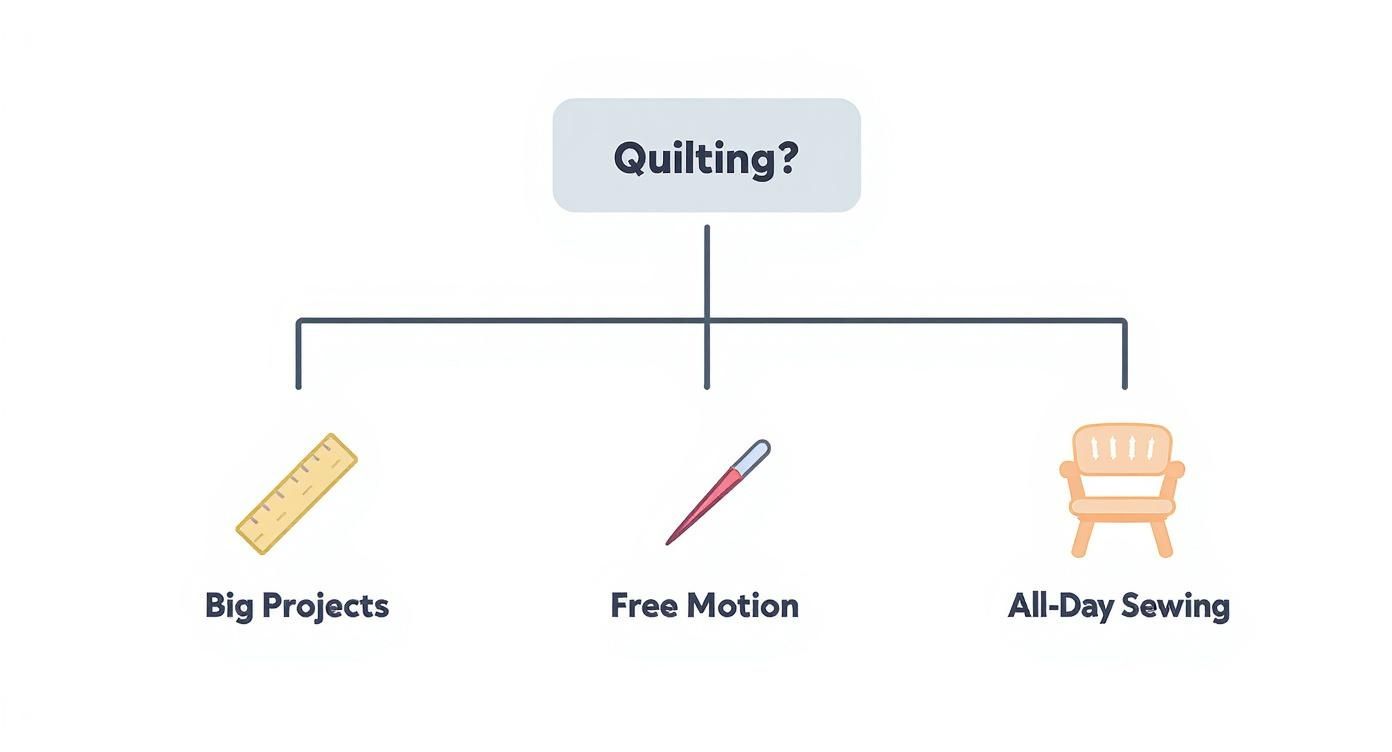
This simple guide makes it clear: your top priorities—whether it’s wrestling king-size quilts, perfecting free-motion designs, or just staying comfortable during long sessions—should steer you toward different must-have features.
Ultimately, the best quilting machine is the one that gets out of your way and lets you create. For beginners, it’s about accessibility and building skills. In the mid-range, it’s about gaining serious power and efficiency. And at the high-end, it's about achieving creative perfection with the best tools available. Understanding these trade-offs will help you choose a machine that feels like a true partner in your quilting journey.
Finding the right sewing machine for quilting isn't about chasing the fanciest specs. It's really about finding a partner for your creative process. The perfect machine for someone who geeks out over traditional, intricate piecing is worlds apart from what a modern, free-motion artist needs. The first step is to be honest about how you actually quilt—that's the secret to finding a machine that feels like an extension of your own hands.
Your personal quilting style is what turns a "nice-to-have" feature into a "can't-live-without-it" necessity. So, what part of quilting truly gets you excited? Is it the meditative rhythm of piecing flawless blocks? The artistic freedom of essentially drawing with thread? Or maybe it's the meticulous detail of appliqué? Each of these passions puts a unique set of demands on a machine.
If your happy place is creating perfectly aligned blocks with crisp, sharp points, your machine has to be a master of precision. The most critical feature, bar none, is a perfect quarter-inch seam. This is about more than just a good quarter-inch foot; it's about having high-quality feed dogs that guide the fabric straight without any pulling or shifting.
A strong motor is another key piece of the puzzle. It maintains consistent power, ensuring every stitch is perfectly formed, even when you're plowing through thick seam intersections. I also find a needle up/down function to be indispensable for this kind of work. It lets you pivot at corners with absolute accuracy, keeping your points sharp and your seams ruler-straight.
Free-motion quilting is where a machine really shows its true colors. This style is all about a fluid dance between the machine's capabilities and your own movements. When it comes to this technique, two features are paramount: generous throat space and reliable stitch regulation.
A large throat space, ideally over 10 inches, gives you the room you need to move a bulky quilt around. Without it, your quilt gets bunched up, and your ability to create smooth, flowing lines goes right out the window. When the quilt has space to breathe, your stitching quality skyrockets.
Stitch regulation is the game-changer that takes free-motion quilting from a frustrating struggle to a pure joy. It uses sensors to match the machine's speed to your hand movements, so every single stitch is uniform. This technology gets rid of the headache of inconsistent stitches, letting you focus completely on your design.
If you're drawn to this style, it's worth taking a deeper look into what free-motion quilting is and how to get started. It’s a skill that can open up a whole new world of creativity.
Love adding detailed shapes and layers with appliqué? Then your machine needs to offer incredible visibility and control. An open-toe presser foot is non-negotiable, as it gives you a clear, unobstructed view of your needle hitting the fabric. This is essential for guiding your work along tight curves and sharp corners with precision.
You'll also want a machine with a solid library of built-in stitches, especially a high-quality satin stitch and blanket stitch. The ability to fine-tune the stitch width and length is crucial for getting the exact look you're after. Some higher-end machines even have tapering functions that automatically narrow the stitch at corners, giving your appliqué a truly clean and professional finish that makes it pop.
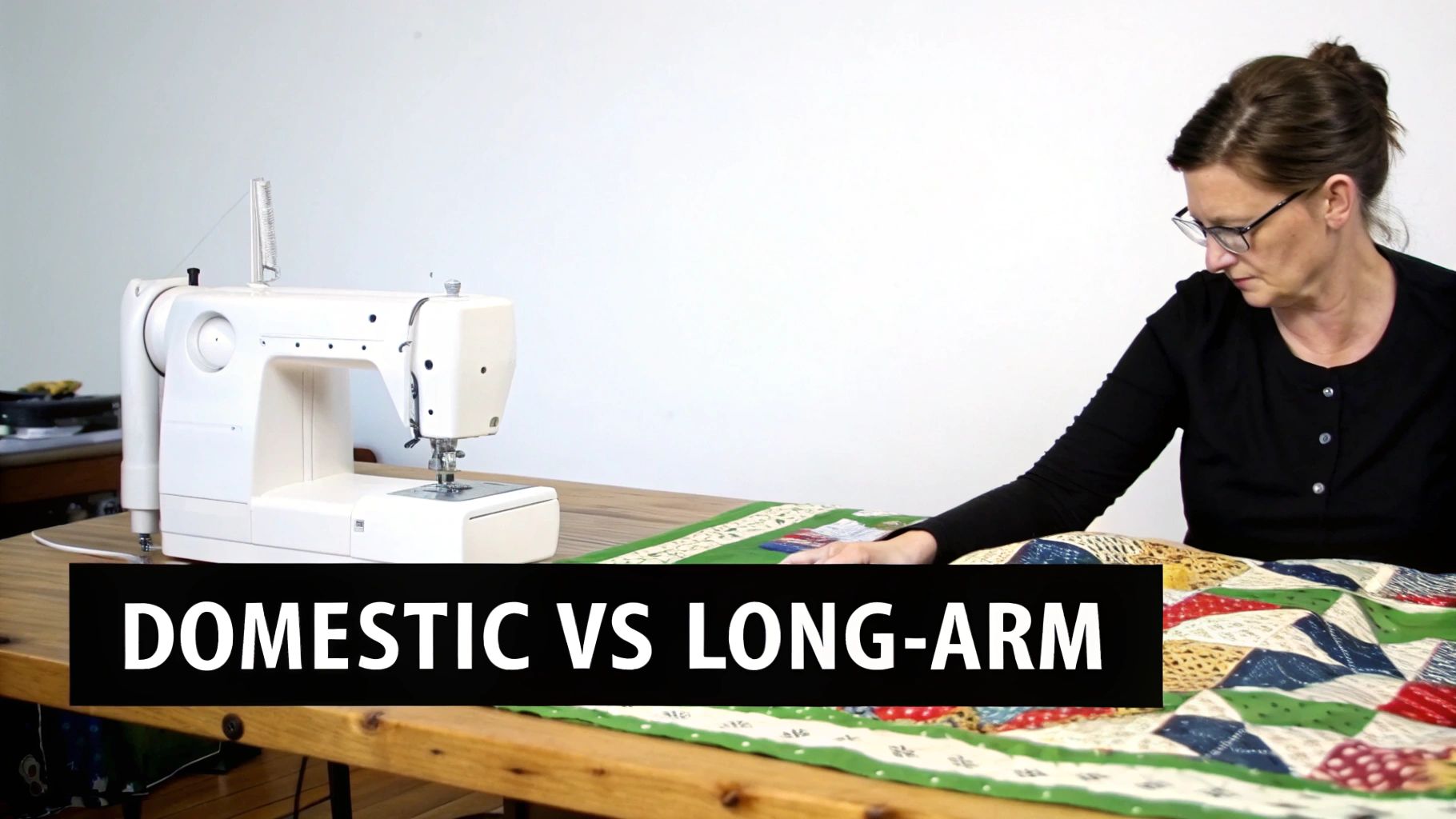
Sooner or later, every serious quilter hits a crossroads. As your quilts get bigger and your designs more ambitious, you'll start asking the big question: stick with a high-end domestic machine or make the jump to a full-blown long-arm quilting system? This is more than just a feature comparison; it's a choice that impacts your space, your budget, and how you fundamentally approach the act of quilting.
A top-of-the-line domestic machine is a true workhorse. It offers incredible versatility, letting you piece, appliqué, and quilt all in one spot. But even with a generous 11-inch throat space, you’re still wrestling the entire weight and bulk of the quilt under the needle. For big projects, that can be a real workout.
A long-arm system completely flips that process on its head. Instead of shoving the fabric around, you move the machine's head over the stationary quilt. This shift completely changes the game, giving you an incredible sense of freedom and control, especially when you're tackling intricate, all-over patterns.
Let's be honest: the two biggest roadblocks to getting a long-arm are space and money. A long-arm isn't something you can tuck away in a closet. It requires a dedicated frame that can easily command a 10- to 12-foot stretch of a room, making it a permanent fixture in your home.
The financial leap is just as significant. While a premium domestic machine is a serious purchase, a complete long-arm setup often starts well into five-figure territory. It's a professional-level investment that really makes you think about your long-term quilting goals. If you're new to the concept, our guide explaining what exactly long-arm quilting involves is a great place to start.
The tipping point often comes down to volume and ambition. If you're finishing multiple large quilts a year or considering quilting for others, a long-arm’s efficiency and ergonomic benefits can quickly justify the investment.
Don't assume your sewing skills will translate perfectly. While a domestic machine is familiar territory, a long-arm requires you to build new muscle memory. Getting the feel for moving the machine head instead of the fabric takes time and practice.
This is a dynamic part of a huge industry. The global quilting machine market was valued at around $850 million in 2023, fueled by incredible innovation in both domestic and long-arm machines. Features like programmable stitch patterns are making both options more powerful than ever.
For the dedicated hobbyist who finishes a few beautiful quilts each year, a powerful domestic machine is often the perfect fit. But if you're a prolific quilter who feels hemmed in by your current setup—or you're dreaming of going pro—a long-arm system can open up a whole new world of creativity and productivity.
When you're diving into the world of quilting machines, a ton of questions pop up. It's totally normal. Matching the right features to what you actually want to create is a big deal, and getting straight answers helps you feel confident about your choice. Let's break down some of the most common questions quilters have.
Of course! A standard sewing machine is fantastic for piecing together your quilt tops. Many of us started exactly that way, and you can absolutely create something beautiful with the machine you already have. The real test comes when it's time to actually quilt it—stitching through all three layers.
You can definitely handle smaller projects like table runners or baby quilts. But once you try to wrangle a lap quilt or anything larger, you'll hit a wall, and that wall is the throat space. This is the workspace to the right of your needle, and on a regular machine, it's pretty cramped. Trying to stuff a big, bulky quilt through that tiny opening is a recipe for frustration, bunched-up fabric, and wonky stitches. This is why investing in a machine with a bigger throat is often the first major upgrade a quilter makes.
Ask a room full of seasoned quilters this question, and you’ll hear a nearly unanimous answer: throat space. Fancy features like stitch regulators and automatic thread cutters are amazing, but if you don't have enough room to work, none of that matters.
A generous throat space of 8.5 inches or more will completely transform your quilting. It's the difference between fighting with your quilt and gliding with it. It eliminates the fabric drag that causes skipped stitches and lets you focus on your design, not on wrestling a textile beast.
Without that space, quilting feels like a chore. With it, the creative process becomes a joy again. It's the one feature that will directly determine whether you can comfortably tackle projects bigger than a wall hanging.
This one often boils down to personal style and budget, but for the vast majority of quilters, the answer is a resounding yes. Computerized features aren't just bells and whistles; they’re game-changers for precision and efficiency. Think needle up/down function, variable speed control, and push-button stitches.
Take the needle up/down setting. It lets you stop with the needle in the fabric, so you can pivot at a sharp corner without the quilt shifting an inch. It's a small thing that makes a huge difference in your accuracy. While mechanical machines are workhorses known for their simplicity, they just can't offer the refined control that makes complex quilting so much more manageable. If you want to do intricate free-motion work or just make your life easier, a computerized model is almost always the best sewing machine for quilting.
Here at High Country Quilts, we know that the right machine can be the key that unlocks your creativity. As an authorized BERNINA dealer, we're here to offer our expertise and help you find the perfect match for your quilting journey. Come explore our collection and meet your new quilting partner.
At High Country Quilts we care deeply about community. With our experiences in retail, we know that a store is not only a place to shop but also a place for the community to gather and share. During this busy...

Hi! We’re Adam and Renee Wheaton, the new owners of High Country Quilts! For more than 40 years, we’ve owned and operated vacuum and sewing businesses. Following in Renee’s father’s footsteps after he retired from All Discount Vacuum and Sewing in Colorado...


Leave a comment