

We Love Our Quilting Community
At High Country Quilts we care deeply about community. With our experiences in retail, we know that a store is not only a place to shop but also a place for the community to gather and share. During this busy...


Choosing a sewing machine isn't about finding the one with the most bells and whistles. It’s about finding the right partner for your creative journey. The best machine for you is the one that fits the projects you're dreaming of, whether that's hemming a pair of pants or crafting an elaborate quilt. The most crucial first step? Figuring out what you actually want to sew.
Before you even start looking at brand names or comparing specs, pause and ask yourself a simple question: "What am I going to make with this?" A heavy-duty machine built for a professional dressmaker is just going to be an expensive, complicated paperweight for someone who only needs to patch jeans. Let your sewing goals be your guide.
The sewing world is massive, catering to everyone from professionals to weekend hobbyists. The global market size hit around USD 4.56 billion recently, with electric models dominating nearly 44.8% of sales because they're just so efficient and easy to use. A huge part of that growth comes from people making their own clothes, which tells you a lot about the features manufacturers are focusing on. You can read more on these market trends to see how they influence the machines on the shelf.
So, who are you as a sewer? Are you a quilter wrestling with huge fabric sandwiches, a fashionista creating a custom wardrobe, or a home decor wiz making custom pillows? Each craft has its own set of needs.
For the Quilter: Space is everything. You'll want a machine with a generous "throat" (the open area to the right of the needle) to manage bulky quilts. A walking foot for even feeding, a needle-down function to pivot corners perfectly, and a rock-solid frame are absolute must-haves.
For the Fashion Creator: Your world revolves around different fabrics and finishes. Look for a machine with a wide variety of high-quality stitches. You’ll need flawless buttonholes (ideally one-step), good stretch stitches for modern knits, and easy options for inserting zippers.
For the Home Decor Enthusiast: Power is your best friend. Projects like curtains, cushions, or light upholstery require a machine with a motor that won't give up. It has to punch through thick layers and dense fabrics without a fight, so durability is key.
My Advice: Don't start by browsing machines; start by picturing your projects. Grab a notebook and list the top three things you want to sew this year. This simple act will bring incredible clarity and stop you from buying a machine that can't do what you need it to.
To get you started, here’s a quick-and-dirty guide to matching common sewing jobs with the right type of machine. Think of it as a starting point. We'll dig deeper into what makes each of these categories unique as we go.
| Project Type | Recommended Machine Type | Why It's a Good Fit |
|---|---|---|
| Basic Mending & Hemming | Mechanical | Simple, tough, and affordable. It gives you the essential stitches without overwhelming you with options. |
| Garment Sewing & Fashion | Electronic/Computerized | Offers a wide range of stitches for various fabrics, perfect one-step buttonholes, and super consistent quality. |
| Quilting & Patchwork | Computerized | Delivers precision, a larger throat for big projects, and handy features like a needle-down function for sharp corners. |
| Heavy-Duty Crafts (Canvas) | Heavy-Duty Mechanical | Built with a stronger motor and metal frame to power through thick, tough materials without skipping a beat. |
This table should help you narrow the field. Now, let’s get into the specifics of what to look for within each type.
When you first start looking for a sewing machine, you'll run into two major categories right away: mechanical and computerized. The easiest way to think about it is like the difference between a classic car with a manual transmission and a brand-new one with a push-to-start button and a GPS screen. Both will get you down the road, but how you drive—and the features you have along the way—are worlds apart.
A mechanical sewing machine is the traditional workhorse you might picture your grandmother using. You're in the driver's seat for everything, controlling stitch selection, length, and width by physically turning knobs and dials. There's a certain satisfaction in hearing that "click" as you lock in a setting.
These machines are legendary for their durability. Many are built with all-metal frames and can handle just about anything you throw at them, often lasting for decades with basic care. Their simplicity is their biggest advantage; with no complex electronics, there's just less that can go wrong. This makes them a fantastic starting point for beginners who want to master the basics without being intimidated by a digital screen. They’re also a go-to for anyone tackling heavy-duty materials like denim or canvas.
The real charm of a mechanical machine is how hands-on it is. You develop a genuine feel for what the machine is doing. Want a zigzag stitch? You turn one dial to the zigzag icon and another to set the width. It’s a very direct, intuitive process that helps you build a solid understanding of how stitches actually work.
This tactile approach is perfect for straightforward, rugged sewing. Think mending a ripped pair of jeans, hemming curtains, or stitching a simple, sturdy tote bag. A mechanical machine will deliver the essential stitches—like your basic straight stitch and zigzag—with incredible strength and reliability, no fuss involved.
My Takeaway: A well-maintained mechanical machine is practically indestructible. If you plan on doing mostly mending, simple projects, or working with tough fabrics, the raw power and uncomplicated controls of a mechanical model are often the smartest choice.
On the other end of the spectrum, you have computerized sewing machines. Instead of knobs and dials, you'll find an LCD screen, push buttons, and a small internal computer that automates many of the functions. This opens up a level of precision and convenience that a mechanical machine just can't offer.
With a computerized machine, you simply select a stitch from a digital menu, and the machine automatically configures the perfect length and width for you. That feature alone eliminates a ton of guesswork and helps you produce more consistent, professional-looking stitches right from the start. These machines often come loaded with dozens, sometimes hundreds, of built-in stitches, from practical stretch stitches for knits to beautiful decorative and embroidery patterns.
It's no surprise that many quilters and garment makers eventually move to computerized models for their advanced features.
For example, imagine you're quilting. A computerized machine lets you set your stitch length to a consistent 3.5mm with a single touch, ensuring every stitch looks uniform across the entire project. Trying to achieve that level of precision manually can be tough.
Of course, all these convenient features come at a higher price, and repairs can be more costly if an electronic component fails. In the end, it really boils down to what you value most in your sewing: the pure, simple power of a mechanical machine or the smart, time-saving precision of a computerized one.
Walking into a craft store and seeing the feature list on a sewing machine box can be both thrilling and totally overwhelming. With machines boasting hundreds of stitches and countless attachments, it’s easy to fall into the “more is better” trap. But here's the secret: the key is to separate the workhorse features you'll use every single day from the shiny, expensive extras that might just gather dust.
Focusing on the core functions ensures you're investing in quality where it really counts. A machine that does a few things perfectly is always a better choice than one that does a hundred things poorly.
Some functions are the bedrock of nearly every sewing project. Whether you're hemming a pair of pants, piecing a quilt top, or whipping up a simple tote bag, you will be relying on these basics. A machine that masters these is worth its weight in gold.
A Perfect Straight Stitch: This is it—the single most important stitch. It needs to be straight, consistent, and strong, with no puckering or annoying loops. A good machine produces a balanced stitch where the top and bobbin threads lock perfectly between the fabric layers.
A Versatile Zigzag Stitch: This is your go-to for finishing raw fabric edges to stop them from fraying. It's also essential for sewing with stretchy knit fabrics and can even be used for some simple decorative work. A quality zigzag stitch will look even and symmetrical.
An Easy-to-Use Buttonhole Function: Trust me, trying to create buttonholes manually is a one-way ticket to frustration. A machine with a one-step buttonhole feature is a non-negotiable if you plan on making clothes. You just pop the button into a special foot, and the machine stitches a perfectly sized buttonhole for you automatically.
Adjustable Stitch Length and Width: This is all about control. A longer stitch length, say 3.0 mm to 4.0 mm, is great for things like topstitching and quilting. A shorter stitch creates a stronger, more durable seam. Being able to adjust the width of your zigzag is just as critical for handling different fabric weights and applications.
This infographic breaks down the core features versus the more specialized extras to help you see the difference.
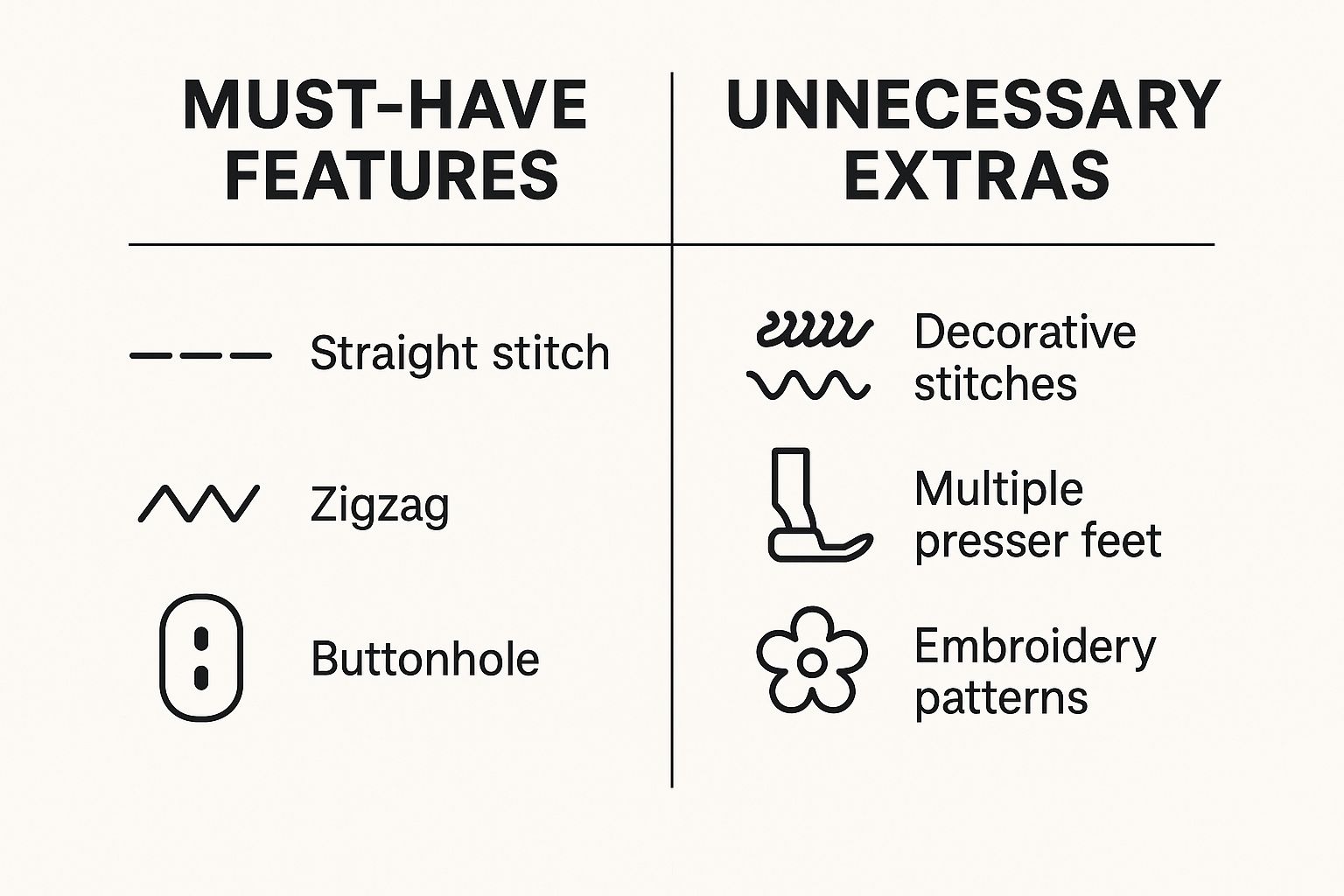
As you can see, there's a clear line between the foundational stitches needed for construction and the features that are purely for embellishment. This is where your focus should be, especially at first.
Beyond the absolute must-haves, some features just make sewing so much more enjoyable by saving time and cutting down on headaches. While not strictly essential for the machine to run, they are so helpful that they quickly feel like necessities, particularly if you sew often.
A perfect example is an automatic needle threader. This tiny hook mechanism gracefully pulls the thread through the needle's eye for you, saving you from minutes of squinting. It's a small luxury you'll appreciate every single time you switch your thread.
Another game-changer is a drop-in bobbin system. Instead of fiddling with a clunky side-loading bobbin case, you simply drop the bobbin in from the top. Most of these have a clear cover, so you can see exactly how much thread is left. No more "bobbin chicken," where you unexpectedly run out of thread right in the middle of a beautiful seam.
A feature I personally cannot live without is the needle up/down button. It lets you program the needle to always stop in the "down" position, sunk into the fabric. This is fantastic for pivoting on sharp corners—a technique every quilter and garment maker uses constantly—without your fabric shifting an inch.
To help clarify what's truly essential versus what's nice to have, here's a quick breakdown.
| Feature | Description | Who Needs It? |
|---|---|---|
| Straight & Zigzag Stitches | The two most fundamental stitches for construction and finishing. | Everyone. These are non-negotiable for any type of sewing. |
| One-Step Buttonhole | An automated function that creates perfectly sized buttonholes. | Garment Sewers. Essential for shirts, dresses, and trousers. |
| Adjustable Stitch Length/Width | Allows you to control the size of your stitches for strength and style. | Everyone. This control is crucial for quality results on all fabrics. |
| Needle Up/Down | A button that sets the needle's stopping position (in or out of fabric). | Quilters & Garment Sewers. Invaluable for precision piecing and corners. |
| Automatic Needle Threader | A small mechanism that threads the needle for you. | Everyone, but especially those with vision challenges or who value convenience. |
| Decorative Stitches | A wide variety of stitches used for embellishment, not construction. | Crafters & Embellishers. Fun for creative projects, but not a core need. |
| Embroidery Functions | Built-in capabilities to stitch complex, programmed designs. | Embroidery Hobbyists. A specialized feature that adds significant cost. |
This table illustrates that your sewing goals directly dictate which features are "must-haves" and which are simply "nice-to-haves."
One feature that's often overlooked by beginners is adjustable presser foot pressure. This little dial or setting lets you control how hard the presser foot pushes down on the fabric as it's fed through the machine.
Why is this so important?
Without this adjustment, you're stuck with one default pressure setting that's often too aggressive for fine materials and not strong enough for heavy ones. It’s a feature that gives you a level of control that directly impacts the professional quality of your finished project.
So, where do you draw the line? It's tempting to go for the machine with 200 stitches, but in reality, most of us use fewer than ten on a regular basis. Those beautiful, intricate decorative stitches look great on the machine's display panel, but they rarely see the light of day in everyday projects.
The same logic applies to a massive collection of included presser feet. A zipper foot and a buttonhole foot are essential, but you probably don't need the dozen others that come in the box right away. It's often smarter to buy high-quality, specialized feet (like a walking foot for quilting) as your skills grow and your projects demand them.
This push toward high-tech features is a major market trend. In fact, fully automated and computerized sewing machines are projected to grow at a rate of around 6.9% annually through 2030 as everyone from home hobbyists to industrial producers seeks more efficiency. While these machines offer incredible capabilities, their high price tags can be a major barrier. You can explore sewing machine market trends to see how this technology is shaping consumer options.
Ultimately, the best thing you can do is be honest about what you want to sew. Don't pay for embroidery functions if you only want to make quilts, and don't be swayed by 200 stitches if a solid, reliable straight stitch is what you truly need. Choose a machine for the quality of the features you'll actually use, not the quantity of ones you won't.
Alright, let's talk money. Figuring out your budget is obviously a huge part of picking a sewing machine, but I want you to think about it in terms of value, not just the price on the box.
Trust me, a cheap machine that constantly jams, needs repairs, or just can't handle the project you’re excited about isn't a bargain. It's a source of frustration that might make you quit sewing altogether.
The real goal here is to find a machine that not only meets your needs today but is also built well enough to grow with you. That means looking past the initial cost and thinking about things like build quality, brand reputation, and whether it’ll still be chugging along happily in a few years.
For a lot of people, a machine under $200 is the first step into the sewing world. These are typically lightweight, often have a plastic frame, and give you a handful of basic stitches to get started. They’re designed to be simple and are perfect for getting a feel for the absolute fundamentals.
Think of these as your sewing training wheels. They're great for:
Just be realistic about their limits. These machines tend to struggle with multiple layers of fabric or anything heavy like denim or canvas. Their smaller motors can get overworked, which leads to skipped stitches and wonky tension. They’re a fantastic starting point, but you might find yourself wanting more pretty quickly if you get hooked.
This is where things get interesting. For most dedicated hobbyists, the $200 to $600 range is the real sweet spot. You’ll see a major jump in build quality here—many of these machines have a sturdy metal interior frame, which makes them more stable and cuts down on all that rattling and vibration.
This is also where you start to see some really useful electronic and computerized features become standard. Things like a needle up/down button (a lifesaver!), speed control, and a much wider variety of reliable, clean stitches. A good mid-range machine is a true workhorse, ready to tackle everything from dressmaking with fussy knit fabrics to piecing an intricate quilt top.
Expert Insight: Honestly, investing in a solid mid-range machine is often the smartest long-term move. It's durable enough to last for years and has enough features to keep you from feeling like you need an upgrade as soon as your skills improve.
This part of the market is booming, especially in places like the U.S. where home sewing is a nearly USD 2 billion industry. People spending in this range are looking for reliability and good customer support, balancing the cost of a new machine against the gamble of a cheap, used one. You can dig into more stats on sewing habits and discover more insights on cognitivemarketresearch.com.
Once you start looking at machines over $600, you’re stepping into the world of high-performance and specialized equipment. These models are engineered for precision, power, and a seriously long life. They're often physically larger, with more "throat space" for big projects like quilts, and they're packed with advanced computerized features that can automate some of the trickiest tasks.
Here’s what you can expect in this price range:
A high-end machine is a serious investment for a passionate enthusiast or someone running a small business from home. For instance, a dedicated quilter might choose a machine in this bracket for its huge throat space and stitch regulator, making free-motion quilting incredibly smooth and professional. Likewise, an aspiring clothing designer would love its perfect buttonholes and flawless handling of luxury fabrics like silk or velvet. The upfront cost is steep, no doubt, but for those who will truly push it to its limits, the performance is worth every penny.
https://www.youtube.com/embed/nyOw4TDm3ac
After all the research, comparing specs, and wrestling with your budget, it's finally time to pull the trigger. All that homework is about to pay off. If I can offer one single piece of advice at this stage, it’s this: if at all possible, always test-drive a machine before you buy it.
Nothing on a website or a spec sheet can truly capture how a machine feels when you’re in the driver's seat. You need to hear the motor purr (or strain), feel how the foot pedal responds, and see if the controls are laid out in a way that just makes sense to you. Getting that hands-on experience is the best way to avoid any surprises when you get it home.
The absolute best place for a hands-on trial is your local sewing machine dealer. These aren't just stores; they're hubs run by people who are passionate about sewing. Unlike a big-box store, the staff at a dealer expect you to sit down and give the machines a proper spin.
To get the most out of your visit, show up prepared.
Bring your own fabric swatches—and I mean the exact types of fabric you love to work with. Got some slinky, frustrating knit? A tough scrap of denim? A delicate piece of quilting cotton? Bring them all. Sewing on materials you already know gives you a real, honest baseline for how the machine performs.
While you're sewing, tune into a few key things:
My Two Cents: Don't just sew a boring straight line. Try turning a corner using the needle-down function. See how the reverse button feels. If you're into making clothes, you absolutely have to test out the one-step buttonhole. Mimicking how you’ll actually use the machine tells you so much more about its design than a simple straight stitch ever could.
Sometimes, heading to a local shop just isn't in the cards, or a fantastic deal pops up online. While you miss out on the test drive, you can still make a great choice by being a savvy digital shopper. Remember, not all online sellers are created equal.
Before you even think about clicking "add to cart," run through this quick mental checklist:
Where you buy your machine can be just as important as which machine you buy. The level of support you get can vary wildly, and that can make all the difference in your sewing journey.
| Aspect | Local Sewing Dealer | Big-Box Store / Online Retailer |
|---|---|---|
| Expertise | Staff are true specialists. They can offer personalized advice based on years of experience. | Staff are generalists with very limited, specific knowledge about sewing machines. |
| Support | Often includes free intro classes, help with troubleshooting, and a person you know by name. | Support is usually a generic 1-800 number or the manufacturer's hotline. |
| Service & Repair | On-site technicians can handle warranty work, tune-ups, and most repairs. | You'll almost always have to pack up and ship your machine to a regional service center. |
| Price | Typically follows MSRP, but you're paying for the incredible value of service and support. | Often has lower prices and big sales, but you're on your own after the purchase. |
Ultimately, picking your machine is a balance between its features, how it feels to use, and the kind of support you want in your corner. If you're just starting out, the guidance and free lessons from a local shop like High Country Quilts can be absolutely priceless. But if you're a seasoned pro who knows exactly what you need, snagging a great deal online might be the perfect move.
Whichever path you take, making a thoughtful choice now means you'll have a creative partner you love for many years to come.
After you've done all the research, there are always a few final questions that pop into your head right before pulling the trigger. It’s completely normal. Nailing down these last few details is what separates a good purchase from one you'll love for years to come.
Let's walk through some of the most common questions I hear from sewers who are trying to find their perfect machine. Getting these answers straight will help you buy with total confidence.
This is the classic dilemma, isn't it? The best choice really boils down to your budget and how comfortable you are with potential maintenance.
A brand-new machine is almost always the safest bet, especially if you're just starting out. You get the full manufacturer's warranty, all the latest features, and—most importantly—the support of the dealer who sold it to you. That peace of mind is invaluable.
On the flip side, a used machine can be an incredible bargain. Those vintage, all-metal workhorses are famous for their durability and can often be snagged for a steal. But here's the catch: they will almost certainly need a professional tune-up and will lack modern conveniences like an automatic needle threader or a one-step buttonhole.
My Two Cents: For a first machine, I almost always recommend buying new. The warranty and dealer support are worth the extra cost. If you find a vintage gem you can't pass up, make sure you buy it from a reputable sewing machine repair shop that has already serviced it from top to bottom.
This one trips a lot of people up. A serger might look like a sewing machine on steroids, but they are two completely different tools designed for different jobs.
Think of your regular sewing machine as your construction expert. It's what you use to build your projects—sewing seams, hemming, topstitching, and making buttonholes.
A serger, which is also called an overlocker, is a finishing specialist. In one super-fast pass, it uses multiple threads to trim the raw fabric edge and wrap it in a clean, professional-looking stitch. This is how you get those stretchy, durable seams you see on store-bought t-shirts and activewear.
A serger is the perfect second machine to add to your sewing room, but it absolutely cannot replace your primary sewing machine. It can't install zippers, sew buttonholes, or do any decorative topstitching.
It's so easy to be wowed by a machine that boasts 200+ stitches. But trust me on this, that big number should not be your deciding factor.
The truth is, for 95% of all your sewing, you'll be using the same handful of stitches over and over again.
What you really need are these core stitches, executed perfectly:
The quality of these essential stitches is far more important than the quantity of decorative ones you'll rarely touch. A machine that does 10 stitches flawlessly is a much better investment than one that does 100 stitches poorly. Focus on how well the machine handles the basics, and you'll have a reliable partner for any project you can dream up.
At High Country Quilts, we believe there’s a perfect machine out there for every creative journey. As an authorized BERNINA dealer, we're here to offer expert advice, hands-on training, and the kind of support that builds confidence from your very first stitch. Visit us in-store or explore our selection online at https://hcquilts.com to find the machine that will bring your ideas to life.
At High Country Quilts we care deeply about community. With our experiences in retail, we know that a store is not only a place to shop but also a place for the community to gather and share. During this busy...

Hi! We’re Adam and Renee Wheaton, the new owners of High Country Quilts! For more than 40 years, we’ve owned and operated vacuum and sewing businesses. Following in Renee’s father’s footsteps after he retired from All Discount Vacuum and Sewing in Colorado...


Leave a comment