

We Love Our Quilting Community
At High Country Quilts we care deeply about community. With our experiences in retail, we know that a store is not only a place to shop but also a place for the community to gather and share. During this busy...


When someone asks what the best fabric for quilt backing is, my answer is almost always a high-quality, 100% cotton. If you can find it in a wide-back format—usually 108 inches wide—even better, because it lets you skip piecing a seam down the middle. Cotton just hits that sweet spot of being breathable, strong, and easy to work with, which is why it's a favorite for quilters everywhere, from beginners to seasoned pros.
We all know the quilt top gets the spotlight. It's where we spend hours upon hours piecing together intricate blocks and telling a story with color and pattern. But the backing? It’s the unsung hero of the whole project, quietly ensuring your quilt is comfortable, durable, and hangs just right.
It's easy to pour all your energy into the top and then treat the backing as an afterthought. I've seen it happen many times! But the truth is, the fabric for quilt backing you choose is the foundation for the entire quilt's future.
Think of it this way: the quilt top is the beautiful painting, but the backing is the sturdy canvas it’s built on. A poor choice here can cause all sorts of headaches later—puckering after the first wash, uneven wear, or a quilt that feels stiff and board-like instead of soft and cuddly.
Picking out your backing fabric is a major decision that influences everything from basting your quilt sandwich to putting in that very last stitch. It’s about more than just covering the batting; it's about honoring all the hard work you've already put in.
A few key things come into play that can truly make or break your quilt:
By the end of this guide, I hope you’ll see quilt backing not as a chore, but as another exciting opportunity to add personality and lasting quality to your masterpiece.
Choosing the right fabric for your quilt's back is a bit like casting the perfect supporting actor. While your quilt top gets all the attention, the backing is doing the heavy lifting—providing structure, comfort, and durability. It’s what makes the whole project come together. Let's walk through the fabrics most quilters swear by, so you can get a real feel for what might work for you.
There's a reason quilting cotton is the undisputed champion for backing. It's breathable, a breeze to handle, and the sheer variety of colors and prints means you'll always find the perfect match for your quilt top. Its stable weave behaves beautifully, whether you're piecing the backing together or feeding it through your machine.
This reliability is why cotton is everywhere in the quilting world. The global quilt market, valued at over USD 695 million, continues to grow, with cotton leading the charge. Here in North America, where quilting is a massive $4.5 billion industry, an estimated 70-80% of quilt backs are made from good old cotton. That number speaks for itself. For more on these trends, you can explore this comprehensive quilting market analysis.
If you’re just starting out or simply value a predictable, no-fuss experience, you can't go wrong with cotton. It holds a press like a dream, washes well, and gets softer and softer over time, turning your quilt into a true heirloom.
When you want to dial up the warmth and create something seriously snuggly, flannel is your best friend. It has a soft, brushed surface—what we call a "nap"—that gives it a plush, cozy feel. It’s absolutely perfect for quilts meant for chilly nights on the couch.
That brushed texture has a hidden superpower, too. It gently grips the batting, which helps keep your quilt sandwich from shifting and bunching while you quilt. This makes it a fantastic choice for newer quilters who are still getting the hang of keeping everything smooth.
A couple of things to remember when working with flannel:
For baby quilts, kid's throws, or any project where you want next-level softness, Minky is the undisputed star. This is a super-plush polyester knit that feels like a velvety cloud. It's a true sensory delight and an instant favorite with little ones.
Better yet, Minky doesn't shrink, and its colors stay bold and bright wash after wash. This makes it a surprisingly durable choice for quilts that are going to be well-loved and frequently washed.
A key thing to know about Minky is that it stretches. It's a knit, so it behaves very differently from woven cotton. To keep it from warping, you'll want to use a walking foot on your machine, plenty of pins or wonder clips, and a stretch needle. Trust me, these tools will make the process go so much smoother.
If you're aiming for a quilt with a more modern, sophisticated look, consider linen or a cotton-linen blend. Pure linen gives the back of a quilt a beautiful, slightly rustic texture that adds a ton of character and visual depth. It's also incredibly strong and gets softer with every wash.
Working with 100% linen can be a little challenging because it loves to wrinkle and shift. That's why a cotton-linen blend is often the perfect compromise. You get the gorgeous drape and texture of linen with the stability and easier handling of cotton. For a deeper dive into materials, our guide on the best fabrics for quilting can help you coordinate your top and back fabrics perfectly.
Ultimately, the best fabric for quilt backing comes down to what the quilt is for. A decorative wall hanging has very different needs than a baby quilt destined for daily cuddles. Once you understand the personality of each fabric, you can choose a backing that doesn't just look great, but truly elevates your finished masterpiece.
We’ve all been there—that sinking feeling when you realize you’re short on fabric just as you're getting to the finish line. When it comes to quilt backing, a little bit of math up front saves a world of frustration later. Getting this number right isn’t just about covering the back; it's about setting yourself up for a smooth, pucker-free finish.
The first thing to remember is the quilter’s golden rule of overage. You absolutely need extra fabric on all four sides of your quilt top. This isn't optional, especially if you plan on sending it to a longarmer.
Think of this extra fabric as your safety net. It’s the space a longarmer needs to clamp the quilt onto their frame. It also gives them (or you!) a place to test thread tension and lets the quilting design run right off the edge of the quilt top, ensuring the pattern covers every last inch without any awkward stops.
As a rule of thumb, you must add at least 4 inches of extra fabric to all four sides of your quilt top. This means your final backing needs to be 8 inches wider and 8 inches longer than your quilt top.
Let's walk through an example. Say your finished quilt top measures 60 inches by 70 inches:
So, your mission is to end up with a single piece of backing fabric that measures at least 68" x 78". This is the magic number you'll take to the fabric store.
This is where you can make your life a whole lot easier. Extra-wide fabrics, often called "wide backs," are typically 108 inches wide, which is a huge leap from the standard 42-44 inches.
Using a wide back is often the simplest path to a seamless finish, as you rarely need to piece it for most common quilt sizes.
Let's go back to our example quilt top (60" x 70"), which needs a backing of at least 68" x 78". The 108-inch width of the fabric easily covers the 68-inch width we need. That means we only have to worry about the length. We need 78 inches of it.
To figure out the yardage, just divide the inches by 36 (since there are 36 inches in a yard).
Since fabric stores don't cut in hundredths of a yard, you'll want to round up. It’s always smart to buy a little extra, so you'd ask for 2.25 yards (or 2 1/4 yards). Simple as that!
The infographic below shows some of the most popular choices you'll be calculating for.
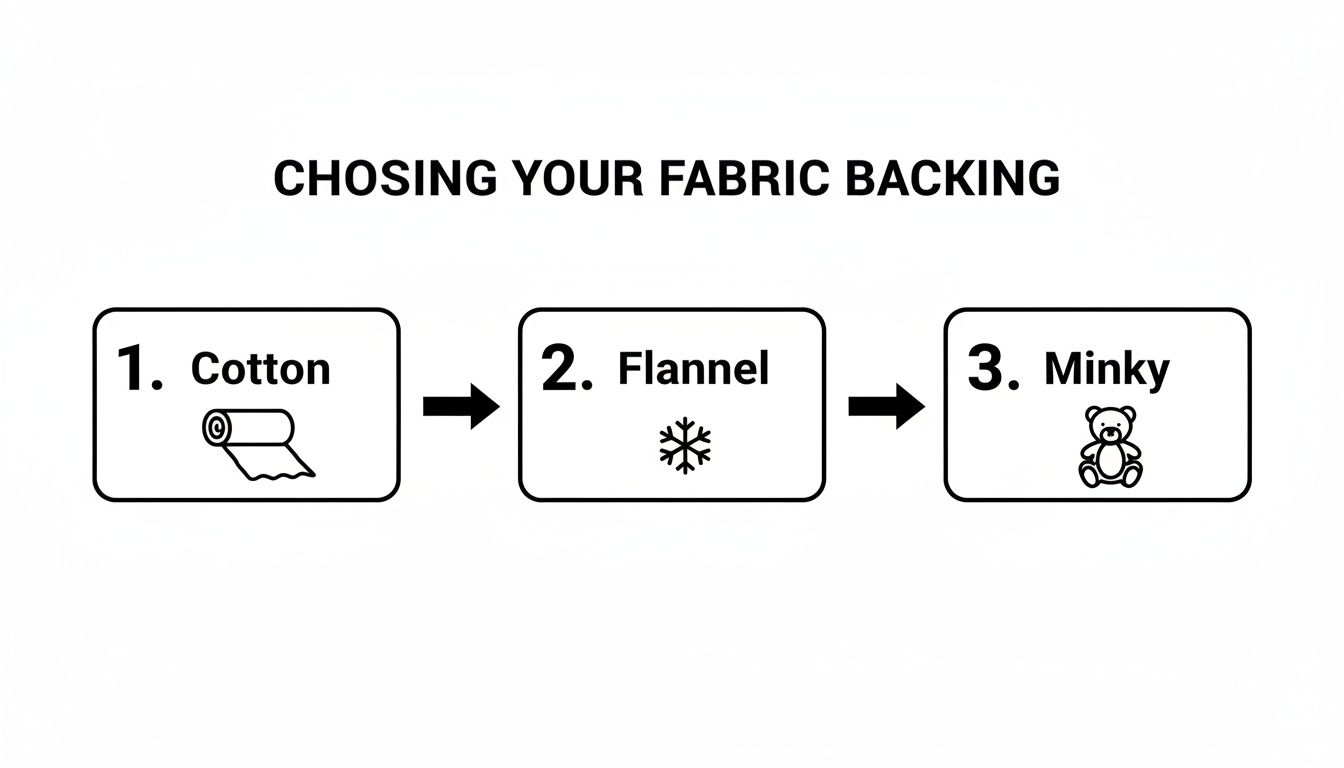
Whether you choose classic cotton, cozy flannel, or luxurious Minky, getting the yardage right from the start is key to a perfect result.
What if a wide back isn't in the cards? No problem. You'll just need to piece together standard-width fabric (which is about 42"–44" wide). This means sewing two or more lengths of fabric together to create a large enough panel. You can do this with either a vertical or a horizontal seam. If you want to dive deeper, our detailed guide on calculating yardage for quilts has even more tips.
Let’s stick with our 68" x 78" backing requirement. A standard bolt of quilting cotton is about 42 inches wide once you trim off the selvages.
Option 1: Vertical Seam For this method, you'll sew two long pieces together side-by-side.
Option 2: Horizontal Seam Sometimes, turning the fabric sideways can save you a bit of yardage. Let's see.
Look at that! In this case, piecing with a horizontal seam saves you half a yard of fabric. It’s always worth taking a minute to do the math both ways to see which one works out better for your specific quilt dimensions.
Great quilting starts long before your needle ever touches the fabric. Seriously. The real secret to a smooth, pucker-free quilt lies in careful preparation, and your backing fabric is the foundation of that success. Taking a little extra time here transforms the quilting process from a potential wrestling match into a genuinely joyful experience.
Think of it like painting a room in your house. You wouldn't just slap a new color over bumps and cracks, right? You'd sand and prime the surface first to get that professional, smooth look. Prepping your quilt backing is the exact same idea, and it's what ensures your finished quilt looks as beautiful on the back as it does on the front.
Ah, the age-old question in quilting circles: to pre-wash or not to pre-wash? While some quilters live on the edge and skip this step, it's a non-negotiable for certain fabrics. If you're using a backing with rich, saturated, or vibrant colors like fire-engine reds or deep navy blues, pre-washing is your best friend. It helps prevent any nasty dye bleeds onto your beautiful quilt top later on.
Pre-washing also takes care of shrinkage before you quilt, not after. Some fabrics, especially cozy flannels, are notorious for shrinking quite a bit. If you don't wash it first, you risk ending up with a crinkled, distorted quilt the first time it hits the laundry.
When to Always Pre-Wash:
- When using deeply saturated colors (we're looking at you, reds, navies, and purples).
- When your backing is 100% flannel or another material known for high shrinkage.
- If you are mixing different types of fabrics between your top and back.
Once your fabric is washed and dried, the next crucial step is giving it a really good press. And I don't mean a quick once-over with the iron. You want to hunt down and eliminate every single wrinkle and crease. A perfectly flat backing creates a perfectly flat quilt sandwich, which is your number one defense against puckers and tucks during the quilting stage.
If you pieced your backing, how you press those seams makes a world of difference.
For a complete walkthrough, check out our guide on how to piece a quilt back for more detailed instructions and visuals.
The final prep step, and one that's surprisingly easy to overlook, is squaring up your backing fabric. Fabric rarely comes off the bolt perfectly straight. Taking the time to trim your edges so they are perfectly square—with true 90-degree corners—is what separates a good quilt from a great one.
A squared-up backing loads onto a longarm quilting frame straight and true, which prevents all sorts of warping and distortion as it's being quilted. Even if you're quilting on your home machine, a square backing helps you create a much neater and more manageable quilt sandwich. This precision matters, especially when you consider the investment. The global quilting fabric market was valued at USD 3.5 billion in 2023, and backing fabric can easily account for 30-40% of a project's material cost.
Dedicating a bit of time to these prep steps is really about honoring all the hard work you've already put into your quilt top. You're setting the stage for a flawless, professional-quality finish you can be proud of for years to come.
As quilters, we pour so much of ourselves into our work. It’s only natural that our awareness of the materials we choose grows right along with our skills. For many of us, quilting isn't just about making a beautiful object; it’s about making choices we feel good about. This has kicked off a fantastic movement toward sustainable and eco-friendly fabrics, making it easier than ever to quilt with a conscience.
These fabrics do more than just help the planet—they introduce unique textures and qualities to your quilts. Think of your backing as another layer in your quilt's story, one that speaks to intention and a connection to the natural world.
When you choose a sustainable backing, you’re throwing your support behind farming and production methods that are much kinder to our environment. We're talking about fabrics grown without harsh pesticides, processed using less water, and colored with safer dyes. The result is a quilt that feels good in every sense of the word.
This isn't just a niche trend; the quilting community is embracing this shift in a big way. In fact, 40% of quilters in the U.S. are now actively looking for sustainable options. That demand is changing the game. For instance, switching to plant-based dyes alone can slash the use of harmful dye chemicals by up to 70%. If you're curious, you can dig into more data on these quilting industry trends and see how these conscious choices are adding up.
Ready to explore some green alternatives? You'll find a handful of fantastic options out there, each with its own distinct personality.
When you're out shopping for these fabrics, keep an eye peeled for certifications like GOTS (Global Organic Textile Standard) and OEKO-TEX. Think of these labels as your guarantee that the fabric meets high environmental and social standards, from the field all the way to the bolt.
Choosing a sustainable fabric for quilt backing is more than just a technical decision. It's a way to weave purpose and intention right into the very fiber of your work, ensuring your quilt's story is one of beauty, care, and mindfulness.
Now that we’ve walked through all the different options for quilt backing, you get to do the best part: picking out the perfect fabric for your project! While reading articles online is a great start, there’s really no replacement for seeing and feeling fabrics in person. For us, touching the material is a non-negotiable step in getting the choice just right.
Here at High Country Quilts, we’ve spent years curating a collection of beautiful, high-quality fabrics that we’d be proud to use in our own quilts. Come on in and browse the rows of vibrant quilting cottons, get your hands on our deliciously soft flannels, and check out the convenience of our extra-wide backings. There’s something special about seeing how a color really looks in the light and feeling its weight and texture—it’s the best way to guarantee your finished quilt will be everything you hoped for.
Our team isn’t just here to ring you up at the counter. We’re all passionate quilters who live and breathe this craft, and we genuinely love helping fellow quilters find what they need.
Struggling with the math for your yardage? Let’s double-check it together. Can’t find just the right shade to pull out a tricky color from your quilt top? We’ll be your second set of eyes. Think of us as your trusted quilting partners, here to help you bring your vision to life.
Choosing a quilt backing is such a personal, tactile decision. We invite you to come into the shop, unroll a few bolts, and find the one fabric that feels like it was made for your quilt.
We also have a great selection of seamless options that make finishing larger quilts so much easier. For example, our extra-wide backings, like this gorgeous 108-inch wide tonal vineyard fabric, can be a real time-saver, letting you skip the piecing altogether.
From helping you find the best fabric for quilt backing to offering a bit of expert advice, High Country Quilts is here for your entire quilting journey. We also offer a variety of workshops to help you build your confidence with finishing techniques in a fun, supportive space. Stop by anytime—we’d love to help you put the finishing touches on your next masterpiece.
Even the most experienced quilters have questions when it comes to the finishing touches. Let's tackle some of the most common things that pop up when you're choosing and prepping your backing fabric.
This is a big one, especially if you're sending your quilt to a longarmer. The golden rule is that your backing fabric must be at least 4 inches larger than your quilt top on all four sides. That means the final piece of backing fabric needs to be 8 inches wider and 8 inches longer than your quilt top.
This extra fabric isn't just for show. It's absolutely essential for the longarm quilting process.
Think of that extra 8 inches as the longarmer's version of a seam allowance. It’s a crucial part of the process that ensures your quilt comes back looking professionally finished.
It's tempting, isn't it? A bed sheet seems like a thrifty, easy solution. But in most cases, it's a shortcut you'll want to avoid.
Standard bed sheets are woven much more tightly and have a higher thread count than quilting cotton. This density is a nightmare for a quilting needle. Trying to punch through that tight weave can lead to all sorts of frustrations, like skipped stitches, broken needles, and wonky tension. It's best to stick with fabrics that are actually made for quilting to get a beautiful, lasting result.
Honestly? It's a really good idea. Think of it as a little insurance policy for your quilt.
Pre-washing does two important things. First, it gets rid of any excess dye, which is critical if you're using a bold color like red or a deep navy that could bleed onto your beautiful top. Second, it pre-shrinks the fabric.
Many quilting fabrics, especially 100% cotton and flannel, can shrink quite a bit in their first wash. If you skip this step, your backing could shrink up while your quilt top doesn't, causing the whole quilt to pucker and lose its shape. Taking that extra hour to pre-wash can save you a ton of heartache later.
Here at High Country Quilts, we know that the right materials are the foundation of a quilt you'll love for years. Come on down to the shop and let us help you find the perfect high-quality backing for your next project. You can get inspired and see what we have in stock over at https://hcquilts.com.
At High Country Quilts we care deeply about community. With our experiences in retail, we know that a store is not only a place to shop but also a place for the community to gather and share. During this busy...

Hi! We’re Adam and Renee Wheaton, the new owners of High Country Quilts! For more than 40 years, we’ve owned and operated vacuum and sewing businesses. Following in Renee’s father’s footsteps after he retired from All Discount Vacuum and Sewing in Colorado...


Leave a comment