

We Love Our Quilting Community
At High Country Quilts we care deeply about community. With our experiences in retail, we know that a store is not only a place to shop but also a place for the community to gather and share. During this busy...


Want that classic, crinkly, heirloom finish? 100% cotton batting is almost always the answer. The natural fibers give it a beautiful drape and a breathability that just can't be beaten. But what if you're making a quilt for a child that needs to survive countless trips through the washing machine? That's where a sturdy polyester or an 80/20 cotton-poly blend really shines, giving you durability with minimal shrinkage.
Every quilter knows the batting is the unsung hero of the project. It’s that hidden middle layer, the "stuffing," that gives a quilt its warmth, weight, and overall personality. Think of it as the soul of your quilt—it’s what makes the difference between a light, airy wall hanging and a heavy, comforting bed quilt.
Picking the right batting can feel like navigating a maze of options, but it’s the secret to turning a good quilt into a great one. This guide will walk you through everything you need to know. We’ll break down the different materials, explain what all those terms on the packaging actually mean, and help you find the perfect match for your next project.
Before we get into the nitty-gritty of fiber types, let's look at the three big things that determine how a batting will behave: breathability, warmth, and durability. These are the core characteristics you'll be balancing with every choice you make.
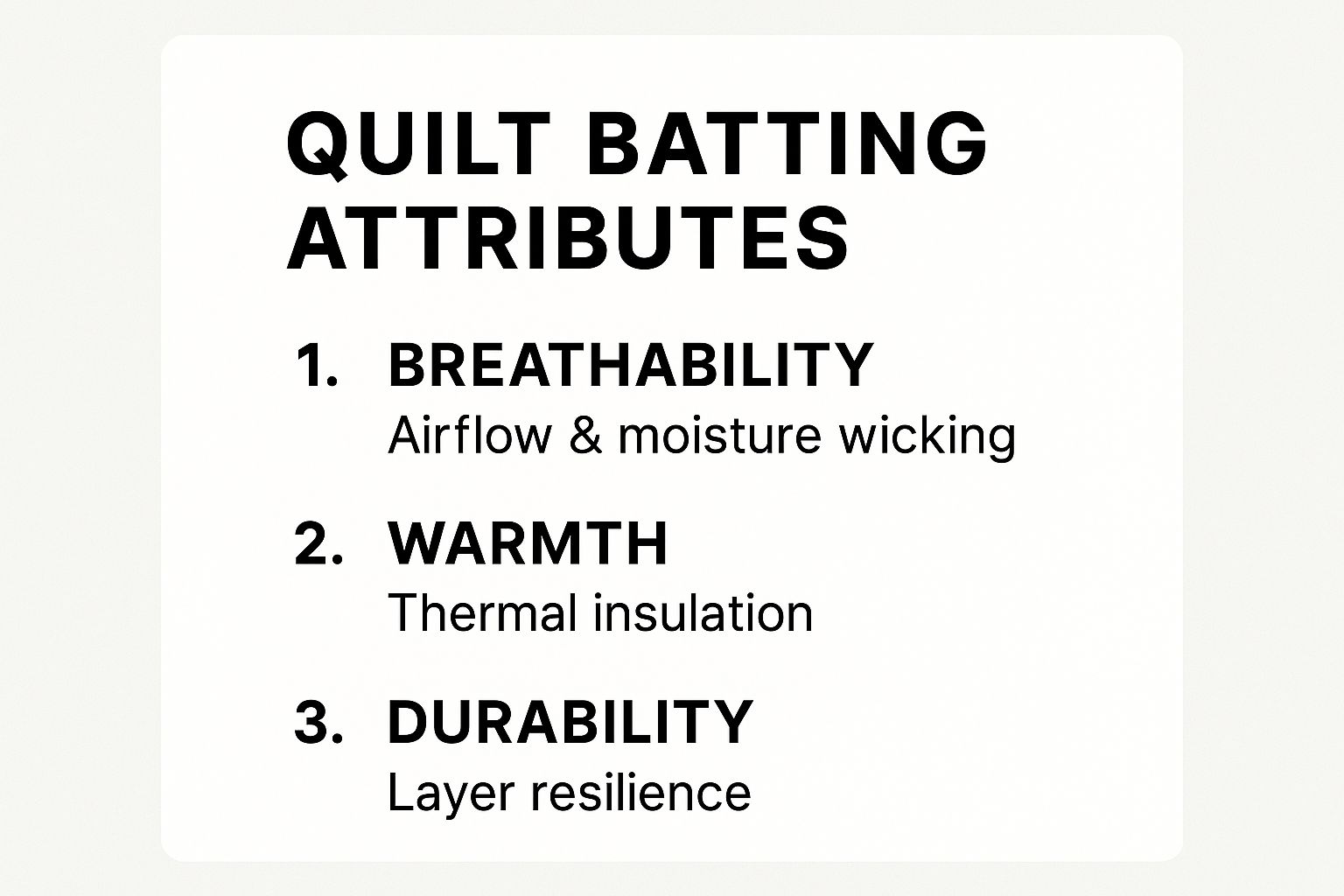
As you can see, natural fibers like cotton and wool are fantastic for breathability. On the other hand, synthetics like polyester often give you a lot of warmth without the weight and are incredibly tough.
Sometimes, you just need a quick comparison to get started. This table breaks down the most common batting types to help you see the differences at a glance.
| Batting Type | Key Characteristic | Best For | Loft | Shrinkage |
|---|---|---|---|---|
| Cotton | Natural, breathable, soft drape | Heirloom quilts, traditional designs, baby quilts | Low to Medium | 3-5% (creates a crinkled look) |
| Polyester | Durable, high-loft, non-allergenic | Bedding, children's quilts, tied quilts | Medium to High | Minimal (0-1%) |
| Wool | Exceptionally warm, lightweight, resists creasing | Bedding, show quilts, hand quilting | Low to High | 2-3% |
| 80/20 Cotton/Poly Blend | Best of both worlds: soft and stable | All-purpose quilts, machine quilting | Low | 2-3% |
| Bamboo | Silky soft, eco-friendly, antibacterial | Modern quilts, baby quilts, apparel | Low | 2-3% |
This chart is a great starting point, but remember that the "best" batting is always the one that's right for your specific project.
Pro Tip: Don't just think about how the finished quilt will be used—think about your quilting process, too. If you're a hand quilter, you'll probably love the feel of a soft, low-loft cotton or wool. If you're quilting by machine, a sturdier blend that can handle dense stitching might be your best friend.
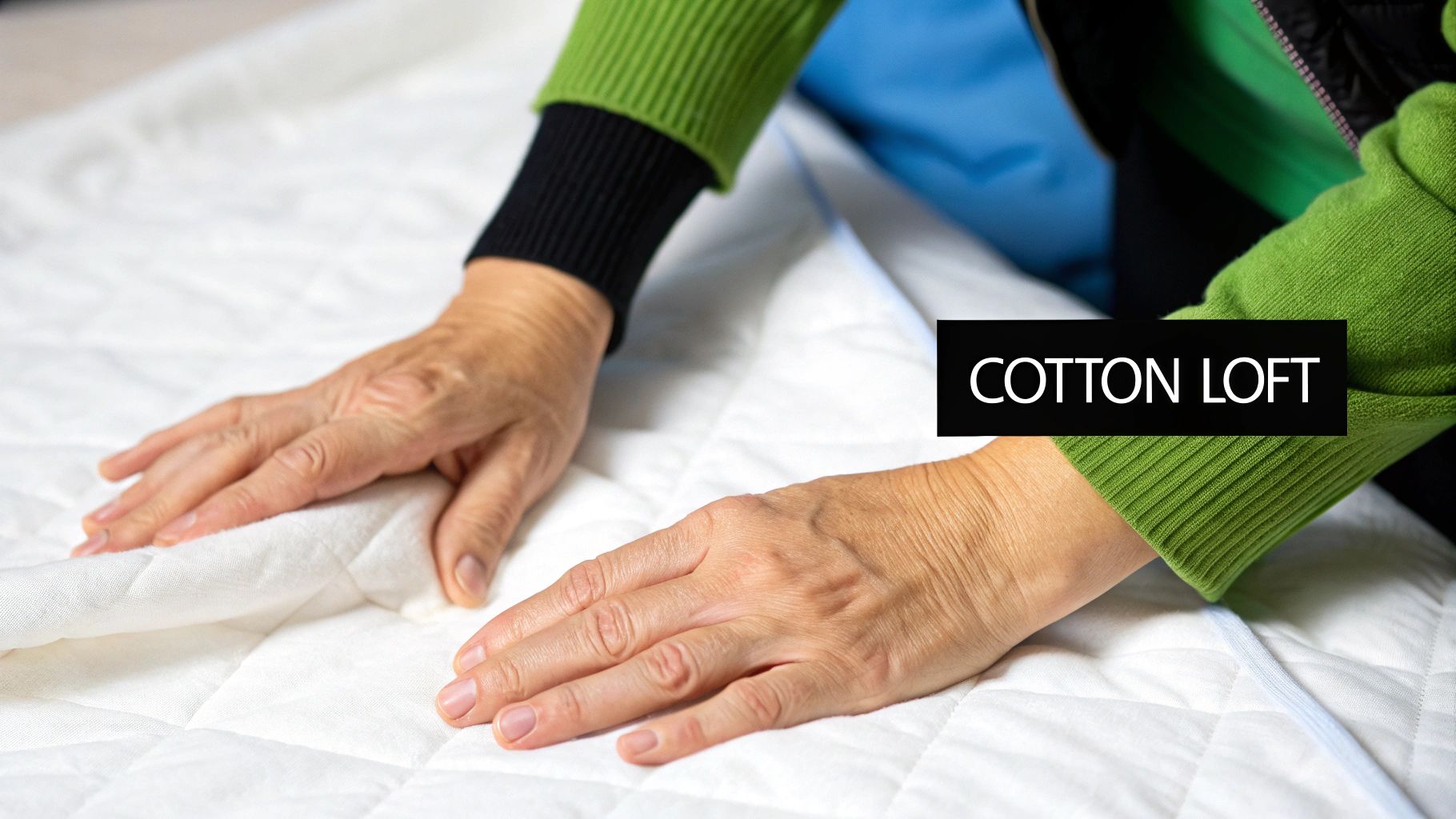
Choosing the right batting is a lot like picking the right flour for a recipe. Each type has its own personality and gives your final project a distinct texture and feel. So, let’s get past the basic definitions and really dig into how the four main batting types behave in the real world.
There's a reason cotton batting is a classic. It’s made from natural fibers, feels wonderfully soft and substantial—almost like a thick flannel—and it breathes exceptionally well. This breathability makes it perfect for bed quilts you want to use all year long.
The most iconic thing about cotton is what happens after the first wash. It typically shrinks about 3-5%, which gently pulls the quilt top and backing together. The result? That beautiful, slightly puckered, vintage look that so many of us are after. If you dream of a crinkly, well-loved heirloom, 100% cotton is your go-to.
The modern appreciation for handmade goods has kept cotton front and center. With the quilting market projected to hit $9.67 billion by 2035, cotton’s strong position, holding around 42.7% of the market, is a testament to its timeless appeal. This trend really underscores our love for the traditional feel that only cotton can provide. You can explore more about these quilt market trends and the industry's growth.
Picture the coziest, most cloud-like quilt you can imagine—chances are, it's filled with wool. Wool batting gives you incredible warmth without the heavy weight, creating a quilt that feels both light and lofty. It’s a fantastic natural insulator that keeps you toasty in winter but remains surprisingly breathable.
One of wool's best-kept secrets is its natural memory. It resists creases and bounces back beautifully, which gives your quilting stitches a lovely, rounded definition. This makes it a favorite for show quilts or any project where you want your stitching to be the star.
A Quick Note on Care: While many modern wool battings are treated so they can be washed, they can still shrink. It’s always a good idea to double-check the manufacturer’s instructions to keep your quilted masterpiece looking its best.
Polyester is the tough, no-fuss member of the batting family. As a synthetic fiber, it’s naturally resistant to mold and mildew, it won’t shrink, and it’s incredibly durable. That makes it the perfect choice for quilts that need to stand up to heavy use and frequent washing—think baby quilts, kids' blankets, and charity quilts.
Polyester is also known for having a high loft, meaning it’s thick and puffy. This is what you want if you’re aiming for a quilt that looks and feels more like a fluffy comforter. The trade-off is that it’s less breathable than natural fibers and can sometimes "beard," which is when tiny fibers work their way through the fabric over time.
Can't decide? You don't have to. Cotton/polyester blends, usually an 80/20 mix, are crafted to give you the best of each fiber.
This clever combination creates a versatile, all-purpose batting that’s fantastic for machine quilting. You get most of the traditional character of cotton but with a little extra stability and a more accessible price point. It’s no wonder it’s a go-to for so many quilters.
When you start digging into the world of quilt batting, you'll hear the term loft thrown around a lot. So, what is it? Simply put, loft is just a quilter's way of talking about the thickness and fluffiness of the batting.
Think of it as the soul of your quilt's texture. The loft you choose will completely change the final look and feel of your project, influencing everything from how it hangs to how your quilting stitches pop. It's the key to deciding if you want a sleek, modern piece or a puffy, traditional heirloom.
Low-loft batting is your go-to when you want a thin, dense layer. It’s not going to add a lot of puff, feeling more like a substantial flannel inside your quilt. This minimal thickness is precisely what makes it perfect for showcasing your intricate stitch work.
Because there’s less fluff for your stitches to sink into, every single quilting line stands out with incredible clarity and definition. The quilting itself becomes the star of the show.
This makes low-loft batting the ideal choice for projects like:
For that crisp, clean finish, a low-loft cotton or an 80/20 cotton-poly blend is a fantastic option.
On the other end of the spectrum, we have high-loft batting. This stuff is thick, airy, and wonderfully fluffy—picture the cozy filling inside a brand-new comforter. All that volume creates a quilt with deep, pillowy textures and an incredibly inviting feel.
When you quilt through a high-loft batting, your stitches pull the fabric down into the fluff, creating dramatic shadows and valleys. This makes the un-quilted areas puff up beautifully, adding a wonderful dimension to the finished piece.
High-loft batting is what you reach for when you want a quilt that screams warmth and luxury. The extra thickness traps more air, giving you better insulation and that comforting, substantial weight we all love in a good quilt.
This type of batting really shines in:
Once you’ve chosen the perfect batting to get the loft you want, taking care of it is key. For more tips on keeping your filled bedding in great shape, this guide on how to wash a duvet and keep it perfectly fluffy has some great related advice. In the end, deciding between low and high loft is all about your vision: do you want to show off your stitching, or create a soft, cloud-like treasure?
Walking down the batting aisle at the craft store can feel a little overwhelming. The packages are covered in jargon that sounds technical and confusing, but those terms are actually your best clues for finding the right middle layer for your quilt. Think of me as your personal translator—let's break down exactly what these words mean for your next project.
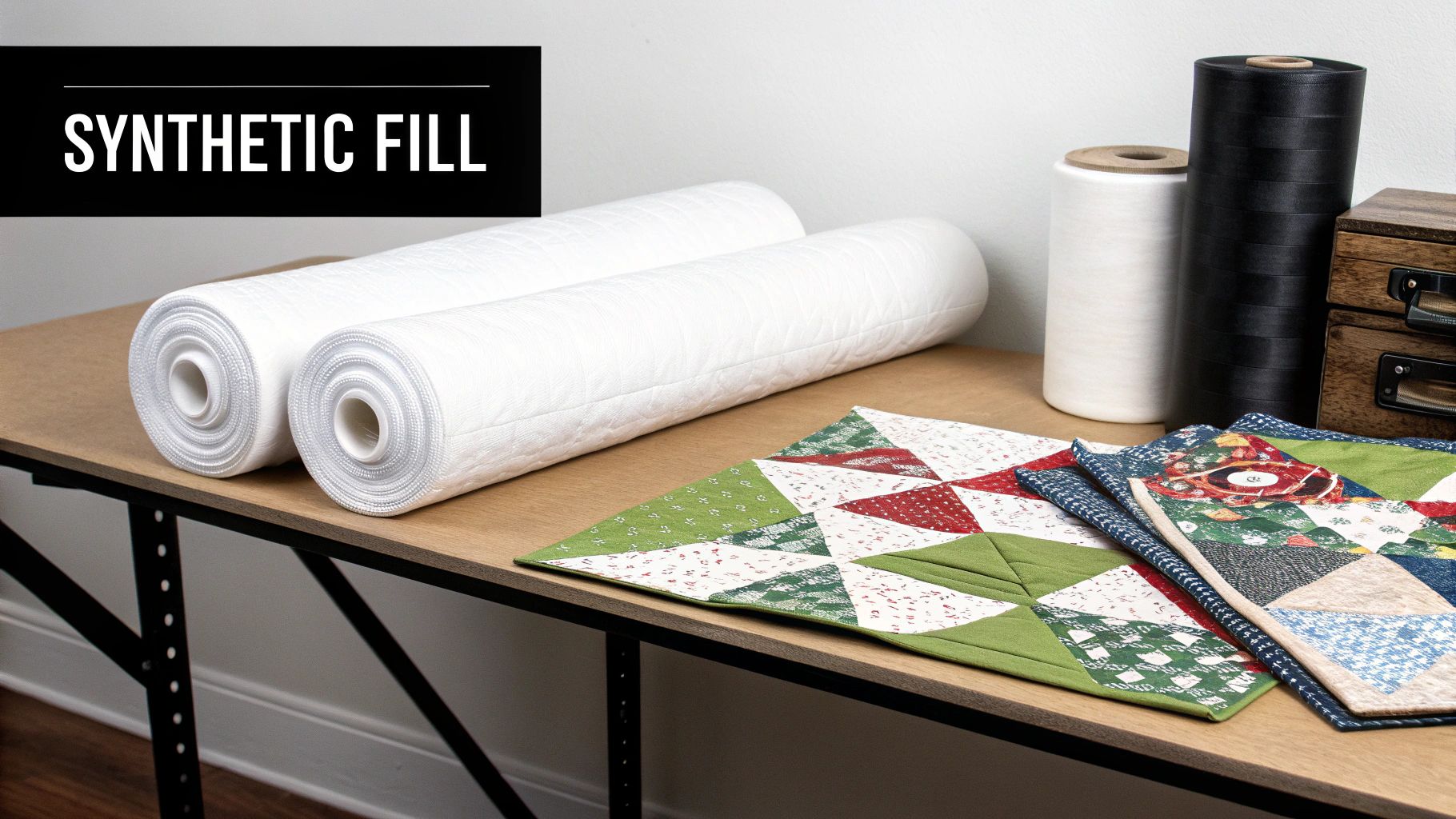
Once you understand the lingo, you can move from just guessing which batting to buy to confidently selecting the perfect one every single time. You’ll be able to pick up a package and know exactly how it’s going to behave under your needle and in the finished quilt.
One of the most common but misunderstood terms you'll see is scrim. It's not as complicated as it sounds.
Just think of scrim as a very thin, lightweight, grid-like stabilizer that’s been attached to one side of the batting. Its entire job is to add strength and keep the batting fibers from shifting around, stretching out, or pulling apart while you work.
So, why would you want this? Batting with scrim is a lifesaver for machine quilters. Because it’s so stable, you can place your quilting stitches much farther apart—sometimes up to 8–10 inches! This makes it a fantastic choice for quilts with big, open areas or those with a more modern, minimalist design.
But that extra stability has a downside. The very thing that makes scrim great for machine quilting—its density—makes it a real pain to quilt by hand. If you’re a hand quilter, you’ll definitely want to choose a batting without scrim for a much softer, easier-to-needle experience.
Next up are the terms that describe how the batting fibers are held together in the first place. The two big ones you’ll encounter are bonding and needle-punching, and they create two very different products.
Key Takeaway: Needle-punched batting is dense and gives your quilting stitches beautiful definition. Bonded batting is puffier and better suited for a fluffy, comforter-like feel.
Finally, don’t ignore the color of the batting itself. It might seem like a tiny detail since it’s going to be hidden inside the quilt, but it can actually make a huge difference in your finished project.
If you use a natural or off-white batting under a quilt top with a lot of crisp, bright white fabric, it can give those whites a slightly muddy or yellowish tint. To keep your whites looking pure and vibrant, always reach for a bleached white batting.
On the flip side, if you're working with a lot of dark fabrics like navy, charcoal, or black, a black batting is your best friend. It ensures that no stray light-colored fibers can poke through and dull your rich, saturated colors. It’s a simple choice that makes a world of professional difference.
So, what’s the "best" batting? The honest answer is, it depends entirely on what you're making. A cozy bed quilt has totally different needs than a gallery-worthy wall hanging. The secret is to think about the quilt's future life before you even start cutting fabric.
When you start with the end in mind, the decision gets a lot easier. Instead of feeling overwhelmed by all the options, you can just ask yourself, "What is this quilt's job?" From there, the perfect batting almost picks itself.
Baby quilts lead a tough life. They're destined for spit-up, tummy time on the floor, and countless trips through the washer and dryer. That means they need to be two things above all: durable and highly washable.
This is where polyester or a cotton/poly blend really shines. They’re built to withstand a beating, resisting shrinking and bunching even after repeated washes. Many are also hypoallergenic, which is a huge plus. A pure polyester will give you a puffier, comforter-like feel, while an 80/20 blend offers a lovely soft drape with a little more stability.
When your quilt is a piece of art, its main job is to hang beautifully and show off your hard work. For wall hangings, table runners, and placemats, the last thing you want is puffiness or sag. The goal is a flat, crisp finish that lets your piecing and quilting take center stage.
For this, your best bets are a low-loft cotton or a fusible batting. A thin cotton provides excellent stitch definition without adding bulk, helping the piece lay perfectly flat against the wall. Fusible batting is a game-changer; it has a light adhesive on both sides that you activate with an iron. This temporarily tacks your quilt sandwich together, eliminating any chance of shifting and guaranteeing a smooth, professional result.
Key Insight: For decorative quilts, structure is everything. A stable batting that holds its shape ensures your design remains the star of the show, free from any distortion or sagging over time.
A bed quilt is all about comfort. It’s the piece you curl up under on a cold night, so it needs to deliver warmth, a wonderful drape, and an inviting feel. This is where you can really embrace loft and the luxuriousness of natural fibers.
If you’re aiming for maximum warmth without the heavy weight, wool batting is an exceptional choice. It’s a fantastic natural insulator but is also surprisingly breathable, making it comfortable pretty much all year round. For that classic, heavier quilt with the crinkly, well-loved texture, you can’t go wrong with a high-quality cotton or a fluffy high-loft blend. That cozy, heirloom feel is a big reason why quilts remain so popular—the global quilt market is even projected to hit $9.26 billion by 2034. You can explore more in the global quilt market research, which shows just how much we love these functional works of art in our homes.
Choosing the right batting is all about matching its characteristics to the quilt's purpose. To make it even simpler, here's a quick reference table to guide your next project.
| Quilt Project | Primary Need | Recommended Batting | Why It Works |
|---|---|---|---|
| Baby Quilt | Durability & Washability | Polyester or 80/20 Cotton/Poly Blend | Withstands frequent washing without shrinking or bunching. Often hypoallergenic. |
| Bed Quilt | Warmth & Drape | Wool, High-Loft Cotton, or Blends | Wool offers breathable warmth. Cotton provides classic weight and a cozy, crinkly texture. |
| Wall Hanging | Stability & Flatness | Low-Loft Cotton or Fusible Batting | Lays flat to showcase intricate stitching. Fusible options prevent shifting and sagging. |
| Table Runner | Flatness & Heat Resistance | 100% Cotton or Insulated Batting | Cotton lays flat and won't melt under hot dishes. Insulated batting offers extra protection. |
| T-Shirt Quilt | Stability & Softness | 80/20 Cotton/Poly Blend with Scrim | The scrim provides support for stretchy knit fabrics, while the blend stays soft and drapes well. |
| Modern Quilt | Definition & Minimalist Look | Low-Loft Cotton or Bamboo | Creates crisp, defined quilt lines and a flat profile well-suited for negative space designs. |
This table serves as a great starting point, but don't be afraid to experiment! The more quilts you make, the more you'll develop a personal preference for how different battings feel and perform.
Finally, don't forget to consider how you plan to quilt your project. Whether you're working by hand or on a machine will make a big difference in your experience and the final result.
Hand Quilting: This beautiful, traditional method calls for a batting that’s soft and easy to needle. Think low-loft cotton (specifically one without a scrim), wool, or a silk blend. These fibers are gentle on your hands and allow your needle to glide through the layers like butter.
Machine Quilting: A machine can power through much denser materials. A cotton/poly blend or a cotton batting with a scrim provides excellent stability, which helps prevent the layers from bunching or puckering under the needle. This added strength also means you can space your quilting lines farther apart, which is perfect for more modern, minimalist designs.
https://www.youtube.com/embed/YaPZ_1Tga3k
Even after you've learned about all the different types of batting, a few practical questions always seem to pop up right as you're ready to start. Let's dig into some of the most common things quilters wonder about.
Getting these little details right can be the difference between a good quilt and a great one. Think of this as the advice you'd get from a friend at your quilting guild—the practical stuff that helps you avoid headaches and make sure your project turns out exactly how you envisioned it.
This is the big one, and the honest answer is: it depends entirely on the final look you're going for. The whole decision comes down to one thing: shrinkage.
100% cotton batting, for instance, is famous for shrinking, sometimes by as much as 3-5%. If you adore that classic, crinkly, vintage look that makes a quilt feel like it has a story to tell, then don't pre-wash it. That gentle puckering that appears after its first trip through the laundry is precisely what creates that gorgeous, well-loved texture.
On the other hand, if you're making a modern wall hanging or a quilt that needs to lie perfectly flat, pre-washing is your best bet. Just soak the batting in a tub of lukewarm water, gently squeeze out the excess (never wring it out!), and lay it flat to air-dry. For polyester or wool battings, you can usually skip this step since they have very minimal shrinkage.
Pay close attention to this number! The "quilting distance" on the package is probably one of the most critical instructions for the long-term health of your quilt.
It tells you the maximum space you can leave between your lines of stitching. If you go further apart than the recommendation, the batting can start to shift, bunch up, or even separate over time, especially after a few washes. So, if your batting says "quilt up to 8 inches apart," make sure your quilting lines are never more than eight inches from each other anywhere on the quilt.
Key Takeaway: Ignoring the recommended quilting distance can ruin your quilt's structure down the road. Sticking to it keeps all three layers locked together, ensuring your work stays beautiful and intact for years.
You'll notice that battings with a scrim—a thin, non-woven stabilizer—often allow for a much wider quilting distance. This makes them a fantastic choice for modern quilts with lots of open space or minimalist quilting designs.
Absolutely! Doubling up your batting is a brilliant way to make an exceptionally warm and heavy quilt with a wonderfully luxurious feel. It’s perfect for those extra-chilly nights.
A great tip is to use two layers of a thinner, low-loft batting instead of one super-thick high-loft one. You'll get all that delicious weight and warmth, but it will be much easier to manage under your needle, whether you're quilting by machine or by hand.
You can even mix and match fibers to get the best of both worlds. Try pairing a layer of breathable cotton with a layer of insulating wool for a quilt that’s cozy but not stuffy. Just remember to baste both layers securely to your top and backing to keep everything from shifting while you quilt.
Ready to find the perfect foundation for your next masterpiece? At High Country Quilts, we offer a wide selection of high-quality battings to match any project. Explore our collection online or visit us in-store to feel the difference for yourself.
Find your ideal batting at https://hcquilts.com.
At High Country Quilts we care deeply about community. With our experiences in retail, we know that a store is not only a place to shop but also a place for the community to gather and share. During this busy...

Hi! We’re Adam and Renee Wheaton, the new owners of High Country Quilts! For more than 40 years, we’ve owned and operated vacuum and sewing businesses. Following in Renee’s father’s footsteps after he retired from All Discount Vacuum and Sewing in Colorado...


Leave a comment