
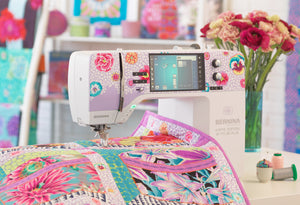

We Love Our Quilting Community
At High Country Quilts we care deeply about community. With our experiences in retail, we know that a store is not only a place to shop but also a place for the community to gather and share. During this busy...


What separates a beautiful quilt from a prize-winning quilt? Often, it isn't the piecing pattern or the quilting motif alone. It's the binding. Judges touch it first, follow it all the way around, pinch it at the edge, inspect the corners, and notice immediately whether the finish supports the quality of the whole piece.
That's the gap many quilters miss. They treat binding as the last chore instead of a scored design decision. In competition, binding isn't just a border. It's evidence. It tells a judge whether you control seam allowance, edge fill, corner construction, pressing, and final handwork.
For quilt binding techniques for competition, small choices matter. A strip that's too wide, a corner left soft, or a back stitch that shows on the front can pull attention away from otherwise excellent work. A clean binding does the opposite. It frames the quilt and reassures the judge that the maker finished with intention.
I'm going to give you the judge's-eye view of eight binding approaches. Some are traditional. Some are more design-forward. All can work in the right category if they're executed with precision. You'll see where each technique shines, where it can get risky, and what details usually separate “very good” from “award ready.”
If you enter only one competition quilt this year, this is the binding I'd want you to master first. Double-fold binding remains the standard reference point because it balances durability, tradition, and precision. It's also the finish many judges expect to see on bed quilts, traditional quilts, and finely executed pieced work.
One widely taught competition method uses a 2-1/4-inch binding strip and a precise 1/4-inch seam allowance. That combination gives enough flexibility to attach the binding neatly while still finishing cleanly at the edge. Judges often look for a binding that stays the same width all the way around, with neatly closed corners and batting that reaches into the edge.

A strong French binding feels firm but not bulky. When I inspect one, I'm checking whether the edge is fully filled, whether the front width matches the back finish, and whether each corner comes to a true right angle. If one corner is sharper than the others, it stands out quickly.
Your tools matter. A BERNINA 1/4-inch foot helps you hold that seam allowance steadily, and a fresh rotary blade keeps your strips consistent before you ever sit down to sew. If you're building your competition toolkit, start with BERNINA accessories at High Country Quilts that support exact seam placement and controlled edge finishing.
Practical rule: If the quilt is traditional in style, your binding should look calm, deliberate, and almost effortless. Judges should notice the accuracy, not the struggle.
This technique suits quilts where craftsmanship is the headline. Think of a finely pieced sampler, a feathered medallion, or a quilt with intricate border work. In those settings, a classic hand-finished binding usually supports the entry better than a more decorative edge.
Use thread that blends with the binding on the front-facing stitches and consider the back color when you hand-stitch. Press the strip before application, starch it lightly if needed, and practice your corner folds on a sample sandwich first. That rehearsal pays off.
Machine-finished binding can be competition worthy, but only when it looks intentional and controlled. Newer quilters sometimes receive mixed messages on this point. The issue isn't whether a machine did the work. The issue is whether the result looks crisp, flat, and nearly invisible from the front.
In judged settings, visible wobble is the usual problem. If the ditch stitching drifts, if the back edge flips unevenly, or if the needle catches too much fabric on the front, the binding reads as rushed. A well-executed machine finish can still earn respect, especially in contemporary categories or quilts completed on a deadline, but the margin for visible error is narrow.
A competition demonstration of binding emphasizes stopping and pivoting at each corner with only one or two backstitches for security, then finishing with a small, close hand finish around the edge in methods that favor show quality as demonstrated in this competition binding video. Even if you choose a machine-assisted finish, that same restraint matters. Too much backstitching creates bumps and thread buildup exactly where judges are touching the quilt.
For invisible machine work, test tension on scraps that include your quilt top, batting, and backing. Use a walking foot for the first pass if the layers want to shift. Then use needle positioning carefully on the second pass so your line lands where it's meant to.
A quick visual example helps if you're exploring fully machine-finished methods:
This method works best when the quilt's category welcomes technical innovation or when the design itself feels modern and sleek. A sharply geometric quilt with dense straight-line quilting can carry a machine-finished edge beautifully if every inch is even.
Curves change the conversation. If your quilt has rounded edges, scallops, circles, or unusual angles, straight-grain binding can fight the shape. Bias binding solves that problem because it bends more willingly around the perimeter.
That flexibility is why many art quilts and appliqué-heavy show pieces rely on it. A judge won't award points just because the binding is cut on the bias, but they will notice when a curved edge lies smooth without pleats or drag lines. Good bias binding looks relaxed and exact at the same time.

Bias binding tells me the maker understood the shape of the quilt and chose a finish that supports it. That's a strong design decision. It can also improve wear along curves because the fabric wraps the edge more naturally instead of resisting it.
The danger is stretch. Bias strips can distort while you prepare them, while you press them, and while you stitch them on. Roll them loosely, handle them gently, and don't overwork them at the ironing board. A BERNINA walking foot can help keep the edge from creeping while you apply the strip.
On curved quilts, judges forgive complexity more readily than distortion. A difficult edge that lies smoothly usually scores better than an easier method that puckers.
Bias binding belongs on quilts where the perimeter is part of the design. Circular medallions, vine-heavy appliqué quilts, and art quilts with organic outlines all benefit. It also works beautifully when you want subtle pattern movement along the edge.
A useful pairing for this technique is a strong pressing routine and accurate cutting tools. High Country Quilts carries quilting notions and specialty tools that make bias preparation easier, especially rulers, feet, and pressing aids that support cleaner edge control.
Piping can enhance a quilt. It can also overpower one. In competition, piped binding succeeds when it looks deliberate and proportional to the quilt's style. The tiny raised line adds separation between the quilt center and the outer edge, which can sharpen the whole presentation.
This is especially effective on heirloom-inspired quilts, formal medallions, and pieces with strong border architecture. The judge's question is simple. Does the piping frame the quilt, or does it distract from it?
Piping has to be even. If the cord peeks out more in one area than another, the inconsistency is visible immediately. The seam line also needs to stay smooth at the corners. Bulky turns make the quilt feel clumsy, even if the rest of the workmanship is strong.
One detailed competition-binding method combines squared edges, a rotary cutter and ruler, Elmer's School Glue, heavy starch, pressing, and a ladder stitch, with the maker describing the result as “perfect” and “outstanding” in a show-focused workflow in this competition binding demonstration. That same discipline applies to piping. Precision starts before the final stitching.
Use piping when the quilt benefits from a couture finish. A Baltimore-style appliqué quilt, a refined holiday showpiece, or a formal wall quilt can carry it well. It's less successful on casual scrap quilts unless the whole design language is highly intentional.
If you love polished finishing details, consider building those skills through quilting and sewing classes at High Country Quilts. Hands-on instruction helps with the small adjustments that are hard to diagnose from photos alone.
This is a high-risk, high-reward finish. Prairie points and pleated edges turn the quilt perimeter into a design feature instead of a quiet frame. That can be wonderful in the right category. It can also create enough visual and structural noise that the edge competes with the quilt itself.
Judges read this technique as intentional embellishment. That means the spacing, fold quality, and attachment all need to feel planned from the first point to the last. If one triangle collapses or one pleat sits higher than the next, the repetition breaks and the eye catches it immediately.
The challenge isn't folding the units. The challenge is feeding multiple layers evenly while preserving alignment at the edge. That's why I recommend sample-making before the final quilt. Test the exact point size, the spacing, and how much bulk your batting creates once the binding is added.
This technique suits innovation categories, playful contemporary quilts, and certain art quilts better than traditional judged classes. It needs a quilt that welcomes dimensionality. On a formal competition quilt, prairie points can feel like an unrelated flourish unless the shapes echo motifs used elsewhere in the design.
Decorative edges only score well when they look as disciplined as the piecing inside the quilt.
A quilt with repeated triangle motifs, folded texture, or architectural geometry can carry prairie points beautifully. Pleats work best when they reinforce movement already present in the composition.
Keep the folds crisp with starch, pin thoroughly before stitching, and use a walking foot if the edge wants to shift. If you're shopping for fabrics that will hold a sharp crease and still coordinate across the whole project, browse the quilting fabric collections at High Country Quilts for options that support both structure and design unity.
A faced finish removes the visual outline of traditional binding. That changes the way a judge sees the quilt. Instead of stopping at the edge, the eye moves directly to the design. For modern and art quilts, that can be exactly the right decision.
Faced edges look simple, but they aren't casual. They require accurate trimming, careful turning, and very even pressing. If the edge rolls forward or backward, the illusion breaks. The front should look clean and intentional, not as if the binding disappeared by accident.
When faced binding is done well, it gives a quilt a gallery presentation. That's especially useful for minimalist work, asymmetrical layouts, and quilts with strong negative space. A contrasting facing can also create a whisper of color at the edge if you control the turn precisely.
Competition guidance from quilters discussing fair and contest judging often favors bindings with closed mitered corners, a flat profile, and full batting in the edge, while deducting for dog ears, loose corners, or an edge that doesn't feel fully padded when pinched in this quilting discussion on fair-ready binding. Faced edges need to meet that same standard for fullness and corner control, even without a visible traditional binding.
Choose facing when the quilt's design should visually run off the edge. Art quilts with strong imagery benefit from this. So do contemporary quilts where a conventional border would feel too heavy.
A self-facing version keeps the finish discreet. A contrasting facing can become a design accent if just a sliver shows. Either way, press carefully after turning, and let the quilt rest flat before final evaluation so you can catch any rolling edge.
A scrappy binding can look joyful, clever, and highly resolved. It can also look accidental. The difference is planning. In competition, a pieced binding should feel like part of the composition, not leftover fabric stitched together at the end.
This style works especially well on scrap quilts, modern quilts with active color play, and quilts where the border already uses varied fabric. Judges tend to respond well when the binding extends the quilt's rhythm. They respond less well when the edge becomes visually choppy for no clear reason.
Start with strip width consistency. If your pieced units vary before folding, the finished binding won't stay even. Press every seam carefully to control bulk, and think about seam placement at the corners. A busy join landing exactly at a miter can make the corner harder to form cleanly.
There's also a practical issue. Competition quilts are transported, hung, handled by judges, and examined up close. Existing tutorials cover clipping, securing corners, stitch-in-the-ditch options, and bias methods for odd angles, but they don't offer evidence-based guidance on which approaches hold up best through repeated show handling as noted in this discussion of binding realities for unusual edges. That makes testing your own scrappy binding samples especially worthwhile before using them on an important entry.
A pieced binding shines when the quilt already celebrates variety. A controlled rainbow quilt, a scrap medallion, or an improvisational modern piece can all support it. Keep the value shifts intentional and avoid visual chaos at the corners.
Sometimes the edge needs to do more than finish the quilt. It needs to participate in the design. Decorative binding can include appliqué, embroidery, specialty stitching, or other embellishment integrated into the perimeter. In competition, this only works when the finish belongs to the quilt's artistic language from the start.
A decorative edge is judged on two levels. First, the underlying binding still has to be structurally excellent. Second, the embellishment must be secure, balanced, and relevant to the quilt. If the decoration feels tacked on, judges notice that disconnect right away.
This approach suits art quilts, embellished show quilts, and entries where surface design already plays a major role. If you've used appliqué motifs in the center, echoing them lightly at the edge can create a refined sense of completion. If you've used machine embroidery elsewhere, repeating that vocabulary in the binding can tie the composition together.
The risk is excess. Heavy beading, dense stitched motifs, or thick appliqué layers can make the edge bulky. That affects both appearance and handling. In a judged setting, the edge still has to lie well, corner cleanly, and avoid snagging during inspection or hanging.
A decorative finish earns attention best when the workmanship underneath is so sound that the embellishment feels effortless.
This is a strong choice for a specialty category, an exhibition piece, or a quilt with a clear decorative theme. It's less effective when used solely to make a basic quilt feel more elaborate.
Plan the embellishment before quilting if possible. That gives you more control over placement, density, and edge balance. If you're using a BERNINA embroidery-capable machine or specialty feet, the best results come from sampling first on a quilt sandwich that matches the final project.
| Binding Technique | Complexity 🔄 | Resources & Tools ⚡ | Expected Outcomes ⭐📊 | Ideal Use Cases | Key Advantages 💡 |
|---|---|---|---|---|---|
| Double-Fold Binding (French Binding) | High, hand‑stitching + precise miters | Moderate fabric waste; time‑intensive; ¼" presser foot recommended | Competition‑grade, durable, very polished ⭐📊 | Traditional and AQS competition quilts | Professional, durable edge; measurable consistency |
| Machine‑Stitched Binding (Invisible Machine Binding) | Medium‑High, tension and foot setup learning curve | Specialty blind‑stitch foot, correct thread tension, practice samples | Nearly invisible seam, consistent and faster than hand ⭐📊 | Contemporary divisions, tight timelines, arthritis‑friendly | Faster, consistent finish; machine efficiency |
| Bias Binding Technique | High, cutting on 45° and careful joining | Higher fabric use; rotary ruler, precise cutting tools | Smooth, flexible finish on curves; signals advanced skill ⭐📊 | Curved, circular or appliqué‑heavy quilts | Only reliable method for curves; excellent pattern placement |
| Piping Binding with Cording | High, bulk control and smooth application | Piping/cord, piping foot, possibly heavier needles | Dimensional, couture edge that attracts attention ⭐📊 | Heirloom/traditional show quilts and couture entries | Distinctive, elegant edge with texture and contrast |
| Bound Edge with Prairie Points or Pleats | Very High, placement and bulk management | Extra fabric for points, careful prep, walking foot helpful | Ornate, three‑dimensional perimeter; inventive impact ⭐📊 | Art quilts and innovation categories | Unique decorative edge; strong design statement |
| Faced Binding (Self‑Facing or Contrasting) | Medium, precise sewing and pressing | Moderate fabric; pressing tools; careful measurement | Seamless front appearance; modern, clean finish ⭐📊 | Contemporary/minimalist and design‑excellence quilts | Invisible front stitching; color/blocking flexibility |
| Scrappy or Pieced Binding | Medium, planning and seam alignment | Many fabric scraps; extra piecing time | Playful, cohesive edge that extends palette ⭐📊 | Modern, scrap quilts, creative competition categories | Reduces waste; creative, one‑of‑a‑kind edge |
| Appliquéd or Decorative Binding Finish | Very High, multi‑technique execution | Embellishments, embroidery tools/modules, extra time | Dramatic, show‑stopping edge; high artistic impact ⭐📊 | Art, embellishment and wearable art competitions | Maximum artistic expression; showcases multiple skills |
Binding deserves the same design attention you give to fabric selection, piecing accuracy, and quilting density. In competition, it isn't a finishing chore. It's part of the score. Judges read it as proof of control, and the edge of the quilt often confirms whether the rest of the workmanship can be trusted.
That doesn't mean there's only one correct choice. It means the binding has to suit the quilt. A double-fold French binding supports traditional excellence. Bias binding handles curves gracefully. Facing gives a modern quilt a cleaner visual stop. Piping adds refinement when the quilt can carry it. Decorative and dimensional edges can be successful too, but only when the execution is disciplined and the design asks for them.
If you remember one thing, remember this. Judges notice consistency before they notice complexity. A plain binding done flawlessly will usually serve you better than an elaborate finish done almost well. Even width, full batting at the edge, flat application, secure corners, and invisible or controlled stitching are the details that keep a judge focused on your strengths instead of your finishing mistakes.
Practice helps more than perfectionism. Make a few small edge samples with the exact batting, backing, and binding fabric you plan to use. Test corner folds. Test how the edge feels when pinched. Test whether the binding rolls forward or backward after pressing. Those little auditions reveal problems early, while they're still easy to fix.
Your tools matter too. A reliable machine, the right presser foot, sharp cutting tools, stable pressing habits, and well-chosen thread all support stronger results. If you're working on quilt binding techniques for competition, don't leave those choices to chance. Build a finishing setup that helps you repeat good results.
Most of all, finish with intention. The binding should look like it belongs to the quilt and like you meant every decision. That confidence shows.
Ready to refine your finishing skills? Visit High Country Quilts in Colorado Springs for in-person guidance, or explore their BERNINA accessories, notions, fabrics, and classes online. The right support can turn your last step into one of your strongest ones.
If you're ready to refine your competition finishing, visit High Country Quilts for expert help, BERNINA support, specialty notions, beautiful fabrics, and classes that help you turn good bindings into show-ready edges.
At High Country Quilts we care deeply about community. With our experiences in retail, we know that a store is not only a place to shop but also a place for the community to gather and share. During this busy...

Hi! We’re Adam and Renee Wheaton, the new owners of High Country Quilts! For more than 40 years, we’ve owned and operated vacuum and sewing businesses. Following in Renee’s father’s footsteps after he retired from All Discount Vacuum and Sewing in Colorado...


Leave a comment