
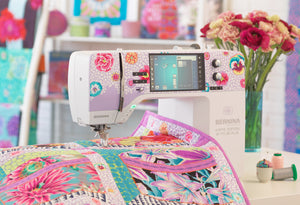

We Love Our Quilting Community
At High Country Quilts we care deeply about community. With our experiences in retail, we know that a store is not only a place to shop but also a place for the community to gather and share. During this busy...


Quilting is a language spoken in thread and fabric, and every style tells a unique story. Beyond the simple squares of a nine-patch, a vast universe of techniques awaits, each with its own history, aesthetic, and creative potential. For many, the journey begins with basic piecing, but the true artistry unfolds when you explore the rich diversity of different quilting styles. Understanding this spectrum is the key to unlocking your full creative expression, allowing you to choose the perfect method for any project, from a cherished family heirloom to a bold contemporary wall hanging.
This guide is your roadmap to that universe. We'll move beyond generic definitions to provide a comprehensive roundup of distinct quilting approaches, detailing their defining characteristics and practical applications. Whether you are a seasoned quilter looking to master a new skill or a curious beginner trying to navigate your first fabric purchase, this list offers actionable insights to guide you. You will learn to identify everything from intricate Appliqué to the geometric precision of Foundation Paper Piecing and the free-form beauty of Art Quilting.
Prepare to discover which techniques resonate with your personal style and learn what it takes to bring them to life. We will break down the essential tools, recommended fabrics, and ideal projects for each method, helping you build a solid foundation for your next creation. By the end, you'll not only recognize these styles but also feel equipped to start stitching one yourself, confidently transforming your fabric stash into a work of art.
Patchwork is arguably the most foundational and recognizable of all the different quilting styles. It is the art of sewing small pieces of fabric, or "patches," together to form a larger design, often arranged in repeating blocks. This method is the cornerstone of traditional quilting, where geometric precision and thoughtful color placement create stunning visual effects.
Once the quilt top is assembled from these pieced blocks, it's layered with batting for warmth and a backing fabric. The final step, quilting, involves stitching through all three layers to secure them, adding texture and reinforcing the structure. This historical technique, born from the necessity of using up fabric scraps, has evolved into a sophisticated art form.
The hallmark of patchwork is its reliance on piecing and seam accuracy. The complexity can range from simple squares to intricate, curved designs.
Success in patchwork quilting hinges on precision and consistency. For quilters new to this style, mastering a few key techniques can make all the difference.
Pro Tip: Always use a consistent quarter-inch seam allowance. Specialty presser feet are available for most sewing machines to help you maintain this crucial measurement, ensuring your blocks fit together perfectly.
To achieve clean, sharp points and perfectly aligned blocks, press your seams consistently. Pressing seams to one side, often towards the darker fabric, helps them "nest" together when joining blocks, which reduces bulk. Additionally, checking your block measurements at each stage prevents small errors from compounding into a larger problem later on. This simple habit will save you from the frustration of a quilt top that won't lie flat.
In contrast to patchwork, appliqué quilting is the art of layering smaller fabric shapes onto a larger background fabric and stitching them in place. This technique liberates quilters from the geometric constraints of piecing, allowing for fluid curves, intricate pictorial scenes, and a sense of layered dimensionality. It’s a versatile style that adds character and narrative to a quilt top.
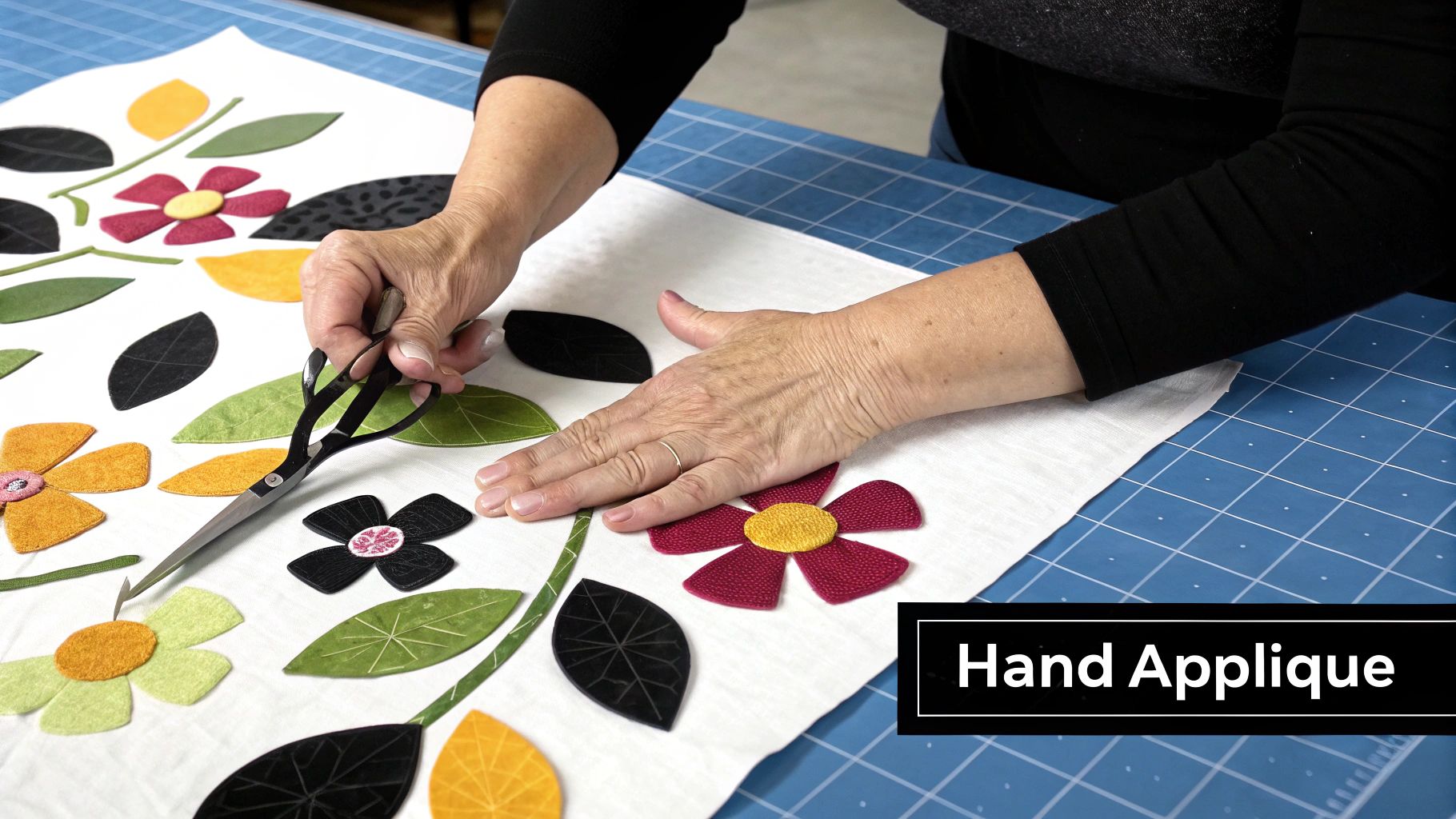
The methods for securing appliqué pieces range from traditional to modern. Hand-sewn techniques like needle-turn create a classic, soft-edged look, while machine stitching can secure raw edges for a more graphic effect. Fusible web has become a popular tool, allowing for precise placement before the final stitching is added, making this one of the most artistically flexible quilting styles.
The defining feature of appliqué is its additive nature, where motifs are placed on top of the fabric rather than pieced into it. This allows for virtually any shape or design.
Success in appliqué relies on clean shapes and secure stitching. Whether you are working by hand or machine, careful preparation is the key to a professional-looking result.
Pro Tip: For beginners, fusible web is a game-changer. It temporarily glues your appliqué pieces to the background, preventing any shifting while you stitch the edges down. For a lightweight option that won’t stiffen your quilt, explore the benefits of Heat n Bond Feather Lite.
For crisp, clean edges, especially with complex shapes, prepare your fabric with starch before cutting. This gives the material more body and prevents fraying. When doing hand appliqué, use a thread that matches your appliqué fabric, not the background, to make your stitches nearly invisible. For machine appliqué, placing a stabilizer underneath the background fabric will prevent puckering and result in smooth, even stitches.
Paper Piecing, often called Foundation Paper Piecing (FPP), is a precision-focused technique that allows quilters to achieve incredibly sharp points and intricate designs with unparalleled accuracy. Instead of cutting exact shapes and sewing them together, this method involves sewing fabric directly onto a printed paper foundation that has the pattern marked on it. The lines on the paper serve as a stitch-and-flip guide, ensuring every seam is perfectly placed.
This style is ideal for patterns that would be difficult or impossible to create with traditional piecing. Once a section is complete, the paper foundation is carefully torn away, leaving behind a flawless block. This technique transforms complex geometric challenges into a manageable, step-by-step process, making it a favorite among quilters who love crisp, detailed results.
The defining characteristic of foundation paper piecing is its reliance on a paper guide, which guarantees precision. The designs are often angular and complex, showcasing the technique's ability to handle sharp points and unusual shapes.
Success in paper piecing comes from embracing a different mindset and a few specific techniques. It's less about perfect cutting beforehand and more about accurate sewing on the line.
Pro Tip: Set your sewing machine to a short stitch length, around 1.5. This perforates the paper more thoroughly, making it significantly easier to tear away cleanly when you're finished without pulling on your stitches.
To begin, always cut your fabric pieces larger than the area they need to cover. This gives you ample room for seam allowances and placement, as you will trim the block to its final size later. Also, use a postcard or an "Add-A-Quarter" ruler to create a clean, straight edge for folding back the paper and trimming your seam allowance accurately before adding the next piece. For a different but related hand-sewing technique, you can explore English Paper Piecing, which also uses paper templates for precision. You can learn more about the process of English Paper Piecing here.
Free-motion quilting (FMQ) is where the stitching process itself becomes an art form. Unlike straight-line quilting, which follows a rigid path, this technique allows the quilter to move the fabric in any direction under the machine's needle, essentially drawing with thread. By disengaging the feed dogs on the sewing machine, you gain complete control to create flowing, organic, and custom designs across the quilt top.
This method transforms the quilting layer from a simple structural element into a primary design feature. It is one of the most expressive and different quilting styles, offering limitless creative potential. Whether you are adding simple texture or intricate motifs, free-motion quilting allows your personal style to shine through every stitch.
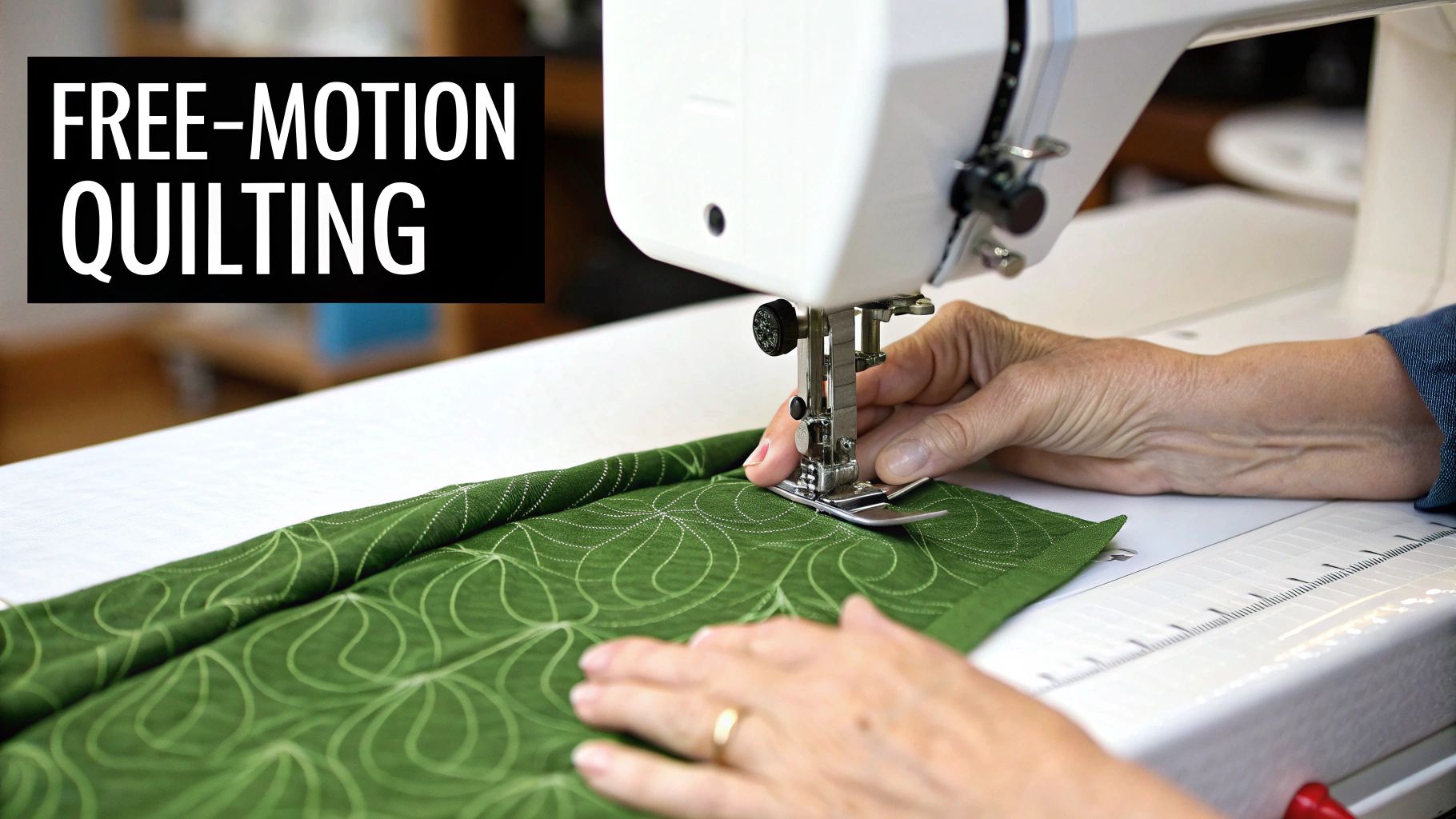
The defining characteristic of free-motion quilting is its fluid, hand-guided nature, resulting in unique, non-uniform patterns. The quilter's movement, not the machine, dictates the design.
Success in free-motion quilting is all about rhythm and muscle memory. Finding a comfortable and consistent hand speed in coordination with your machine speed is the key to creating even, beautiful stitches.
Pro Tip: Wear quilting gloves. These lightweight gloves have grips on the fingertips that give you superior control over the fabric, reducing hand and shoulder fatigue and allowing for smoother, more precise movements.
To build confidence, start by practicing on scrap fabric sandwiches before moving to your final quilt. This helps you find your rhythm without pressure. It's also crucial to maintain a consistent speed; if you move the fabric too fast for the machine's speed, you'll get long stitches, and if you move too slow, you'll create tiny, dense knots. Choosing the best thread for machine quilting on hcquilts.com will also ensure your stitches are strong and visually appealing.
While many different quilting styles celebrate the art of piecing fabric, whole cloth quilting places the focus entirely on the stitching itself. This elegant technique uses a single, solid piece of fabric for the quilt top, creating its pattern and texture through intricate quilting lines rather than patchwork. The "canvas" is the fabric, and the "paint" is the thread, resulting in a quilt where texture and shadow play are the stars.
The artistry of a whole cloth quilt lies in the quilter's skill in creating elaborate designs with thread. Once the solid top is layered with batting and backing, the quilting stitches are applied, often by hand or with a longarm machine, to bring the design to life. This style elevates the quilting from a structural element to the primary decorative feature, showcasing pure stitching prowess.
The defining characteristic of whole cloth quilting is its lack of piecing on the quilt top, allowing the quilting design to be the uninterrupted focal point. These quilts often feel like sculpted textiles due to the high-contrast texture.
Success in whole cloth quilting is all about planning your design and executing clean, consistent stitches. The fabric and thread choices are paramount, as they are the only visual elements.
Pro Tip: Select a high-quality, solid-colored fabric with a smooth, tight weave, like cotton sateen or silk. This provides a perfect canvas that allows your stitching to shine without the distraction of a printed pattern.
To ensure your design is accurate, use a reliable marking tool that is visible on your fabric but can be easily removed, such as a water-soluble pen or chalk pencil. It's also wise to practice your quilting motifs on a small practice sandwich before starting on your final project. This helps you establish a consistent rhythm and stitch length, which is crucial for achieving a professional and polished look where every stitch is on display.
Crazy quilting is a lavish and freeform style that throws the rules of geometric precision out the window. It involves stitching irregularly shaped pieces of fabric onto a foundation cloth in an overlapping, haphazard manner. The true artistry, however, lies in the embellishment. Seams are covered with elaborate, decorative embroidery stitches, and the surface is often adorned with beads, buttons, lace, and charms.
This technique became immensely popular during the Victorian era, a time when opulence and decoration were highly valued. Unlike utility quilts, crazy quilts were parlor throws and decorative showpieces, created from luxurious fabrics like silks, velvets, and brocades. Today, it remains one of the most expressive and artistic of the different quilting styles, allowing for immense creativity.
The defining characteristic of crazy quilting is its lack of a repeating pattern and its focus on surface embellishment over precise piecing. Each block is a unique composition of texture, color, and stitchery.
Success in crazy quilting is less about precision and more about creativity and stabilization. For quilters exploring this expressive style, a few foundational techniques are key.
Pro Tip: Use a foundation fabric like muslin or old cotton sheeting. Stitching your irregular scraps onto this stable base prevents stretching and distortion, giving you a solid canvas for your elaborate embroidery.
To manage the chaotic nature of the fabric scraps, start from the center of your foundation block and work your way outwards. Place your first scrap, then add subsequent pieces, stitching and flipping them to cover the raw edges. This "stitch-and-flip" method on a foundation is the core of assembling a crazy quilt block. When it comes to embellishing, plan your decorative stitch placement after the block is pieced but before you begin sewing. This allows you to create a more balanced and visually cohesive design.
Bargello quilting is a dramatic style that creates the illusion of movement, curves, and waves using only straight seams. Inspired by Bargello needlepoint from Florence, Italy, this technique involves sewing fabric strips into a specific color or value progression. These strip sets are then cross-cut and sewn back together with deliberate offsets to create stunning, flowing patterns that ripple across the quilt top.
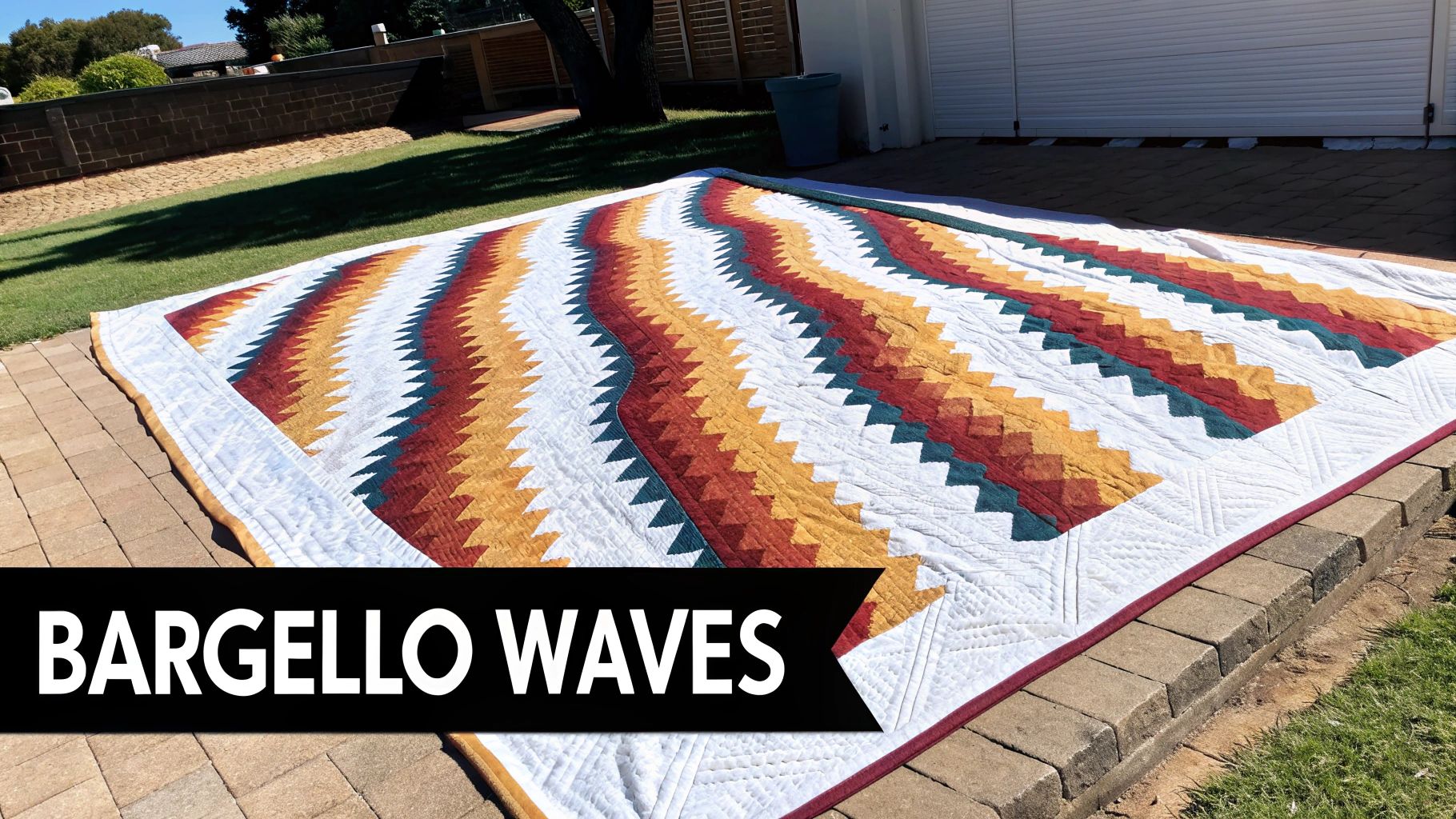
This method produces optically complex designs from a relatively simple strip-piecing process. The magic lies in the careful planning of color placement and the precise offsetting of each new column. Once the dynamic top is pieced, it is layered, batted, and quilted like other styles, often with quilting lines that echo the fluid motion of the design.
The defining characteristic of Bargello is its sense of flowing movement achieved through the incremental shifting of fabric strips. The designs are known for their vibrant, gradient-like effects.
Success with Bargello quilting depends less on intricate piecing and more on organization and careful cutting. Keeping your strip sets in the correct order is paramount.
Pro Tip: Number your strips! Before you start sewing, use pins, sticky notes, or masking tape to label each fabric strip in its intended sequence. This simple step is the single most effective way to prevent costly and time-consuming errors.
To ensure your design flows smoothly, audition your fabric choices on a design wall or the floor. Arrange your uncut fabrics to see how the colors blend and transition before you make a single cut. Additionally, chain piecing your initial strip sets will significantly speed up the construction process. Finally, focus on pressing your seams open or consistently to one side to reduce bulk where the columns join, ensuring your finished quilt top lies perfectly flat.
Art quilting pushes the boundaries of the craft, transforming the medium from a functional bed covering into a powerful form of artistic expression. This style prioritizes aesthetics, narrative, and original design over traditional patterns and utility. Art quilters are textile artists who use fabric and thread as their paint and canvas, often incorporating a vast array of techniques to bring their unique visions to life.
These quilts are typically intended for display on walls, similar to a painting, and may explore complex themes, abstract concepts, or personal stories. Techniques can range from innovative piecing and appliqué to surface design, painting, dyeing, thread painting, and even embedding non-traditional materials. This style represents a significant evolution in the world of different quilting styles, valuing creativity and personal voice above all else.
The hallmark of an art quilt is its original design and artistic intent. Unlike traditional quilting, there are no rules, and the artist's message or aesthetic exploration is the central focus.
Success in art quilting comes from embracing experimentation and finding your artistic voice. For quilters looking to explore this expressive style, shifting your mindset from following a pattern to creating a design is the first step.
Pro Tip: Keep a sketchbook or design journal dedicated to your ideas. Don't worry about whether an idea is "quiltable" at first; just capture concepts, color palettes, and compositions that inspire you. This becomes an invaluable resource for future projects.
To develop your unique style, take inspiration from other art forms like painting, sculpture, and photography. Studying principles of composition, color theory, and design will elevate your work significantly. Also, experiment freely with materials beyond traditional cottons. Try silks, sheers, wools, or even non-fabric elements to add texture and interest. The goal is not perfection in a traditional sense, but the successful execution of your artistic vision.
While not a design style in the same way as patchwork or appliqué, longarm quilting is a distinct method of finishing a quilt that dramatically expands artistic possibilities. It utilizes a large, specialized machine where the sewing head moves over a stationary quilt "sandwich" (top, batting, and backing) stretched on a frame. This setup allows for the quilting of large projects without the quilter having to manipulate the heavy, bulky layers under a small machine throat.
This method is the key to achieving professional-grade finishing, enabling intricate, expansive, and consistent stitching across the entire quilt surface. Operated by dedicated enthusiasts or professional quilters, a longarm machine turns the quilting step from a functional task into a prominent artistic element, adding texture and a secondary layer of design that complements the pieced top.
The hallmark of longarm quilting is the ability to execute complex, large-scale designs with fluidity and precision, something very difficult to achieve on a domestic sewing machine. The results can range from simple edge-to-edge patterns to breathtaking custom artwork.
Longarm quilting represents a significant investment in both equipment and skill. For quilters interested in this method, either for their own projects or as a business, a structured approach is crucial for success.
Pro Tip: Before committing to a machine, rent time on a longarm at a local quilt shop. This provides invaluable hands-on experience and helps you understand the machine's scale, operation, and capabilities without the upfront cost.
A key to a beautifully finished quilt is ensuring the quilt top is perfectly centered and loaded onto the frame. This is where specialized tools become indispensable. Using a tool like longarm centering tape helps you precisely align your backing and quilt top, preventing distortion and ensuring your quilting is perfectly placed. Additionally, taking a professional training course is highly recommended. These classes cover everything from machine maintenance and thread tension to advanced free-motion techniques, building a strong foundation for your longarm journey.
Medallion quilting is a classic style where the entire quilt design radiates outward from a central, prominent block or motif. Unlike block-based quilts that build a design from repeating units, a medallion quilt grows in concentric frames or borders, each one designed to complement and enhance the central showpiece. This methodical, symmetrical construction creates a powerful focal point and a sense of deliberate, structured beauty.
This style begins with selecting or creating a stunning center panel, which could be anything from a large, intricate pieced block to an appliqué scene or even a piece of treasured fabric. Successive borders are then added, layer by layer, expanding the quilt to its final size. This technique allows for immense creativity in how the borders are treated, making it one of the most versatile and impressive of the different quilting styles.
The defining characteristic of a medallion quilt is its central-focus design, framed by multiple, distinct borders. The artistry lies in the interplay between the center and the surrounding elements, creating harmony and balance.
A successful medallion quilt is the result of careful planning and precise measurement. The relationship between the center and its borders is crucial to the final aesthetic.
Pro Tip: Plan your entire quilt on paper or a design wall before you cut a single piece of border fabric. This allows you to audition fabrics and border styles, ensuring the proportions are balanced and the colors work together cohesively.
To ensure your quilt top lays flat, measure your quilt top through the center before cutting borders. Do not rely on the pattern's measurements, as slight variations in seam allowance can cause significant size differences. By measuring the actual center of your work vertically and horizontally, you can cut borders that fit perfectly, preventing wavy edges. Adding visual interest with varied treatments like pieced, plain, and appliqué borders will elevate the final design. For a professional finish on your borders, explore advanced techniques for your corners. You can learn how to miter quilt borders on hcquilts.com.
| Technique | Complexity 🔄 | Resources ⚡ | Outcomes / Impact ⭐📊 | Ideal use cases & tips 💡 | Key advantages ⭐ |
|---|---|---|---|---|---|
| Patchwork Quilting | Moderate 🔄🔄 — precision seams required | Sewing machine, rotary cutter, rulers, templates ⚡⚡ | Versatile patterned quilts, traditional look ⭐⭐📊 | Bed quilts, scrap use, beginners — use rotary cutter & check block sizes 💡 | Highly versatile, many patterns, beginner-friendly ⭐ |
| Appliqué Quilting | Moderate 🔄🔄 — hand or machine skill | Background fabric, fusible web/needles, templates, stabilizer ⚡⚡ | Curved, pictorial or layered designs with dimensionality ⭐⭐⭐📊 | Decorative panels, pictorial quilts — try freezer-paper templates 💡 | Enables curves/imagery, layered depth ⭐⭐ |
| Paper Piecing (Foundation) | High 🔄🔄🔄 — sequential precision | Printed foundations, accurate cutting, fine needlework ⚡⚡ | Extremely precise geometric results, perfect intersections ⭐⭐⭐📊 | Precision stars, complex geometry — print 100% scale, use lightweight paper 💡 | Superior accuracy and reproducibility ⭐⭐⭐ |
| Free-Motion Quilting | High 🔄🔄🔄 — requires practice | Sewing machine with free-motion foot, hoops/frames, gloves ⚡⚡ | Organic, textured, custom surface designs ⭐⭐📊 | Surface decoration, modern quilts — start with stippling practice 💡 | Creative freedom, strong textural impact ⭐⭐ |
| Whole Cloth Quilting | High 🔄🔄🔄 — advanced quilting skills | Large high-quality fabric, marking tools, superior thread ⚡⚡ | Elegant, texture-focused heirloom quilts where quilting is main design ⭐⭐⭐📊 | Showcases quilting mastery, wall/bed quilts — mark quilting lines in advance 💡 | Highlights quilting artistry and thread work ⭐⭐⭐ |
| Crazy Quilting | Low–Moderate 🔄🔄 — forgiving construction | Fabric scraps, embroidery floss, beads/buttons, foundation ⚡⚡ | Highly decorative, unique art pieces (often not fully functional) ⭐⭐📊 | Memory quilts, art pieces — plan embellishment placement before sewing 💡 | Scrap-friendly, highly personalized, forgiving of imprecision ⭐⭐ |
| Bargello Quilting | Moderate 🔄🔄 — planning for value progression | Long fabric strips, consistent cutting tools, design wall ⚡⚡ | Bold wave/flame optical effects, strong modern visual impact ⭐⭐📊 | Contemporary bed quilts, color-study projects — audition fabrics on design wall 💡 | Striking visuals with relatively simple strip piecing ⭐⭐ |
| Art Quilting (Contemporary) | High 🔄🔄🔄 — multidisciplinary practice | Mixed-media supplies, prints/transfers, studio space ⚡⚡⚡ | Unique textile art, gallery/show potential, expressive statements ⭐⭐⭐📊 | Exhibitions, narrative or experimental work — keep a sketchbook, experiment freely 💡 | Total creative freedom, combines many techniques ⭐⭐⭐ |
| Longarm Quilting | High 🔄🔄🔄 — equipment + operator skill | Longarm machine, frame, large space, training; high cost ⚡⚡⚡ | Professional-quality, fast quilting for large pieces ⭐⭐⭐📊 | Professional finishing, large/king quilts — take training, practice pantographs 💡 | Speed and consistent professional finish for big quilts ⭐⭐⭐ |
| Medallion Quilting | Moderate 🔄🔄 — careful measurement | Center focal fabric, assorted border fabrics, measuring tools ⚡⚡ | Balanced, framed composition with a clear focal point ⭐⭐📊 | Showcasing special center fabrics or motifs — plan borders on paper and use design wall 💡 | Structured, centered design that highlights a focal motif ⭐⭐ |
We’ve journeyed through a vibrant and diverse world of quilting, exploring ten distinct styles that form the rich heritage and exciting future of this craft. From the structured precision of Patchwork and Paper Piecing to the lavish, artistic freedom of Crazy Quilting and Art Quilting, it's clear that there is a creative path for every personality. You’ve seen how styles like Whole Cloth and Medallion quilting honor deep-rooted traditions, while techniques such as Free-Motion and Longarm quilting push the boundaries of texture and design. Each of these different quilting styles offers more than just a method; it provides a unique language for you to tell your story with fabric and thread.
The most important takeaway is that you don't have to choose just one. The beauty of modern quilting lies in the fusion of ideas. An artist might incorporate appliqué into an art quilt, use free-motion techniques on a traditional medallion center, or add a touch of Bargello flair to a patchwork border. Your quilting journey is your own, and these styles are simply tools in your creative toolkit, ready to be mixed, matched, and reimagined.
Feeling inspired is wonderful, but turning that inspiration into a finished quilt is where the real magic happens. The path from reading about different quilting styles to mastering them is paved with practice and supported by community. Don't let the sheer number of options overwhelm you. Instead, take a focused, step-by-step approach to begin your next project with confidence.
Here’s a simple plan to get started:
Mastering these different quilting styles is about more than just making beautiful objects. It's about connecting with a timeless art form, challenging your creativity, and developing a skill that brings joy and comfort to you and those you love. Every quilt you create is a tangible piece of your personal history, a warm embrace for a loved one, or a stunning piece of art that brightens a home. By stepping out of your comfort zone and trying a new technique, you are not just growing as a quilter; you are expanding your creative voice. The skills you build today will become the foundation for the heirlooms of tomorrow.
Ready to turn your curiosity into a beautiful, finished quilt? At High Country Quilts, we provide the fabric, tools, and expert guidance you need to explore all the different quilting styles you've learned about today. Visit our Colorado Springs store or check us out online at High Country Quilts to sign up for a class, get personalized advice, and join a vibrant community of passionate makers.
At High Country Quilts we care deeply about community. With our experiences in retail, we know that a store is not only a place to shop but also a place for the community to gather and share. During this busy...

Hi! We’re Adam and Renee Wheaton, the new owners of High Country Quilts! For more than 40 years, we’ve owned and operated vacuum and sewing businesses. Following in Renee’s father’s footsteps after he retired from All Discount Vacuum and Sewing in Colorado...


Leave a comment