

We Love Our Quilting Community
At High Country Quilts we care deeply about community. With our experiences in retail, we know that a store is not only a place to shop but also a place for the community to gather and share. During this busy...


You're standing in a quilt shop with one Halloween bolt in orange and black, another covered in smiling pumpkins, and a third printed with tiny bats on a cream background. They all look seasonal, but only one may suit the project you have in mind. A pillowcase, wall hanging, washable quilt, pet bandana, and costume each ask different things of the fabric.
Retro Halloween fabric becomes much easier to choose when you stop treating “retro” as one vague style. Look for the era behind the artwork, the palette supporting it, the substrate carrying the print, and the care routine your finished project will need. The right choice preserves the nostalgic mood without creating avoidable problems with bleeding, shrinkage, muddy color combinations, or heat exposure.
A beginner often starts with the picture. A quilter starts with the picture's visual language. Is the pumpkin drawn like an old postcard illustration, a mid-century catalog icon, a 1970s harvest motif, or a 1990s cartoon? That distinction affects the colors, motif scale, and project personality.
Early twentieth-century designs often feel theatrical and slightly formal. Mid-century prints may use simplified cats, owls, stars, or geometric shapes. Seventies-inspired fabric leans toward warm harvest colors, while nineties nostalgia favors friendlier cartoon forms and stronger outlines. None of these is automatically more authentic than the others. They each tell different Halloween stories.
Shop-floor rule: Choose the mood first, then choose the yardage.
A large postcard-style panel can become the center of a wall hanging, but it may be awkward in a small pieced block. A tiny allover bat print can disappear in a large quilt, yet work beautifully as a binding or pocket lining. A bold orange-and-black plaid may carry a table runner on its own, while a muted cream print may need a dark coordinate to keep the design from looking washed out.
That's why buying retro Halloween fabric differs from grabbing a generic seasonal print. You're matching history, scale, color, fiber, and use. The decisions become manageable once you read the fabric in that order.
Halloween also supports more than children's costumes. The National Retail Federation's 2023 Halloween figures projected $12.2 billion in total spending, with decorations projected at $3.9 billion and costumes at $4.1 billion. That wider demand makes retro fabric useful for quilts, table coverings, banners, pillows, bags, and handmade accessories.
The easiest way to identify an era is to examine motif shape, lettering, line quality, and color temperature. Start with the artwork, not the word “vintage” on the selvage.
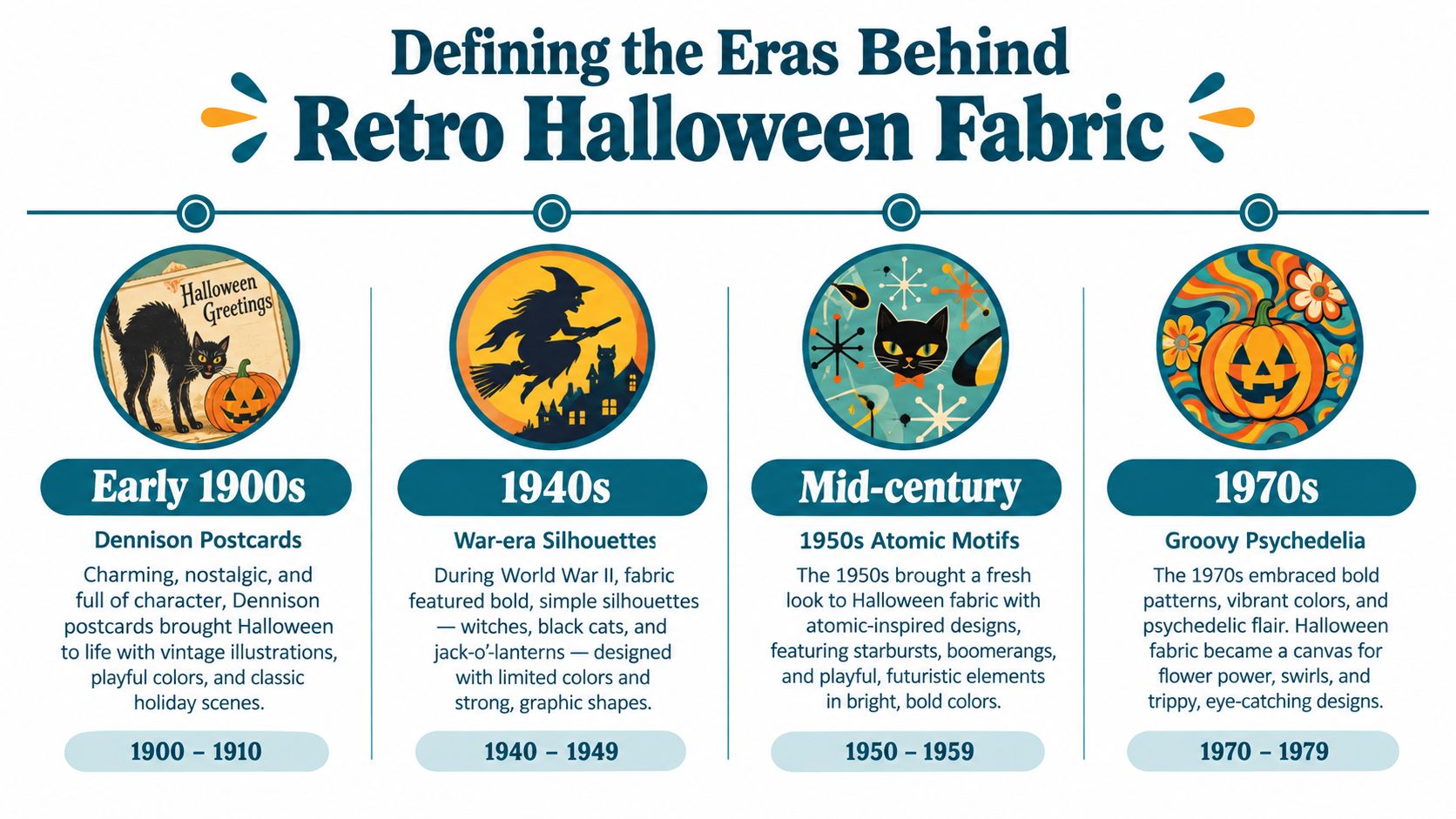
Dennison-style graphics often feature black cats, pumpkins, witches, moons, bats, and bold greeting-card lettering. The figures may look posed rather than active, with silhouettes and decorative borders that resemble printed ephemera. Lesley Bannatyne places Halloween's broader U.S. popularity in the late 1800s, and the Dennison Company introduced its first paper Halloween decorations in 1909, selling them through the 1940s, as documented in this history of Halloween's orange, black, purple, and green color traditions.
These prints suit wall hangings, framed panels, pillows, and small quilts where the illustration can remain visible. Cream, faded orange, charcoal, and warm black help the fabric resemble an aged paper card.
Mid-century Halloween designs simplify the subject. Cats may become sleek curved shapes, owls may sit inside repeated medallions, and stars or moons may form tidy geometric patterns. The palette can include dusty teal, softened pink, cream, gray, and black, creating a spooky look without relying on bright pumpkin orange.
Use this era for adult décor, table runners, modern quilt blocks, and coordinated pillows. The cleaner shapes also work well when you want to combine a large motif with a small blender.
Seventies-inspired fabric usually announces itself through burnt orange, brown, mustard, olive, cream, and occasional rust. Pumpkins, leaves, mushrooms, moons, florals, and harvest borders may share the same print. The look is warmer and earthier than classic Halloween, making it suitable for a seasonal kitchen or dining area.
Choose it for placemats, table runners, aprons, reusable gift bags, and scrappy quilts. It pairs naturally with brown, cream, and muted orange solids.
Nineties-inspired prints use friendlier faces, heavier outlines, repeated icons, and brighter contrast. Ghosts, pumpkins, candy, bats, and cartoon monsters may appear in compact arrangements. These fabrics suit children's projects, trick-or-treat bags, pajamas, pet accessories, and playful pillows.
The key is to decide whether you want a historically styled reproduction or a modern fabric that recalls a decade. Both can be retro, but they create different results.
Color often reveals the era before the motif does. Lay the bolt flat and squint slightly. The dominant color relationship should remain clear even when individual pumpkins, cats, or bats blur together.
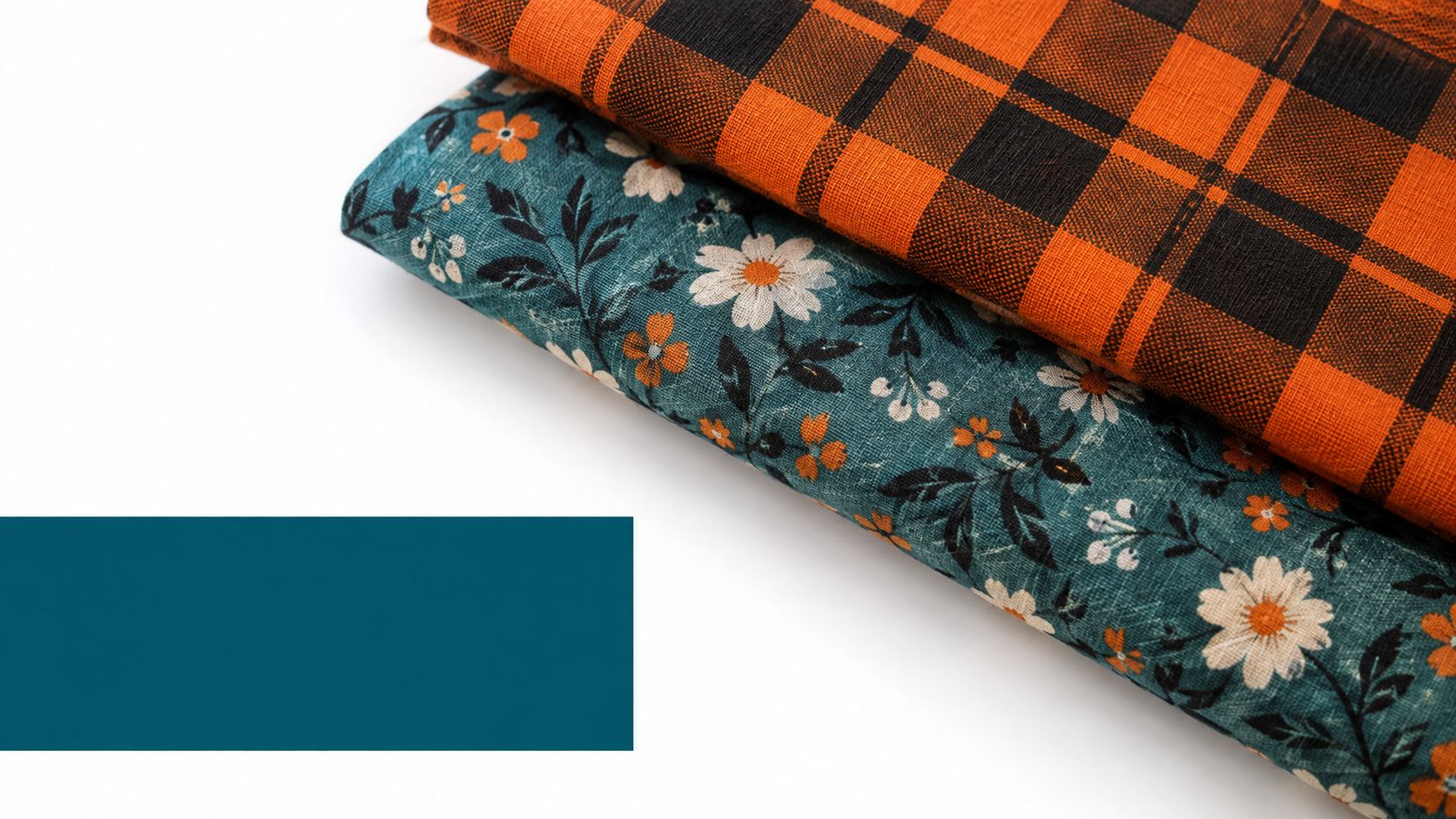
This is the most recognizable Halloween pairing. Orange suggests pumpkins, autumn harvest, and fire, while black evokes nighttime, death, black cats, and bats. The combination works especially well for trick-or-treat bags, banners, table runners, and high-contrast quilt blocks.
A saturated orange with a deep black feels energetic. A softened pumpkin orange with warm black feels older and more like printed ephemera.
Orange and brown shift Halloween toward harvest. This palette suits the 1970s mood and works beautifully in kitchen textiles, placemats, aprons, and patchwork quilts. Add cream to create breathing room, or use a dark brown in place of black when true black feels too sharp.
Dusty teal, faded pink, cream, and charcoal suggest mid-century design. The palette feels decorative rather than frightening, so it flatters adult pillows, wall art, table toppers, and contemporary quilts.
Keep one color dominant. If teal, pink, orange, and black all compete equally, the print may lose its period character and become visually noisy.
Cream and black create the clearest backdrop for postcard-style cats, bats, witches, and haunted houses. This combination works for wall hangings, pillow fronts, framed panels, and small accessories because the silhouettes remain easy to read.
Design check: If a print feels “off,” compare its value, not just its hue. One light ground and one dark anchor usually clarify a busy Halloween palette.
The artwork tells you what the fabric looks like. The substrate tells you how it behaves. Cotton quilting fabric is the default for piecing because it has a stable plain weave, moderate body, and predictable cutting response. Flannel feels softer and warmer, but its nap can make seams shift and its shrinkage behavior deserves attention. Canvas adds structure for bags and baskets. Synthetic blends may offer drape or resistance to wrinkles, but they don't behave like quilting cotton under an iron or needle.
One listed quilting-weight example uses a 42-inch-wide, 4.4-ounce-per-square-yard plain-weave cotton with an opaque appearance, a 120 thread count, expected shrinkage of approximately 5–6% in length and 2–3% in width, according to the product specification for a measurable quilting cotton example. Those figures matter if you're mixing newly purchased yardage with older stash fabric. A block cut before washing may not finish at the same size afterward.
Cotton breathes and washes well, which makes it a strong choice for quilts, table runners, pillowcases, and wearable accessories. Flannel suits cozy pillowcases and soft accessories. Canvas is better when the project needs body, such as a trick-or-treat tote. Synthetic blends can work for selected costume or decorative applications, but check fiber content, heat tolerance, and care instructions before cutting.
If you're making a bag and need a deeper comparison of materials, find your perfect tote fabric offers useful context on how fabric choice affects structure and use.
| Substrate | Best For | Drape | Washability | Shrinkage Risk |
|---|---|---|---|---|
| Cotton quilting fabric | Quilts, runners, pillowcases, blocks | Moderate, stable | Generally easy with suitable care | Moderate, check specifications |
| Flannel | Pillowcases, soft accessories, cozy décor | Soft and relaxed | Washable, nap needs care | Moderate to high |
| Canvas | Totes, baskets, structured bags | Firm | Washable depending on finish | Moderate |
| Synthetic blend | Selected costumes and decorative pieces | Varies from fluid to firm | Depends on fiber and finish | Often lower, but heat sensitivity varies |
A small project lets you test a print before committing to a full quilt. Start with the substrate and scale, then select the era and palette that support the object.
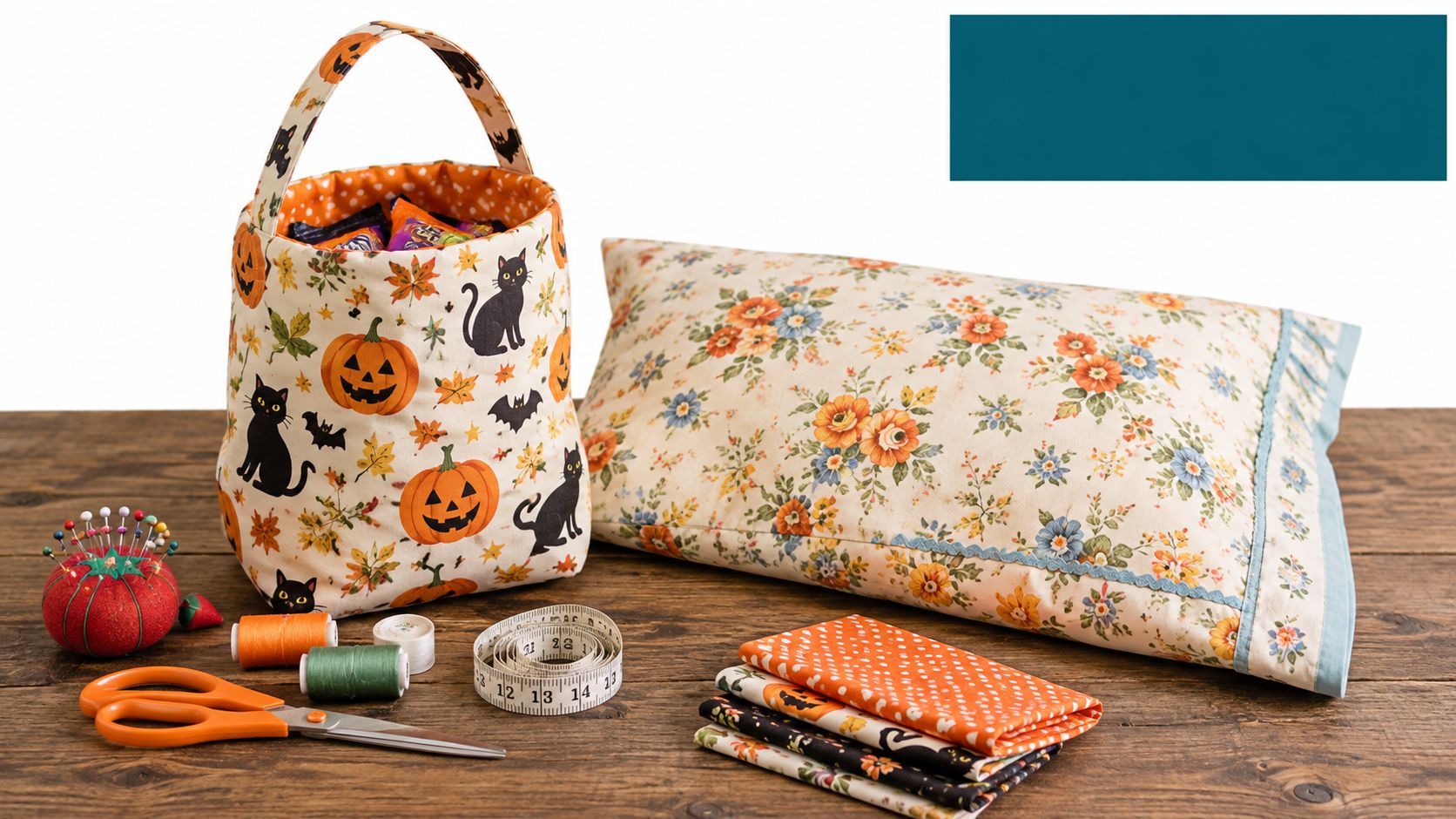
Use quilting cotton for the lining and a sturdier cotton or canvas for the outer layer. A nineties cartoon print makes the bag playful, while a Dennison-style pumpkin print creates a more collected look. This is a practical stash buster, especially when you have a fat quarter with a clear central motif.
A boxed bottom, reinforced handles, and a lining make the small bag more useful than a single-layer fabric pouch. If you're adding a transfer or other decoration rather than piecing, review a clear Raccoon Transfers pressing guide before applying heat to the chosen substrate.
Choose soft quilting cotton or flannel, depending on the feel you want. Cream-and-black silhouettes suit an adult bedroom, while mid-century teal and pink can make a quieter seasonal accent. Pillowcases are a good place for a directional print because the design remains visible across a broad surface.
Try half-square triangles arranged as a spiderweb, or use a charm-pack-style group for a small table runner. Warm orange, brown, cream, and black create an easy harvest palette. These projects benefit from coordinated precuts, so you can test value and scale without purchasing many separate bolts.
A postcard panel, large moon, or central haunted-house motif deserves a project that doesn't break the artwork into tiny pieces. Add a narrow border, backing, and hanging sleeve. This is one of the best uses for early postcard-inspired fabric.
Use a washable quilting cotton with a compact motif. A classic orange-and-black print is easy to recognize, while a nineties-inspired cartoon works for a more playful look. Measure the pet's neck and keep fasteners secure, with no loose parts that could become a hazard.
For project-ready choices, browse the retro Halloween fabric collection for seasonal prints and precuts that can coordinate across small makes.
Reserve a dedicated yardage purchase for a quilt, table runner, or large wall hanging where color continuity matters. Use leftovers, fat quarters, and small cuts for bandanas, bags, pockets, and block testing.
A successful Halloween fabric group usually needs one star, one support print, and one quiet blender. The star carries the era, such as a large postcard pumpkin or mid-century cat. The support print repeats one color in a smaller scale. The blender may be a tone-on-tone dot, stripe, plaid, or solid.
Start with scale. Pair a large motif with a small ditsy print so the eye has somewhere to rest. Then check value. A dark black print beside a light cream coordinate creates definition, while several medium-value browns and oranges may blend together once pieced.
Use one accent print to tie the set together. For example, a dusty teal star print can connect a cream silhouette fabric with a muted pink blender, even if the motifs differ.
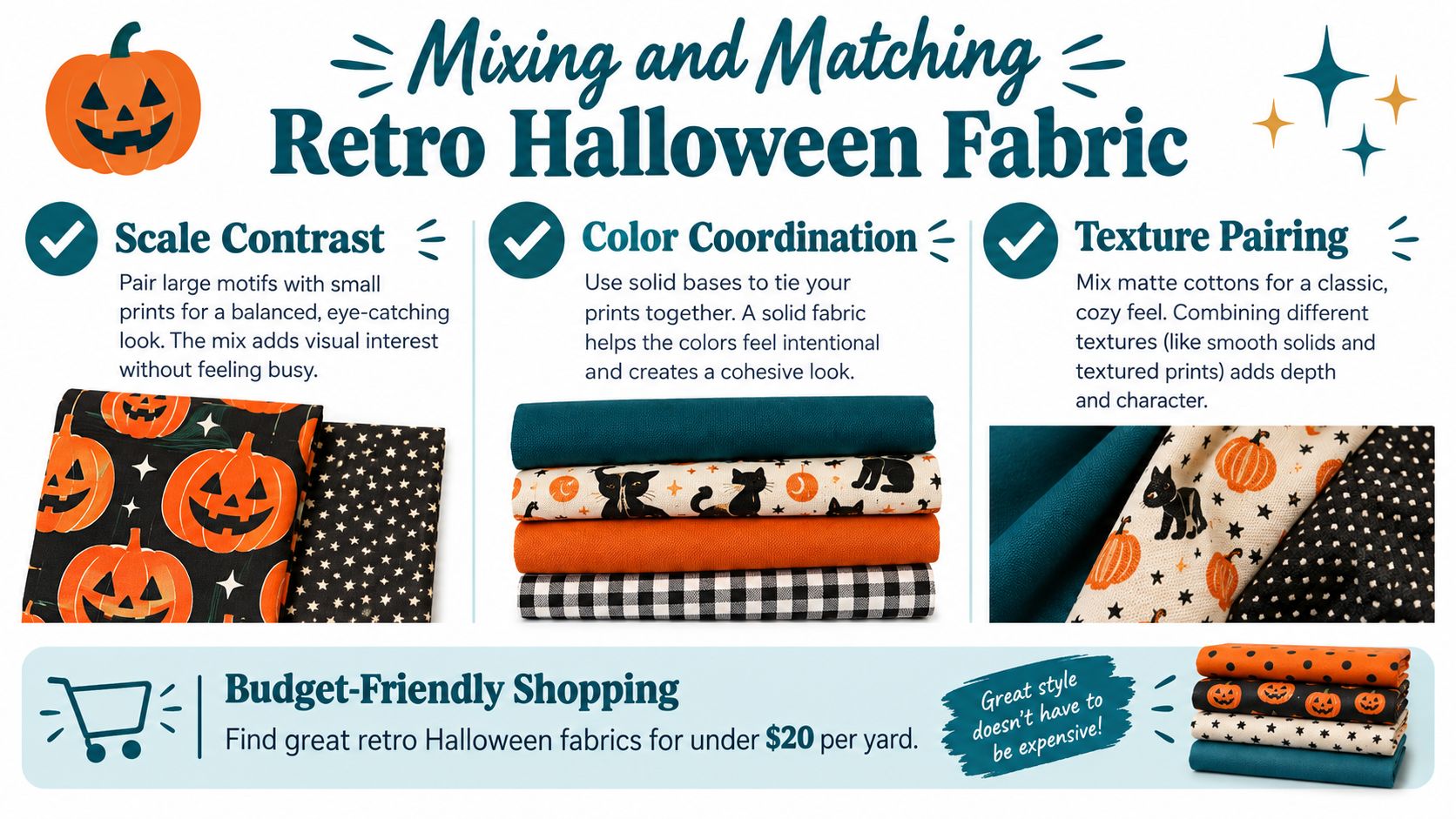
Before cutting, run this quick check:
Reactive dyes bond chemically with cotton fibers and generally offer strong wash resistance, while chlorine can damage the dye bond. Pigment prints can create a muted, chalky, distressed look, but excess pigment or inadequate curing may reduce wash and rubbing durability, as explained in technical guidance on pigment printing performance. A small swatch test is safer than guessing.
Vintage-looking fabric isn't automatically colorfast. Before cutting, wash a sample or the yardage separately in cool or warm water with a mild detergent. Turn the fabric inside out when possible, avoid chlorine bleach, and reduce tumble-dry time to limit color loss.
Test saturated black, purple, and orange areas against white cotton. Rub the print while dry, then dampen the swatch and rub again. Launder it once using the settings you expect for the finished project, then inspect the white cloth, the print edges, and the fabric surface.
Simple test: If the color transfers before you sew, it can transfer after you sew.
Reactive prints are usually the more predictable choice for a quilt that will be washed repeatedly. Pigment prints may be exactly right for a wall hanging, table runner, or intentionally aged decorative piece, but inspect for stiffness, rubbing loss, and fading before committing.
Fiber content matters even more when the item will be worn or used near heat. A cotton-like feel doesn't establish flammability performance, and a retro appearance doesn't tell you how the fabric was finished. Record the fiber content, care label, and any product testing information with your project notes.
A finished retro Halloween project needs a home between seasons. Rotate quilts, runners, and wall hangings into display rather than leaving them in direct light year-round. Strong light can gradually alter pale orange, cream, and yellow areas, which are typically more vulnerable than deeper shades.
For folded quilts and wall hangings, use clean hands, avoid crushing the piece under heavy objects, and fold along different lines when you store it again. Acid-free tissue can soften sharp creases, while a breathable cotton bag protects the textile without trapping moisture the way an airtight plastic container can. For broader seasonal-storage guidance, MG Self Storage for seasonal stock provides practical advice on keeping textiles clean, dry, and protected.
A table runner can lie flat or roll around a clean, padded tube. A small wall hanging benefits from a sleeve or a hanger that supports its width rather than creating a stress point. Bags should be emptied before storage so candy residue, makeup, or outdoor debris doesn't remain in the fibers.
Label each item with its fabric content, washing method, and whether it was intended for display or frequent laundering. That note saves guesswork next season, especially when several black, orange, and cream projects look similar in a storage bin.
A wall quilt usually stays away from direct flame. A cape, mask, banner, or costume may pass close to candles, fireplaces, or other heat sources. The intended use changes the safety question.
Under the U.S. Consumer Product Safety Commission's Standard for the Flammability of Clothing Textiles, 16 CFR Part 1610, fabric samples are tested with a flame applied at a 45-degree angle for one second. Materials are classified as Class 1 Normal Flammability, Class 2 Intermediate Flammability, or Class 3 Rapid and Intense Burning, as described in this overview of how fabric burns under the standard.
The regulation includes exemptions for certain plain-surface fabrics made entirely or partly from acrylic, modacrylic, nylon, olefin, polyester, or wool, as well as certain plain-surface fabrics meeting the stated weight condition. An exemption doesn't mean every project is automatically safe. Fiber content, fabric construction, intended use, and applicable product requirements still need separate consideration.
Safety first: Never use a fabric's vintage appearance, cotton-like hand, or dark color as a substitute for checking its intended use and flammability information.
For costumes, keep fabric away from open flames and heat sources, and avoid assuming that a decorative banner belongs in the same category as a quilted wall hanging. Finish raw edges cleanly, especially on projects that will be handled often. A BERNINA dealer or sewing-notions department can help you choose suitable needles, thread, edge-finishing tools, and pressing equipment for the substrate you selected. High Country Quilts, a quilting and sewing shop in Colorado Springs, carries seasonal fabrics, precuts, sewing accessories, and BERNINA equipment and support.
A reliable seasonal plan is simple: choose one visual era, build a small palette around it, select a substrate that matches the project, test a swatch, and label the finished piece as a display quilt, costume, bag, or table textile. Retro Halloween fabric isn't only a mood board. It's a craft category with visual history, material behavior, and practical limits.
Visit a local shop in Colorado Springs or browse the collection online before you cut. Start with one manageable project, such as a fat-quarter bag or small wall hanging, then use what you learn to plan the larger quilt.
High Country Quilts offers seasonal quilting fabrics, precuts, sewing notions, BERNINA machines, and hands-on support for makers choosing materials for projects like these. Visit High Country Quilts to browse retro Halloween fabric and gather the supplies for your next seasonal make.
At High Country Quilts we care deeply about community. With our experiences in retail, we know that a store is not only a place to shop but also a place for the community to gather and share. During this busy...

Hi! We’re Adam and Renee Wheaton, the new owners of High Country Quilts! For more than 40 years, we’ve owned and operated vacuum and sewing businesses. Following in Renee’s father’s footsteps after he retired from All Discount Vacuum and Sewing in Colorado...


Leave a comment