

We Love Our Quilting Community
At High Country Quilts we care deeply about community. With our experiences in retail, we know that a store is not only a place to shop but also a place for the community to gather and share. During this busy...


You're standing in front of a colorful bundle of neatly folded fabric, wondering whether those small rectangles could possibly become a quilt. The label says fat eighths, but the name doesn't tell you much about what you can cut, how many pieces you'll get, or whether the bundle fits your pattern.
That's where this guide helps. You'll learn what fat eighths fabric is, why measurements vary, how to check the usable area, and when a bundle makes more sense than fat quarters or yardage. You'll also find beginner-friendly project ideas and a practical way to plan before you buy.
A first-time quilter might pick up a bundle and see a stack of modest rectangles, each one covered in a different print. The pieces look too small for a quilt, especially beside a full bolt. Then the label gives a measurement, perhaps 9 x 21 inches, and the project starts to feel possible.
A fat eighth is a precut quilting rectangle, generally about 9 x 21 inches or 9 x 22 inches, depending on the manufacturer and the original fabric width. Many quilters describe it as half of a fat quarter, while a standard one-eighth-yard cut is much narrower and longer, usually about 4.5 x 40 to 44 inches. The shape is the important part. A fat eighth keeps useful width, so you can cut patchwork units that won't fit across a skinny strip. Bloomerie Fabrics' quilting measurements guide explains the common commercial measurements and the variations shoppers may encounter.
Think of the cut as a friendly middle ground. It gives you more choice than a small charm square, but it doesn't require you to purchase a large piece of every print in a collection. That makes it useful for scrappy blocks, appliqué, paper piecing, sampler quilts, and small gifts.
Two fat eighths are commonly treated as the equivalent of one fat quarter, and eight fat eighths are approximately equivalent to one yard of fabric. That conversion is useful for broad planning, but it isn't a promise that every bundle will produce the same pieces. Bear Creek Quilting Company's precut guide notes that some markets also use measurements such as 11 x 18 inches, so the package specification matters.
Practical rule: Treat the printed measurement on the package as the source of truth, not the name alone.
Once you see a fat eighth as a wide, manageable sample of a print, the bundle becomes easier to evaluate. You're not asking whether one rectangle can make an entire quilt. You're asking which parts of the quilt it can make, and how many coordinated rectangles your pattern needs.
Precuts are easiest to understand when you compare their shapes, not just their names. A fat eighth is short and wide. An eighth-yard cut is long and narrow. A fat quarter gives you roughly twice the area of a fat eighth, while a charm square arrives ready for small patchwork without much cutting.
The table below uses common quilting-market descriptions. Measurements can vary by manufacturer, so check the product details before cutting a precision project.
| Precut Type | Approx. Size | Best Use |
|---|---|---|
| Fat eighth | About 9 x 21 or 9 x 22 inches | Small patchwork, appliqué, sampler blocks, fussy cutting |
| Fat quarter | About 18 x 21 or 18 x 22 inches | Larger blocks, borders, garments, versatile stash building |
| Standard eighth-yard cut | About 4.5 x 40 to 44 inches | Long narrow strips and selected border work |
| Charm square | 5 x 5 inches | Small squares, quick patchwork, low-cutting projects |
| Jelly roll strip | 2.5 x 40 to 44 inches | Strip piecing, log cabins, rail fences, coordinated strip quilts |
The wide edge gives fat eighths their practical advantage. You can position a motif for fussy cutting, cut short strips, or place several smaller units across the fabric instead of working from a narrow ribbon. The Sewing Directory's patchwork terms distinguishes the fat eighth from a regular eighth-yard cut, which is much longer and narrower.
An eighth-yard cut may be a better choice when your pattern calls for continuous strips, binding, or long borders. A fat quarter gives you more room for large squares and directional prints. A charm square saves cutting time, but its fixed size limits what you can make from it.
Fat eighth bundles fit the way many shops curate fabric collections. You can sample several prints without buying full yardage of each one, which suits beginners who are still learning to balance color, scale, and contrast. A fat eighth bundle guide from Fat Quarter Shop describes the format as a common 9 x 21-inch rectangle, with slight variation possible.
Don't choose a bundle solely because it contains many prints. Compare the actual piece size with your pattern's largest cut. A collection of narrow cuts can offer wonderful color variety, yet still be the wrong purchase for a quilt built from large blocks or long directional sections.
The familiar fat eighth shape comes from dividing fabric differently than a standard eighth-yard cut. Start with fabric that is about 44 inches wide. Measure 18 inches along the selvage, which gives you a half-yard section, then cut that section across the width to divide it into two pieces. The result is commonly sold as two rectangles of about 9 x 21 inches, after accounting for the fold and selvage.
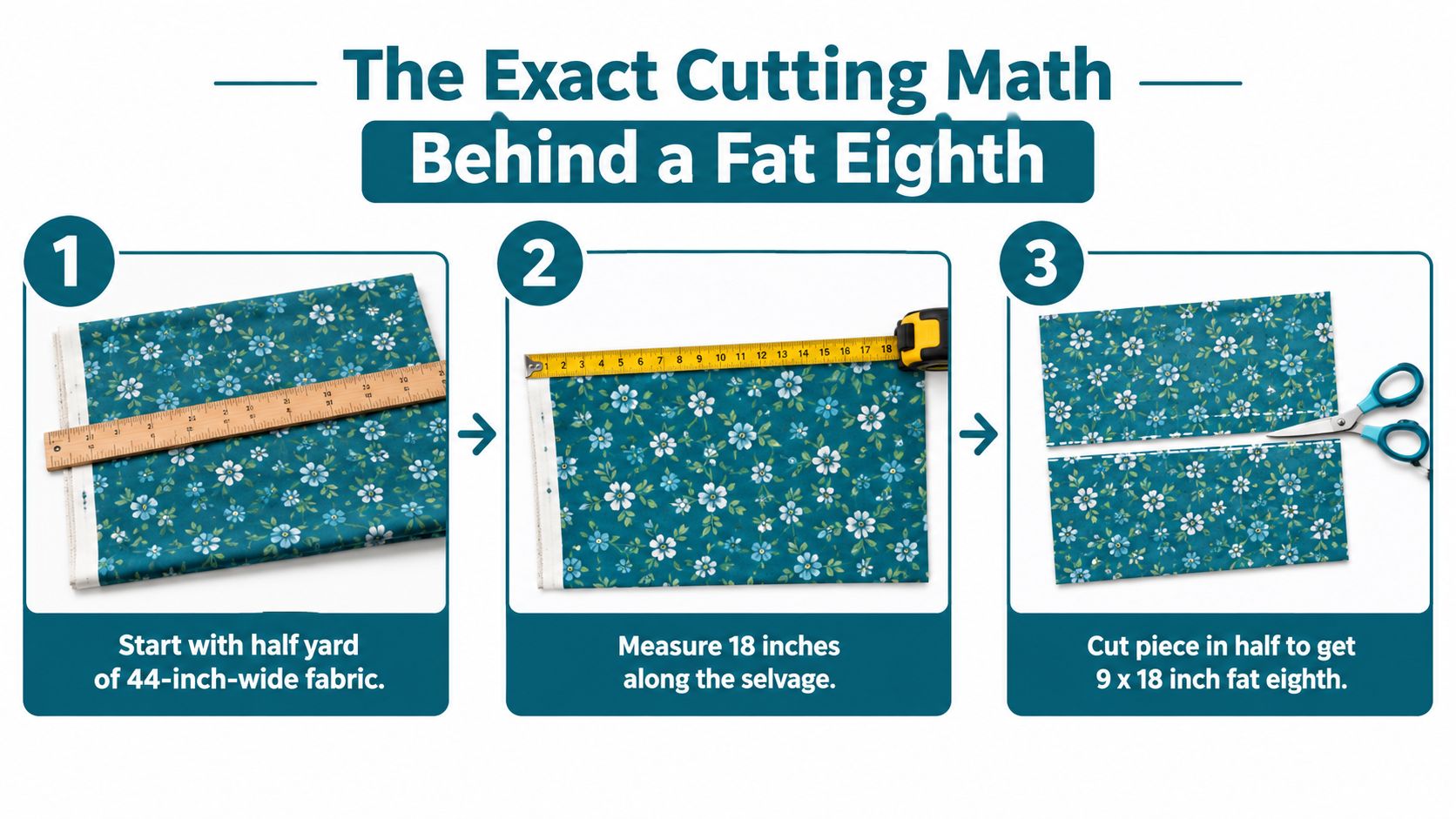
Lay the piece flat before planning a cut. The folded bundle may look compact, but the usable rectangle is determined by the cut edge, the selvages, and any uneven trimming. A Quilting Life's fat eighth advice uses the common 9 x 21-inch starting point and explains that a standard one-quarter-inch seam allowance on all sides leaves an approximate finished working area of 8.5 x 20.5 inches.
That distinction matters. A pattern may call for an unfinished square, while your finished block measurement is smaller after sewing. Always separate these three ideas:
From one common fat eighth, you might cut an 8-inch square, two 4.5-inch squares, or a 2.5 x 20-inch strip, depending on the grain and the pattern layout. Those examples are planning guides, not guarantees. Directional motifs, trimming, and a shorter cut can change the yield.
The broad conversion remains helpful for stash math. Eight fat eighths are approximately equivalent to one yard of fabric, but that doesn't mean eight pieces behave exactly like one continuous yard. Seams, layout, and the direction of the print determine how much of that area becomes useful patchwork.
The right number depends on the largest unit in your pattern, the amount of background fabric, and whether you need repeated pieces from one print. A fat eighth is strongest when a block uses compact squares, triangles, or rectangles. It becomes less convenient when the pattern asks for long strips or a large uninterrupted field.
Start by listing the cuts for one block. If the pattern uses 5-inch pieces, one fat eighth may cover the fabric for a single small block, depending on layout and seam allowances. A 10-inch or 12-inch square needs more careful checking, especially when the fabric has a directional design or the seller's cut is shorter than the commercial norm.
Multiply the fabric needed for one block by the number of blocks in the quilt. Then separate prints from background. A coordinated bundle may supply the feature fabrics, while the background, border, binding, and backing usually need yardage or larger cuts.
| Project Type | Approx. Fat Eighths | Best For |
|---|---|---|
| One small patchwork block | One | Testing a block or using 5 to 6-inch pieces |
| Small pillow front | Two | Compact patchwork with repeated small units |
| Small wall hanging or table runner | Several | Simple grids, half-square triangles, and accent layouts |
| Crib-sized quilt top | A coordinated bundle of 12 to 20 | Scrappy patchwork with a separate background and border |
The broad project ranges above reflect common planning guidance, but they shouldn't replace the cutting diagram in your pattern. Yellow Umbrella Quilts' fat eighth FAQs emphasizes that the number required depends on project size and complexity, with some projects using a broad range such as 10 to 25 fat eighths.
A pattern that needs long sashing strips, bias binding, or several matching motifs from one fabric may leave you short. In those cases, choose fat quarters, half yards, or yardage for the specific fabric rather than forcing a precut to do a job it wasn't designed to do.
Round up when your design permits it. Keeping two extra pieces can help with a miscut, a directional-print mistake, or a late color-balance change. The extra fabric also gives you room to test a seam allowance before cutting the entire bundle.
The most reliable purchase starts with the product description, not the photograph. Look for the actual dimensions, the number of pieces, whether the cuts are from one collection, and whether the shop trims selvages before packaging. Hailey Stitches' fat eighth explanation points out that 9 x 21 inches and 9 x 22 inches are common benchmarks, but yield changes with the long edge and the shop's trimming practice.
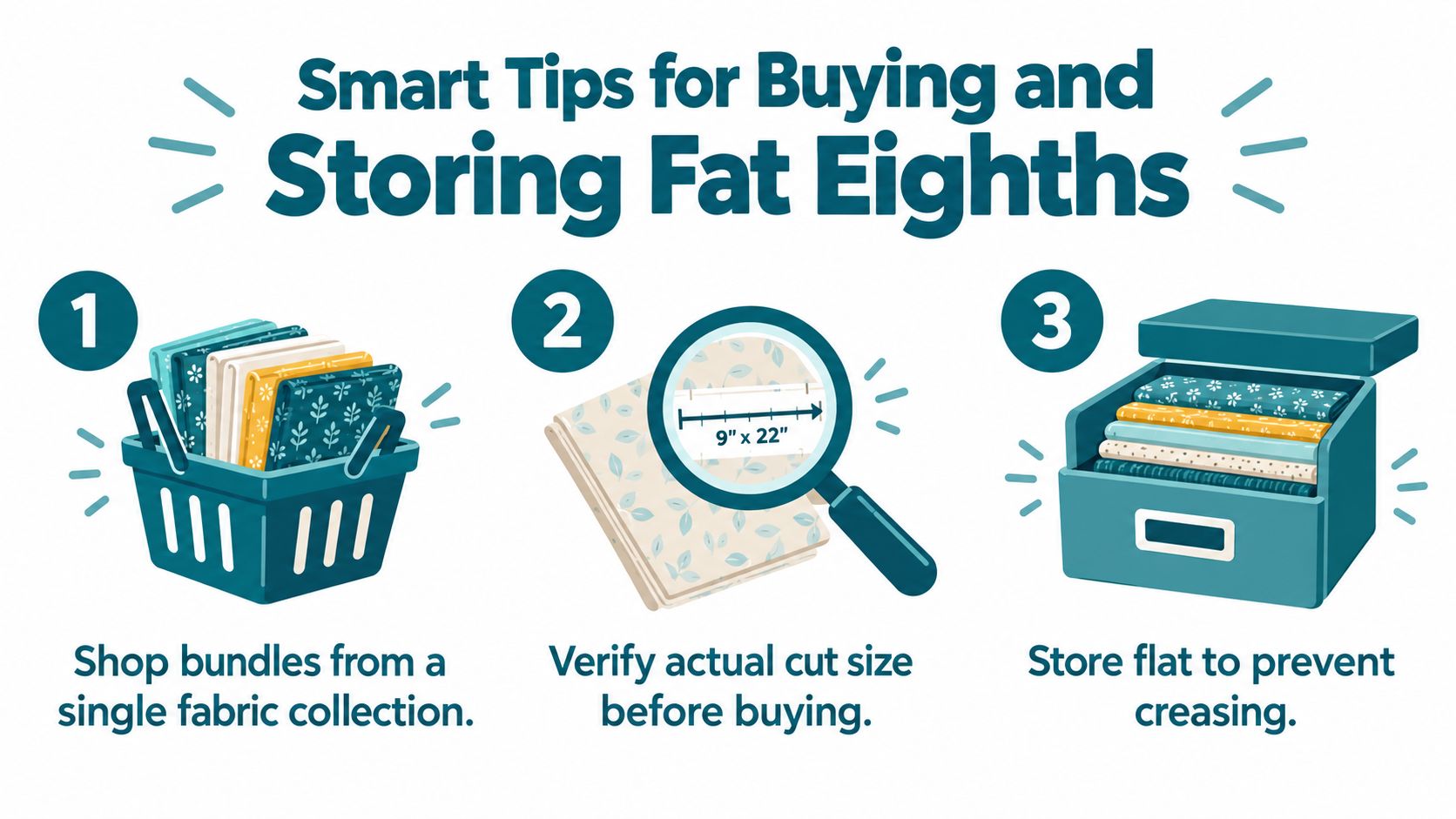
A quick inspection can prevent frustration. If you're shopping in person, unfold or measure a sample piece. Online shoppers should save the listed dimensions and compare them with the pattern's cutting chart when the package arrives.
Fat Quarter Shop's precut fabric guide is useful for understanding why measurements vary across markets. It notes that fat eighths may appear as 9 x 21 inches, 9 x 22 inches, or 11 x 18 inches, depending on how the fabric is cut and the width available.
Store fat eighths in a shallow bin, drawer, or protective sleeve where you can see the colors without unfolding the entire collection. A comic-book sleeve can keep an individual cut clean, while a labeled fabric box works well for a complete collection.
Avoid hanging the pieces from clips or hangers. Gravity can pull the weave and leave a curve that makes accurate cutting less pleasant. Keep the fabric away from direct sunlight, pets, and damp areas, and label the collection name so you can plan a project without sorting through every bundle.
High Country Quilts offers precut quilting fabrics through its precut fabric collection, giving shoppers one place to browse formats before matching a purchase to a pattern.
A bundle becomes much less intimidating when you give each print a small, clear job. The following projects build different skills, from straight seams to half-square triangles, while keeping the fabric decisions manageable.
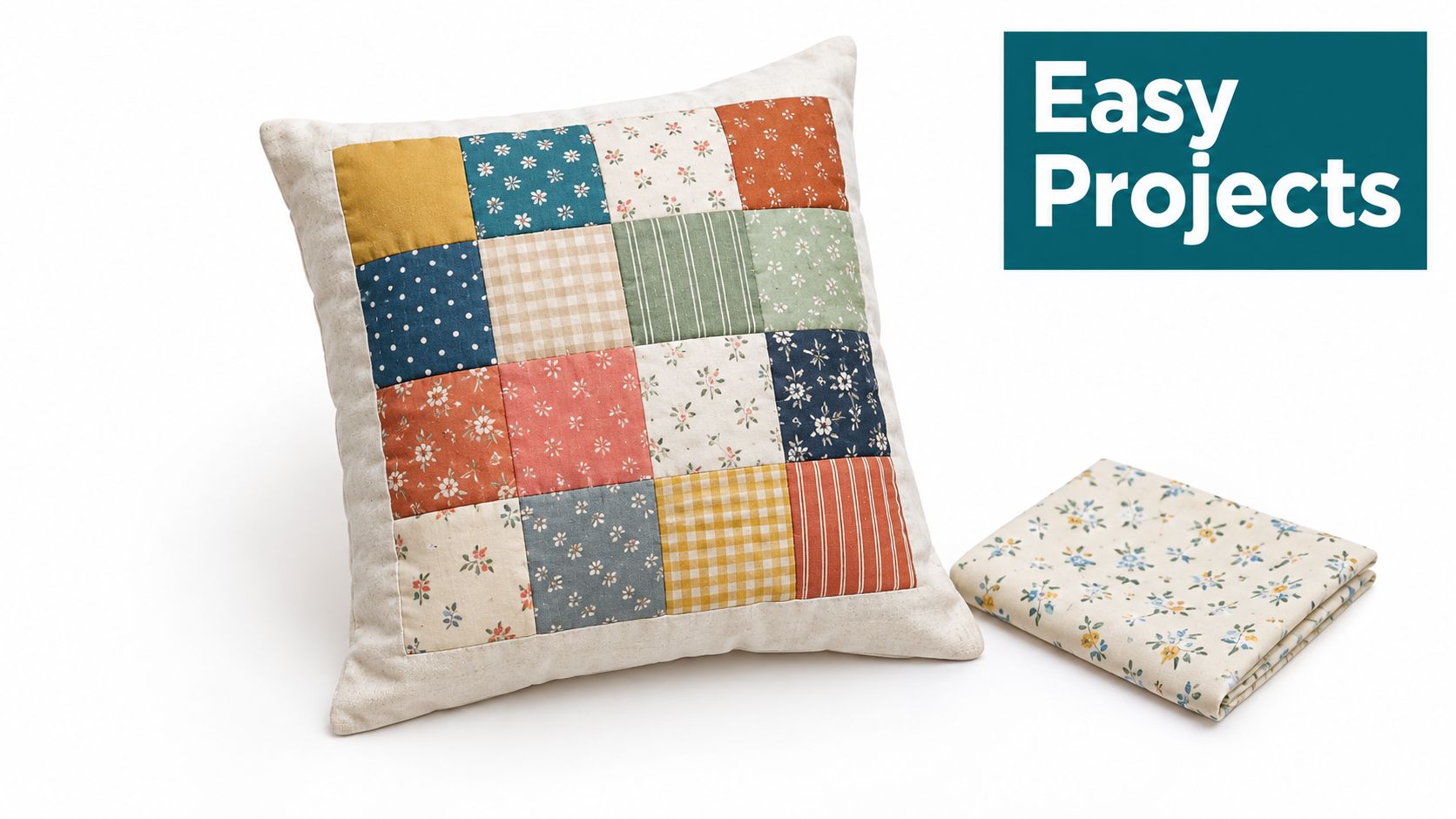
Begin with a pillow front made from twenty 5-inch squares cut from assorted fat eighths, plus a fat quarter of background fabric. Sort the prints into a pleasing arrangement, sew the squares into rows, and press each row consistently before joining the rows.
You'll need a rotary cutter, quilting ruler, cutting mat, sewing machine, thread, iron, and a basic quarter-inch presser foot. This project gives you repeated practice with seam allowances without requiring a large quilt commitment. It's also a good place to test whether your machine feeds small pieces evenly.
For a thoughtful finished gift, you can look at the layout and color possibilities in this custom photo quilt by That Blanket Co, especially if you're interested in turning meaningful images or coordinated fabrics into a personal keepsake.
Cut small squares from several prints and pair them with a solid to make 4-inch half-square triangles. Arrange the units in a simple grid, then add a narrow border if your remaining fabric allows. The project teaches you to match points, press seams, and watch how neighboring colors affect the pattern.
A rotating cutting mat can make trimming easier, but a standard mat, acrylic ruler, rotary cutter, pins, and walking foot are enough. Use a scant quarter-inch seam only if your pattern specifies it, and make a test unit before cutting the complete set.
A short video can help you visualize the rhythm of piecing and pressing before you begin:
A coordinated bundle can supply the patchwork fabrics for a baby-sized quilt top, while a solid fabric handles the background or border. A simple design may finish around 36 x 48 inches, but the final measurement depends on the pattern, seam allowances, borders, and trimming.
Choose a pattern with compact repeated blocks rather than large uninterrupted sections. Before cutting, group the fat eighths by light, medium, and dark values. That small planning step helps the patchwork read clearly, even when the prints come from one collection.
Keep the rest of the project simple. A beginner-friendly tool list includes a rotary cutter, cutting mat, quilting ruler, sewing machine, iron, thread, clips or pins, and a walking foot for later quilting. If you want a broader starting point, browse beginner quilt patterns that identify the required cuts before choosing your bundle.
Fat eighths fabric is a practical choice when your design uses scrappy blocks, small appliqué pieces, paper-pieced units, or sampler blocks. The common commercial benchmark is about 9 x 21 inches, though the seller may provide a slightly different cut, so measure the fabric before relying on a cutting plan. A fat eighth can add print variety, but it isn't a replacement for full yardage when your quilt needs a large background, long sashing, binding, or a continuous border.
Match the precut to the pattern first, then choose the collection. You can browse curated fat eighth bundles, request a swatch comparison, or visit the Colorado Springs shop to feel the fabric and compare colors in person. The quilting precuts collection and beginner quilt patterns resource make it easier to move from measurement questions to a project you're ready to sew.
High Country Quilts offers quilting precuts, fabric collections, sewing tools, classes, and hands-on guidance for makers who are getting started or refining their skills. Visit High Country Quilts to compare fat eighth options with your pattern, ask about the right cut for your project, and choose supplies with confidence.
At High Country Quilts we care deeply about community. With our experiences in retail, we know that a store is not only a place to shop but also a place for the community to gather and share. During this busy...

Hi! We’re Adam and Renee Wheaton, the new owners of High Country Quilts! For more than 40 years, we’ve owned and operated vacuum and sewing businesses. Following in Renee’s father’s footsteps after he retired from All Discount Vacuum and Sewing in Colorado...


Leave a comment