
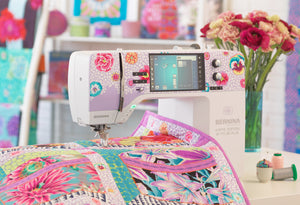

We Love Our Quilting Community
At High Country Quilts we care deeply about community. With our experiences in retail, we know that a store is not only a place to shop but also a place for the community to gather and share. During this busy...


So, you’ve heard other quilters talk about “stippling” and wondered what it’s all about? You're in the right place. Stippling is one of the most common and useful skills in free-motion quilting, and it’s easier to master than you might think.
Think of it as doodling with your sewing machine. Stippling is a free-motion technique where you stitch a single, continuous, meandering line that fills an area without ever crossing over itself. The result looks a lot like puzzle pieces, brain coral, or a meandering stream.

Stippling isn’t meant to steal the show; it's the ultimate supporting actor. Its main job is to create a flat, dense texture in the background of your quilt.
By filling in the negative space, this technique compresses the batting and fabric, which makes your main design elements—like pieced blocks or appliqué—seem to puff up and pop forward. It’s a fantastic way to add dimension and make the focal points of your quilt truly stand out.
To put it in perspective, it helps to see how stippling differs from other common quilting styles. This quick table breaks it down.
| Quilting Style | Line Characteristic | Primary Use |
|---|---|---|
| Stippling | Continuous, non-crossing, meandering lines | Creating a flat background texture to highlight other design elements. |
| Crosshatching | Straight, evenly-spaced grid lines that intersect | A classic, formal fill that adds structure and a traditional feel. |
| Echo Quilting | Lines that outline a motif, like ripples in a pond | Emphasizing a specific shape or appliqué by outlining it repeatedly. |
As you can see, stippling has a unique job. It’s all about creating that beautiful, uniform texture that gives a quilt a professionally finished look.
Understanding what stippling is—and what it isn't—is your first step. And here at High Country Quilts in Colorado Springs, we have the classes, expert guidance, and top-of-the-line BERNINA machines to help you master this timeless craft.
To really get a feel for machine stippling, it helps to rewind a bit. Believe it or not, the technique didn't start with a sewing machine at all. It began with the patient hands of quilters who were borrowing a trick from classic painters.
The whole point of this new background style was to make other design elements pop. By packing the background with dense stitching, the fabric compresses and flattens out. This makes any appliqué or pieced blocks seem to lift right off the quilt, creating a beautiful, almost three-dimensional effect.
Think of stippling as the ultimate supporting actor. Its job isn't to steal the spotlight but to make the main designs shine by adding texture and depth all around them.
Originally, hand-quilters would place thousands of tiny, individual stitches across the background, much like an artist using dots of paint—a technique called stippling, famously used by painters like Van Gogh. It was a painstaking process of building up a gorgeous, textured background one little stitch at a time. The experts at Handi Quilter have some great insights on these origins.
Then came the sewing machine, which completely changed the game. A machine is built to sew a continuous line, so replicating thousands of separate, random stitches just wasn't possible. So what did quilters do? They did what quilters always do: they adapted. They invented the flowing, meandering, continuous-line stitch we all recognize as modern machine stippling.
This story is a perfect example of how our craft evolves. What was once done by hand, stitch by meticulous stitch, can now be accomplished with the fluid motion of a machine. It’s a direct line connecting quilting’s rich history with the amazing tools we have today, like the BERNINA machines we love and support here at High Country Quilts.
It’s a living tradition, passed down and refined in quilting circles everywhere, connecting us to all the creative hands that came before.
Ready to dive into stippling? The good news is you don’t need a mountain of fancy gear to get started. But, just like a chef needs a good knife, having a few key tools will make all the difference between a frustrating afternoon and a beautifully finished quilt.
Your absolute must-have is a free-motion quilting foot, which you might also know as a darning foot. This little wonder is the key to the whole operation. Instead of clamping your fabric down, it floats just over the surface. That freedom is what lets you glide your quilt around in any direction you please—forward, backward, and in all those lovely, loopy curves.
A reliable, well-maintained sewing machine is your best friend in free-motion quilting. Models from trusted brands like BERNINA are designed for precision and can handle the demands of stippling, ensuring your creative vision isn’t limited by your equipment.
With the right foot attached, it's time to tell your machine what you're about to do. A few simple adjustments are all it takes to switch from straight-line sewing to creative free-motion quilting.
And let’s not forget about thread! It plays a huge role in the final look. A contrasting thread color will make your stippling pop as a dynamic design feature. If you want a more subtle, textural effect, choose a matching thread that blends in with your fabric. The thread's weight matters, too—thinner threads recede, while thicker ones make a statement.
You can find all these essential tools, from darning feet to the perfect thread, right here at High Country Quilts. We’re here to help you get started on your stippling journey.
Think of learning to stipple like learning to doodle. Instead of a pen on paper, you're guiding fabric under your machine's needle. Your goal is to fill the space with one continuous, curving line, almost like you're drawing a giant, loopy puzzle piece across the whole quilt.
The real trick to mastering this is all about muscle memory. Before you even dream of touching your beautiful quilt top, grab some scraps. Make a practice “quilt sandwich” with two pieces of fabric and a small bit of batting. This is your doodle cloth—a no-pressure zone where you can just play and find your rhythm.
The Three Unbreakable Rules of Stippling:
- Keep Your Hands and Machine in Sync: Your hand speed should match your machine speed.
- Make Smooth, Organic Curves: Relax your hands! No sharp points or jerky lines.
- Never Cross Your Stitch Lines: The aim is a single, continuous path that meanders without ever intersecting itself.
Before you can start doodling, a few quick adjustments to your machine are crucial for free-motion success. This image shows you the three non-negotiable steps to get set up for perfect stippling.

Making these changes essentially hands you the steering wheel. You get complete control over stitch length and direction because the machine is no longer feeding the fabric for you. Dropping the feed dogs and setting the stitch length to zero are what allow you to create those classic, smooth stippling curves.
Now, with your practice sandwich under the needle, start moving the fabric in gentle, curving motions. Seriously, don't worry about perfection. Just focus on making a pattern that wanders around the fabric without crossing over itself. The more you do it, the more natural it will start to feel.
Once you’re feeling more confident, you can start playing with different styles. Each one gives your quilt a totally different texture and look.
I always tell people to start with meandering to get comfortable, then try tightening it up into a classic stipple. Remember, every expert was once a total beginner. The secret to beautiful stippling is just practice, patience, and giving yourself the freedom to doodle.
We’ve all been there. You’re in the zone, guiding your quilt, and then you flip it over to find a mess on the back. It’s frustrating, but don't give up! Most stippling problems are easy to solve once you learn to read the clues your quilt is giving you.
One of the most common headaches is finding tiny, frustrating loops on the back of your quilt. We call these “eyelashes,” and nine times out of ten, they mean your top thread tension is too loose. The machine is pulling that top thread to the back before it has a chance to form a proper stitch. Just tighten your top tension by one number and run a new test swatch.
Are your stipples coming out with sharp, pointy corners instead of gentle, organic curves? This usually happens when your hands pause for a split second while the machine is still stitching, causing a pile-up of stitches in one spot. It can also be a sign of hesitant or jerky hand movements.
The real secret to beautiful stippling is finding the perfect rhythm between your hands and your machine. If your hands move too fast for the machine's speed, you'll get long, gangly stitches. If they move too slowly, the stitches will be tiny and dense, creating those sharp points you're trying to avoid.
To smooth things out, concentrate on a steady, flowing motion. Grab a practice quilt sandwich and play around until you find that sweet spot where your hands and machine are working in harmony. Don't hesitate to slow your machine speed down until you find a pace that feels comfortable and gives you total control.
Still running into trouble? Let's run through a quick diagnostic checklist:
Here at High Country Quilts, we've seen every quilting challenge imaginable. If you’re stuck, just bring your project into the shop! Our team loves a good quilting puzzle and can help you figure out what's going on, whether it's a simple machine setting on your BERNINA or a technique that needs a little tweaking.
Reading about stippling is one thing, but actually feeling the fabric glide under the needle? That's where the real magic happens. The best way to move from theory to practice is to simply start stitching, and it’s always more fun when you’re surrounded by people who share your passion.
Here at High Country Quilts, we're all about building that creative community right here in Colorado Springs.
This idea of quilting together is as old as the craft itself. It reminds me of the famous Baltimore Album Quilt movement in the 1840s, where groups of women would pour their skills into creating breathtaking, signed blocks for a single quilt. You can read more about their incredible work in this article from the Baltimore Beat. We love keeping that collaborative spirit alive today.
We've built our shop to be a welcoming hub for quilters of every skill level. Whether you're trying free-motion for the first time or you're an old hand at it, we've got something for you.
So, come on down to the shop in Colorado Springs. Let's talk about your latest project, help you find that one-of-a-kind fabric, or get you signed up for a class. We can't wait to create something beautiful with you.
Once you start exploring stippling, a few questions always seem to pop up. We hear them all the time in our shop and classes, so let's tackle some of the most common ones.
This is a great question, and the short answer is: sort of. True stippling is a free-motion technique, which is why we use a darning or free-motion foot. It lets you glide the fabric smoothly in any direction.
Using a walking foot creates a different effect. Because the foot only moves forward and back, you have to stop and pivot the entire quilt to change direction. This results in a more geometric, angular look rather than the soft, organic curves that are the signature of classic stippling.
People often use these terms interchangeably, but there's a small difference that's helpful to know. Think of traditional stippling as a dense, non-crossing pattern of tight little curves, almost like a path of tiny pebbles.
Meandering, on the other hand, is like a lazy river. The lines are bigger, more open, and flow across the quilt top in wider curves.
For anyone just starting out, we always recommend beginning with meandering. It’s a fantastic way to build the muscle memory for that fluid, random motion before trying to master the tight control needed for dense stippling.
That classic "rule" about not crossing your lines really comes down to texture and appearance. The whole point of stippling is to create a flat, uniform background that lets your piecing or appliqué shine.
When your stitch lines cross, you get a little buildup of thread at the intersection. It might not seem like much, but it creates a tiny focal point that draws the eye and interrupts that smooth, puzzle-like texture you're working so hard to create. The goal is a single, continuous path that fills the space without ever doubling back on itself.
Ready to put these tips into practice? The team at High Country Quilts is here to help you get the tools, fabrics, and expert advice you need. Visit us at hcquilts.com or stop by our Colorado Springs shop
At High Country Quilts we care deeply about community. With our experiences in retail, we know that a store is not only a place to shop but also a place for the community to gather and share. During this busy...

Hi! We’re Adam and Renee Wheaton, the new owners of High Country Quilts! For more than 40 years, we’ve owned and operated vacuum and sewing businesses. Following in Renee’s father’s footsteps after he retired from All Discount Vacuum and Sewing in Colorado...


Leave a comment