
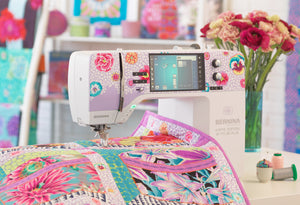

We Love Our Quilting Community
At High Country Quilts we care deeply about community. With our experiences in retail, we know that a store is not only a place to shop but also a place for the community to gather and share. During this busy...


Ever run your hand along a bolt of fabric and noticed those finished edges? The ones that are a little denser, sometimes with tiny holes or printed text? That’s the fabric selvage.
In a nutshell, the selvage is the fabric's built-in safety net. It’s created during the weaving process to keep the material from fraying and unraveling while it's still on the loom and long after.

The name itself, a twist on "self-edge," tells you exactly what it is. As a loom weaves, the crosswise threads (the weft) have to turn around at the end of each row. This turning and looping action interlocks tightly with the long, lengthwise threads (the warp), creating a strong, self-finished band along both sides of the fabric.
This isn't just a happy accident of production. The selvage serves a few key purposes:
For a quilter, that selvage is more than just a throwaway edge. It’s a road map printed right on your fabric. It tells you who made it, what colors are in the print, and most importantly, it shows you the fabric’s grainline—a critical guide for accurate cutting.
To help you quickly identify and understand these edges on your own fabric, here’s a quick summary of what to look for.
| Characteristic | Description | Why It Matters For Quilting |
|---|---|---|
| Texture & Weave | Tighter and denser than the rest of the fabric. May feel slightly stiffer. | This density means it behaves differently—it can pucker or shrink at a different rate, so it's usually removed. |
| Printed Information | Often includes the manufacturer, designer, fabric collection name, and small dots for each color in the print. | The color dots are perfect for matching threads and coordinating fabrics for your project. |
| Tiny Holes | You might see small, evenly spaced pinholes along the edge. | These are from the "tenterhooks" that hold the fabric straight during finishing processes. They don't affect the main fabric. |
| Direction | The selvage always runs parallel to the lengthwise grain (warp threads). | This is your most reliable guide for finding the fabric's grain, which is essential for preventing stretching and distortion in your quilt blocks. |
This table acts as a great cheat sheet when you're at the cutting table, ensuring you always know what you're looking at.
While modern machinery makes creating a selvage look easy, the concept is ancient. Weavers were reinforcing fabric edges by hand as far back as 5000 BC in places like Egypt and Mesopotamia to make everything from clothing to ship sails last longer.
The process became a standard part of textile production with Edmund Cartwright’s power loom in 1785. His invention automated the creation of this self-finished edge, ensuring that the bolts of fabric arriving in shops are stable and ready to use.
If you're curious to learn more, exploring the basics of fabric construction and characteristics can give you a deeper appreciation for how different materials are made and why the selvage plays such an important role.
Think of a fabric selvage as its built-in cheat sheet. Far from being just a throwaway edge, it’s loaded with details that can tell you everything you need to know about the fabric in your hands. Once you learn to read it, you'll have a secret weapon for identifying, matching, and understanding your stash.
First, just run your fingers along the edge. You’ll feel it right away—the selvage is woven much tighter and feels stiffer than the rest of the material. That dense weave is great for preventing frays during manufacturing, but it also behaves differently when washed and sewn, which is why we almost always trim it off. You might also see tiny, uniform pinholes, which are just leftover marks from the tenterhooks that held the fabric straight as it was processed.
The texture is one thing, but the real magic is in the printed information. This is where you get the full story of your fabric’s life, from its creator to its specific color palette.
What usually jumps out first is a series of colorful circles or squares. These are the printer’s registration marks. Each little dot stands for a single color used in the fabric’s design. The manufacturer uses them to make sure every color lines up perfectly during printing.
For us quilters, those color dots are a goldmine. They’re a ready-made color palette, showing you every single hue in the print. It makes finding coordinating solids and blenders for your project completely foolproof. No more second-guessing!
Beyond the color dots, you’ll find a few other critical pieces of information that tell your fabric's story. Keep an eye out for:
Learning to read these details helps you become a more intentional and knowledgeable quilter. You'll be able to hunt down that one "unicorn" print you've been searching for and build a stash that truly works together.
If you want to achieve perfectly square blocks and a quilt that lies flat and beautiful, the selvage is your new best friend. Think of it as the North Star for your fabric's grainline. This tightly woven, self-finished edge always runs parallel to the lengthwise grain—the strongest, most stable direction of your fabric with the least amount of stretch.
When you align your pattern pieces with this grain, you're setting yourself up for success. It’s the secret to ensuring your quilt blocks won’t stretch out of shape, warp, or go wonky during sewing or after a trip through the wash. For precision quilting, cutting on-grain isn't just a suggestion; it's a golden rule.
Take a closer look at the selvage, and you’ll see it’s a little map printed right on the edge of your fabric.

As you can see, it often tells you the designer, the collection name, and even shows all the coordinating colors used in the print. It's a handy cheat sheet for matching fabrics!
Think about building a house. If the frame is warped, the entire structure will be unstable from the start. Fabric works in a very similar way. The lengthwise grain (running parallel to the selvage) has almost no give, making it the perfect foundation. The crosswise grain has a bit of stretch, and the fabric's bias grain, which runs at a 45-degree angle to the selvage, has the most stretch of all.
Cutting with the grain gives you stronger, more stable seams, prevents your projects from sagging over time, and delivers that professional, high-quality finish we all strive for. It’s the single most important first step.
This isn’t just a rule for quilting cottons, either. The strength of the selvage is critical across the entire textiles industry. In the industrial fabrics sector, a market valued at a whopping USD 155.13 billion in 2023, those reinforced edges are essential for preventing fraying under extreme stress.
For example, the selvage on automotive fabrics has to withstand 20-30% higher tensile forces than the rest of the material. So, when you’re working on your next project, remember that a clean, sturdy selvage is a sign of a well-made fabric that’s ready to perform, whether it's destined for a car seat or your beautiful quilt.
Sooner or later, every quilter holds up a beautiful piece of fabric and asks the same question: "Do I really need to trim the selvage off?" It feels like a waste to cut away even a tiny bit of that precious print.
But as a general rule, my answer is almost always yes, trim it off. This isn’t just some fussy, old-fashioned advice; it's a practical step that will save you a lot of headaches down the road.
The selvage is woven much more tightly than the rest of the fabric. Think of it like the hard, stiff binding on a book compared to the flexible pages inside. If you stitch that dense edge into your quilt top, it's going to behave differently than the rest of your block, especially after washing. It often shrinks at a different rate, which leads to unsightly puckering and can throw your perfectly aligned seams out of whack.
On top of that, its thickness can make getting an accurate quarter-inch seam a real challenge. Your presser foot might not sit flat, and your needle can even get pushed slightly off course, ruining the precision that piecing relies on.
Now, like any good rule in quilting, this one is sometimes meant to be broken. There are a few specific times when leaving the selvage on is perfectly fine and can even be a smart move.
The key is to remember this: if the selvage is going to be caught inside a seam on your quilt top, cut it off. If it’s going to live on an outer edge that won't be sewn to another piece, you can probably leave it.
Once you get the hang of it, deciding what to do becomes second nature. To make it easier, let's break down the most common scenarios.
This quick table breaks down when it's best to remove the selvage and when you can safely leave it be. Consider it your cheat sheet for making the right call on your next project.
| Project Type | Recommendation | Reason |
|---|---|---|
| Quilt Blocks | Always Remove | The dense selvage will cause puckering and throw off your seam allowance when pieced into a block. |
| Quilt Backing | Can Keep | If the selvage is on the very outside edge of the backing, it adds stability and prevents fraying before you bind it. |
| Long Borders | Can Keep | For single-strip borders, the selvage can act as a finished outer edge for the quilt top, keeping it stable. |
| Selvage Projects | Keep | In projects designed to feature selvages (like bags or pincushions), the selvage edge is the star of the show. |
Ultimately, understanding how the selvage behaves is what matters most. By removing it for piecing and strategically keeping it for outer edges, you ensure your finished quilts look flat, professional, and beautiful for years to come.

After you've carefully trimmed the selvage from your yardage, hold on before you toss those colorful strips into the bin! For many quilters, these aren't scraps; they're treasures. It’s common to see a "selvage jar" or basket right next to a cutting mat, slowly filling up with these little reminders of past projects.
Using your selvages is a wonderful way to honor the beautiful fabrics you've invested in. Instead of waste, you get a whole new source of inspiration for small, fun projects that are packed with character.
The best part about crafting with selvages is that it's low-pressure and incredibly satisfying. You don't need a complex pattern to make something truly special.
Here are a few ideas to get you started:
Denim selvages, with their distinctive weave, are especially sought after. Creative shops like High Country Quilts even teach classes on incorporating these rugged edges into quilt backs or sturdy tote bags. It's a growing trend—crafters now repurpose an estimated 5-10% of their denim selvages. This popularity is reflected on sites like Etsy, where sales of accessories made from these scraps have jumped by 25% year over year. You can learn more about the broader denim fabric market and its trends to see why this material is so loved.
Think of your selvage collection as a scrapbook of all the quilts you’ve made. Each little strip carries a memory of a project, and using them gives that memory a new life.
Another brilliant use for these strips is to create your own "made fabric." Just grab a piece of lightweight muslin or interfacing to use as a foundation and start sewing your selvage strips onto it, side-by-side.
Once your foundation is covered, you have a brand-new, scrappy textile! You can then cut into this piece just like regular yardage to make tote bags, zippered pouches, or even interesting, textured quilt blocks. It’s a fantastic feeling to create a totally unique piece of fabric from bits you would have otherwise thrown away.
Even after you get the hang of the basics, some questions about fabric selvage just keep coming up at the cutting table. Let's tackle some of the most common ones so you can approach your fabric with confidence every single time.
This is a big one, and the short answer is no, you really shouldn't. It’s a good habit to trim the selvage off before you start cutting your pieces.
The selvage is woven much more tightly than the rest of the fabric, meaning it has virtually no "give." It also tends to shrink differently when washed, which can lead to puckering that can ruin all your beautiful work. That dense edge can also make getting an accurate quarter-inch seam a real struggle.
The only time you'd break this rule is if you're making a project specifically designed to show off those colorful strips, like a "selvage quilt."
Think of it like this: sewing a selvage into your quilt block is like adding a strip of stiff cardboard into a soft, flexible blanket. It just won’t behave the same way as the rest of the fabric, causing distortion and tension right where you don't want it.
Almost any woven fabric you buy off a bolt will have a selvage. It’s a natural part of how quilting cottons, denim, linen, and canvas are made on the loom.
However, you won't find a selvage on materials that aren't woven. These are made using entirely different methods.
Keep in mind that pre-cuts, especially fat quarters, often have one or both selvage edges trimmed off. In that case, you’ll have to rely on other clues, like the stretch test, to find the fabric's grain.
Those little colored circles are your secret decoder ring for the fabric! They're actually registration marks from the printing process. Each dot represents one of the ink colors used in the design, and they help the manufacturer ensure every color printed clearly and in the right spot.
For us quilters, they're a goldmine. They show you the exact color palette of the fabric, making it incredibly easy to pick out matching threads or find other fabrics that will coordinate perfectly.
You'll often notice the selvage is plain white or a solid color, even on a busy print. This can happen for a couple of reasons. Sometimes, the threads used to weave that sturdy edge are stronger or thicker, and they simply don't get dyed with the rest of the fabric.
A plain background also makes it much easier to read the important info printed there, like the designer, the collection name, and those handy color dots. Other times, the design itself just doesn't extend to the full width of the fabric on the loom, leaving that little band unprinted.
At High Country Quilts, we believe that knowing your materials inside and out is the first step toward creating something you love. For more expert tips, a stunning selection of fabrics, or hands-on classes, come visit us online and join our creative community
At High Country Quilts we care deeply about community. With our experiences in retail, we know that a store is not only a place to shop but also a place for the community to gather and share. During this busy...

Hi! We’re Adam and Renee Wheaton, the new owners of High Country Quilts! For more than 40 years, we’ve owned and operated vacuum and sewing businesses. Following in Renee’s father’s footsteps after he retired from All Discount Vacuum and Sewing in Colorado...


Leave a comment