

We Love Our Quilting Community
At High Country Quilts we care deeply about community. With our experiences in retail, we know that a store is not only a place to shop but also a place for the community to gather and share. During this busy...


Alright, let's get you set up for your next project! I'm so excited to share our exclusive "Colorado Sunset Stripes" quilt pattern with you. It’s completely free, and I think you'll find it’s one of the most satisfying and straightforward quilts to make. It's a fantastic design whether you're just starting out or have years of quilting under your belt.
Ready to dive in? Go ahead and download your free pattern now!

I like to think of this pattern as a creative launchpad. We designed "Colorado Sunset Stripes" to be a fun, rewarding, and visually striking project that you can tackle with total confidence. The real magic of a striped quilt pattern free from tricky piecing is that it lets you truly play with color and get into the relaxing rhythm of sewing.
This guide will walk you through everything, but first things first: let's get your sewing space ready. Trust me, taking a few minutes to organize your tools before you start cutting makes the whole quilting process so much smoother and more enjoyable.
Before we get to the fun part of choosing fabrics and cutting, let's pull together the basic tools you'll need. A well-prepped station is your first step toward a beautiful quilt.
This free striped quilt pattern is more than just a set of instructions; it’s a canvas for your creativity. Whether you stick to our color palette or go completely rogue with your own, the simple construction is designed to let your fabric choices shine.
Once you’ve got these basics gathered, you’re officially ready for the best part—picking your fabrics and bringing this quilt to life. Let's get started

This is where the real magic happens. Before you make a single cut, let’s talk about the heart of your quilt: the fabric. Choosing a color palette is so much more than just grabbing your favorite shades. It’s about building a mood, creating contrast, and telling a story. And because this striped quilt pattern is free from fussy piecing, it’s the perfect canvas to let your fabric choices sing.
The freedom to play with color is a huge part of what makes quilting so addictive. It's no wonder the U.S. quilting market has blossomed into a $4.5 billion industry, with millions of us finding joy in fabric and thread. If you're curious, you can dive deeper into these quilting trends and market insights and see just how much our community has grown.
First, think about the overall vibe you're going for. Are you aiming for something bold and zippy, or calm and soothing? A high-contrast palette, where you pair very light fabrics with very dark ones, will give you a sharp, graphic look. I love the classic punch of a crisp navy and white or the energy of a bright citrus yellow against a moody charcoal.
On the other hand, you could go for a more blended, watercolor effect with a monochromatic or analogous scheme. Imagine a quilt flowing through every shade of blue, from a pale, misty morning sky to a deep indigo night. Or maybe a warm sunset of soft pinks, corals, and oranges. These low-contrast pulls create such a beautiful, gentle flow.
My Two Cents: Don't get so caught up in color that you forget about value! Value is simply the lightness or darkness of a fabric. A truly successful quilt almost always has a good mix of light, medium, and dark values. It's what gives the design depth and keeps it from looking flat.
Okay, you've pulled a stack of contenders. Now it's time to see how they play together. Lay them all out on a table or the floor, stand back, and squint. Sometimes a fabric that you loved on the bolt just doesn't work once it's in the group.
Here's my go-to trick for checking values:
This simple step strips away all the color and instantly reveals the true values. You might be surprised! Two fabrics you thought were totally different might actually be the same value, meaning they'll blur together in the finished quilt. This little test is your secret weapon for making sure your stripes really pop.
With your fabrics officially selected, the fun continues as you plan the layout. The best part of this free striped quilt pattern is how flexible it is. There are no rules saying your strips have to be a uniform width.
Here are a few ideas to get you started:
Don't rush this part. Auditioning your fabrics and playing with the layout is where your creative voice really comes through and makes the quilt entirely your own.
Alright, with your beautiful fabrics chosen, it's time to tackle the one step that truly makes or breaks a striped quilt: precision cutting. I can't stress this enough—accurate cutting is the foundation for everything that comes after. It's what gives you a quilt that lays flat and has those satisfyingly perfect points where your seams meet.
Let's put an end to guessing how much fabric to buy or wrestling with wonky strips. We’re going to get this right from the start.
Before you even think about unfolding your rotary cutter, let's talk yardage. There is nothing—and I mean nothing—more frustrating than running out of your main fabric halfway through a project. Our free "Colorado Sunset Stripes" pattern includes a handy chart to make sure you have exactly what you need.
This table breaks down how much fabric you'll need for our quilt in several popular sizes. These numbers are based on standard fabric that's 42 inches wide after you trim off the selvages. Use this to determine the yardage and how many 2.5-inch strips to cut for your project.
| Quilt Size | Dimensions | Fabric A (Light) | Fabric B (Medium) | Fabric C (Dark) | Binding | Backing |
|---|---|---|---|---|---|---|
| Crib | 36" x 48" | 3/4 yard | 3/4 yard | 3/4 yard | 1/2 yard | 3 yards |
| Throw | 54" x 68" | 1 1/4 yards | 1 1/4 yards | 1 1/4 yards | 1/2 yard | 4 yards |
| Twin | 72" x 90" | 2 1/4 yards | 2 1/4 yards | 2 1/4 yards | 3/4 yard | 5 1/2 yards |
| Queen | 90" x 108" | 3 1/2 yards | 3 1/2 yards | 3 1/2 yards | 1 yard | 8 1/2 yards |
Just a friendly reminder to always pre-wash and press your fabrics before cutting! This simple step washes out any factory sizing and, more importantly, pre-shrinks the cotton. It's your best defense against puckered seams after you wash the finished quilt.
Now for the fun part. Getting perfectly straight, consistent 2.5-inch strips is non-negotiable for a quilt that looks polished and professional. A single wobbly strip can throw off your entire quilt top. It’s worth taking your time here.
Here’s my tried-and-true method for getting crisp, clean cuts every single time:
A Quick Tip from the Shop: If you find your ruler is slipping around on the fabric (it happens to all of us!), try adding a few transparent ruler grips to the back. They add just the right amount of traction to keep everything locked in place while you cut.
Feeling a bit short on time? Or maybe you just want to skip the cutting and get straight to the sewing machine? The Jelly Roll is your best friend. These are pre-cut bundles containing dozens of perfectly uniform 2.5-inch strips, often from a beautifully coordinated fabric collection.
Using a Jelly Roll is a fantastic shortcut for this free striped quilt pattern (or any other, for that matter!). You can just open the package and start piecing. You’ll still need to buy backing and binding fabric by the yard, but the quilt top is basically ready to go. I often recommend this route for new quilters—it lets you build confidence at the sewing machine without the pressure of mastering rotary cutting on day one. It's all about making the process enjoyable
Alright, let's get to the fun part—turning all those individual fabric strips into a beautiful quilt top. This is where you really start to see the magic happen as your design comes to life. For this quilt, we're going to lean on a fantastic technique called strip piecing. It's a massive time-saver and the secret to getting those perfectly straight, parallel stripes.
Instead of sewing a bunch of tiny squares together, we'll first sew our long fabric strips into larger panels, which quilters call "strip sets." Not only is this method way faster, but it’s also the key to keeping your lines crisp and accurate. This is where all that careful cutting you did earlier really pays off!
The basic workflow is simple and efficient: sew your strips, press the seams, and then cut your finished blocks.

Following this process is the surest way to get accurate blocks and a stunning finished top. Each step builds right on the last one, making assembly smooth and predictable.
First things first, grab your first two strips and place them right sides together, making sure one of the long edges is perfectly aligned. A few pins will help keep everything from shifting while you sew.
Now, take them to your machine and sew along that pinned edge with a consistent quarter-inch seam allowance.
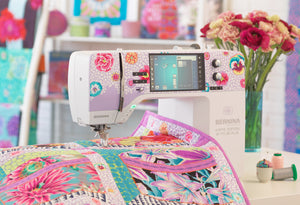
If you have a quarter-inch foot for your machine, now is the time to use it. A good one, like the feet available for BERNINA machines, acts as a physical guide and takes all the guesswork out of maintaining that perfect seam. It makes a huge difference.
Once that first seam is stitched, head to your ironing board. Open up the two strips and press the seam allowance to one side. I almost always press toward the darker fabric to make sure it doesn't shadow through the lighter one. Now, just add the third strip to your growing set, sewing and pressing the same way. Keep going until you’ve built all the strip sets your pattern calls for.
A Game-Changing Tip for Flat Seams: As you make your strip sets, try alternating the direction you press the seams. For example, press all the seams in the first strip set to the left. For the second strip set, press them all to the right. This little trick is my secret weapon—it helps the seams "nest" together later, giving you unbelievably flat junctions and perfectly matched points.
With your strip sets all sewn and pressed, it’s time to cut them down into the blocks that will make up your quilt.
Lay a strip set on your cutting mat. The first thing you'll want to do is trim one end to create a clean, straight starting edge. Now, from that squared-up edge, you can measure and cut your blocks. So, if the pattern calls for 8.5-inch blocks, just line up the 8.5-inch mark on your quilting ruler with the clean-cut edge and slice. Continue cutting segments down the length of the strip set until you have all the blocks you need.
This method of strip piecing isn't new; it has deep roots in quilting history. It’s the same efficient thinking that gave us beloved 19th-century designs like the Rail Fence and Log Cabin, which made quilting more accessible to everyone. Striped patterns, often shared freely among makers, are a huge part of America’s quilting heritage, and their classic appeal is stronger than ever. In fact, Etsy’s quilt sales saw a 30% jump year-over-year recently! You can learn more about the enduring popularity of quilt markets and classic patterns and how they continue to thrive.
This is the final and most satisfying moment of piecing—putting it all together.
Lay out your blocks on a design wall or a big, clean patch of floor. This is your chance to play! Move the blocks around until you love the flow of colors and patterns. Take a picture with your phone once you're happy so you don't forget the layout.
Now, it’s time to sew the blocks into rows. Working one row at a time, pick up the blocks in order and stack them. Sew the first two blocks together, then add the third, and keep going until the row is complete. Press all the seams in this row in one direction.
For the very next row, press the seams in the opposite direction. Remember that pressing trick from earlier? This is the payoff! When you go to sew your rows together, those opposing seams will nestle right into each other, almost locking in place. It makes matching your stripes a total breeze. Pin at each seam intersection to keep things extra secure.
Sew your rows together, one by one, and watch as your gorgeous striped quilt top finally comes together. It’s a fantastic feeling

Congratulations, your quilt top is done! That's a huge accomplishment. Now, let's take that beautiful piecing and turn it into a real-deal quilt that's ready for snuggling. This part of the journey is all about the finishing work: basting, quilting, and binding.
First things first, we need to make a "quilt sandwich" by basting your top, batting, and backing fabric together. A quilt that's basted well won't shift or pucker while you're quilting it, which is the secret to getting a smooth, professional-looking finish. Your method really comes down to personal preference and the size of your project.
Every quilter seems to have their favorite basting technique. I’ve tried them all over the years, and I definitely recommend experimenting to see what works best for you.
A common mistake I see is skimping on the basting. Whether you use pins or spray, be generous! I always tell my students that you should be able to place your hand anywhere on the quilt top and feel a pin. This is what prevents those frustrating puckers from forming on the back.
This is where the magic really happens. The quilting itself adds so much texture and brings your design to life. Since you're working with our striped quilt pattern free of tricky piecing, simple and clean quilting lines often look the most striking.
One of the easiest and most effective approaches is "stitching in the ditch." Using a walking foot on your machine, you simply stitch right in the existing seams between your fabric strips. This is a fantastic choice if you're new to quilting; it's very forgiving and really makes those clean, linear stripes pop.
Another great option is to echo the seams with straight-line quilting. You can quilt a quarter-inch away from each side of every seam, creating a subtle "frame" for your stripes. It adds a lovely texture and is a great way to get comfortable using your walking foot. Once you feel more adventurous, you can even explore free-motion quilting to add some curvy waves or loops for contrast.
The very last step is adding the binding—a fabric frame that encases the raw edges for a durable and polished look. Before you do anything else, you'll want to trim your quilted sandwich so all the edges are perfectly straight and the corners are squared up.
For a throw-sized quilt, you'll generally need to cut five or six 2.5-inch strips of fabric. Sew them together end-to-end to create one long strip, then press it in half lengthwise. This is your binding.
Next, align the raw edge of your binding with the raw edge of your quilt top. Sew it on with a quarter-inch seam allowance, mitering the corners as you go. To finish, just wrap the folded edge of the binding around to the back of the quilt and stitch it down. You can do this by hand for a nearly invisible finish or by machine if you want extra durability. This final touch is what truly completes your quilt.
Every quilt, no matter how simple it seems, has its own little quirks and questions that pop up along the way. Even with a straightforward striped quilt pattern free from tricky piecing, you might hit a snag. Let's walk through a few of the most common issues I see so you can keep your project humming along.
The biggest culprit I hear about? A wavy quilt top that refuses to lie flat. More often than not, this is because the fabric strips got stretched, either during sewing or while pressing. The best way to avoid this is to let your sewing machine do the heavy lifting—don't push or pull the fabric through. Let the feed dogs guide it naturally. When you press your seams, make it a simple up-and-down motion with the iron instead of sliding it back and forth.
My Go-To Trick: A little spray starch or sizing before you even make your first cut is a total game-changer. It gives the cotton just enough stability to resist stretching, which leads to perfectly flat and accurate strip sets. It makes a huge difference.
Oh, the satisfaction of getting those stripes to match perfectly when joining rows! The secret is all about nesting your seams and not being shy with your pins. Because you pressed the seams in opposite directions, the seam allowances should snuggle right up against each other where the rows meet.
Stick a pin directly into that nested seam to lock it in place. I like to add pins or quilting clips every four to six inches along the entire length of the row to prevent any sneaky shifting. A walking foot is your best friend here, too—it ensures the top and bottom fabric layers feed through your machine evenly.
You bet! In fact, this pattern is absolutely fantastic for turning that overflowing scrap bin into a stunning, unique quilt. It's the perfect way to give new life to all those beautiful fabrics you couldn't bear to part with.
Here’s how I approach a scrappy version to make it look intentional:
The result is a quilt that’s bursting with personality and texture. No two will ever be the same.
Here at High Country Quilts, we know every project is a chance to grow your skills. For more inspiration, our favorite tools, and a community of fellow quilters, come say hello over at High Country Quilts.
At High Country Quilts we care deeply about community. With our experiences in retail, we know that a store is not only a place to shop but also a place for the community to gather and share. During this busy...

Hi! We’re Adam and Renee Wheaton, the new owners of High Country Quilts! For more than 40 years, we’ve owned and operated vacuum and sewing businesses. Following in Renee’s father’s footsteps after he retired from All Discount Vacuum and Sewing in Colorado...


Leave a comment