
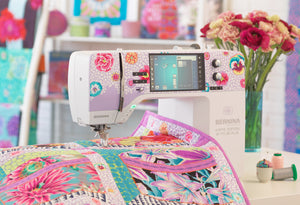

We Love Our Quilting Community
At High Country Quilts we care deeply about community. With our experiences in retail, we know that a store is not only a place to shop but also a place for the community to gather and share. During this busy...


The Starburst quilt block is one of those classic, eight-pointed star patterns that just pops. It’s built from a series of diamonds that radiate outwards, creating a real sense of energy and movement. It looks intricate, but don't let that fool you—it's a fantastic way to sharpen your skills, especially if you're ready to tackle diamond piecing.

There's a reason the Starburst block has stuck around for so long. It has a visual punch that’s hard to beat and a history that quilters appreciate. While other star blocks are beautiful, the Starburst seems to burst from the center, immediately drawing your eye and holding your attention.
It’s a design with deep roots in American quilting, popping up as a bold variation of the classic eight-pointed star in the late 19th century. One of my favorite historical examples is a stunning quilt from Pennsylvania, dated around 1870, made with a wild assortment of period fabrics. The way the small diamonds are arranged in bands gives it that signature explosive feel. You can see pictures and learn more about this incredible piece of history over at Stellarubin.com.
Looks aside, the Starburst is an incredible project for leveling up your quilting game. It’s the perfect introduction to working with diamond shapes and their tricky bias edges. Once you get the hang of this block, your confidence will soar.
Here’s what makes it such a great learning experience:
Tackling a Starburst block teaches you more than just a pattern; it teaches you control, precision, and the rewarding feeling of seeing intricate pieces come together perfectly.
In this guide, I'll walk you through everything, step-by-step, so you can create your own beautiful Starburst quilt block without any of the headaches.

Before you even think about making that first cut, let’s talk about setting yourself up for success. Taking a few minutes to gather the right gear can be the difference between a fun afternoon of sewing and a frustrating pile of mismatched points.
Your absolute must-haves are a sharp rotary cutter, a good self-healing mat, and a clear acrylic ruler. This trio is the foundation of accurate piecing. Without them, getting those crisp, clean cuts needed for a sharp starburst block is nearly impossible.
And here's a little tip I swear by: always start with a fresh blade in your cutter. A dull one will drag and pull at your fabric, especially on the bias edges of the diamonds, and you'll end up with wonky pieces that just won't play nicely together.
While the basic trio will get the job done, a few extra tools can make piecing these diamond shapes so much easier. If you plan on making more than one of these blocks, a 60-degree diamond ruler is a total game-changer. It has the angle built right in, so you can forget about guesswork and be confident that every single diamond is cut perfectly. It’s a huge improvement over trying to line up a standard ruler.
Here are a couple of other things I like to have handy in my own sewing space:
This is the fun part! Choosing your fabrics is where the starburst block really starts to shine. The whole "burst" effect comes down to two things: color and value. You need to create good contrast between the fabric you use for the star points and what you choose for the background.
A super simple trick I use all the time is to take a black-and-white photo of my fabric choices with my phone. This little hack instantly reveals the value (the lightness or darkness) of each fabric. If they all blur into the same shade of gray, your star points are going to get lost.
You could create a really stunning ombre effect by picking fabrics from the same color family that go from light to dark, which gives the star a beautiful, radiant look. Or, you could dive into your scrap bin and make a scrappy starburst for a block that’s buzzing with energy and personality.
My Two Cents: Whether or not to pre-wash fabric is a hot debate among quilters, but for a high-contrast project like this, I always do it. It helps prevent any unfortunate color bleeding in the wash and pre-shrinks the cotton. That way, your block stays perfectly square and beautiful for years to come.
No matter what colors you choose, make sure you calculate your yardage correctly. There’s nothing worse than running out of a fabric mid-project! I always suggest buying a little extra—about a ¼ yard more than you think you’ll need. This gives you a nice safety net for any cutting mistakes or shrinkage.
Any experienced quilter will tell you the secret to a stunning Starburst block isn't what happens at the sewing machine—it's what happens on your cutting mat. Those crisp, perfect points we all chase are born from sharp, accurate cutting. Even a tiny slip of the ruler can throw the entire block out of whack, leading to a whole lot of frustration later.
This guide is designed to help you cut with confidence. Below, you'll find a handy chart with the exact measurements you need for the star's diamond points and the background pieces. Whether you're tackling a tiny 6-inch block or going bold with a 12-inch one, we've got you covered.
Before your rotary cutter even touches the fabric, take a moment to double-check your ruler. Accuracy is everything here. A good quilting ruler with clear markings, especially for those pesky 1/8 and 1/4 inch lines, will be your best friend.
| Fabric Piece | 6-inch Finished Block (Cut Size) | 9-inch Finished Block (Cut Size) | 12-inch Finished Block (Cut Size) |
|---|---|---|---|
| Star Diamonds | Cut 8 diamonds from a 2" strip | Cut 8 diamonds from a 2¾" strip | Cut 8 diamonds from a 3½" strip |
| Background Triangles | Cut 2 squares 3⅞" x 3⅞", then cut diagonally twice to get 8 triangles | Cut 2 squares 5⅜" x 5⅜", then cut diagonally twice to get 8 triangles | Cut 2 squares 6⅞" x 6⅞", then cut diagonally twice to get 8 triangles |
These measurements all include a standard ¼-inch seam allowance, so your finished block will come out to the perfect size.
One of the biggest hurdles with diamonds is the bias edge. Since these edges are cut at a 45-degree angle to the fabric's grain, they have a natural stretch that can easily get distorted. If you pull or handle them too roughly, your perfectly cut pieces can quickly turn into warped, wavy messes.
Here are a few tips I've learned over the years to keep those bias edges in line:
For projects where precision is non-negotiable, marking your fabric can be a lifesaver. Before you can accurately cut or stitch, it helps to know how to transfer designs onto fabric to ensure every piece aligns just right.
Stick to these guidelines, and you’re setting yourself up for a much smoother sewing experience. Your pieces will fit together like a puzzle, creating the sharp, professional points that make the Starburst block so spectacular. Trust me, the time you invest in careful cutting now will pay off tenfold when you finally sit down to sew.
Alright, with all your fabric pieces neatly cut, it's time for the magic to happen. This is where we take those individual diamonds and triangles and turn them into a stunning, radiant star. We'll build this block in a few simple stages, making sure every point stays sharp and every seam lines up just right.
The whole process boils down to a pretty straightforward workflow. First, you'll sew diamonds into pairs. Then, you'll join those pairs to make four quarters of the star. Finally, we'll add the background triangles to square it all up.
This chart lays out the cutting dimensions we discussed, which is the foundation for a smooth assembly. Getting this part right is half the battle.

As you can see, accuracy right from the first cut is what makes the final block come together without a hitch.
Let's start by creating the eight individual points of the star. Grab two of your diamond pieces and place them right sides together. You'll notice immediately that the ends don't line up perfectly—and that's exactly how it should be!
The trick is to align the edges so the little points sticking out (we call them "dog ears") are offset by ¼ inch at both ends. This little offset is the secret sauce for getting perfectly sharp points when you open up the unit.
Sew along the edge using a scant ¼-inch seam allowance. A scant seam is just a hair smaller than a true ¼ inch, which gives your fabric just enough room to fold over without throwing off your final measurements. Go ahead and sew all eight of your diamond pairs.
How you press your seams is every bit as important as how you sew them. For these initial diamond pairs, I'm a firm believer in pressing the seams open. This simple step helps distribute the fabric bulk, which makes a huge difference in getting the center of your star to lie nice and flat later on.
First, set the seam with a hot, dry iron by pressing it just as it was sewn. Then, gently use your fingers to open the seam before giving it a final, crisp press with the iron. Remember to press up and down—don't drag the iron, as that can easily stretch these bias edges out of shape.
Now that you have eight finished diamond pairs, it's time to create the four quadrants of your star. Take two of your pressed pairs and place them right sides together.
This is your first major intersection, so pay close attention to nesting that center seam. The two seams should butt up against each other snugly. I like to stick a pin directly through the intersection to make sure nothing moves an inch. Sew along the edge, again with your scant ¼-inch seam, and repeat to make four quadrants total.
Here's a little pro-tip: For these quadrant units, I change my pressing strategy. Instead of pressing open, I press the seams to one side. I'll press two with the seam going clockwise and the other two counter-clockwise. This trick is an absolute game-changer when it comes to nesting the final center seams.
Take two of your quadrants—one pressed clockwise, one counter-clockwise—and join them to create a half-star. Because you alternated the pressing direction, you'll feel those center seams lock right into place. It’s one of the most satisfying feelings in quilting and the key to a sharp center point.
Sew the two halves together, pinning carefully at the center. Once you have two star-halves, you'll join them using the exact same method. Pin that final, bulky center intersection securely, and sew the last seam. Unfold it, and you've got a complete eight-point star!
The final piece of the puzzle is adding the background triangles to turn your star into a perfect square. Grab four of the large corner triangles. Align the long edge of a triangle with one of the straight sides of your star, right sides together.
You'll notice the triangle's points hang over the star points a little. Just center the triangle so the overhang is even on both sides, pin it down, and sew. Press these seams toward the background fabric to reduce bulk.
Once you’ve attached the first four triangles, attach the final four small triangles to the diagonal sides in the same way. Give it one last, good press, and your Starburst block is officially complete
Even with the best instructions, quilting has a way of keeping us on our toes. The Starburst block, with all its precise points and angles, is no exception. Let's walk through a few of the most common hiccups you might encounter and share some tricks I've learned over the years to make your blocks truly shine.
One of the first things you’ll notice is the center, where all eight of those diamond points come together. It can get bulky in a hurry. If your block has a little "mountain" in the middle and refuses to lie flat, don't worry—there's a classic trick for that.
The secret is a technique called spinning the center seams. Once you've sewn that final seam bringing the two halves of the block together, take your seam ripper and carefully pick out just a few stitches right at the very center.
This tiny opening is all you need. It allows you to press the seam allowances open in a circular, pinwheel-like pattern on the back. That little maneuver distributes the bulk, and your block will suddenly lie perfectly flat, making it a dream to quilt later on.
Another frequent frustration is when your star points don't quite meet or look a little blunt. The usual suspect here is fabric stretching along the bias edge of those diamonds.
The star quilt block is a true cornerstone of quilting history, with its origins tracing all the way back to the 18th century. Classic designs like the LeMoyne Star and the Sawtooth Star set the stage for patterns like our Starburst, becoming iconic quilt motifs by the mid-1800s. You can dive deeper into the fascinating history of star quilts over at the State Historical Society of North Dakota.
Once you've got the hang of assembling a single block, you can really speed things up with chain piecing. This is one of the best habits a quilter can develop.
Instead of sewing a single diamond pair, cutting the thread, and then starting the next one, just feed them through your machine one after another. Sew the first pair, but don't lift the presser foot or cut the thread. Simply guide the next pair right up to the needle and keep sewing.
You'll create a long "chain" of all your diamond pairs in a fraction of the time. When you’re done, you can snip them apart. This method is a massive time-saver, but it also conserves thread and helps you fall into a steady rhythm, which almost always results in more accurate sewing.
Making a single, perfect Starburst block feels fantastic, doesn't it? But the real magic starts when you imagine them all coming together. This is where your quilt’s personality truly comes to life, and even small changes in layout can create a dramatically different look.
The most straightforward approach is a simple grid, where you just sew the blocks side-by-side. It’s a classic for a reason—it lets each star be the hero. But if you want to dial up the drama, try an on-point setting. Turning each block 45 degrees creates a stunning diamond pattern, and you'll be amazed at the cool secondary designs that appear in the empty spaces between them.
Think back to the fabrics you chose, because they're about to take center stage. If you went with a scrappy look, your finished quilt will have a vibrant, eclectic energy. Each block will be its own little treasure, telling a story with different prints and colors. It's a look that feels both timeless and wonderfully spontaneous.
On the other hand, a two-color Starburst quilt is all about graphic impact. Imagine crisp white stars against a deep navy background—it's modern, bold, and incredibly striking. This minimalist approach really highlights the clean, geometric beauty of the Starburst design itself.
It's also worth remembering the star motif carries deep cultural roots. The eight-pointed star in our Starburst is central to Native American star quilt traditions, where it often symbolizes the Morning Star. Quilting was introduced to Sioux and Assiniboine women by missionaries in the 1880s, providing a new way to express traditional designs after U.S. military campaigns decimated the buffalo herds, making the creation of painted robes impossible. You can dive deeper into this rich history over at The Confident Stitch.
Want to give your stars a little breathing room? Try adding sashing—strips of fabric sewn between each block. Using your background fabric for the sashing creates a clean, cohesive grid. Or, you could use a pop of contrasting color to frame each Starburst and make it stand out even more.
Another fantastic trick is to alternate your Starburst blocks with simple, plain squares of fabric. This is a great way to stretch your fabric supply, but it also gives the eye a place to rest, which makes the detailed Starbursts pop. You get a beautiful rhythm across the quilt, almost like a checkerboard, and it lets you control the "busyness" of the design to make it completely your own.
Here at Famcut.com, we love seeing quilters bring their creative visions to life. For all your fabric, tool, and notion needs, visit us at https://famcut.com to get started on your next masterpiece.
At High Country Quilts we care deeply about community. With our experiences in retail, we know that a store is not only a place to shop but also a place for the community to gather and share. During this busy...

Hi! We’re Adam and Renee Wheaton, the new owners of High Country Quilts! For more than 40 years, we’ve owned and operated vacuum and sewing businesses. Following in Renee’s father’s footsteps after he retired from All Discount Vacuum and Sewing in Colorado...


Leave a comment