
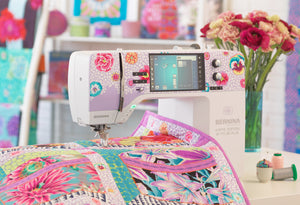

We Love Our Quilting Community
At High Country Quilts we care deeply about community. With our experiences in retail, we know that a store is not only a place to shop but also a place for the community to gather and share. During this busy...


I’m so excited to share this split rail quilt pattern free with you. It’s one of my all-time favorites for a reason—it’s quick, incredibly satisfying, and the perfect way to make a big impact without a lot of fuss. Whether you're looking to burn through your fabric stash or show off a brand-new jelly roll, this pattern is for you.

The Split Rail is a true classic, loved by quilters everywhere for its rustic charm and deceptive simplicity. It’s one of those patterns that looks intricate from a distance but is surprisingly easy to piece together, making it a wonderful project for quilters of all skill levels.
If you’re just getting started on your quilting journey, it can be helpful to get a feel for the basics. For a great overview of what goes into making a quilt from start to finish, check out this fantastic guide on What Is a Quilt. Knowing the fundamentals will give you more confidence as you start cutting and sewing.
To give you a quick overview of what makes this pattern so special, here’s a look at its key features.
| Feature | Description | Benefit for Quilters |
|---|---|---|
| Beginner-Friendly | Made entirely of straight-line seams and simple blocks. | Builds core skills like cutting, piecing, and pressing without tricky points to match. |
| Speedy Assembly | Perfect for strip piecing with 2.5-inch strips (jelly rolls). | You can assemble a quilt top much faster than with traditional block-by-block methods. |
| Versatile Design | The layout creates dynamic diagonal movement with endless color possibilities. | Works beautifully with scraps, curated bundles, or solids for modern or traditional styles. |
As you can see, it’s a powerhouse pattern that delivers impressive results with straightforward techniques.
This beautiful design is a variation of the Rail Fence pattern, and it gets its name from the old split-rail fences you see crisscrossing the countryside. There’s something special about knowing that every stitch connects back to that piece of history.
At its heart, this pattern is all about strip piecing. It’s designed to work perfectly with pre-cut 2.5-inch jelly roll strips, which really speeds things up. Because it relies on straight seams and a consistent ¼-inch seam allowance, you’ll find it’s incredibly forgiving. In fact, many quilters find that patterns like this can reduce matching errors by up to 90% compared to designs with complex angles or curves.
The real magic of the Split Rail is how it looks so complex and dynamic, yet it’s built from the simplest technique in quilting: sewing straight lines.
This is a fantastic confidence-booster. The repetition of sewing strips helps you dial in your seam allowance and perfect your pressing, two skills that will make every future project better.
A Split Rail isn’t just a quilt; it’s a blank canvas. Its simple construction opens it up to so many creative uses beyond just a bedspread.
Ready to get started? You'll find the link below to download your split rail quilt pattern free printable. Let’s grab our fabric and make something wonderful.
Every beautiful quilt starts well before you ever sit down at your sewing machine. The secret to a smooth project lies right here, in choosing your fabrics and making those first precise cuts. Getting this part right sets you up for success and makes the whole process so much more fun.
Think of picking your fabric like putting together the perfect outfit. You want colors and patterns that work together to tell a story. You could go for a bold, high-contrast look that really pops, or maybe a softer, more muted palette for something cozy and traditional.
The Split Rail design is fantastic because it works with almost anything. It’s a perfect candidate for those pre-cut 2.5-inch strip bundles (jelly rolls), which is a huge time-saver since the color palette is already sorted for you.
But this is also one of my favorite patterns for "shopping" my own stash. If you're pulling from your collection, I’ve found the key is to group your fabrics by value: light, medium, and dark. It's this contrast that makes the "rails" stand out and gives the quilt that wonderful sense of movement. Don't stress about finding perfect matches—some of the most stunning quilts come from surprising combinations!
Working out yardage can feel like a chore, but it’s a necessary one. To make it easy, we've put together this simple chart that breaks down what you'll need for several common quilt sizes, assuming you're working with four different colors.
| Quilt Size | Dimensions (Approx.) | Yardage Per Color (4 Colors) | Total Strips Needed |
|---|---|---|---|
| Baby / Crib | 40" x 50" | 1/2 yard | 48 |
| Lap / Throw | 50" x 65" | 3/4 yard | 80 |
| Twin | 70" x 90" | 1 1/2 yards | 168 |
| Queen | 90" x 108" | 2 1/4 yards | 288 |
These amounts are a solid starting point. I always recommend grabbing an extra 1/4 yard of each color, just in case. It's a little insurance against a miscut or fabric shrinkage after pre-washing.
Free Split Rail patterns like this one have become a quilter's staple. For a generous twin-size top, around 72 x 88 inches, you're looking at about 1.75 yards per color. This pattern is also a fantastic way to use up scraps, which is a big win for sustainability—it's no surprise that over 60% of us are trying to create more with less waste. We've even seen its forgiving nature make it a hit in the cosplay community, where satisfaction with free, adaptable tutorials often tops 90%. If you're curious, you can learn more about the history of rail fence blocks and get even more inspired.
Okay, let's get ready to cut. For the clean, straight 2.5-inch strips this quilt is built on, you really need three key tools: a rotary cutter, a self-healing mat, and a long acrylic ruler. Trust me, these are non-negotiable for getting accurate results.
Our goal is simple: consistency. Every single strip needs to be 2.5 inches wide. Take a deep breath and go slow here—the accuracy you achieve now will save you a world of frustration when it's time to piece everything together.
First, you need to square up your fabric. Fold your yardage neatly so the selvage edges line up, then use your ruler and rotary cutter to trim one side for a perfectly straight starting edge.
From that clean edge, you can now start cutting your 2.5-inch strips across the width of the fabric (WOF). Keep your ruler steady and your eyes on the measurement line. Once your pile of strips is ready, the real fun begins—it’s time to sew
Alright, with all our fabric neatly cut, it's time for the fun to really get started. This is where you'll see those individual strips of fabric come together to form the building blocks of your quilt. We're going to create what quilters call "strip sets" and then slice them up into perfect little blocks.
The key to this whole process is a consistent ¼-inch seam allowance. I can't stress this enough! If your seams are off, even by a little bit, your finished blocks won't be the right size, and lining them up later can become a real headache. If you're feeling a bit rusty, just grab a couple of scraps and sew a few practice seams. It’s worth taking a minute to get it right.
All the careful prep work you did—choosing fabric, measuring, and cutting—is what makes this stage go smoothly.

Think of it this way: a good foundation makes for a strong house, and it's the exact same with quilting.
First up, we'll sew our long 2.5-inch strips together into sets of three. Go ahead and grab one strip from each of your fabrics—your light, medium, and dark, for example.
Place your first two strips (let's say the light and medium) with their right sides facing each other. Line them up along one of the long edges as perfectly as you can. I like to use quilting clips to keep them from shifting, but pins work great, too. Now, sew along that long edge using that scant ¼-inch seam allowance we talked about. Just let the machine do the work; guide the fabric gently and avoid pulling or stretching it.
Once you’ve sewn that first seam, take your third strip (the dark one) and place it right sides together with the open edge of the medium strip. Sew this seam exactly the same way. That's it! You've just made your first strip set. Keep doing this until you've sewn all your strips into these three-rail units.
Pro Tip: Embrace Chain Piecing Want to speed things up? Try chain piecing. Once you finish sewing a seam on one pair of strips, don't cut the threads. Just feed the next pair of strips right up to the needle and keep on sewing. You'll end up with a long chain of sewn pairs that you can snip apart all at once. It's a huge timesaver.
Now for a crucial step that many beginners overlook: pressing. And I do mean pressing, not ironing. A good press sets your stitches and makes your blocks lie beautifully flat. For a Split Rail, here’s a tip that will save you a lot of grief: press your seams toward the darkest fabric. This keeps the darker seam allowance from peeking through your lighter fabrics.
Here’s my method for a perfect press every time:
Taking the time to press properly now makes everything that comes next so much easier. Your seams will "nest" together nicely when you join the blocks, reducing bulk and making your points match up like a dream.
With your strip sets all sewn and perfectly pressed, it's time to chop them up into blocks. This is just like when you cut your initial strips—accuracy is your best friend.
Lay a pressed strip set on your cutting mat. The first thing you'll want to do is use your rotary cutter and ruler to trim off one of the short ends. This gives you a clean, perfectly square edge to measure from.
Now you're ready to cut your blocks. Since you started with three 2.5-inch strips, your sewn strip set should now measure 6.5 inches wide (after accounting for the two seam allowances). So, you're going to cut this wide strip into 6.5-inch segments. Every slice will give you a perfect 6.5" x 6.5" square block.
Just keep cutting 6.5-inch segments down the entire length of the strip set. Do this for all of your strip sets, and before you know it, you'll have a gorgeous, satisfying stack of Split Rail blocks, all ready for arranging into your quilt top.
With a beautiful stack of finished blocks ready to go, you're at my favorite part of any quilting project: the design phase. This is where the magic really happens. It’s incredible to see how simply turning a block can completely transform the entire look of a quilt. That’s the true power of the Split Rail.
Before you even think about sewing your rows together, you need to audition your layout. Trust me on this one—it’s a step you absolutely can't skip. Laying out all your blocks on a design wall, a clean patch of floor, or even a spare bed lets you stand back and see the full picture. It’s your chance to play, shuffle things around, and fall in love with your design before making that final commitment.

Taking a moment to do this now will save you from any "what was I thinking?" moments later. It helps you spot any colors that are clustering awkwardly or patterns that just aren’t flowing. A great trick is to snap a few photos with your phone; seeing the layout in a small picture can give you a surprisingly fresh perspective.
The humble Split Rail block is a design powerhouse. Just by rotating your blocks 90 degrees, you can create anything from a classic stair-step to a bold chevron. Let's look at a couple of the most beloved arrangements.
1. The Zigzag or Chevron This is probably the most iconic Split Rail design, and it’s remarkably simple to pull off.
2. The Stair Step or Barn Raising This layout creates a more structured, geometric feel, almost like a Log Cabin quilt block that has grown to take over the whole quilt.
The real joy of a split rail quilt pattern free of charge is the freedom it gives you to play. There’s no right or wrong answer here—the best layout is simply the one that makes you smile.
If you lean more towards a contemporary or improvisational style, the Split Rail block is the perfect playground. Sometimes, the most stunning quilts come from breaking the rules entirely.
The Scrappy Field This approach is all about creating controlled chaos and is perfect if you’ve used a ton of different fabrics.
Don't forget that how you place your colors is just as important as how you turn your blocks. The "value" of your fabric—its relative lightness or darkness—is what really makes a pattern pop.
Here are a few ideas to get you started:
Give yourself permission to really spend time at this stage. It’s a low-effort step with a huge payoff, transforming a simple project into something truly special. Once you’ve landed on a layout you love, carefully stack your blocks row by row (label them!), and you're finally ready to sew your quilt top together.
All that careful cutting and piecing has paid off—you've got a beautiful quilt top. Now for the really fun part: turning that flat piece of art into a cozy, three-dimensional quilt you can actually use. This is where the magic happens, giving your quilt its texture, warmth, and that professional, polished look.
The first thing we need to do is build our "quilt sandwich." It's just what it sounds like: your backing fabric, the fluffy batting in the middle, and your quilt top. Getting this layered up smoothly is the secret to avoiding those frustrating puckers on the back later on.
You’ll want a big, clean space for this—I usually clear off my living room floor. Lay your backing fabric down first, wrong side up. Smooth it out completely, then use painter's tape to tape the edges to the floor. You want it taut, but don't stretch the fabric out of shape.
Next, unroll your batting over the backing, smoothing out any wrinkles. Finally, center your gorgeous quilt top over the batting, right side up. Take a few minutes to smooth everything from the center out, making sure all three layers are perfectly flat.
Now, we baste. This is just a temporary way to hold the layers together while you quilt.
Don’t skimp on this step. A well-basted quilt is significantly easier to quilt without shifting. My personal rule is that you can never have too many pins.
With your quilt sandwich secure, you're ready to add the stitches that officially turn it into a quilt.
One of the great things about this split rail quilt pattern free of tricky curves is that the quilting can be just as straightforward. The strong lines of the blocks look fantastic with simple quilting that complements the design instead of competing with it. A walking foot for your sewing machine is non-negotiable here; it's essential for feeding all three layers through evenly.
Here are a few of my favorite quilting approaches for a Split Rail:
A good habit to get into is to start quilting in the middle of the quilt and work your way out. This helps push any extra fabric or fullness toward the edges, giving you a smoother finish.
The final touch is the binding—that neat fabric frame that encloses the raw edges. The first thing you'll do is trim the excess batting and backing flush with your quilt top. A long ruler and a rotary cutter make this quick and precise.
For the binding itself, you'll cut 2.5-inch wide strips of fabric, just like for the blocks. Sew them end-to-end to make one long strip, press it in half lengthwise, and you're ready to go.
Attach this folded strip to the front of your quilt with a ¼-inch seam, mitering the corners as you go for that sharp, professional look. Then, simply wrap the binding around to the back and stitch it down. You can do this by hand for a lovely, invisible finish, or stitch it down by machine.
Once the binding is on, give it a wash. This is my favorite part! The cotton fabric, thread, and batting all shrink up just a little, creating that wonderful, crinkly texture that makes a quilt so inviting. For example, one quilter's stunning 99-block batik Split Rail started as a 72.5 x 88.5-inch top and finished at 70 x 86 inches after washing. That's a typical 3-5% shrinkage, which you can see in this beautiful finished quilt example. This final transformation is the perfect end to your quilting journey.
Even with a beautifully simple pattern like the Split Rail, a few questions are bound to come up as you get sewing. I've been there! Here are a few things I get asked all the time, along with the tried-and-true advice I share with fellow quilters.
This is one of my favorite things about the Split Rail—it’s incredibly versatile. It works just as well for a meticulously planned project as it does for a "use-what-you've-got" quilt.
If you're looking for a quick, coordinated look, a jelly roll is your best friend. These bundles of pre-cut, coordinating 2.5-inch strips take all the guesswork out of fabric selection. You know everything will look great together, which is perfect when you want to get straight to the sewing.
On the other hand, the Split Rail is an absolute dream for busting through your stash. It’s one of the best ways I know to make a dent in that ever-growing pile of leftover 2.5-inch strips. The secret to a successful scrappy version is to mind your fabric values. Before you start, sort your strips into light, medium, and dark piles. Keeping that contrast strong within each block is what gives the quilt its classic dimension and stops the colors from turning to mud.
Ah, the wavy seam. This is a super common hiccup, especially when you're piecing long strips together. Almost every time, the issue comes down to the fabric getting stretched, either at the machine or on the ironing board.
When you're feeding those long strip sets through your machine, let the feed dogs do all the work. Your only job is to guide the fabric and keep it from veering off course. It’s so tempting to pull or push it along, but that’s what stretches the bias and creates those frustrating waves.
Your pressing technique is the other half of the equation. Don't slide your iron back and forth like you're scrubbing a floor—that’s a surefire way to distort your fabric. Instead, think "lift and press." Place the iron down on a section of the seam, give it a moment, lift it straight up, and move to the next spot. This sets the seam without warping all your hard work.
A Quick Tip for Stability: If you're working with fabrics that feel a bit shifty or you’re still battling wavy seams, try a light mist of spray starch before cutting. It gives the cotton just enough extra body to behave itself, making your cutting and sewing much more accurate.
This is such a creative idea! The bold, graphic nature of a Split Rail is perfect for cosplay, allowing you to create your own custom "textiles" for a costume.
Think beyond quilting cottons. You could use materials like vinyl, faux leather, or even a heavy twill to piece together a really unique vest, a dramatic cape, or panels for futuristic-looking armor.
Just remember to switch up your tools to match the material.
By piecing together large panels first, you can then lay out your costume pattern pieces and cut them from your unique, custom-made fabric. It’s a brilliant way to add a layer of texture and detail that makes a costume truly stand out.
At Famcut, we're passionate about helping our local Atlanta community bring their creative visions to life. Whether you're quilting a family heirloom or crafting the perfect cosplay, we have the supplies and expertise you need. Find high-quality materials and friendly advice for your next project at https://famcut.com.
At High Country Quilts we care deeply about community. With our experiences in retail, we know that a store is not only a place to shop but also a place for the community to gather and share. During this busy...

Hi! We’re Adam and Renee Wheaton, the new owners of High Country Quilts! For more than 40 years, we’ve owned and operated vacuum and sewing businesses. Following in Renee’s father’s footsteps after he retired from All Discount Vacuum and Sewing in Colorado...


Leave a comment