

We Love Our Quilting Community
At High Country Quilts we care deeply about community. With our experiences in retail, we know that a store is not only a place to shop but also a place for the community to gather and share. During this busy...


So, you’re ready to dive into the wonderful world of sewing! It’s an exciting step. Before you get lost in a sea of amazing fabrics and intriguing gadgets, let's talk about what you really need to get started.
The absolute essentials—the things you can't sew without—are a reliable machine, a pair of sharp fabric shears, good quality thread, and a few accurate measuring tools. Think of this as your starter pack for success. Getting these right from the beginning will save you a world of frustration.
Jumping into a new hobby can feel a bit like learning a new language, complete with its own unique vocabulary and tools. It's so easy to walk into a craft store and feel the urge to buy one of everything. But the best way to start is slowly, building your toolkit as you build your skills.
Consider it like stocking a kitchen for the first time. You don't need a sous vide machine on day one; you need a good knife, a solid cutting board, and a decent pan. This guide is here to be your chef's guide to sewing, helping you assemble a core collection of tools without breaking the bank or cluttering up your creative space.
Taking a step-by-step approach to building your sewing kit is the smartest way to invest your time and money. When you begin with just the essentials, you set yourself up for success.
Starting with quality basics is key. Investing in a good pair of scissors and reliable thread prevents common frustrations like snagged fabric and broken stitches, making the learning process smoother and more enjoyable.
The great thing is, you're joining a thriving community! The passion for DIY crafts has exploded, and the global sewing supplies market was valued at an incredible USD 5.24 billion in 2024. It’s expected to grow to nearly USD 7.81 billion by 2032, which just shows how many people are discovering the joy of making something with their own hands.
As you get comfortable with the basics, you might even want to explore other online courses for hobbyists to see where your creativity takes you. By the time you finish this guide, you’ll have a clear, simple shopping list and the confidence to take those exciting first stitches.
Your sewing machine is the heart and soul of your sewing space, so picking your very first one feels like a pretty big deal. When you see all the models and features out there, it’s easy to get overwhelmed. But I promise, finding the right machine is much simpler than it looks.
Think of it like learning to drive. You don’t need a fancy sports car with a million confusing buttons just to learn the rules of the road. What you need is a reliable, straightforward car that lets you build your confidence. It’s the exact same idea with a sewing machine.
The goal is to find a machine that’s dependable and easy to understand. That way, you can focus on mastering the basics of sewing instead of wrestling with complicated technology.
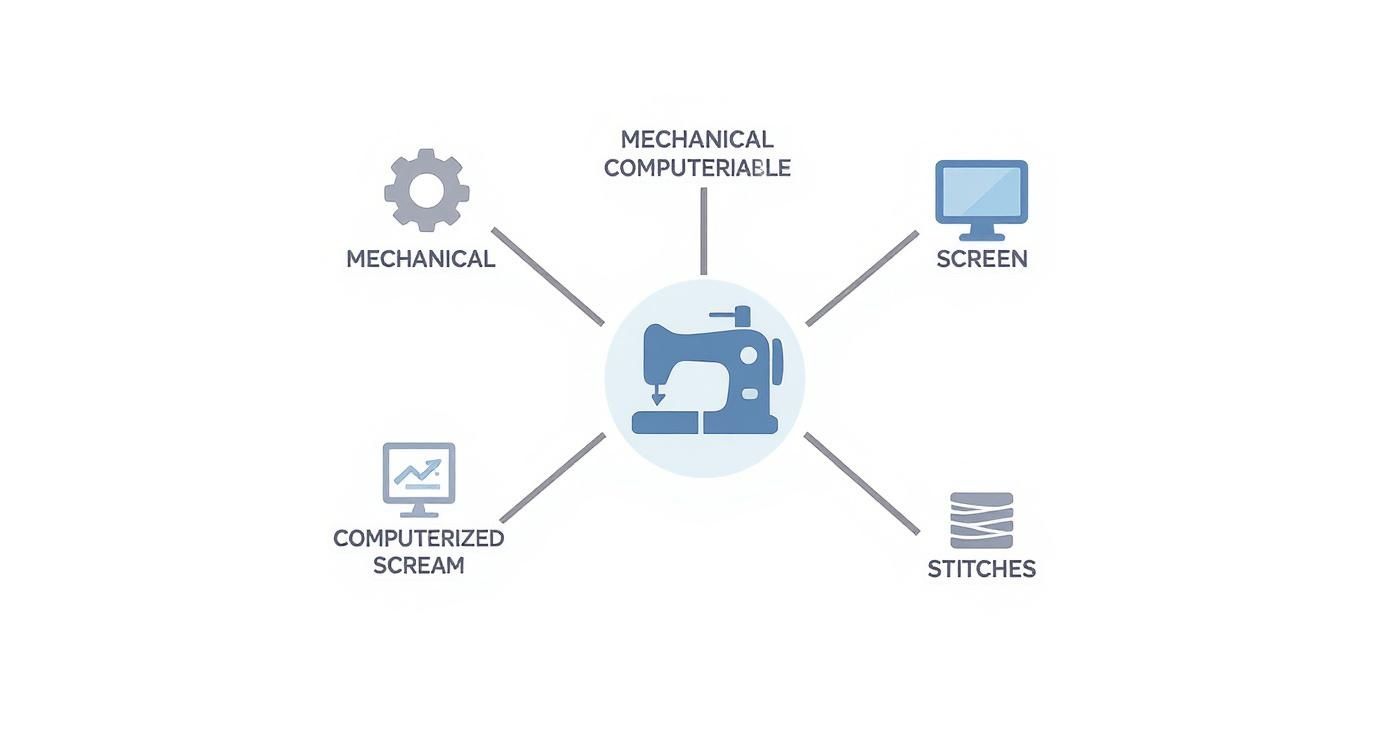
One of the first forks in the road you'll encounter is the choice between a mechanical and a computerized machine. There’s no right or wrong answer here; they just offer different experiences, especially when you’re just starting out.
Honestly, for most beginners, a good-quality mechanical machine is the perfect way to get started. It has everything you need without being overwhelming, and it helps you build a solid foundation of sewing knowledge that you’ll use forever.
When you're starting out, you can completely ignore all the bells and whistles, like hundreds of decorative stitches. A great beginner machine just needs to do a few basic things—and do them really, really well.
Here are the features I’d consider non-negotiable:
If you focus on these core features, you'll end up with a capable partner for your sewing journey. A machine from a trusted brand like BERNINA, which you can find right here at High Country Quilts, will give you the reliability and support you need to build your skills with total confidence.
Before you ever make a single stitch, the success of your project hinges on two things: accurate measurements and clean cuts. Think of it like cooking—if you don't measure your ingredients correctly, the final dish just won't turn out right. Getting this foundation solid from the very beginning makes everything that follows so much easier.
Every great project starts with precision. It’s not just about getting a shirt to fit; it’s about making sure your seams line up, your corners are crisp, and all your pattern pieces play nicely together. Shaky cuts and wonky measurements are a recipe for frustration down the line.
When it comes to measuring, you’ll want a couple of specific tools in your kit, as each one has a job it does best.
This diagram shows how different features on a sewing machine come together, much like how your various hand tools work together to create a finished project.
Just as you choose a machine based on its capabilities, you'll choose your cutting tools based on the task at hand. Your two main options are traditional fabric shears and the more modern rotary cutter. Shears are essentially specialized scissors with incredibly sharp blades designed to glide through fabric without snagging. A rotary cutter, on the other hand, looks like a pizza cutter and is used with a ruler and a special self-healing mat to slice through fabric with rolling precision.
Choosing between them often comes down to personal preference and the type of project you're working on. Here’s a quick breakdown to help you decide.
| Tool | Best For | Pros | Cons |
|---|---|---|---|
| Fabric Shears | Curved cuts, intricate shapes, delicate fabrics, and general-purpose cutting. | Excellent control, great for beginners, no extra mat needed, works on any surface. | Can be tiring for large projects, harder to cut perfectly straight lines, can shift fabric if not careful. |
| Rotary Cutter | Long straight cuts, cutting multiple layers at once, and perfect for quilting blocks. | Extremely fast and precise, clean edges, less hand fatigue. | Requires a self-healing mat and ruler, blade replacement needed, steep learning curve for safety. |
Ultimately, many sewists end up with both in their toolbox! You might use a rotary cutter to break down large pieces of fabric for a quilt and then switch to shears for trimming smaller, more detailed pieces.
Key Takeaway: If you can only buy one thing, invest in a single, high-quality pair of fabric shears. A sharp, dedicated pair will give you clean, crisp edges that are foundational to a professional-looking finish. Keep them for fabric only—cutting paper will dull them in a heartbeat!
The tools we use today are a far cry from the bone and ivory needles of our ancestors. The rise of paper patterns from companies like Simplicity and McCall's in the 19th and 20th centuries truly made sewing accessible, placing a new emphasis on the importance of precise cutting. You can dive deeper into the fascinating evolution of sewing supplies to see just how much things have changed. By choosing the right tools, you're taking part in a long, rich history of craftsmanship.
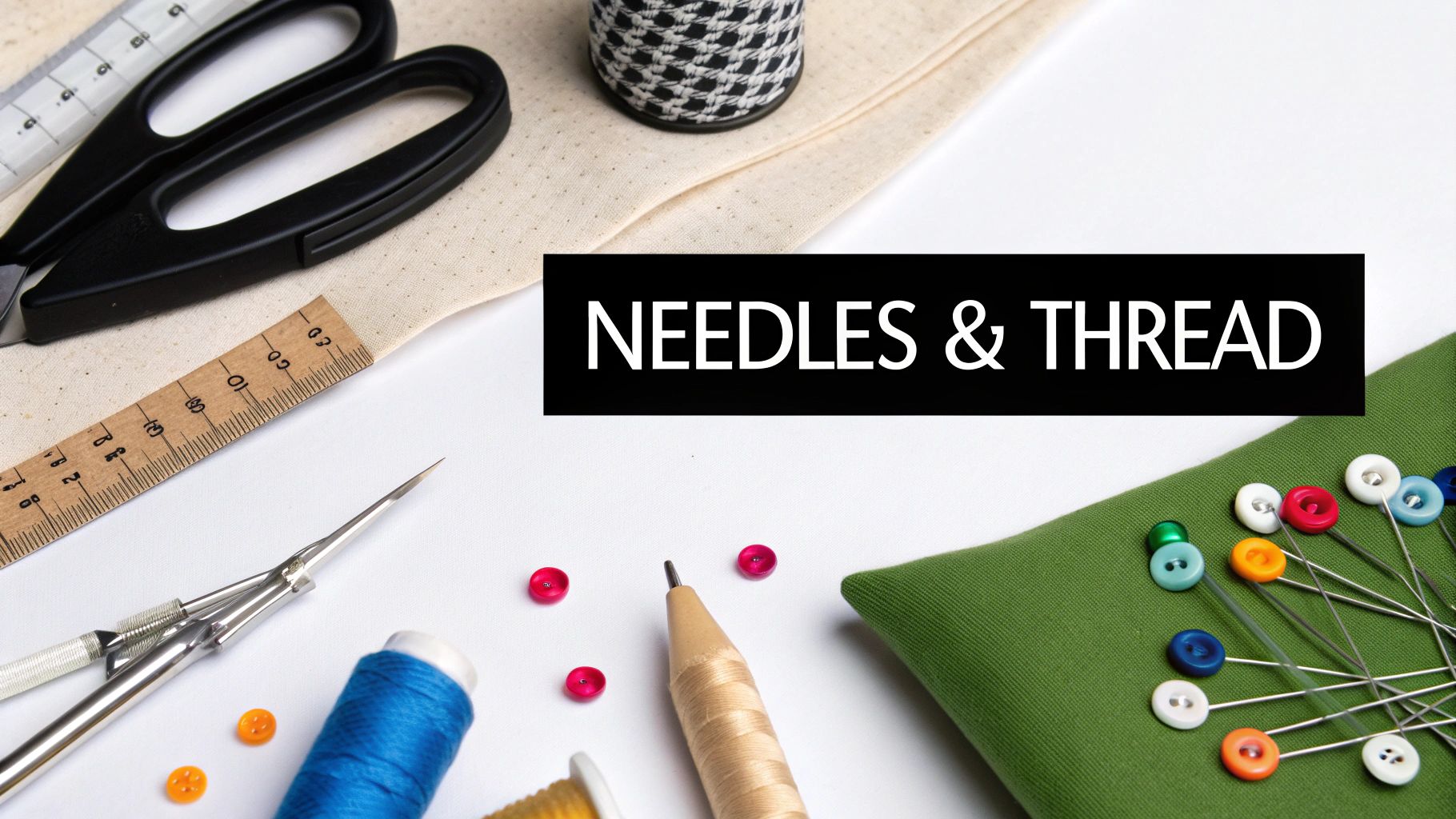
While the sewing machine is the engine, the real magic happens with the smaller details: the needles, threads, and notions. Think of them as the supporting cast in your sewing production. They might not get the spotlight, but the show simply can't go on without them. Getting these small but mighty elements right is the secret to strong seams and a finish that looks truly professional.
These tiny tools are the unsung heroes of every single project. Understanding how to choose the right ones will save you from countless headaches down the road, from frustrating skipped stitches to tangled thread.
Matching your needle and thread to your fabric is a bit like choosing the right tires for your car. You wouldn't use racing slicks in the snow, right? In the same way, you shouldn't use a heavy-duty needle on a delicate silk. This is one of those fundamental steps that makes all the difference.
For beginners, let’s keep it simple. There are two needle types you really need to know:
A fresh needle is your best friend. Seriously. A good rule of thumb is to change your needle after every 8-10 hours of sewing, or whenever you start a new project. A dull needle is the number one cause of skipped stitches and fabric snags.
When it comes to thread, start with a high-quality, all-purpose polyester. It’s strong, has a little bit of give, and plays nicely with a huge variety of fabrics. Just how important is this single component? The global sewing thread market alone is projected to reach USD 4.91 billion by 2035, which shows you how crucial it is to millions of hobbyists worldwide. You can discover more about the sewing supplies market to see the bigger picture.
"Notions" is just the classic catch-all term for all the other small tools that make sewing possible. They’re the little helpers that guide you from a flat piece of fabric to a finished creation. While the wall of notions at a craft store can feel overwhelming, you only need a few key items to get started.
Here’s what your non-negotiable starter toolkit should include:
Having these basic sewing supplies for beginners on hand will make your creative process so much smoother and more enjoyable. Here at High Country Quilts, we can help you find the perfect needles, threads, and BERNINA-compatible notions to get you started on the right foot.
Diving into sewing doesn't have to break the bank. With a little planning, you can build a fantastic collection of starter sewing supplies that will serve you well for years to come. The real secret is to think of it as a journey, not a race—you'll add new tools as your skills grow and your projects call for them.
This approach keeps you from ending up with a drawer full of gadgets you don't actually need. A common mistake is buying one of those big, pre-packaged beginner sewing kits. While they look like a bargain, they're often filled with low-quality tools that only lead to frustration. Think scissors that chew up your fabric instead of cutting it, or thread that snaps every few stitches. Building your own kit, piece by piece, ensures every tool you own is one you can count on.
For your very first project, you honestly only need a handful of really good items. Sticking to the basics lets you get comfortable with the fundamentals without feeling overwhelmed by a mountain of tools. This is your "can't-sew-without-it" list.
So what should be in your starter pack? The essentials really come down to five key items:
Once you have these core tools, you're more than ready to get started.
To make it even easier, here's a checklist that breaks down your shopping list into three manageable tiers. Start with Tier 1 and add items from the other tiers as you get more comfortable and discover what you enjoy making most.
| Tier 1 Bare Essentials | Tier 2 Level Up Your Kit | Tier 3 Worth the Splurge |
|---|---|---|
| Fabric Shears | Rotary Cutter & Self-Healing Mat | High-Quality Iron & Pressing Mat |
| Seam Ripper | Smaller Snips/Embroidery Scissors | Tailor's Ham & Seam Roll |
| All-Purpose Thread (Neutral Colors) | Fabric Marking Pen or Chalk | Wonder Clips |
| Glass Head Pins & Pincushion | More Thread Colors & Bobbins | A Full Set of Rulers (various sizes) |
| Clear Acrylic Ruler (6x24 inch) | Flexible Tape Measure | Magnetic Pin Bowl |
| Hand Sewing Needles | Bodkin or Safety Pin for Threading | Seam Gauge |
This tiered approach lets you build a personalized, practical, and long-lasting collection without feeling pressured to buy everything at once.
As you start sewing more, you'll naturally figure out which tools you reach for over and over. That's your signal for what to add next.
If you find yourself falling in love with quilting, that rotary cutter and self-healing mat from Tier 2 will quickly become your next must-have purchase. If you're drawn to making clothes, a tailor's ham for pressing curves will be an absolute game-changer.
Don’t be afraid to invest in the tools you use the most. A quality tool not only works better, but it also makes the entire process more enjoyable. Spending a little extra on great scissors or a comfortable seam ripper pays off in every single project you make.
Ultimately, the perfect kit is the one that's built for you. It’s a budget-friendly strategy that ensures every single item in your sewing box is a valued partner on your creative journey.
Jumping into a new hobby like sewing is thrilling, but it's totally normal for a few questions to pop up. Think of us as your friendly sewing guide, here to help you get past those initial "what if" moments. Getting good answers early on helps you build confidence and keep your creative flow going.
We’ve gathered some of the most common questions we hear from folks just starting out. Let’s clear up the confusion so you can get right to the fun part—sewing!
Hands down, the biggest misstep is buying everything at once. It’s so easy to get sucked in by a giant, all-in-one kit that seems like a great deal. The reality? Those kits are often overwhelming and packed with low-quality gadgets you won’t touch for years.
The smarter move is to start small with a handful of high-quality essentials. Get yourself a fantastic pair of fabric shears, a sturdy seam ripper, good all-purpose thread, a clear ruler, and a simple marking tool. As you tackle new projects and learn new skills, you can add tools to your collection as you actually need them.
This "buy-as-you-go" approach keeps your sewing space from getting cluttered and your budget happy. You’ll end up with a curated toolkit filled with reliable tools you genuinely love and use.
When you're starting out, you want a fabric that’s your friend, not your enemy. Stick with stable, medium-weight woven fabrics like quilting cotton, chambray, or a nice linen blend. They’re a dream for beginners because they don’t stretch or slide around, which makes cutting and sewing so much easier and more forgiving. They do what you tell them to do, letting you focus on learning the ropes.
Save the slinky satins, stretchy knits, and tricky patterns for later. A solid color or a small print that doesn't need to be perfectly matched up will let you practice sewing straight lines and getting comfortable with your machine without any extra stress.
This is such a simple tip, but it prevents a world of sewing headaches. A great rule of thumb is to pop in a fresh needle after every 8-10 hours of sewing time, or just start fresh with every new project. It’s a tiny action that makes a huge difference.
A dull or bent needle is the number one culprit behind skipped stitches, pulled threads, and wonky tension. Honestly, a new needle is the cheapest insurance you can buy for your project. Using a fresh, sharp needle that's the right type for your fabric is one of the easiest ways to get clean, professional-looking stitches and keep your fabric from getting damaged.
While a pre-made kit looks like a shortcut, buying your tools one by one is almost always the better choice in the long run. Kits are notorious for including lower-quality items that just lead to frustration—think flimsy scissors that chew up fabric instead of cutting it, or brittle thread that snaps if you look at it wrong.
When you buy items individually, you can put your money where it counts and invest in the tools you’ll use most, especially your scissors, seam ripper, and rulers. It might feel like a little more of an investment at first, but it saves you from the headache and cost of having to replace cheap tools that just don't work. You’ll be building a reliable toolkit you can count on from day one.
Ready to put together a beginner's toolkit you'll love? The experts at High Country Quilts are here to help you pick out the best tools, fabrics, and even your first BERNINA machine. We'll make sure your sewing journey gets off to a fantastic start.
Explore our beginner-friendly sewing supplies at hcquilts.com
At High Country Quilts we care deeply about community. With our experiences in retail, we know that a store is not only a place to shop but also a place for the community to gather and share. During this busy...

Hi! We’re Adam and Renee Wheaton, the new owners of High Country Quilts! For more than 40 years, we’ve owned and operated vacuum and sewing businesses. Following in Renee’s father’s footsteps after he retired from All Discount Vacuum and Sewing in Colorado...


Leave a comment