
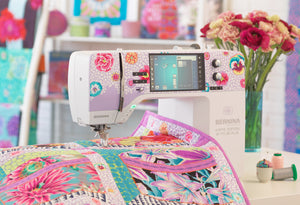

We Love Our Quilting Community
At High Country Quilts we care deeply about community. With our experiences in retail, we know that a store is not only a place to shop but also a place for the community to gather and share. During this busy...


A quilting shop in Colorado Springs should help you solve the main challenge that starts after the quilt top is finished, which is choosing a backing that fits your budget, your machine, and how the quilt will be used. Polyester sheets are bed linens made from synthetic polymer fibers, and for many quilts they can be a wide, single-piece, budget-friendly backing if you handle their stretch and slick surface correctly.
That moment happens in our shop all the time. Someone walks in carrying a beautiful pieced top, usually folded over an arm with the batting question already settled, then they stop at the backing wall and freeze. They know what they like on the front. The back feels harder. If you're searching for a quilting shop Colorado Springs quilters use for practical advice, this is exactly the kind of decision we talk through every week.
A finished quilt top can make you feel done, right up until you realize the back still matters just as much as the front. I’ve watched customers spend weeks on points, seams, border math, and color placement, then get stuck because backing fabric suddenly feels like a high-stakes decision.
For a lot of projects, 100% polyester sheets deserve a fair look. They’re wide, they can save you from piecing a backing seam, and they hold up well on quilts that will be used hard instead of admired from a distance. They are not the right answer for every quilt. They are a very workable answer for more quilts than many people think.
What makes local advice useful is that it’s shaped by real projects, not theory. In the Pikes Peak region, quilting has deep roots, and Colorado’s only dedicated quilt museum in the Pikes Peak Region draws about 10,000 visitors annually while honoring quilting history through collections tied to Colorado Springs, as noted by the Colorado Springs quilt museum coverage in The Gazette. That local quilting culture matters because people here make every kind of quilt, from practical donation quilts to carefully planned heirloom pieces.
The usual version sounds like this:
“I love the top. I just don’t want to ruin it with the wrong back.”
That’s a smart concern. Backing changes drape, warmth, feel, quilting tension, washing behavior, and how easy the sandwich is to manage under the machine. Cotton is still the default for many quilters, and for good reason. But if you need width, durability, and easier care for an everyday quilt, a polyester sheet can make a lot of sense.
People walking into a quilting shop near me aren’t usually looking for abstract fabric theory. They want answers to questions like:
That’s where hands-on guidance matters. The right backing isn’t the most traditional choice. It’s the one that matches the project.
Polyester gets lumped together as if every sheet feels and sews the same. It doesn’t. One polyester sheet can behave almost politely. Another can skate across your cutting mat, resist pinning, and stretch just enough on the bias to make you mutter at your rotary cutter.

Polyester is a synthetic fiber. In bedding, it’s often woven into sheets designed for softness, durability, and easy care. Microfiber is a very fine polyester fiber. For quilters, that usually means a fabric that feels smooth, light, and tightly woven.
If you're trying to understand how polyester is made and why some sewists look for more sustainability in synthetics, this primer on recycled polyester fabric is useful background.
When I handle sheet sets for possible backing, I pay attention to three things before color even enters the conversation.
You don’t need a textile lab. Use your hands.
Fold a corner over itself. Rub the layers together. If they skate around immediately, that tells you something. Hold the fabric up and let it drop. If it puddles with no body at all, that may be fine for a soft throw, but less fun for controlled machine quilting.
Practical rule: If a sheet feels hard to control in your hands at the store, it won’t become easier when you add batting and a quilt top.
I also check for excessive sheen. A little is fine. A very glossy surface can make stitches stand out in a way some quilters hate, especially if tension isn’t perfectly balanced.
Brand name matters less than behavior. Fancy packaging doesn’t tell you how the sheet will feed under the machine. Neither does the word “luxury.” Quilters need stability, not marketing language. Touch, fold, test for slip, and think about the actual use of the quilt.
Cotton is still the emotional favorite. I understand why. It presses beautifully, cuts cleanly, grips batting nicely, and feels familiar. But familiarity isn’t the same thing as suitability. For some quilts, polyester backing solves problems that cotton creates.

| Property | Polyester Sheeting | Cotton Fabric |
|---|---|---|
| Warmth | Tends to hold warmth a bit more | Usually feels more temperature-neutral |
| Breathability | Less breathable in many cases | Usually breathes better against the skin |
| Durability | Strong for heavy everyday use and frequent washing | Durable, but can show wear differently over time |
| Grip while quilting | Slipperier under the machine | Easier to control and baste |
| Static | More likely to build static | Less likely to build static |
| Pilling risk | Depends heavily on finish and sheet quality | Usually less of a concern with good quilting cotton |
| Pressing behavior | Doesn’t love high heat | Presses predictably and tolerates heat better |
| Traditional look | Less traditional hand and drape | Classic quilt feel |
For utility quilts, polyester can be a smart backing. I like it for kids’ quilts, couch quilts, dorm quilts, pet quilts, and picnic quilts. It’s often easier to find in widths that reduce or eliminate backing seams, and that matters more than some quilters admit. A large center seam in the wrong place can become the weak point in a frequently washed quilt.
Polyester also resists the tired, worn look some heavily used cotton backs develop. If somebody tells me the quilt is going to live on a bunk bed, ride in a car, visit soccer fields, or survive snacks and pets, I’m more open to polyester.
If the quilt is meant to breathe well and feel classic, cotton is hard to beat. It’s usually the better choice for traditional pieced heirlooms, show-focused work, and quilts where pressing precision and ease of quilting matter more than convenience.
Cotton also tends to forgive small machine setup issues better. Polyester can expose every little problem. Slightly uneven feed, a dull needle, tension that’s only almost right, or a stitch length that’s a touch short will show up faster on a slick backing.
Cotton is more forgiving. Polyester is more demanding, but often more durable for rough use.
When customers bring in quilts that are going to be used daily, the question I ask is simple. Do you want tradition, or do you want practicality? Sometimes the answer is both, and then we steer back to cotton. But sometimes the honest answer is, “I need this quilt to survive children, dogs, and repeated washing.” That answer points in a different direction.
One of the biggest misconceptions is that polyester-backed quilts always feel cheap. They don’t. Cheap polyester feels cheap. A decent sheet with a balanced finish can feel smooth, light, and very usable.
The essential exchange is control versus convenience.
A backing should serve the quilt’s life, not just the shopping trip.
A lot of polyester-backed quilts walk into the shop with the same complaint. The quilt top went together fine, then the backing started shifting, rippling, or tunneling under the foot. Polyester exposes setup problems fast, especially when the backing came from a sheet with a slick finish.

One customer recently brought in a practice sandwich with ridges building up behind the presser foot. She had pinned carefully and blamed the fabric. The actual problem stemmed from a universal needle, a stitch length that was too short, and uneven feeding on a slippery backing.
We changed three things and the problem settled down:
I see this often on budget-friendly polyester sheet backings. People buy them for the width and durability, which can be a smart choice, but the machine has to be set up for the fabric you have, not the cotton you wish you were sewing.
Polyester rewards control. It also punishes shortcuts.
What usually makes things worse is pulling from the front or back of the quilt to force it through. That creates drag and shows up later as puckers, uneven stitches, or a back that looks slightly twisted.
If the backing is moving, fix the feeding and the basting first.
Polyester sheets can stretch enough to fool you during prep. The fabric looks square on the table, then relaxes crooked once it is pinned into a quilt sandwich. I tell customers to spread it out on a large flat surface, smooth it by hand, and let it rest for a minute before cutting. Do not tug it into submission.
A few habits help:
If you are quilting on a domestic machine, support the rolled quilt bulk on the table or in your lap. The weight of the quilt can pull against the needle path, and polyester backing shows that drag quickly.
Slick backing is less forgiving than cotton. A machine that is slightly out of adjustment may sew cotton well enough and still struggle on polyester. I have seen tension that looked acceptable on one project turn messy the moment a sheet backing went under the foot.
That is one reason I tell Colorado Springs quilters to test on the final backing before they commit to the quilt. Do not rely on a cotton scrap test if the actual quilt has a polyester sheet on the back. The fabric finish, the weave, and even static in our dry climate can change how it feeds.
Before quilting the actual project, sew a sample that includes the top, batting, and backing you plan to use.
This video gives a helpful visual refresher on handling slippery fabric under the machine.
Static is a real issue here in Colorado Springs, especially in dry months. Polyester sheet backing can cling to itself, shift unexpectedly, and attract lint in ways cotton usually does not. Keep the work area clean and avoid excessive handling once the backing is cut.
Be careful with heat too. Polyester does not respond well to the same aggressive pressing used on stubborn cotton. Use lower heat, press lightly, and test on a scrap first.
If a polyester backing keeps fighting you, stop and sample again. That saves more quilts than pushing through on hope.
Once the quilt is done, care is usually simpler than people fear. Polyester-backed quilts are meant to be used. The main mistake is treating them like an all-cotton quilt at pressing or drying temperatures.
I recommend a gentle approach:
People ask if polyester will melt in the dryer. High heat is the main risk. Normal, careful low-heat drying is different from cooking the quilt. Heat management matters far more than fear.
Pilling depends on the quality and finish of the sheet. A poor-quality brushed sheet is more likely to disappoint over time than a smoother, tighter woven one. That’s why fabric choice at the start matters so much.
Treat polyester-backed quilts gently with heat, not fearfully with heat.
For household quilts, the simplest rule is this. Wash when needed, dry with restraint, and skip aggressive heat. If the quilt lives on a bed, couch, or in a car, that care routine is usually enough to keep it looking good and feeling comfortable.
Polyester backing shines when a quilt is going to live a busy life. I don’t reach for it first on every project, but I reach for it quickly when function outranks tradition.

There are projects where I still want cotton, and I’ll say so plainly.
Exercising strong opinions proves beneficial. Not every budget-friendly option is wise, and not every traditional option is practical. Polyester backing works best when the quilt’s job is to be used hard and washed often.
Don’t choose polyester just because it’s available. Choose it because the quilt needs what polyester does well. If you hate the hand of the fabric before quilting, you won’t love it after quilting. The backing doesn’t become a different personality once it’s attached.
A quilter walks in with a finished top, a tight budget, and a queen-size backing problem. That happens here all the time. In many cases, a good polyester sheet solves it better than a narrow quilting cotton backing that needs extra seams, costs more, and still may not suit the way the quilt will be used in a Colorado Springs home.
Colorado Springs has a real quilting culture, and it runs on shared advice. The Piecing Partners Quilting Guild, formed in Colorado Springs in the early 1970s, helped revive the communal quilting spirit of the older bees tradition. I see that same habit of comparing notes across the cutting table. Someone brings in a top for a college kid, a pet quilt, or a cabin throw, and the backing choice becomes a practical discussion, not a sentimental one.
That is why I tell people to bring the quilt top into the shop. Polyester sheet backing is one of those materials that has to be judged in person. Some sheets feel slick and cheap. Some are surprisingly usable, with enough body to quilt well and enough width to save you a piecing headache. As a BERNINA tech, I care about that difference because I also see what badly chosen fabric does at the machine.
If you are looking for a quilting shop Colorado Springs quilters can use for side-by-side comparison, come ready to test the whole plan, not just the color. Set the top against a few backing options. Fold batting into the stack. Check the drape with your hands. A backing that looks fine on the bolt can become stiff, noisy, or awkward once it is quilted.
A few habits save trouble later:
At High Country Quilts, that conversation stays grounded in use. If a polyester sheet is the smart choice, I will say so. If cotton will make the quilt behave better, wear better for that project, or feel better in the long run, I will say that too. A good backing earns its place after the quilt is washed, used, and hauled back out for another season.
Yes, if the print isn’t so busy that it competes with the quilt top or makes your quilting stitches visually messy. Printed sheets can be fun on casual quilts. Just make sure the fabric quality is acceptable and the hand feels good enough for actual use.
No, not if you choose the sheet carefully. Bad polyester feels bad. Better polyester can feel smooth, soft, and practical. The issue is usually breathability and hand, not some dramatic plastic effect.
No. Polyester sheeting is woven and relatively flat. Minky and Cuddle fabrics are plush pile fabrics with stretch and bulk of their own. They create a very different quilt, and they bring a different set of handling challenges.
Not always, but thread compatibility helps. Polyester thread is often a sensible pairing for polyester backing, especially for everyday utility quilts. What matters most is balanced tension, a fresh needle, and testing on a sample sandwich first.
A cautious beginner can. I’d rather see a beginner use polyester backing on a simple, forgiving quilt than on a complicated showpiece. Keep the quilting design simple, baste thoroughly, and test settings before stitching the actual project.
Yes, but slick backing still needs careful loading and tension checks. Polyester isn’t impossible on a longarm. It just asks for attention. If the backing shifts easily or has too much stretch, the operator needs to account for that before quilting starts.
If you’re deciding between cotton yardage and a polyester sheet for your next quilt back, High Country Quilts can help you sort out the trade-offs with real fabric, real machine advice, and hands-on guidance for your project in Colorado Springs.
At High Country Quilts we care deeply about community. With our experiences in retail, we know that a store is not only a place to shop but also a place for the community to gather and share. During this busy...

Hi! We’re Adam and Renee Wheaton, the new owners of High Country Quilts! For more than 40 years, we’ve owned and operated vacuum and sewing businesses. Following in Renee’s father’s footsteps after he retired from All Discount Vacuum and Sewing in Colorado...


Leave a comment