
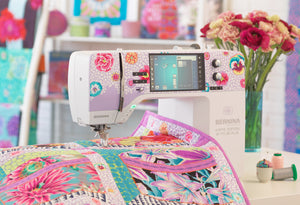

We Love Our Quilting Community
At High Country Quilts we care deeply about community. With our experiences in retail, we know that a store is not only a place to shop but also a place for the community to gather and share. During this busy...


Welcome to the colorful world of quilting! Every beautiful quilt starts with the right fabric, and for quilters, that foundation is almost always high-quality cotton. When you start buying quilting cotton fabric by the yard, you're really taking the first step toward having total creative control over your projects.
This isn't just any old cotton. It's a special, sturdy fabric designed specifically for the precision and durability that a beautiful, long-lasting quilt needs.
Think of quilting cotton as the perfect artist's canvas. It’s a medium-weight, tightly woven material that’s stable enough for precise cutting and piecing but still soft enough to make a quilt you'll actually want to snuggle under.
Unlike the drapey cottons you might find in a shirt or a dress, quilting cotton is engineered to hold its shape and resist stretching. That unique stability is exactly why it has become the go-to fabric for quilters everywhere—it can handle the demands of cutting and sewing intricate patterns without losing its integrity.
When you begin shopping for quilting cotton fabric by the yard, you'll discover an endless universe of colors, prints, and possibilities. Buying fabric this way, instead of in pre-cut bundles, gives you the ultimate freedom to bring your unique vision to life.
So, what makes this fabric so perfect for patchwork and appliqué? It all comes down to its construction, which provides a few key advantages that ensure your finished quilt is not just beautiful but built to last.
Here’s what really sets it apart:
Quilting cotton is more than just a material; it's a reliable partner in your creative process. Its predictable behavior allows you to focus on design and technique, confident that your fabric will perform exactly as you need it to.
In this guide, we'll walk through everything you need to know about selecting, measuring, and preparing your fabric. Once you understand the fundamentals of fabric weight, width, and quality, you’ll feel inspired and ready to choose the perfect quilting cotton for your next project.
When you walk into a quilt shop, every bolt of fabric is telling a story. To pick the best quilting cotton for your project, you have to learn its language. Think of it as developing a quilter's intuition—it’s what allows you to move beyond just grabbing a pretty print and start choosing materials that will truly make your quilt shine.
And it’s a great time to be a quilter! The community is growing like crazy. In fact, the global market for cotton quilting fabric was worth around $5.6 billion in 2023 and is expected to climb to $8.7 billion by 2032. If you're curious about the numbers behind this quilting boom, you can dive into the details in this market report on Dataintelo.com.
With all these amazing new fabrics hitting the shelves, knowing what makes a quality cotton is more important than ever. The two most important clues on any bolt are its thread count and weight.
Let’s start with thread count. It’s simply the number of threads packed into one square inch of fabric, counting both the threads running lengthwise (the warp) and crosswise (the weft). For a good quality quilting cotton, you're looking for a thread count of at least 60x60. Anything higher is even better. This tight, dense weave is what gives the fabric its smooth feel and durability, helping it stand up to all the cutting, pressing, and stitching you’re about to do.
Then there's fabric weight. This is usually measured in ounces per square yard. A good quilting cotton is considered a medium-weight fabric, typically landing somewhere between 4.0 to 4.5 ounces per square yard. This weight gives it just enough substance to hold a nice, crisp press without being stiff or bulky. It’s the perfect balance for a quilt that’s both durable and soft enough to snuggle under.
The sweet spot for quilting is a fabric with a high thread count and a solid medium weight. This combination is what keeps your fabric from fraying, helps your seams lie flat, and ensures your patchwork points meet perfectly. It’s the secret to that polished, professional look.
When you’re buying fabric by the yard, the width of the bolt is a huge deal—it directly impacts how much you need to buy. For quilting cotton, you’ll mainly run into two standard sizes, each with a specific job.
Getting comfortable with these basics—thread count, weight, and width—is the first step to becoming a more confident fabric buyer. Once you know what to look for, you can walk into any quilt shop ready to find the perfect materials for your next masterpiece.
Ah, the eternal quilter's question: "How much fabric do I actually need?" We’ve all been there. You either guess too low and have to make a frantic trip back to the store (praying they still have your print!), or you guess high and end up with a drawer full of remnants you’re not sure what to do with.
Thankfully, figuring out how much quilting cotton fabric by the yard you need is more science than art. Think of it like a recipe. You wouldn't just start throwing flour in a bowl to bake a cake, right? A little bit of simple math upfront can save you a world of frustration later on.
At its heart, calculating yardage is all about figuring out how many strips of a certain size you can cut from the width of your fabric bolt. Most quilting cotton you'll find is about 44-45 inches wide on the bolt, which gives you a solid 42 inches of usable fabric once you trim off the selvages.
Here’s a simple, step-by-step way to break it down for your quilt top:
This diagram shows you the key measurements on a fabric bolt that you'll use for these calculations.
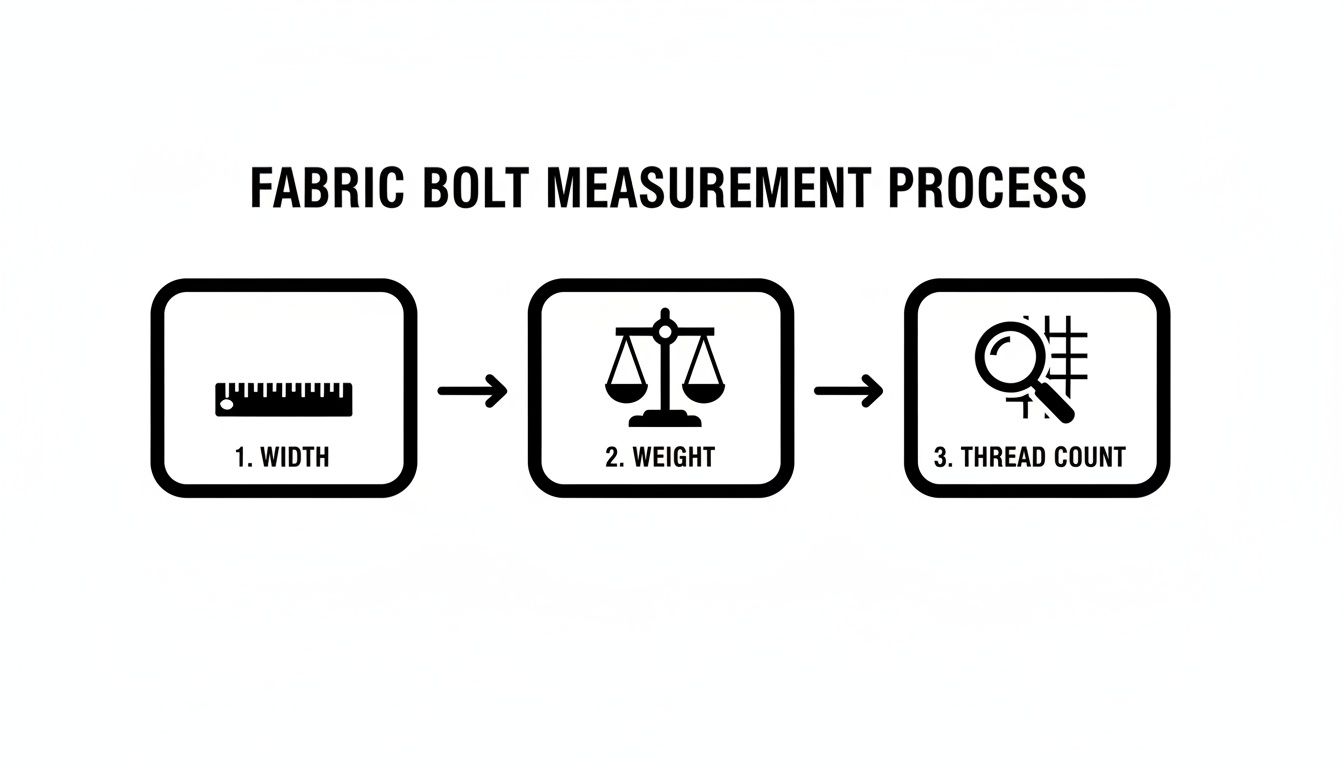
Getting comfortable with these three metrics—width, weight, and thread count—is the first step to confidently walking up to the cutting counter.
Of course, your quilt top is only part of the story. You still need fabric for the backing and the binding, and they each have their own calculation quirks.
For the backing, you need to give yourself some extra room to work with during the quilting process. The golden rule is to add at least 4 inches of overage to both the length and the width of your finished quilt top. So, if your top measures 60" x 80", you'll want a backing piece that’s at least 64" x 84". For bigger quilts, I highly recommend looking for extra-wide 108" backing fabric. It’s a total game-changer because it means you won’t have to piece your backing together.
Binding is much more straightforward.
First, find the perimeter of your quilt. Just add up the lengths of all four sides. For that same 60" x 80" quilt, the math is (60 + 80) x 2 = 280 inches. I always add another 10-12 inches to that number to have enough for turning corners and joining the ends, which brings us to around 292 inches.
Now, just divide that total length by the usable width of your fabric (42 inches). That’s 292 ÷ 42 = 6.95, so you'll need to cut 7 strips. If you’re making a standard 2.5-inch binding, you'll multiply 7 strips by 2.5 inches, which equals 17.5 inches of fabric. A quick 1/2 yard will be plenty.
To make things even easier, here's a quick cheat sheet for estimating yardage for common quilt sizes.
This table gives you a ballpark idea of how much fabric to buy for the top, backing, and binding of some standard quilt projects. Remember, these are just estimates—your specific pattern will always be the best guide!
| Quilt Size | Dimensions (inches) | Top Yardage (approx.) | Backing Yardage (approx.) | Binding Yardage (approx.) |
|---|---|---|---|---|
| Crib | 36" x 52" | 2-3 yards | 1.5 yards | 1/2 yard |
| Throw | 50" x 65" | 3-4 yards | 3.5 yards | 1/2 yard |
| Twin | 70" x 90" | 5-6 yards | 5.5 yards | 3/4 yard |
| Queen | 90" x 108" | 7-8 yards | 8.5 yards | 1 yard |
| King | 110" x 108" | 9-10 yards | 9.5 yards | 1 yard |
Keep in mind that intricate patterns with lots of small pieces may require more fabric to account for seam allowances and potential cutting mistakes. It never hurts to buy just a little extra
Every beautiful quilt starts well before you ever sit down at your sewing machine. The secret to getting those crisp points, flat blocks, and a quilt that will last for years is all in the prep work. It really boils down to two key steps: washing and cutting.
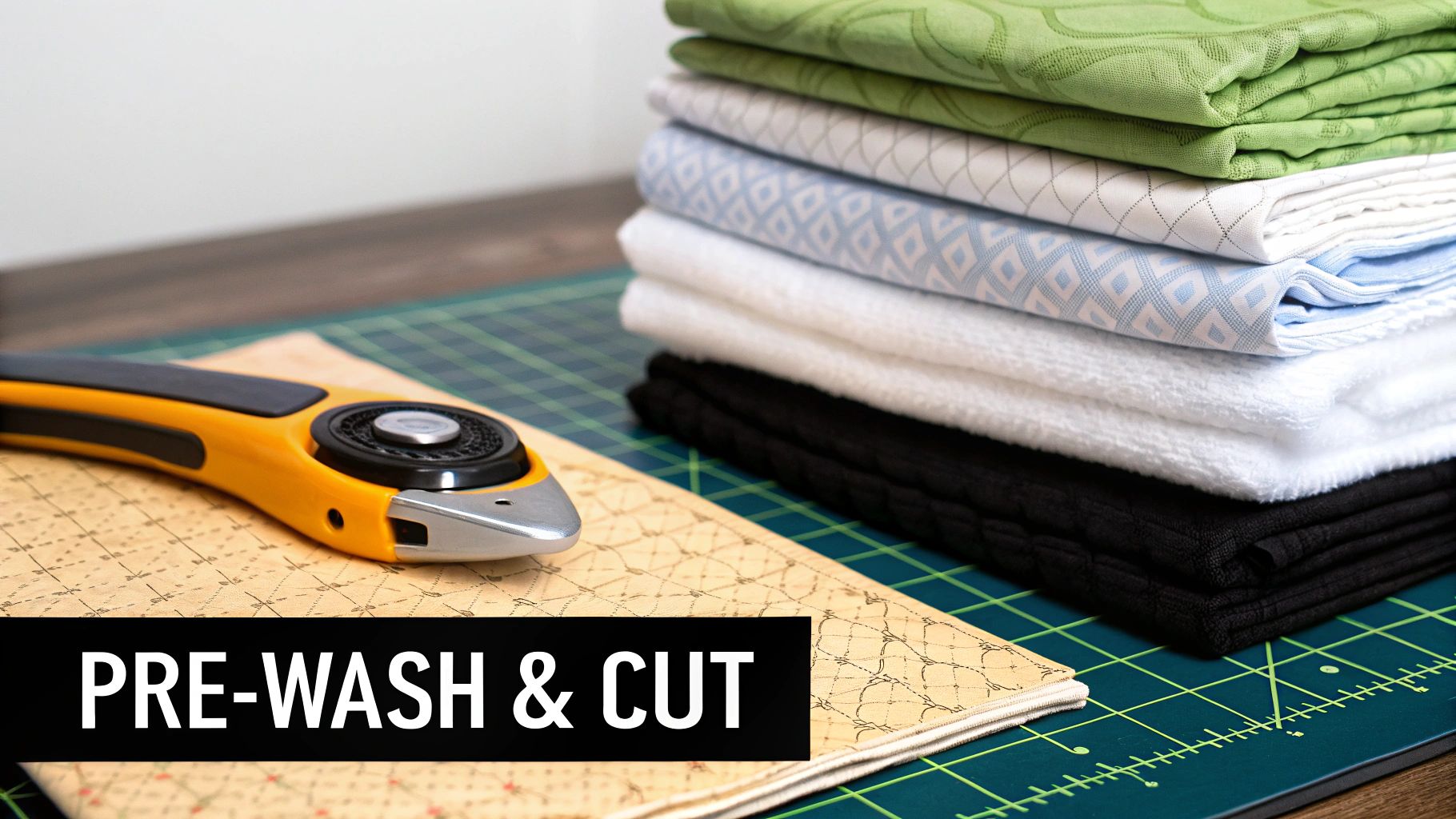
First up, you have to decide whether you're going to pre-wash your fabric or not. This is a genuinely hot topic in the quilting world, and you'll find seasoned quilters on both sides of the fence. Let's break down the pros and cons so you can decide what’s right for your project.
Pre-washing can feel like a chore when you're excited to start a new quilt, but there are some compelling reasons to do it. Then again, some quilters swear by the feel of fabric straight off the bolt.
Why You Might Want to Pre-Wash:
Why You Might Skip Pre-Washing:
The golden rule here is consistency. If you wash one fabric for a quilt, you need to wash them all. This ensures every piece behaves the same way. But if your quilt has high-contrast colors, pre-washing is always the safest move.
Once you’ve made your washing decision and the fabric is ready, it’s time to cut. Accurate cutting is the absolute foundation of good patchwork. Your best friends for this job are a sharp rotary cutter, a clear acrylic ruler, and a self-healing mat.
First things first, you need to square up your fabric. Lay your fabric on the mat and line up the folded edge with one of the horizontal lines. Next, place your ruler on top and trim a perfectly clean, straight edge along one side. This gives you a perfect 90-degree corner to work from, setting you up for success.
Keep an eye out for directional prints! If your fabric has a clear "up" and "down," like a pattern of little birds or climbing vines, you have to make sure you cut all your pieces facing the same direction. If you don't, your finished quilt can look a bit chaotic. For those gorgeous large-scale prints, you might want to try "fussy cutting"—this just means centering a specific part of the design inside your ruler or template so it gets showcased perfectly in your block.
While it's tempting to click and buy fabric online, there's a certain magic to stepping inside your local quilt shop that a website just can't replicate. It's so much more than a store. It's the heart of a community, a place where your creative ideas can really take flight.
Here, fabric isn't just a tiny square on a screen—it's real. You can feel the difference between the weights and textures of various bolts of quilting cotton fabric by the yard. Most importantly, you can match colors and prints with your own eyes, saving you from that all-too-common disappointment when your online order arrives and the shades are just a little off.
A local quilt shop is a creative sanctuary. It’s where you can get instant, expert advice on a tricky pattern, troubleshoot a project with people who get it, and stumble upon new techniques you’d never find on your own.
This hands-on experience is backed by a powerful domestic industry. The U.S. is a major player in the cotton world, producing a staggering 12.07 million bales in the 2023/2024 season alone. That strong supply chain is what keeps shops like High Country Quilts stocked with the high-quality fabrics we all love. For a deeper dive into how U.S. production affects the quilting world, check out this great article on quilting and tariffs at sherriquiltsalot.com.
Beyond the endless bolts of beautiful cotton, your local shop offers something truly priceless: expertise and support. These shops are the lifeblood of the local quilting scene, offering resources you simply can't get from a web browser.
They’re hubs of learning and connection, often providing:
When you choose to shop local, you’re not just buying fabric. You're investing in your own skills, supporting the experts who offer their guidance, and helping keep a vibrant, inspiring space alive for the entire quilting community.
Even with all the right math and prep, you're bound to have questions when you start a new quilting project. When it comes to buying quilting cotton by the yard, a few key queries pop up again and again. Getting solid, practical answers is the last piece of the puzzle before you can quilt with total confidence.
Let's walk through the most common questions quilters ask. Getting a handle on these details will help you make smarter choices at the cutting counter and get much better results in your sewing room.
This is probably the most important question of all. While they both come from the same plant, quilting cotton is specifically made for the job. Think of it like flour: all-purpose flour is fine for most things, but bread flour has a higher protein content to create that perfect, chewy loaf. It’s designed for a purpose.
In the same way, quilting cotton has a higher thread count and a firm, plain weave that keeps it from stretching and fraying. That sturdy structure is absolutely essential for the precise patchwork that quilting demands. Apparel cotton, on the other hand, usually has a lower thread count and a softer drape, which makes it comfortable to wear but a nightmare for holding sharp points and straight seams.
High-quality quilting cotton is often mercerized. This is a finishing process that strengthens the fibers, gives the fabric a beautiful luster, and helps it hold dye better. It’s the secret behind those vibrant, long-lasting colors that ensure your quilt remains a masterpiece for years to come.
Ah, the great quilter's debate! There are definitely some major pros to pre-washing. It preshrinks the fabric, which prevents your finished quilt from puckering after its first wash. It also removes excess dye that could bleed and rinses out any chemicals left over from the manufacturing process.
That said, many of today’s high-quality quilting cottons have very little shrinkage and are quite colorfast. Some quilters even prefer to skip pre-washing because the unwashed fabric is stiffer and easier to cut with laser-like precision.
So, what's the right move? It really comes down to your project and your personal preference.
You can often identify great fabric just by using your senses. High-quality cotton will feel smooth and substantial in your hands, not flimsy or coarse. It should have a tight, even weave that doesn’t feel loose or see-through.
A simple test you can do right in the store is to hold the fabric up to a light. If you can see through it easily, it’s probably a lower thread count material that won't stand up to years of use and washing. The print quality is another dead giveaway—the colors should be rich and saturated, and the designs should be crisp and clear, not blurry or faded at the edges.
Finally, stick with reputable brands known for their quality. The quilting world is a surprisingly big business, with around 150 million units sold globally each year. Leading brands like Timeless Treasures, Wilmington Prints, and Moda Fabrics have built their reputations on delivering exceptional fabric, and they hold a huge share of the market. You can learn more about the global quilting cotton market on wiseguyreports.com. When you invest in good fabric from a trusted name, you're not just buying cotton; you're ensuring your quilt will become a beautiful heirloom that stands the test of time.
Ready to feel the difference for yourself? Visit High Country Quilts to explore an extensive selection of premium quilting cottons from the best brands in the industry. Let our experts help you find the perfect fabric for your next masterpiece. Start shopping now at hcquilts.com
At High Country Quilts we care deeply about community. With our experiences in retail, we know that a store is not only a place to shop but also a place for the community to gather and share. During this busy...

Hi! We’re Adam and Renee Wheaton, the new owners of High Country Quilts! For more than 40 years, we’ve owned and operated vacuum and sewing businesses. Following in Renee’s father’s footsteps after he retired from All Discount Vacuum and Sewing in Colorado...


Leave a comment