

We Love Our Quilting Community
At High Country Quilts we care deeply about community. With our experiences in retail, we know that a store is not only a place to shop but also a place for the community to gather and share. During this busy...


Picking the right machine quilting thread is one of the most important—and fun—decisions you'll make for your quilt. It’s not just about holding the layers together. Think of it as the final, defining brushstroke on a masterpiece. The thread you choose can either disappear into the background or pop right off the fabric, creating its own layer of art.
This single choice will shape your quilt's entire personality: its look, its feel, and how well it stands the test of time.
Walking into a quilt shop and seeing that giant wall of thread can be intimidating. So many colors! So many brands! It's tempting to just grab a spool that matches your fabric and call it a day, but there’s so much more to it.
The right thread brings your creative vision to life, influencing everything from how sharp your stitches look to the way the finished quilt drapes over a bed. Choosing wisely isn't just about preventing frustrating thread breaks and tension headaches (though that’s a huge plus!). It's about making a deliberate artistic statement.
Do you want a thick, bold thread that becomes part of the design itself? Or would you prefer a fine, stealthy thread that lets your patchwork be the star of the show? Your answer will guide you to the perfect spool.
To cut through the confusion, I always tell quilters to think about three key things. Getting these right is the secret to a beautifully finished project.
This chart shows how most experienced quilters weigh these three factors.
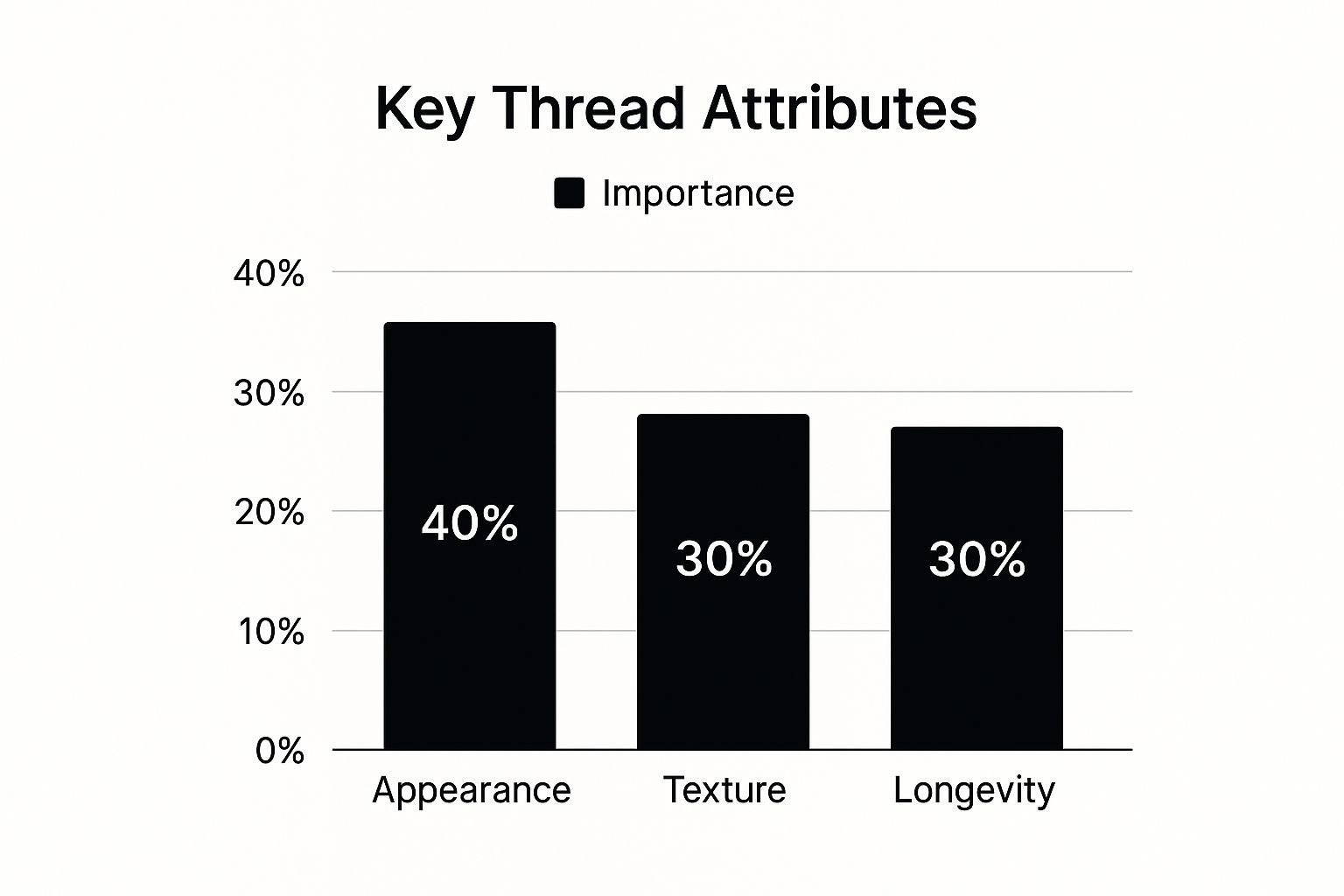
As you can see, a pretty color is often what catches our eye first. But the real magic happens when you balance that beautiful appearance with a wonderful texture and the rock-solid durability your quilt deserves. This is how you transform your quilting from simple stitching into a true work of art.
Choosing the right thread fiber is a bit like casting an actor for a play. Every material brings its own unique personality, strengths, and style to the stage of your quilt top. The fiber you pick for your machine quilting threads directly impacts not just the final look, but also the quilt's feel, durability, and how it will age over the years.
Let's dive into how these different fibers actually behave on a quilt. Getting to know their characteristics will give you the confidence to pick the perfect thread for whatever project you're dreaming up.
For generations of quilters, cotton has been the go-to, and for good reason. It’s the traditional choice, the one our grandmothers likely used.
Cotton thread has very little give, which helps you create beautifully crisp, defined stitches. It also has a soft, matte finish that blends right into cotton quilting fabrics, creating a wonderfully cohesive and gentle texture. Think of it as the perfect dance partner for your fabric—it moves with the material, not against it.
One of the biggest pluses is that cotton thread and cotton fabric wear at the same rate. This means that after years of love and washing, your stitches and fabric will age gracefully together, ensuring your heirloom quilt stays intact.
Key Takeaway: Cotton is your best bet for traditional quilts where you want the stitching to create a soft texture rather than pop. It's a reliable, low-lint, and low-stretch workhorse for most piecing and quilting.
If cotton is the classic artist, polyester is the modern engineer. Polyester threads are celebrated for their incredible strength and durability, making them a fantastic choice for any quilt that's going to live a busy life.
We're talking quilts for kids, everyday bedspreads, or any project destined for frequent trips to the laundry room. Polyester’s resilience means your quilting stitches will hold up under serious stress without snapping. It also offers a subtle, attractive sheen that can catch the light and add a bit of dimension to your quilting designs.
The popularity of synthetics is huge. In fact, threads like polyester make up about 80% of the global sewing thread market, a testament to their strength in all sorts of applications, including quilting. You can find a deeper in-depth analysis of the sewing thread industry if you're curious about market trends.
To help you decide, here's a quick look at how the most common fibers stack up against each other.
| Fiber Type | Key Characteristics | Best For | Things to Consider |
|---|---|---|---|
| Cotton | Soft, matte finish, low stretch, low lint | Traditional piecing, heirloom quilting, blending with cotton fabrics | Can break under high tension, may not be as strong as synthetics |
| Polyester | Very strong, durable, slight sheen, lint-free | High-use quilts (e.g., for kids), clothing, bags, decorative stitching | Can sometimes cut through older, delicate fabrics due to its strength |
| Silk | High sheen, very fine, strong for its weight | Appliqué, fine detail quilting, projects needing a touch of luxury | More expensive, can be slippery to work with |
| Monofilament | Transparent, very fine, strong | "Invisible" quilting like stitch-in-the-ditch, quilting on busy prints | Can be stiff, may become brittle over time, can melt under a hot iron |
| Metallic | High sparkle and shine, decorative | Holiday projects, wall hangings, adding accent details | Can be finicky, often requires a special needle and slower speed |
Ultimately, knowing the pros and cons of each fiber type puts you in the driver's seat.
Once you've mastered the basics, a whole world of specialty threads opens up, offering incredible creative possibilities. These are the threads you grab when you want to add a specific flair or solve a unique problem.
Each of these specialty threads gives you another tool in your creative kit. Your choice of machine quilting threads really comes down to balancing the look you want with the practical needs of the finished quilt.
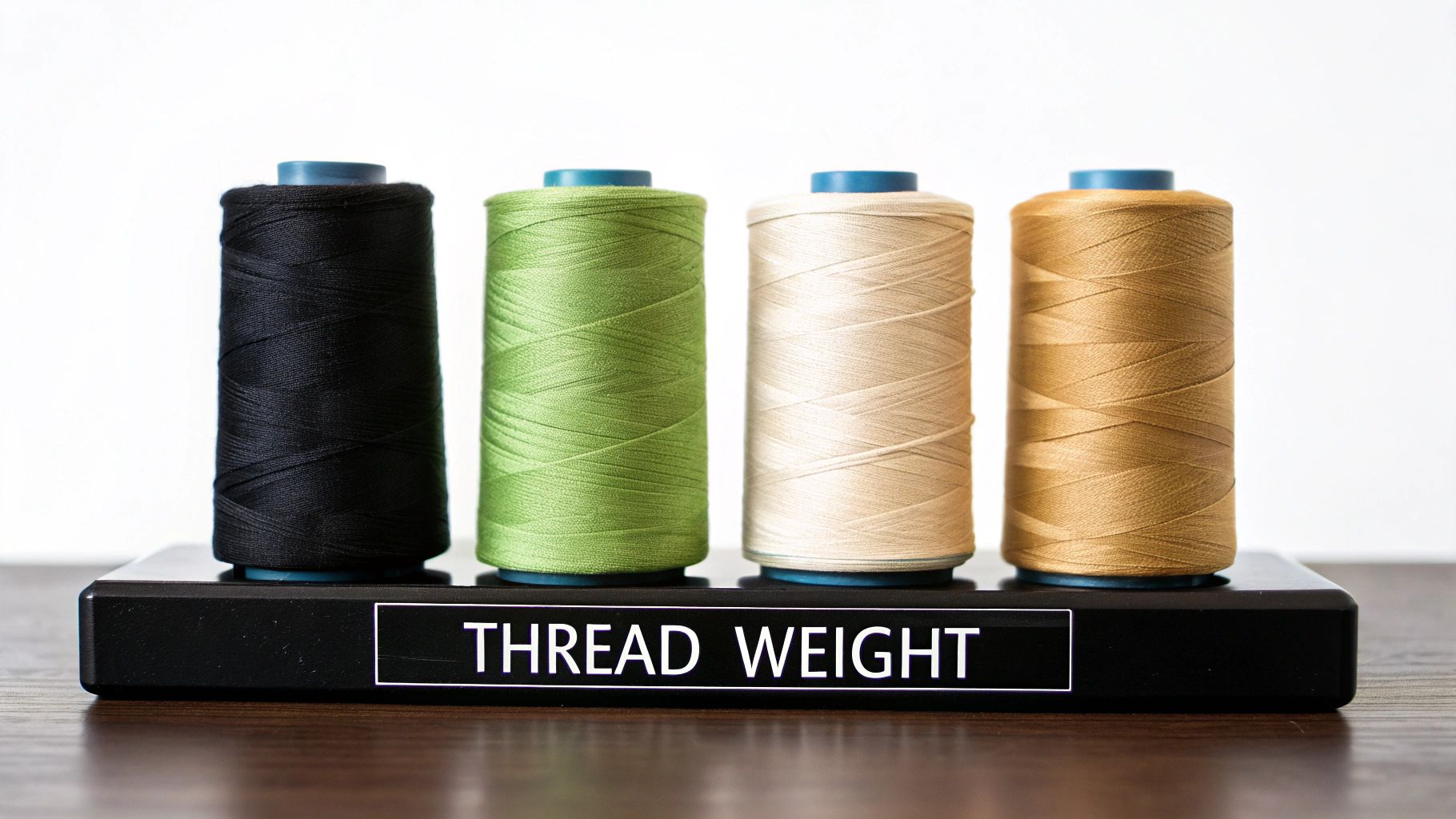
When you first start exploring machine quilting threads, that little number on the spool—the weight—can be seriously confusing. It seems to work backward from what you’d expect, but once you get the hang of it, you’ll realize it’s one of the most powerful tools for controlling your quilt’s final look.
I like to think of it like picking out a pen. A thick, bold marker creates a line that demands attention, while a super-fine technical pen is all about delicate, precise details. Thread weight works the same way, just with a numbering system that feels upside down.
A lower number (like 12wt or 30wt) means a thicker, heavier thread. This is your bold marker.
A higher number (like 60wt or 100wt) means a thinner, finer thread. This is your superfine pen.
It's a bit quirky, but the logic is simple: the number represents how much of that thread it takes to weigh a certain amount. You need a lot more of a fine thread to hit that weight, so it gets a higher number. Easy!
So, how does this play out on your quilt? The weight you choose is a direct dial for visual impact. Are you aiming for stitches that pop and become a design element in their own right? Or do you want the quilting texture to be a subtle whisper that supports your piecing?
For Bold, Decorative Quilting: To make your quilting the star of the show, grab a heavier thread like a 30wt or 40wt. These create a pronounced, gorgeous stitch that adds a strong graphic punch. They're fantastic for modern quilts, adding decorative topstitching, or making your free-motion quilting a true focal point.
For Blended, Subtle Quilting: When you want the texture to shine without overpowering your patchwork, a finer thread like a 50wt or 60wt is your go-to. These threads are designed to nestle beautifully into the fabric, creating a soft, textural effect. In fact, 50wt is often considered the gold standard for both piecing and general quilting.
For "Invisible" Quilting: Sometimes you want the texture without any visible stitch line at all. For that magic, you'll want an ultra-fine thread like an 80wt or even a 100wt. These are perfect for intricate appliqué, micro-stippling, or any time you want the quilting to look like it appeared out of thin air.
While our focus is on quilting thread, understanding how thicknesses are classified across different crafts can be useful. For a broader look, you might find it interesting to check out this comprehensive yarn weight chart.
Now, let's talk about the other number you might see on a spool: the ply. If you look closely at any thread, you'll notice it isn't just one single strand. It’s actually made of multiple smaller strands twisted together to form the final thread. The number of those individual strands is the ply.
For instance, a spool labeled 50/3 tells you it's a 50-weight thread made from three plies. Most of the high-quality quilting threads you'll encounter are either 2-ply or 3-ply.
So, what does ply actually do? It all comes down to two things:
Strength and Durability: More plies generally create a stronger, rounder, and more durable thread. This means a 3-ply thread is typically more robust than a 2-ply of the same weight, making it a great choice for quilts that will be loved, used, and washed often.
Smoothness and Profile: The ply also affects how the thread behaves. A 2-ply thread is a bit flatter and can create less bulk in your seams—a real advantage when you’re piecing fabrics with a high thread count like batiks. A 3-ply thread has a rounder profile, which helps it stand out just a bit more for beautiful, decorative quilting.
By playing with both weight and ply, you gain incredible control. A strong 40wt, 3-ply polyester might be your workhorse for a kid's quilt, while a delicate 60wt, 2-ply cotton could be the perfect, elegant choice for an heirloom piece.
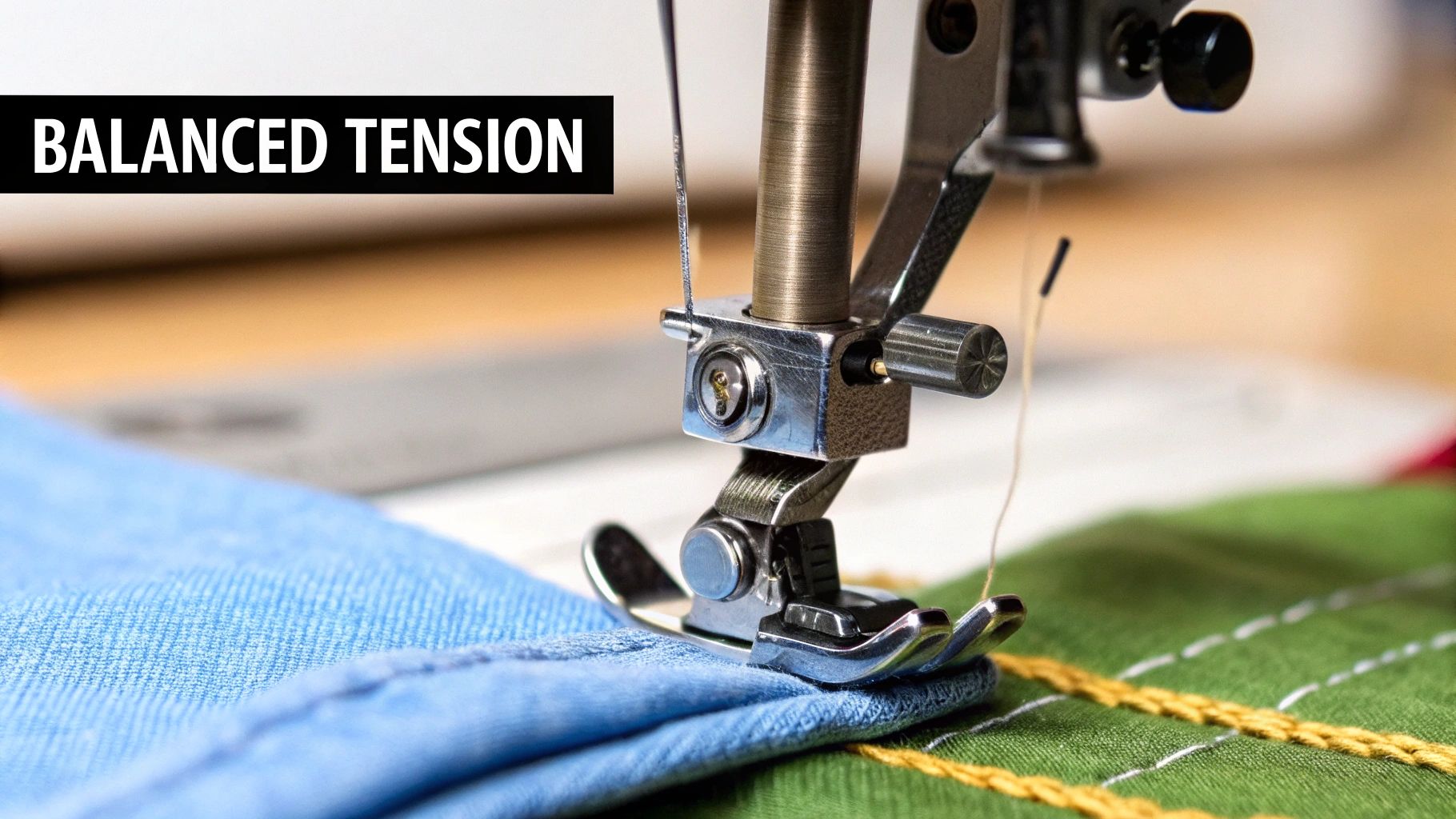
Beautiful, even stitches are the hallmark of great machine quilting, and the secret to getting them isn't so secret: it's tension. That one word can make quilters shudder, but it doesn't have to be a fight. Think of it this way: your machine's tension discs are just gatekeepers, controlling how the top and bobbin threads meet.
The goal is to get those two threads to have a perfect handshake right in the middle of your quilt sandwich. When the top and bobbin threads lock together neatly inside the batting, hidden from sight, you’ve nailed it. Your stitches will look identical on the top and the back—smooth, uniform, and strong.
This perfect balance is what takes a quilt from looking homemade to looking professionally handmade.
Before you can fix tension, you have to know what you’re aiming for. A perfectly balanced stitch is a beautiful thing.
My best advice? Never start a project without first making a small practice quilt sandwich with scraps from your actual project. Stitching a few test lines is the single best way to avoid the headache of ripping out stitches later on.
Pro Tip: To really see what’s going on, use a different and contrasting color thread in your bobbin for your test piece. It makes it instantly obvious if one thread is pulling the other to the wrong side.
When your stitches are off, your machine is trying to tell you something. Learning to read the signs is the key to a quick fix. Luckily, most issues fall into two camps.
1. Top Tension is Too Tight
If your top tension is cranked up too high, it's basically winning a tug-of-war with the bobbin thread, yanking it all the way up through the fabric.
2. Top Tension is Too Loose
On the flip side, if your top tension is too loose, the bobbin thread becomes the bully, pulling the top thread down to the back of the quilt.
Tension is a game of small adjustments. Go slow, and test after every tiny change.
One of the most common reasons quilters run into tension issues is when they use different machine quilting threads on the top and in the bobbin. This is actually a fantastic technique! Using a thick, decorative 30wt thread on top with a fine 60wt thread in the bobbin is a pro move that reduces bulk on the back.
But remember, your machine's default setting (usually around 4) is calibrated for using the same thread in both spots. When you put a heavier thread on top, you will almost always need to loosen your top tension. This allows the finer bobbin thread to successfully pull that thicker top thread down into the middle of the quilt sandwich.
The demand for these kinds of versatile threads is on the rise, driven by new machine capabilities and our collective desire for high-quality, creative textiles. You can read more about the trends shaping the sewing machine threads market to see where things are headed.
Don't be afraid to touch that tension dial. Once you get the hang of it, you’ll unlock a new level of control and be able to produce flawless stitches every single time.
This is where the magic happens—connecting all the technical stuff about thread to the actual quilt you’re about to create. Once you have a feel for different fibers and weights, you can stop guessing and start making confident, intentional choices for every single project.
Picking the right machine quilting threads isn't about memorizing rules. It's about developing an instinct for what works. Let's walk through a few common quilting projects to see this in action. By looking at the "why" behind each choice, you'll start to think like an experienced quilter, matching the thread to the quilt's unique story and how it will be used.
Think about a quilt for a child's bed or a cozy throw that’s going to live on the family sofa. This quilt is destined for a life of pillow forts, movie nights, and plenty of trips through the washing machine. For a piece like this, durability is everything.
You can't go wrong with a 40wt polyester thread. It's a true workhorse.
The subtle sheen of polyester can also give your quilting design a little extra pop, making it a choice that’s both practical and visually appealing.
Now, let's picture a modern quilt with bold colors and crisp, geometric piecing. Here, the quilting is a star player, meant to create sharp lines and add another layer of graphic punch. You want those stitches to be seen and celebrated.
For this job, a 50wt, 3-ply cotton thread in a contrasting color is a fantastic option.
Quilters' demand for better materials is part of a bigger picture. The global sewing machine thread market was valued at around $2.2 billion in 2025 and is expected to keep growing. This is driven by creators like us who are always looking for the perfect thread to bring our ideas to life. You can read more about the sewing machine threads market trends.
Finally, imagine an heirloom quilt with intricate appliqué or quilting designed to look like it was done by hand. The goal here is for the quilting to create a soft, elegant texture that doesn't steal the show from the detailed piecing. You want the stitches to almost disappear into the background.
A fine 60wt or 80wt cotton thread is your best friend for this kind of delicate work.
Thinking through these examples is the best way to build your "thread IQ." The more you practice matching a thread's personality to your quilt's purpose, the more your confidence and creativity will soar.
To make things even simpler, here's a quick-reference guide. Think of it as a starting point for matching your next project with the perfect thread.
| Quilting Project Type | Recommended Thread Fiber | Recommended Thread Weight | Desired Effect |
|---|---|---|---|
| Everyday Bed Quilt | Polyester or Cotton/Poly Blend | 40wt - 50wt | Strong, visible stitches that hold up to heavy use and washing. |
| Wall Hanging / Art Quilt | Cotton, Rayon, or Silk | 40wt, 50wt, or 30wt | Varies: fine stitches to blend, or thick, decorative stitches to stand out. |
| Modern, Graphic Quilt | Cotton (2 or 3-ply) | 50wt or 40wt | Crisp, defined stitch lines that complement geometric piecing. |
| Heirloom with Appliqué | Cotton or Silk | 60wt, 80wt, or 100wt | Very fine, almost invisible stitches that create texture without distraction. |
| T-Shirt or Memory Quilt | Polyester | 40wt or 50wt | Durable stitches that can handle the stretch of knit fabrics. |
| Custom / Free-Motion | Cotton or Polyester | 50wt (general), 40wt (bold), 60wt (detailed) | Versatility for creating varied textures, from bold to subtle. |
This table can help you narrow down your choices quickly, but don't be afraid to experiment. Sometimes the most exciting results come from trying something new
Even after you get the hang of fibers, weights, and tension, you'll still run into little hiccups on your quilting journey. That's completely normal! This section is all about tackling those common questions and frustrations that pop up when you're at your machine.
Think of this as a conversation with a seasoned quilter. We'll sort out everything from picking your first thread to figuring out why it’s suddenly misbehaving, so you can get back to the fun part—quilting!
When you’re just starting, the last thing you want to do is fight with your materials. The best move is to keep it simple with a reliable, high-quality thread that just works for almost any project. This way, you can focus on building your skills, not troubleshooting.
For that reason, a 50-weight (50wt) cotton thread is the undisputed champion for new machine quilters. It’s the perfect workhorse thread and a fantastic starting point for learning what you like.
Here’s why it’s the go-to recommendation:
A little pro tip? Start with a neutral color like cream, off-white, or a soft gray. One spool of a versatile, neutral thread will carry you through dozens of different projects.
There is nothing more maddening than hearing that snap of your thread breaking in the middle of a beautiful line of quilting. It happens to all of us. But before you get frustrated and blame the thread, take a deep breath and check your machine setup first.
Most of the time, the problem isn't a "bad" thread, but something in the path it’s traveling through. It’s a classic puzzle, and there are usually only a few culprits.
My Golden Rule: Before you touch a single tension dial, change your needle. A dull, bent, or nicked needle is the #1 cause of thread shredding and breaking, hands down. A fresh needle for every project is the cheapest insurance policy you can buy for your quilt.
Here’s my mental checklist for troubleshooting shredding thread:
This is such a great question, and the answer is a definite no! While using the same thread top and bottom is the simplest way to go, learning to mix and match is a skill that will seriously elevate your quilting.
It's common practice for pros to pair a show-off decorative thread on top with a much finer, less obtrusive thread in the bobbin. For example, you might want to use a gorgeous 40wt thread to really make your quilting design pop.
Using a finer 60wt or even 80wt thread in the bobbin gives you a few key advantages:
The secret to making this work is to test it out first. Always make a little quilt sandwich with scraps of your project's fabric and batting. This is your playground to get the tension just right before you lay a single stitch on your actual quilt.
You've invested in a beautiful collection of machine quilting threads, so you want to make sure it stays in great shape! Proper storage is more important than most people realize for preserving the strength and color of your thread.
Think of your thread as having two mortal enemies: sunlight and dust.
The best solution is simple: keep your thread in a closed container. Clear plastic bins with lids are fantastic because you can see what you have while keeping it all clean and protected. A dedicated cabinet with drawers is another great option. Just find a cool, dry place away from the sun, and your thread will be ready to perform beautifully for years to come.
Ready to find the perfect thread for your next masterpiece? At High Country Quilts, we offer an extensive selection of high-quality machine quilting threads, fabrics, and BERNINA sewing machines to bring your creative vision to life.
At High Country Quilts we care deeply about community. With our experiences in retail, we know that a store is not only a place to shop but also a place for the community to gather and share. During this busy...

Hi! We’re Adam and Renee Wheaton, the new owners of High Country Quilts! For more than 40 years, we’ve owned and operated vacuum and sewing businesses. Following in Renee’s father’s footsteps after he retired from All Discount Vacuum and Sewing in Colorado...


Leave a comment