

We Love Our Quilting Community
At High Country Quilts we care deeply about community. With our experiences in retail, we know that a store is not only a place to shop but also a place for the community to gather and share. During this busy...


You've pieced the top. You've pressed the seams. You may have even chosen the binding already. Then the quilt goes under the machine, and one small question suddenly feels much bigger than it should.
What stitch length should I use?
That moment stops a lot of quilters. The quilt top is pretty. The batting is smooth. The backing is ready. But stitch length feels like the setting that could either make everything look polished or make the whole project look slightly off. If that sounds familiar, you're in good company.
Stitch length matters because it affects two things at once. It changes how the quilting looks and how the quilting behaves. A stitch that's too short can make the quilting feel stiff or look cramped. A stitch that's too long can look loose and may not suit the design you had in mind.
For many beginners, the most helpful starting point is 2.5 to 3.5 mm, which is about 7.2 to 10.2 stitches per inch, as explained in this machine quilting stitch length overview from Epida Studio. That's a practical place to begin because quilting usually looks better with a slightly longer stitch than piecing.
If you've ever baked bread, this is a lot like oven temperature. There isn't one magic setting for every loaf. A sandwich loaf, a crusty boule, and sweet rolls all need a slightly different approach. Quilting works the same way. Straight-line quilting with a walking foot, soft curves, dense background fills, and decorative thread all ask for different stitch behavior.
The other point that trips people up is that walking foot quilting and free-motion quilting do not work the same way. With a walking foot, your machine helps determine the stitch length. With free motion, your hands and foot control become part of the equation. That's why one chart rarely answers the whole question.
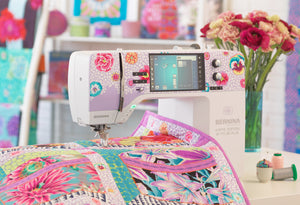
If you're sewing on a BERNINA and want a machine with fine stitch control, dual feed options, or built-in support for quilting features, it's worth browsing the BERNINA sewing machines at High Country Quilts. Good machine control doesn't replace practice, but it does make practice easier to trust.
Start with a safe setting, then let the fabric, thread, and quilting design tell you what needs adjusting.
Stitch length is the distance from one stitch to the next. On most domestic machines, you'll usually see it shown in millimeters. Some quilters also talk about stitches per inch, often shortened to SPI.
Consider driving speed, shown in miles per hour versus kilometers per hour. You're describing the same trip, just with two different measuring systems. A shorter stitch length means more stitches packed into the same space. A longer stitch length means fewer stitches in that space.

A quilted line is never just a line. It creates texture, shadow, movement, and structure. That's why stitch length can change the personality of a quilt even if the quilting design stays exactly the same.
A longer stitch often looks more open and relaxed. A shorter stitch can look finer and more compact. Neither one is automatically correct. The right choice depends on what you want the quilting to say.
Practical rule: Don't ask only, “What number should I use?” Ask, “What do I want this quilting to look and feel like?”
A widely used guideline for machine quilting is 10 to 11 stitches per inch for general quilting, which APQS describes as the most common choice because it works for both delicate motifs and bolder designs in its stitch length guidance for quilting. That's a useful middle ground, not a law.
APQS also notes that heavier cotton thread often looks better at 8 to 9 stitches per inch, while dense heirloom quilting may use about 13 stitches per inch for a finer appearance. That tells us something important. Quilters have always adjusted stitch length to suit the materials and the visual effect.
Here are the main things I want students to consider before they touch the dial:
Some quilters think stitch length is a technical setting and design is the artistic part. In truth, they belong together. Changing stitch length is like changing brush size in painting. The line itself changes.
| Term | What it means | Why it matters |
|---|---|---|
| Stitch length | Distance between stitches | Affects texture and openness |
| Stitches per inch | Number of stitches in one inch | Affects fineness and visual density |
| Longer stitch | Fewer stitches in a given space | Shows thicker thread and open designs well |
| Shorter stitch | More stitches in a given space | Supports fine detail and dense quilting |
When stitch length starts making sense, quilting gets less mysterious. You stop hunting for a universal answer and start making a deliberate choice.
Walking foot quilting is where many quilters begin, and that's a smart place to start. The feed system helps move the layers more evenly, which makes stitch length easier to evaluate. You're not trying to coordinate hand speed and machine speed at the same time.

If there's one habit that saves frustration, it's this one. Make a small test quilt sandwich before you quilt the actual project.
Use the same top fabric, the same batting, the same backing, and the same thread you plan to use on the quilt itself. If the quilt has a border print, test on a scrap of that border print. If the batting is lofty, test with that exact batting. Small differences can change the result.
A good test sandwich helps you answer questions that the stitch-length dial can't answer by itself.
Try this simple sequence:
You don't need laboratory precision here. You're looking for balance.
When a walking-foot line looks calm, even, and suited to the scale of the design, you're close.
A straight-line grid, gentle waves, and serpentine walking-foot quilting don't all need to look the same. Use the design itself as your guide.
| Quilting goal | What to look for | Stitch direction |
|---|---|---|
| Straight-line utility quilting | Clean, even lines | Start with a moderate general quilting length |
| Soft decorative curves | Smooth flow without stiffness | If lines look tight, test slightly longer |
| Dense edge-to-edge walking foot work | Defined but not crowded | If detail gets muddy, test slightly shorter |
| Thicker visible thread | Thread should read clearly on top | Test longer so the thread shape shows |
If you're shopping for supplies that affect this directly, useful tools include a walking foot, quilting needles, and thread in a few weights so you can compare the look on your test sandwich. A curated place to start is the machine quilting books and quilting notions collection at High Country Quilts, especially if you want examples you can test against.
If you quilt on a BERNINA with dual feed or a walking foot setup, use those features to help the layers travel evenly, but still test first. Good feeding improves consistency. It doesn't remove the need to choose the right stitch length for the thread, batting, and pattern.
You lower the feed dogs, start stitching, and the first few inches look nothing like the sample in your head. Some stitches stretch out on curves. Others bunch up into tiny pinpricks. That moment frustrates many beginners, especially if walking foot quilting felt manageable. The reason is simple. In free motion, the machine keeps making needle strokes, but your hands decide how far the quilt travels between each one.

Free-motion quilting changes who controls stitch length. With a walking foot, the machine feeds the quilt and your stitch-length setting has its usual job. In free motion, the feed dogs are disengaged or covered, so the stitch-length dial has little or no practical effect on the finished stitch. Stitch size comes from timing. Needle speed and hand speed have to work together.
A helpful way to read this is to treat free motion like driving a car with both steering and speed under your control. If your foot presses harder on the pedal but your hands do not guide smoothly, the ride gets jerky. If your hands move the quilt quickly while the machine runs slowly, the stitches grow long. If the machine runs fast while your hands barely move, the stitches get very short.
That is why free motion can feel less predictable at first, even on a very good machine.
Start with shapes that give you room to breathe. Large, open motifs make timing easier to feel.
Small feathers and tiny pebbles ask for more control than most beginners have on day one. Learning free motion with miniature motifs is similar to learning to bake by starting with a soufflé. It can be done, but it asks for precision before the basics feel natural.
Uneven free-motion stitches usually come from inconsistent movement, not lack of ability.
Free motion is not one single style. The stitch look you want should guide how fast you move and how dense you quilt.
| Quilting goal | What usually works better |
|---|---|
| Soft texture that blends into the fabric | Moderate speed with open, even spacing |
| Bold thread lines that show the motif clearly | Slightly larger stitches and smoother travel |
| Dense background fill | Smaller, controlled movement with steady machine speed |
| Beginner practice for consistency | Large motifs repeated many times on the same sandwich |
Machine type also matters. On a standard machine without regulation, your practice should focus on building a repeatable rhythm. On a BERNINA equipped for regulation, you can spend more attention on shape and path because the machine helps keep stitches more even as you move.
Simple cues work better than complicated instructions. Many quilters count. Others use a phrase such as “steady hands, steady speed.” The exact words matter less than keeping your motion regular.
Watch for these patterns:
| If this happens | It often means |
|---|---|
| Stitches get long on curves | Your hands moved faster through the turn |
| Stitches get tiny in corners | Your hands slowed too much while the needle kept cycling |
| Stitch length changes a lot within one motif | Your foot control and hand movement are still getting acquainted |
| The design looks shaky | You may be gripping too tightly or stopping too often |
If you are unsure whether the problem is speed or design, draw the same motif on paper first. If it looks smooth on paper but uneven in fabric, the issue is usually rhythm rather than drawing ability.
A stitch regulator helps coordinate stitch formation as you move the quilt, which shortens the learning curve for many quilters. For BERNINA users, the BERNINA Stitch Regulator gives you a practical way to aim for more consistent stitches while you build confidence with free-motion movement. If you want a machine-specific walkthrough, the BERNINA stitch regulator guide from High Country Quilts explains setup and use in practical terms.
The regulator does not choose your path or fix every wobble. It helps you hold a more even stitch while you learn how much hand movement different motifs require.
A short visual demo can also help free-motion concepts click:
You can still quilt beautifully without one.
Reduce variables while you learn. Use the same practice sandwich for several sessions. Keep the same thread and needle. Repeat one motif until it starts to feel automatic. Beginners usually improve faster with one simple shape stitched many times than with a sampler of ten different designs.
If progress feels slow, check posture and grip before blaming the machine. Relaxed shoulders, supported quilt weight, and lighter hands often improve stitch consistency faster than changing settings. For many students, that is the missing piece.
A stitch can be the right length on paper and still look wrong on the quilt.
That usually happens because stitch length, thread, and needle work as a set. If you change thread weight or switch needles, the stitch length that looked balanced before may now look heavy, skimpy, or slightly rough. Many quilters blame tension first, but the mismatch often starts earlier with these three choices.
A simple rule helps: thicker thread usually needs a little more space, and finer thread usually looks cleaner with a slightly shorter stitch. The reason is visual as much as mechanical. A heavier thread needs room to show its shape. A finer thread can make detailed quilting look softer and more refined.
The needle's job is just as important. It opens a path for the thread to pass through the quilt sandwich without abrasion. If that path is too tight, the thread can fray, flatten, or look strained. If the needle is too large, the quilting line can lose some of the crisp, delicate look many quilters want in fine detail.
Thread weight changes how the quilting reads from across the room. Needle size changes how cleanly that thread forms each stitch. Stitch length changes how crowded or open the line appears.
It helps to compare this to baking. The stitch length is the baking time, the thread is the batter, and the needle is the pan. You can follow the same recipe number, but if one part changes, the result changes too. That is why a stitch length that worked beautifully with a fine cotton thread may need adjustment when you switch to a thicker decorative thread.
BERNINA users often notice this clearly because the machines respond so precisely to small setting changes. With walking foot quilting, a longer stitch can help a heavier thread look smooth and intentional. With free-motion quilting, the same thread may still need a larger needle, but your final stitch appearance also depends on how quickly you move the quilt. The goal is not just a certain number on the screen. The goal is a line that suits the quilt.
| Thread Weight | Common Use | Recommended Needle Size | Starting Stitch Length (mm) | Approx. SPI |
|---|---|---|---|---|
| Fine quilting thread | Dense quilting, subtle texture | Match the needle to the thread and fabric, then test | Start on the shorter end of your quilting range | Finer look within your tested range |
| Medium all-purpose quilting thread | General walking foot quilting, everyday quilting | Match needle to thread and quilt sandwich, then test | Start in the middle of your quilting range | General quilting appearance |
| Thicker specialty or decorative thread | Visible quilting lines, decorative texture | Use a needle that accommodates the thread cleanly | Start longer so the thread shape can show | More open appearance |
Use the table as a starting map.
Your actual choice depends on the fabric, batting loft, thread brand, and the look you want. A lofty batting can make stitches look different than a flat cotton batting, even with the same thread and machine setting.
If you want the quilting to blend into the piecing, choose a finer thread and test on the shorter end of your range. This often suits background texture and dense areas where you want the surface to read as texture first.
If you want the quilting lines to stand out as part of the design, use a more visible thread and give it enough stitch length to show clearly. Outlines, gentle curves, and simple walking foot designs often benefit from that slightly more open look.
Dense background quilting needs special care. Thick thread in a very small space can make the area feel busy or stiff. A finer thread usually gives you more control and a cleaner finish.
Bold shapes are different. A slightly heavier thread paired with a slightly longer stitch can make those lines look intentional and crisp, especially on modern quilts where the quilting is meant to be seen.
Stitch a few lines on a practice sandwich made from the same materials as your quilt. Start with the thread you plan to use, then choose a needle that handles it cleanly. Sew one sample at your usual setting, one slightly shorter, and one slightly longer.
Then look at the samples from two distances. Check close up for smoothness and thread condition. Check from arm's length for overall effect. At High Country Quilts, this is often the step that helps a new quilter stop guessing and start choosing settings with confidence.
If stitches suddenly look off after a thread change, check the system in this order: thread, needle, stitch length. That sequence solves many problems before you ever need to adjust tension.
Every quilter eventually sews a sample that looks odd and thinks, “What on earth changed?” Usually, several things can cause the problem, but stitch length is one of the first places to check because it affects both appearance and behavior.
Use this like a small diagnostic checklist.
If your quilting line looks sparse or slightly loose, the stitch length may be too long for the thread or the design.
Try a shorter stitch first. If the line still looks weak, inspect the thread and needle combination too. Fine detail usually needs a more refined stitch than broad utility quilting.
If the quilting feels stiff or visually crowded, your stitch may be too short for the look you want.
Lengthen the stitch slightly and sew another sample line. This often helps thicker thread read more clearly and gives open designs more breathing room.
A quilting line can be technically correct and still look wrong for the style of the quilt.
Puckering isn't always caused by stitch length, but stitch length can contribute. Very short stitches may make the quilting feel tight, especially if the quilt sandwich wasn't basted smoothly.
Check these in order:
This usually points back to rhythm rather than the dial. In free motion, uneven stitches often mean your hands and machine speed aren't synced yet.
Slow down. Practice one easy motif. Keep your movement steady. If your machine has stitch-regulating support, use it while building muscle memory.
Stitch length might not be the main cause here, but it can be part of the picture if the thread is being asked to behave in a way that doesn't suit the setup.
Check the likely culprits:
If you need fresh needles, thread, batting, or other machine-quilting supplies for troubleshooting, a dedicated quilting supply shop is often the quickest way to compare options side by side.
Yes. Quilting often uses a slightly longer stitch than piecing because the goal is different. Piecing focuses on strong seam construction. Quilting also has to create a pleasing visible line across the quilt sandwich.
Yes, it can. Lofty batting can make stitches appear different than flat batting, even with the same machine setting. That's one reason test sandwiches are so useful.
Not always. Some quilters keep one setting throughout for simplicity. Others adjust for different sections, especially when switching from open lines to denser detail, or from subtle thread to decorative thread.
The full quilt is heavier and harder to support. That changes how it moves through the machine. Good table support, smooth handling, and careful basting all help.
Yes, but it's created differently. In free motion, stitch length comes from how quickly you move the quilt in relation to how fast the needle is stitching.
Often, yes, because they usually look better when the stitch gives the thread room to show. But “longer” is still relative to the project. Test on your actual materials.
Put the samples on a wall or across a chair and step back. Quilts live at room distance more than nose distance. Also touch the samples. The hand of the quilting can tell you a lot.
No single number works for every machine, fabric, and thread combination. BERNINA machines may give you excellent control and quilting features, but you still need to match the setting to the project in front of you.
The big lesson is simple. Stitch length isn't a pass-fail setting. It's a tool.
A good machine quilting stitch length guide gives you a place to begin, but your quilt tells you where to go next. The thread, batting, design, and quilting method all shape the answer. Walking foot quilting rewards testing and observation. Free-motion quilting rewards rhythm and practice. Both get easier when you stop looking for one perfect number and start looking for the best fit.
Trust the sample sandwich. Change one variable at a time. Let your eyes and hands vote together.
The more quilts you finish, the easier this decision becomes.
If you'd like help choosing quilting supplies, comparing BERNINA machine features, or finding classes and machine support, visit High Country Quilts.
At High Country Quilts we care deeply about community. With our experiences in retail, we know that a store is not only a place to shop but also a place for the community to gather and share. During this busy...

Hi! We’re Adam and Renee Wheaton, the new owners of High Country Quilts! For more than 40 years, we’ve owned and operated vacuum and sewing businesses. Following in Renee’s father’s footsteps after he retired from All Discount Vacuum and Sewing in Colorado...


Leave a comment