
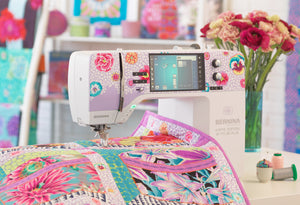

We Love Our Quilting Community
At High Country Quilts we care deeply about community. With our experiences in retail, we know that a store is not only a place to shop but also a place for the community to gather and share. During this busy...


You sit down to make a simple knit beanie. The fabric is cut, the cuff is ready, and the plan is straightforward until the machine setup starts slowing everything down. That is the moment the BERNINA L 890 starts to show its value.
For beginners and hobby sewists, a serger earns its place by helping a project start cleanly and finish neatly. On hats, that means getting stretchy seams that do not pop, clean edges that do not look homemade in the wrong way, and the option to switch techniques without dragging out a second machine or losing momentum halfway through.
The L 890 gives you that kind of workflow. It is built as a combo machine, so it handles overlock, coverstitch, chain stitch, and combo stitches in one setup, with extra space around the needle area that helps when you are turning a small circular project like a hat. On a first hat project, those features are not abstract benefits. They directly affect whether the crown seam feeds evenly, whether the hem finishes neatly, and whether the student keeps going after the first test seam.
At High Country Quilts, I pay attention to the same three points every time I help someone learn a high-end serger for the first time. Can they get the machine threaded without second-guessing themselves. Can they slow it down enough to stay accurate on curved, stretchy pieces. Can they switch from one stitch job to another without feeling like they need to relearn the machine.
That is the practical case for the L 890. Its air threading helps the project start. Its speed control helps new users stay in command. Its stitch range matters because a hat often asks for more than one finish, and this machine is designed to handle that kind of project flow.
You sit down to make a simple knit hat. The pieces are cut, the fabric is curling at the edge, and you have a short window to sew before dinner or school pickup. On many sergers, that is the moment threading turns into the reason the project waits until tomorrow. On the L 890, the air threader removes that delay.
BERNINA explains that the L 890 automatically positions the loopers for One-step Air Threader threading, so you do not need to turn the handwheel and hunt for the right looper position first. You press the foot control and start the threading process. That same machine setup also includes a color touchscreen with Guided Mode, Expert Mode, and stitch memory. In practice, that means less setup friction before the first seam.
For a new serger owner, that matters more than a spec sheet usually shows.
The sticking point is rarely the seam itself. I see students freeze one step earlier. They hesitate because they are not sure the looper is in the right place. They rethread part of the machine and miss one path. They postpone changing from one stitch setup to another because they do not want to lose the threading they already have.
The L 890 directly reduces those stalls:
That is why the air threader matters. It helps the project begin while your fabric, thread, and attention are still on the table.
There is also a teaching benefit. On a first hat project, students already have enough to manage: matching notches, keeping a knit seam from stretching out, and learning how the fabric feeds around a small curve. If threading feels fussy, confidence drops before the machine even starts sewing. If threading is straightforward, they have more mental room for the part that teaches skill.
The trade-off is simple. Air threading does not improve poor fabric handling, and it does not choose the right needle or stitch settings for you. A beginner can still wave a knit edge into the knife, stretch a cuff while sewing, or skip scrap testing and get a disappointing seam.
A more accurate way to state the benefit is this: the air threader lowers the effort required to start and restart a sewing session. It removes one of the steps that often discourages beginners from using a serger for short, practical projects like hats. The retailer discussion of the BERNINA L890 serger and its setup advantages reflects that same buyer concern. People are not only asking whether the machine sews well. They are asking whether they will use it often enough to justify owning it.
On the L 890, the air threader helps answer that question with a better first experience.
A first custom hat usually shows a beginner exactly where a machine helps and where it does not.
The pieces are small, the curves come up quickly, and knit fabric exposes shaky handling right away. If the machine setup keeps interrupting the work, the student spends the session recovering instead of learning. On the L 890, the advantage is not just that it can form different stitch types. It is that a hat project lets you use those stitch options in a practical sequence that makes sense at the table.
For a teaching project, hats work well because they give fast feedback. You can cut, sew, test the fit, and see the finish in one sitting. At High Country Quilts, that matters. A student who completes a wearable project on day one is much more likely to return to the serger with confidence.
A common custom hat workflow might look like this:
What matters here is the order of operations. On a hat, you are often switching from construction to finishing on a compact piece that does not give you much room to correct drift. The L 890 supports that kind of project because you can stay focused on the fabric and the seam sequence instead of treating each stitch change like a separate setup battle.
Different hat styles ask different things from the machine.
| Hat task | What you need from the machine | Why the L 890 helps |
|---|---|---|
| Joining knit panels | A seam that can stretch without tunneling or popping | Overlock stitches build the hat structure cleanly |
| Attaching a cuff | Controlled feeding on layers with different stretch | The machine handles bulky-to-stretch transitions well when settings are tested first |
| Finishing a visible edge | A polished stretch finish that still recovers | Coverstitch capability lets you finish athletic or casual knit styles cleanly |
| Adding decorative construction lines | More than one functional finish option | Chain and specialty combinations give you room to match the look of the project |
| Repeating a setup you already liked | Less guesswork on the second hat | Saved settings help you return to a proven combination faster |
That last point matters more than it seems. Beginners often sew one good sample, then struggle to repeat it because they do not remember exactly how the machine was set. On a hat project, where small changes in fabric or seam bulk show up quickly, being able to return to a setup you already tested saves time and frustration.
I usually teach the first hat with one clear goal. Get a clean, stretchy seam at the crown, then keep the cuff neat and flat. If the student reaches those two points, the rest of the project tends to fall into place.
On a first hat, the machine should support your seam order and fabric control. It should not keep pulling your attention back to setup decisions you already solved earlier.
See the L 890's full stitch capabilities
A first hat goes off track fast when the machine outruns the student.
On the L 890, adjustable speed is more useful than a big stitches-per-minute number because it lets beginners match the machine to the job. BERNINA's overlocker comparison sheet lists a programmable speed range for the L 890, with a lower starting range that can be set for more controlled sewing on early practice passes and a higher range available once handling improves on the BERNINA overlocker comparison sheet.
That matters most on hat seams.
The crown curve is short, visible, and easy to distort if your hands get busy correcting every inch. A slower setting gives you time to keep the knit edge even, watch where the seam allowance is landing, and feel whether the fabric is feeding cleanly before you build bad habits. Students usually sew straighter at a moderate pace because they stop reacting and start guiding.
I teach speed in three steps:
There is a trade-off. Sewing too slowly for too long can make some beginners tense, and tense hands stretch knits more than speed does. The goal is not the slowest possible setting. The goal is a controlled pace that keeps the hat round, the cuff even, and your attention ahead of the presser foot instead of right on the needle.
BERNINA also notes that if the foot control is pressed while the thread cover or looper cover is open, the machine responds in a very limited way during that setup state on the same comparison documentation. In class, that kind of behavior reduces surprises during threading changes and helps the machine feel predictable while a new user is still learning the sequence.
That predictability is what beginners need. A clean hat usually comes from steady feeding, not fast feeding.
On a hat project, stitch choice shows up fast. A beanie seam needs a clean, stretchy overlock. A folded cuff often looks better with a coverstitch finish. A knit hat with a label, binding, or a decorative top detail may call for chain stitch work that sits flatter than a standard seam. The L 890 helps because those options stay in one workflow, so you can keep building the project instead of resetting your whole sewing setup.
That matters most on the styles beginners want to make.
For a simple jersey beanie, I usually start with a 4-thread overlock on the crown and side seams. If the student adds a turned hem instead of a separate cuff, coverstitch becomes the cleaner finish because it keeps stretch and gives the edge a ready-to-wear look. On a fleece or sweater knit hat with bulk at the fold, chain stitch can be the smarter choice for tacking a seam allowance down without adding as much stiffness. Those are practical stitch decisions, not feature-list talking points.
A key benefit is continuity at the table. The hat stays in your hands. You keep the fabric, grain, and stretch behavior fresh in your mind. That reduces small mistakes that happen when a beginner breaks concentration halfway through a project and then has to remember a second machine.
The trade-off is specific. You still need to learn which stitch fits which job, and switching from overlock work to coverstitch work is a skill. But on hats, that learning pays back quickly because the same few stitch families come up again and again. After one or two projects, students usually stop asking, "What else can this machine do?" and start asking the better question: "Which finish will wear best on this hat?"
That is the point where the machine starts helping you sew with intention instead of just getting through construction.
A first hat project usually stalls at an unglamorous moment. The fabric is cut, the student is ready to sew, and then one setting change raises three new questions. Which stitch am I in. What needs to change for this fabric. Did I miss a step on the way over from the last setup.
That is where the L 890 earns its keep.
Its touchscreen guidance reduces the kind of uncertainty that makes beginners stop and second-guess themselves. On a hat, that matters because the project is small enough that one interrupted transition can take more time than the actual seam. Guided Mode gives the student a clear setup path on the machine instead of sending them back to the manual or into trial and error.
I see the difference in class right away at High Country Quilts. Students stay with the project longer when the machine answers the next practical question for them. They are not trying to remember every adjustment from memory while also handling stretchy knit.
Say you have already serged the main seams of a jersey beanie and now want a clean hem finish. A beginner often hesitates here, not because the sewing is too hard, but because the changeover feels risky. Guided Mode breaks that pause into manageable decisions and helps the student confirm the setup before fabric goes under the foot.
The value is simple:
That last point matters more than many buyers expect. Plenty of home sewists use a machine on weekends, then leave it for a week or two. A guided interface shortens the restart time. Instead of relearning the machine each session, you review the prompts and get back to the hat in front of you.
Guided Mode helps beginners work accurately, but it also teaches process. After a few projects, students start to understand the order of operations behind the setup. They learn which adjustments belong to the stitch, which belong to the fabric, and which ones need a scrap test before committing to the actual piece.
That is a better kind of confidence than button-pushing confidence. It holds up when the knit is softer than expected, the fleece is thicker at the fold, or the hem wants to tunnel.
There is a trade-off. Guided support does not replace judgment. You still need to test on scraps, watch how the fabric feeds, and choose the right finish for the hat style. But for a beginner, that support removes enough friction that the lesson stays focused on sewing decisions instead of machine anxiety.
A lot of machine discussions stay abstract. Let's make this practical.
If you're using the L 890 well on a beginner hat project, success usually looks like calmer setup, steadier feeding, and fewer points where you want to quit. Not perfection. Not instant mastery. Just a smoother path.
These are the signs I look for when a student is settling in:
Those are real benefits, even if they don't come with a flashy statistic.
Sometimes sewists blame the serger when the actual issue is technique. On hats especially, watch for these common errors:
| Problem | More likely cause | Better fix |
|---|---|---|
| Wavy seam | Fabric was stretched while feeding | Relax your hands and support the fabric, don't pull |
| Uneven edge finish | Inconsistent seam allowance | Mark guides and watch the cut edge |
| Missed confidence on curves | Sewing too fast too early | Lower the speed and practice on scraps |
| Frustration after switching functions | Incomplete setup familiarity | Use guided support and repeat one sample sequence several times |
That's one reason I like project-based learning with a machine like this. It reveals what the machine handles well and what the sewist still needs to practice.
Don't judge your serger on the first seam. Judge it on whether it helps you correct the second one.
A beginner can use the L 890 successfully, but it helps to be the kind of beginner who wants to learn more than one job on one machine.
I would put it in the hands of a hobby sewist making knit hats, beanies, cuffs, and simple garments before I would give it to someone who only wants to overlock an occasional raw edge. The reason is straightforward. This machine rewards curiosity. If you plan to use the overlock, coverstitch, and chain stitch functions in real projects, the L 890 starts to make practical sense very quickly.
It is a strong match for sewists who want fewer bottlenecks at the table. On a hat project, that can mean assembling seams, finishing edges, and adding a clean hem without setting one machine aside and bringing in another. That matters more in a home sewing room than many shoppers expect. Less swapping usually means fewer setup breaks, fewer chances to lose momentum, and a better chance of finishing the project while your fabric choice and stitch settings are still fresh in your mind.
It is a weaker match for the sewist who wants the simplest possible serger and does not expect to move past basic edge finishing. There is still a learning curve here. The machine helps a great deal, but it does not remove the need to practice stitch selection, fabric handling, and function changes.
That is the proper fit. Not "beginner" versus "advanced." It is better framed as occasional use versus active use.
High Country Quilts lists the BERNINA L 890 Quilters Edition as an overlock and coverstitch combo machine. That description is the part shoppers should pay attention to. If the combo format matches the way you sew, especially if you like making wearable projects as much as quilts, the machine has room to grow with you. If you know you will never use those added functions, a simpler setup may fit better.
The first sewing session shapes your opinion of the machine. Keep that session narrow and purposeful.
Don't try to learn every stitch family in one evening. Don't switch fabrics every ten minutes. Don't judge the machine while you're also wrestling with a brand-new pattern.
Use a hat or beanie project with a stable knit or fleece and work in this order:
That repetition teaches more than hopping between features.
A high-end combo machine rewards discipline. The better your testing habits, the more the machine's features become assets instead of distractions.
A first hat project shows the value of this machine fast. You cut your knit, test the seam on a scrap, stitch the crown, then switch to a finishing step without losing momentum. The L 890 supports that kind of workflow because its air threading, speed control, combo stitching, and Guided Mode reduce the points where beginners usually stop and second-guess themselves.
Those features matter most in real sewing, not on a spec sheet. Air threading shortens setup and makes thread changes less disruptive, which helps when you need to restart after a break or correct a threading mistake. Speed control gives newer sewists time to watch fabric feed and hand position instead of reacting after the seam has already gone off track. Combo stitch capability keeps more of the project on one machine, so the transition from construction to finishing feels more natural.
Guided Mode deserves credit here too. On a high-end serger, the challenge is often remembering the right sequence under pressure. Guided prompts reduce that mental load and help a new owner repeat a successful setup the next time.
The trade-off is simple. The L 890 still asks you to practice, test, and pay attention. It does not replace judgment. It does remove enough friction that your practice is more likely to end with a wearable hat instead of a frustrating hour of rethreading and guessing.
For beginners and hobby sewists who want better results on knits, hats, and other stretch projects, that is its primary benefit. The machine makes success easier to repeat.
At High Country Quilts we care deeply about community. With our experiences in retail, we know that a store is not only a place to shop but also a place for the community to gather and share. During this busy...

Hi! We’re Adam and Renee Wheaton, the new owners of High Country Quilts! For more than 40 years, we’ve owned and operated vacuum and sewing businesses. Following in Renee’s father’s footsteps after he retired from All Discount Vacuum and Sewing in Colorado...


Leave a comment