

We Love Our Quilting Community
At High Country Quilts we care deeply about community. With our experiences in retail, we know that a store is not only a place to shop but also a place for the community to gather and share. During this busy...


A standard jelly roll contains 40 pre-cut strips, each 2.5 inches wide and roughly 42 inches long. That's about 6.35 centimeters by 106.7 centimeters per strip, but usable length varies by manufacturer, so check the package before planning cuts.
Does “2.5 by 42 inches” tell you exactly how much fabric you'll be able to use? Not always. Those dimensions are a helpful starting point, but selvages, uneven cuts, pinked edges, and differences between brands can affect the fabric that reaches your sewing machine. Measuring a few strips and sewing a test unit can help you check a bundle against your pattern before you commit.
A jelly roll's familiar 2.5-by-42-inch size is a starting point, not a guarantee of how much fabric you can sew. The width is the standard cut size; the length can vary with the fabric and manufacturer. Product listings show this common format, but check the dimensions and strip count on the package before planning a project.
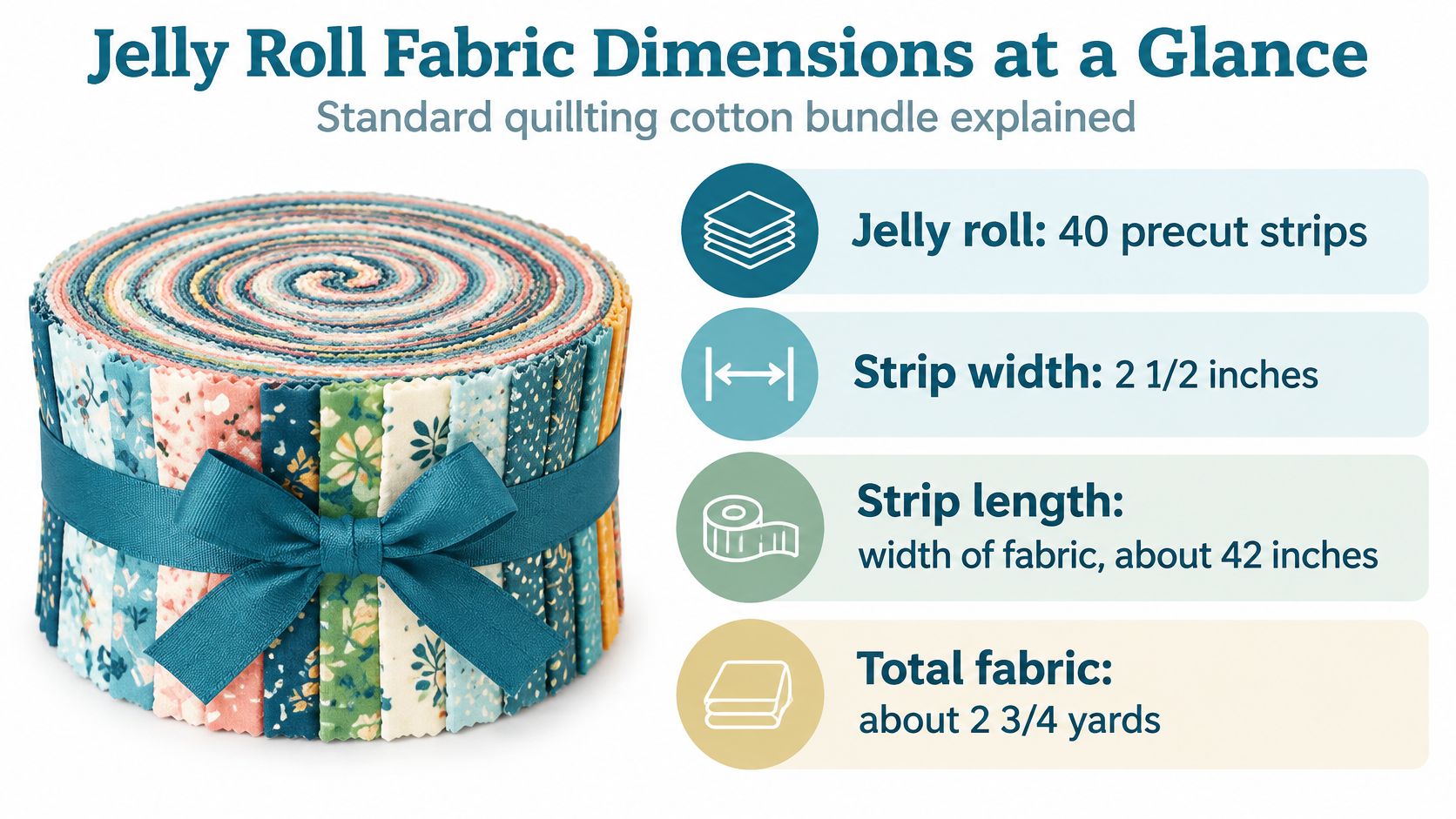
In metric units, a nominal strip measures 6.35 centimeters wide by 106.7 centimeters long. A full-size roll often has 40 strips; some contain 42, while junior rolls commonly have 20. Those counts and the usable strip length can differ by brand.
The image's “about 2 3/4 yards” label is an approximate fabric equivalent, not a promise of usable yardage. Before cutting for a pattern, measure several strips, check the sewable length after accounting for selvages and uneven ends, then test-sew a unit. Use the package count and your measurements to estimate the fabric you can use.
A 2.5-inch (6.35-centimeter) width is the standard starting point for a jelly roll strip, not a promise that every cut measures exactly the same. That width gives you a familiar size for strip piecing, while length depends on the fabric's usable width.
A common nominal length is 42 inches (106.7 centimeters). The strip runs across the fabric from selvage to selvage, so its usable length can be shorter after the selvages are trimmed or an uneven edge is straightened. Product descriptions for jelly roll precuts also describe strips cut across the fabric width.
At the machine, measure the sewable length from the cut edge, not from the outside of a selvage or a crooked tip. Check several strips with the same ruler placement, especially if a pattern calls for long joins.
Pinking can make the edge harder to read because a ruler may cross the zigzag peaks or valleys. Keep your measuring method consistent, then test-sew a short sample and check the result before cutting pieces for the pattern.
Strip count changes how much fabric you get, even when the width remains the same. A full-size roll commonly has 40 strips; some manufacturers package 42, and junior bundles commonly contain 20. Check the product label rather than assuming every roll has the same count.
| Bundle Type | Strip Count | Strip Width | Approx. Total Linear Inches | Approx. Nominal Square Inches |
|---|---|---|---|---|
| Typical full-size bundle | 40 | 2.5 inches | About 1,680 at 42 inches each | About 4,200 at 42 inches each |
| Larger-count bundle | 42 | 2.5 inches | About 1,764 at 42 inches each | About 4,410 at 42 inches each |
| Junior bundle | 20 | 2.5 inches | About 840 at 42 inches each | About 2,100 at 42 inches each |
These are arithmetic estimates using 42 inches per strip, before selvage removal or trimming. Actual usable area depends on the bundle's strip length. The nominal area calculation is strip count × strip width × strip length, so it's a way to compare packages, not a guarantee of sewable fabric.
Equivalent precuts may be sold under names such as roll-ups, Bali Pops, and rolie polies. The name can vary, so look for the dimensions and count in the product description. Compare jelly roll precuts and confirm the details before you buy for a pattern that requires a specific number of strips.
Yardage conversions can be confusing because a jelly roll is a set of narrow strips, not a continuous piece of fabric. For a 40-strip bundle, multiplying the count by the nominal 2.5-inch width gives 100 inches of strip width when the strips are laid side by side. At an assumed 42-inch strip length, the nominal area is 100 × 42, or 4,200 square inches before selvage and trimming allowances.
That's roughly equivalent in area to a piece of fabric about 100 inches long and 42 inches wide, or about 2 3/4 yards at that width. The equivalence is approximate: usable width, selvage removal, and trimming affect what you can sew. A calculation based on longer nominal strip lengths can produce a larger estimate, but it shouldn't be treated as usable yardage without checking the bundle.
For metric planning, the same estimate is about 27,100 square centimeters. That conversion is an area comparison, not a promise that the pieces can be rearranged to match every yardage-based pattern.
Use the package's stated length for your estimate, then subtract the parts that won't be sewn. This is more conservative than treating a bundle as an exact yardage substitute. For projects with a fixed cutting plan, check the listed jelly roll dimensions against the pattern before purchasing.
A quick inspection can prevent a frustrating shortage or mismatched blocks. Don't judge a whole bundle by one strip. Pull several strips and check whether their widths and lengths are reasonably consistent.
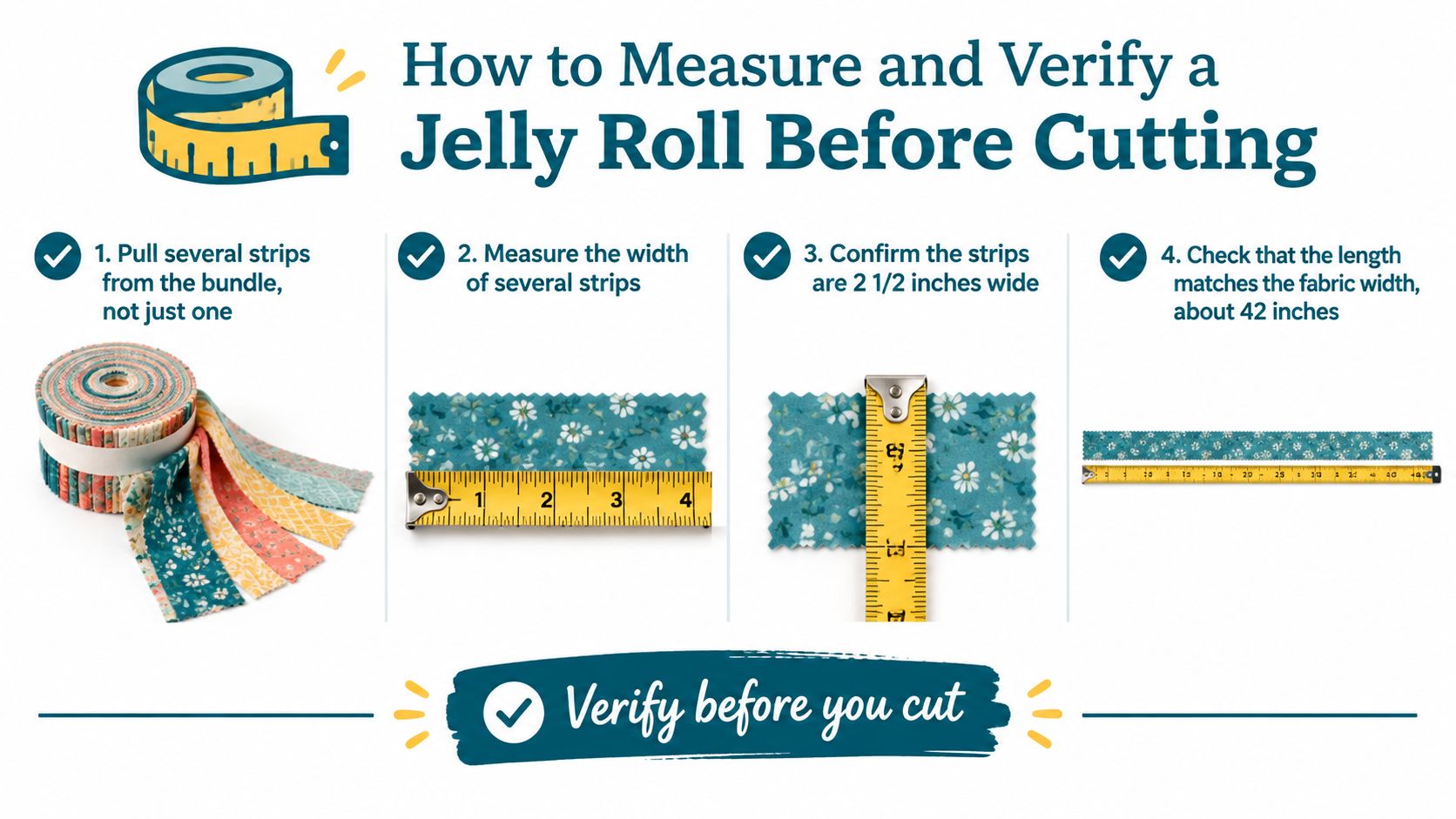
Use this check before cutting into the bundle:
The test seam tells you more than an isolated raw measurement. If the finished unit matches the pattern's expectation, you can proceed without trimming every strip. If it doesn't, check your seam allowance and how the edges were measured before deciding what to adjust.
Trim only after you've confirmed a problem. Removing fabric from every strip can reduce the length or width available for the project.
A cut measurement isn't the same as a finished measurement. With a standard quarter-inch seam, the seam takes up about 0.25 inch from each joined strip. Two strips cut at 2.5 inches therefore make a sewn strip unit about 2 inches wide. That finished width is what matters when you're checking a block or strip set against a pattern.
A consistent seam allowance is important across a long strip set. Small differences can change the finished dimensions and make pieces harder to align. If you're new to patchwork, sew a sample and measure it before making a larger unit. A scant quarter-inch seam may be called for by a pattern, but don't change your seam automatically to compensate for an unverified cut.
The same 2.5-inch cut is widely used for binding. Whether it's the right width for your quilt depends on batting thickness, how the quilt edge is constructed, and your preference. The binding's folded and sewn result, rather than the raw strip width alone, determines whether it fits your edge cleanly.
If your pattern includes a block chart, compare your sewn sample to the finished-unit measurement. That check connects the precut dimension to the result you'll build.
Which precut suits a pattern depends on the pieces it asks you to sew. A jelly roll starts with strips, a layer cake with squares, and a fat-quarter bundle with larger fabric pieces that can be cut into varied shapes. Each format is a different starting point at the cutting table.
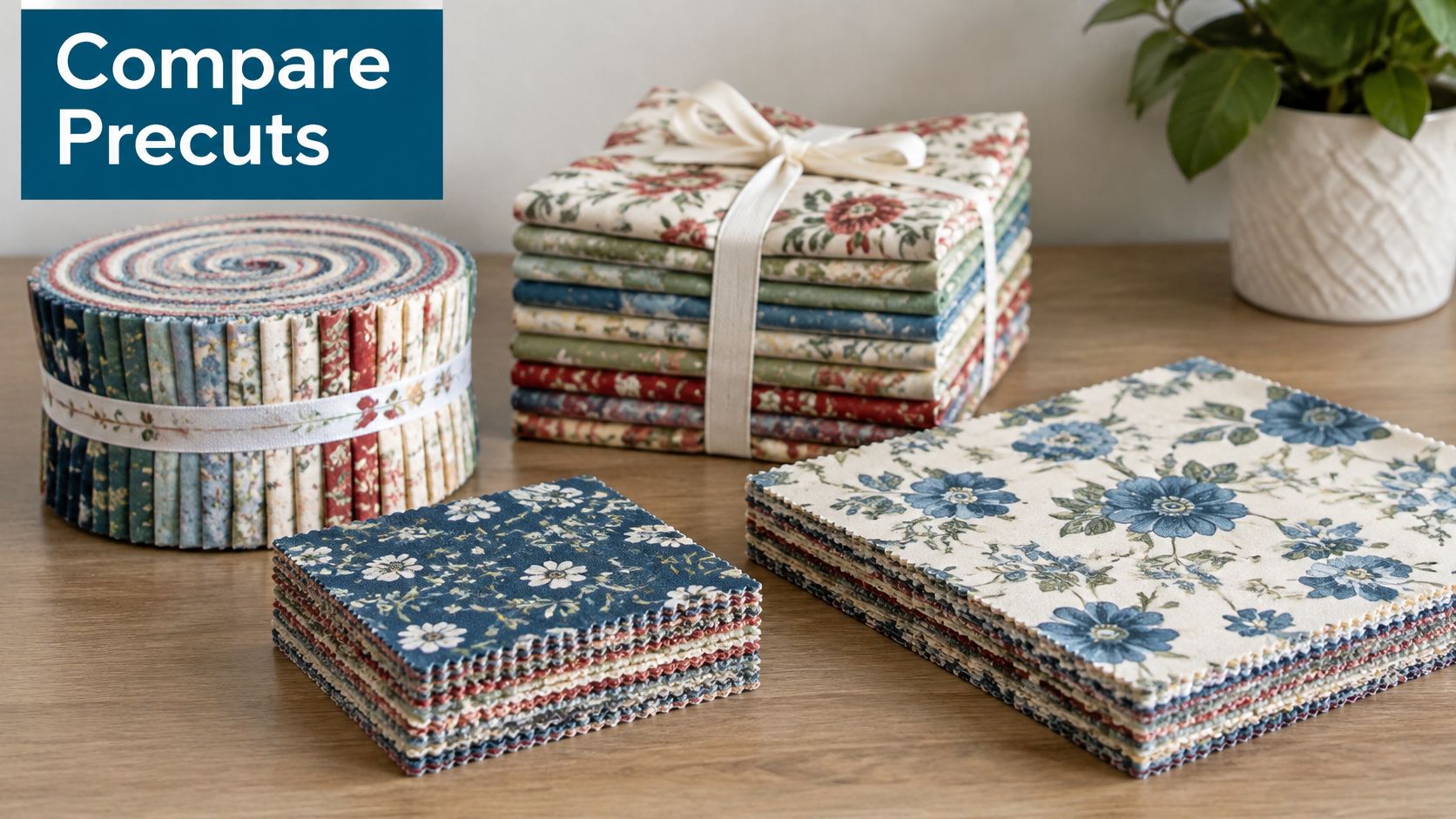
Jelly rolls work well for designs built from repeated strips, such as strip sets and rail-fence blocks. Layer cakes are convenient when a pattern uses larger squares. Fat quarters give you room to cut different shapes, though each piece may need its own cutting layout.
The names tell you the general format, not the exact usable size of every piece. Treat the familiar 2.5-by-42-inch jelly roll measurement as a starting point, then measure the strips and check how much length remains after accounting for selvages. A pattern that needs broad pieces or long cuts may call for yardage instead.
The video below shows quilting precuts and how they suit different projects.
At a shop, bring the pattern and compare its cutting list with the precuts on hand. High Country Quilts in Colorado Springs carries quilting fabrics, precuts, and notions, and staff can help beginners choose a format for a project. When comparing jelly roll listings, check the stated strip count and dimensions, then verify the bundle against the pattern before cutting.
Will the strips in your jelly roll fit the pattern as written? Check the pattern's strip count and required lengths against the bundle in your hands. A nominal 2.5-by-42-inch strip is a starting point, not a guarantee: usable length can vary with selvages, trimming, and the manufacturer.
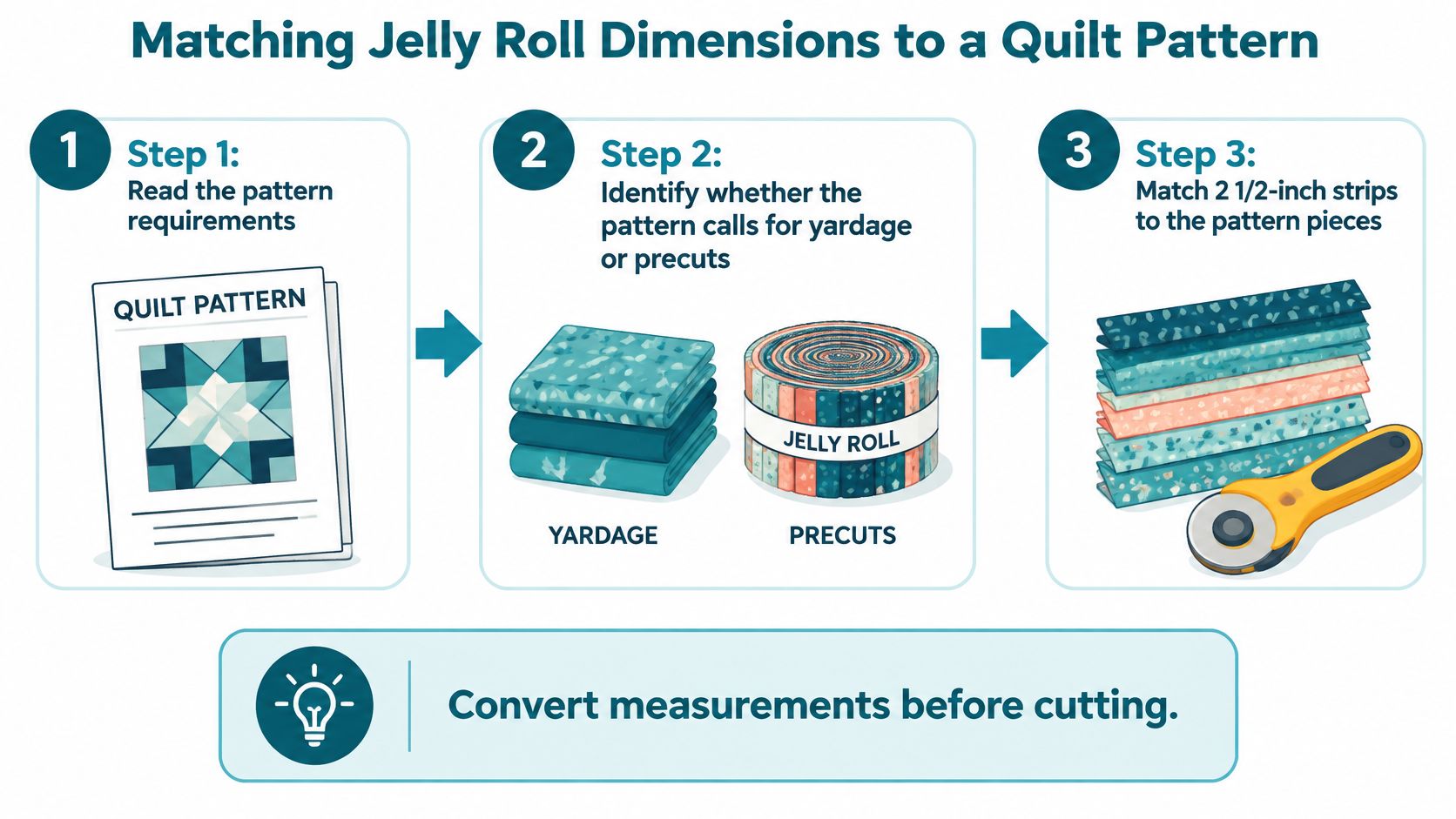
Work through the pattern's cutting list before you cut:
For example, if a pattern needs full-width strips, measure several strips and compare their shortest usable length with the pattern's requirement. Set aside any strips assigned to borders or binding before counting what remains for the main blocks. If your strips fall short, check whether the pattern allows shorter pieces or a seam. Test-sew one sample unit and measure it before cutting the rest.
A bundle can meet the strip count and still fall short on length. Patterns that require broad pieces or exact yardage may need additional fabric. Check the package dimensions and cutting instructions, then verify the fit with a sample unit before committing the roll.
A rail-fence block shows how much variety a narrow strip can create. Sew strips into a set, then crosscut that set into blocks. The strips' nominal 2.5-inch width gives you a consistent starting size, while accurate seams and the pattern's cutting measurements determine the finished block.
Log-cabin blocks also use repeated strips, arranged around a center. A jelly roll can reduce the work of preparing those pieces, though patterns vary in the lengths they require. Check that the usable strip length suits the block before you begin.
These strips also work well for table runners, bags, rugs, and race quilts built from repeated units. They can supply borders or double-fold binding, too. For binding, check the pattern's width against the quilt's batting and edge construction; the bundle's strip count and usable length determine whether you have enough.
Two strips labeled 2.5 inches may not sew into identical units. A pinked edge can be measured at its peaks or valleys, and those choices yield different readings. Trimming a pinked edge also removes fabric. Manufacturers may cut equivalent precuts slightly differently, so mixing brands, batiks, or separately purchased strips can reveal small inconsistencies.
That doesn't mean you can't combine them. It means the sewn result is a better check than the label alone. Measure a sample from each source, then sew two strips with the seam allowance your pattern specifies. Compare the finished unit with the pattern's expected measurement before cutting a full set.
If the test unit is off, check the seam first. Then decide whether a small seam adjustment or careful trimming is appropriate. Don't automatically trim every strip to make the raw edges look identical. That can reduce the fabric available for your pattern without fixing the actual cause of a mismatch.
When you mix bundles, test one unit from each fabric source before you cut for the project.
This simple check is especially useful when the pattern depends on accurately aligned strip sets. The nominal width gives you a starting point; your test-sewn unit tells you whether the pieces behave as expected.
That's the standard nominal width, but individual cuts and edge treatments can vary. Measure a sample and test-sew if your pattern depends on exact finished dimensions.
No. 40 strips is common, but some full-size bundles contain 42, and junior versions commonly contain 20. Check the package count before buying for a specific pattern.
Compare the pattern's strip count and required length with the bundle's actual contents. Use the measuring and test-sewing method above, and account separately for strips needed for borders or binding.
Often, yes. Whether a 2.5-inch strip suits your quilt depends on the batting, edge construction, and your preferred binding method. Make a test piece if you're unsure about the finished fit.
Keep three measurements in mind: a strip is nominally 2.5 inches wide, its length is often around 42 inches, and a joined unit finishes about 2 inches wide with a standard quarter-inch seam. The first two describe the precut; the third is the useful check at the sewing machine.
Before cutting, bring your pattern and bundle together and verify the count, usable length, and test-sewn measurement. If you're in Colorado Springs, High Country Quilts staff can help you compare a pattern with the fabric in the shop. Beginner classes are another place to practice strip piecing and seam accuracy with hands-on guidance.
Choose a jelly roll because its dimensions fit your project, not because the package promises a convenient shortcut. If you're ready to plan a project, visit the shop or browse the precut selection online.
Visit High Country Quilts to explore quilting fabrics, precuts, and sewing notions, or stop by the Colorado Springs shop with your pattern and jelly roll questions. Ask about beginner classes if you'd like hands-on practice measuring strips, test-sewing, and piecing with confidence.
At High Country Quilts we care deeply about community. With our experiences in retail, we know that a store is not only a place to shop but also a place for the community to gather and share. During this busy...

Hi! We’re Adam and Renee Wheaton, the new owners of High Country Quilts! For more than 40 years, we’ve owned and operated vacuum and sewing businesses. Following in Renee’s father’s footsteps after he retired from All Discount Vacuum and Sewing in Colorado...


Leave a comment