

We Love Our Quilting Community
At High Country Quilts we care deeply about community. With our experiences in retail, we know that a store is not only a place to shop but also a place for the community to gather and share. During this busy...


You're standing at the clearance table, holding a jelly roll that looks almost perfect. The colors still work. The wrap is a little rumpled. The price tag says "deal," but you're wondering whether it's a smart buy or just a bundle of leftovers someone else passed over.
That's the right question. Jelly roll fabric clearance isn't about chasing the deepest markdown. It's about buying usable strips, not buying a pretty package with a red sticker. A good clearance roll can save time, give you coordinated fabric without buying full yardage, and open the door to quick projects. A bad one can leave you short on strips, fighting frayed edges, or trying to force an incomplete collection into the wrong quilt.
A clearance jelly roll usually creates the same split reaction. First, excitement. Then suspicion.
One bundle looks untouched. Another has a torn label. A third has colors you love, but you're not sure whether the collection was discontinued for a harmless reason or because nobody wanted it. That hesitation is healthy. Shops move older stock for all kinds of reasons, and a clearance label by itself tells you nothing about whether the roll is a win for your sewing room.
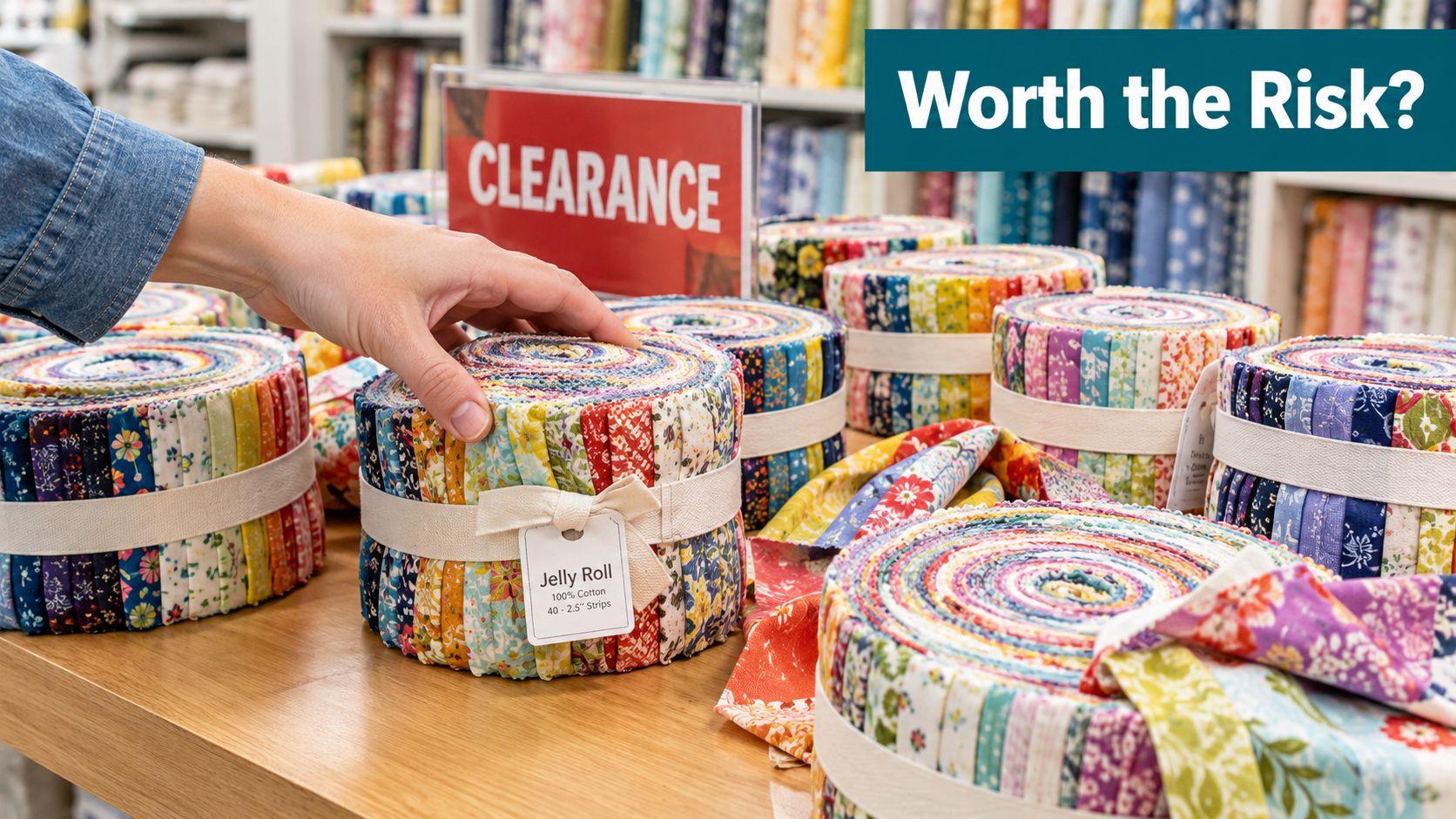
Too many quilters buy the bundle first and ask questions later. They look at the color story and the discount, then assume the rest will work itself out. It won't.
A clearance precut has to answer a few hard questions before it earns a spot in your cart:
Practical rule: If you can't name the project or at least the use, such as binding, a runner, or rail-fence blocks, leave the roll on the table.
I'd rather see a quilter buy one solid clearance roll with predictable dimensions than three cheap problem bundles. That's especially true because the jelly roll format became important not just because it's cute and rolled up, but because it turned coordinated collections into a project-ready bundle with consistent strip sizing that beginners could use right away for strip quilts, log-cabin variations, runners, and small home projects, as noted by Sherri Quilts A Lot on the history of jelly rolls.
If you shop clearance with that mindset, you stop bargain hunting and start buying on purpose.
A clearance jelly roll earns its place by the usable strips it provides, not by the size of the discount sticker.
The format became standardized through Moda Fabrics in 2006. Its appeal was practical: quilters could buy a coordinated portion of a collection, avoid cutting every strip from yardage, and begin sewing with consistent pieces. That makes the format useful for strip piecing, but only when the bundle still follows recognizable specifications.
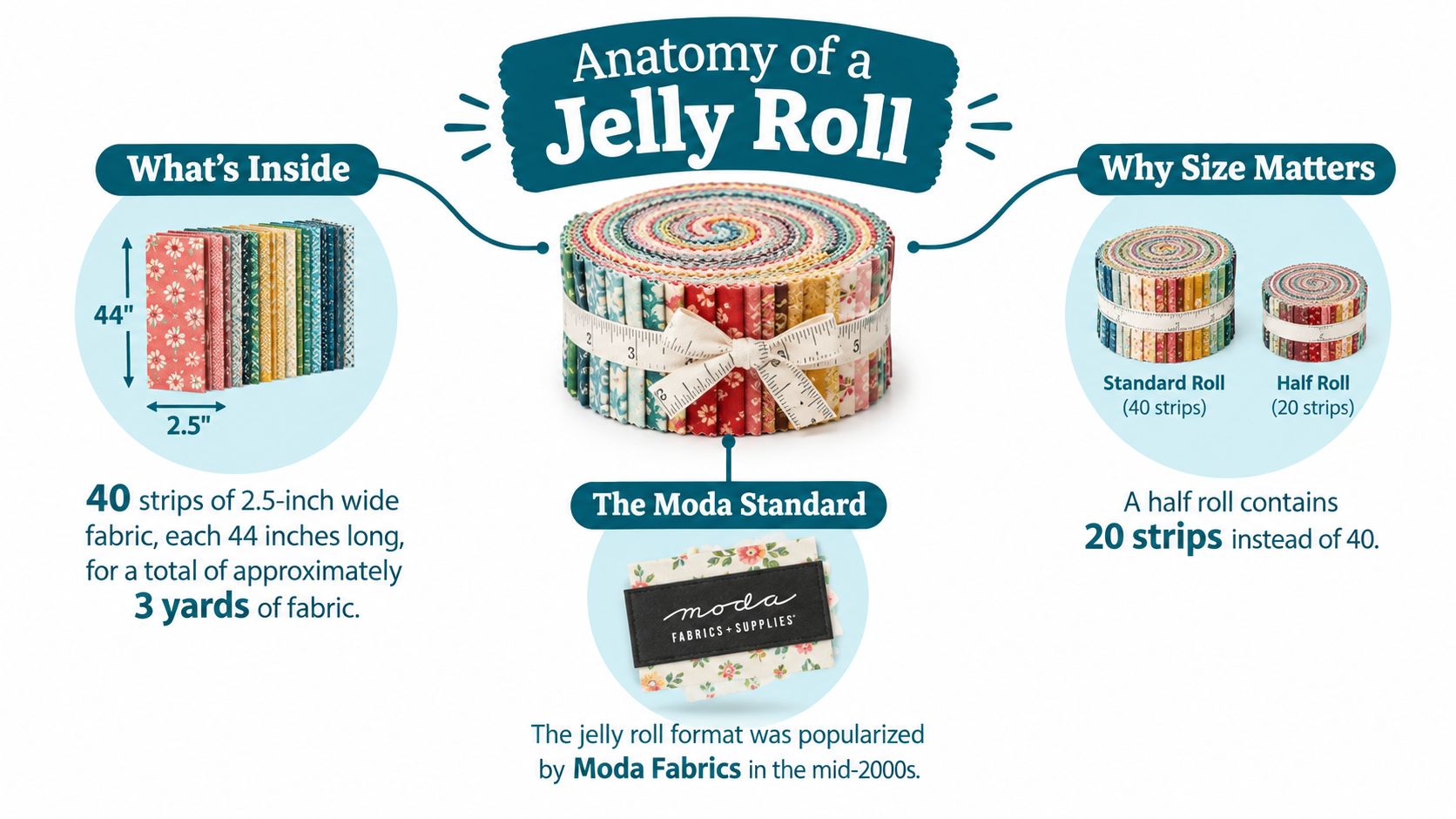
A full jelly roll commonly represents about 2.75 yards of fabric, although the equivalent depends on the strip count and the manufacturer's cutting specifications, as shown on Missouri Star's Honeycrisp jelly roll listing. The standard format uses strips 2.5 inches wide and usually cut across the usable width of quilting cotton.
That format affects your project in three direct ways:
Use Missouri Star's jelly roll collection guide to compare a clearance package with the standard format, then check the actual label before assuming it qualifies. A discontinued collection can still be an excellent buy, but only if its contents fit the project you have in mind.
With a quarter-inch seam allowance on both sides, a strip finishes at about 2 inches wide, according to Quilt Keeper Studio's precut guide. That finished width makes strip sets and simple panels predictable. For example, 20 strips sewn side by side create a panel roughly 40 inches wide before borders, sashing, or quilting shrinkage.
The cost per usable strip matters. A roll with uneven edges, short pieces, or missing strips may offer less working fabric than its label suggests. For a table runner, binding, or scrappy blocks, an incomplete collection may work well. For a pattern requiring a coordinated set, it can leave you short halfway through.
Buy the clearance roll for the project it can complete, not for the collection name printed on the wrapper.
Some manufacturers change the strip count, and junior rolls commonly contain 20 strips instead of roughly 40 in a full roll. The label's dimensions and contents matter more than the word “jelly roll.” If the package does not identify the strip count, width, or length, treat that missing information as a warning and price the bundle by the strips you can use.
Clearance doesn't automatically mean damaged. In quilting, it often means the collection got old before the fabric got bad.
That's normal in a category with steady demand and constant product turnover. A 2025 report from Craft Industry Alliance, citing Quilting Trends Survey results, estimated the annual U.S. quilting market at approximately $4.5 billion, up from $4.2 billion in 2020, $3.6 billion in 2010, and $1.8 billion in 2000. The same report estimated 9 to 11 million active quilting consumers, with 64% preferring local quilt shops and 13% preferring online purchasing, according to Craft Industry Alliance's quilting market survey summary.
In a market that large, collections keep cycling. Shops can't leave every seasonal line, designer print, or color story on the shelf forever. They need room for newer collections, and older precuts become prime clearance candidates even when the fabric is still perfectly useful.
That's why jelly roll clearance usually falls into one of these buckets:
A smart buyer doesn't ask, “Why is this cheap?” and stop there.
Ask better questions:
Most clearance jelly rolls are useful because the strip format still solves the same problem it solved at full price. You get coordinated, project-ready fabric without cutting it yourself.
If you treat clearance as inventory rotation first and possible defect second, you'll inspect the right things and skip the drama.
You find a clearance roll with a tempting sticker, but the outer strip is faded and the packaging feels loose. Put it back until you know what you are buying. Clearance shopping is not bargain hunting. It is a cost-per-usable-strip decision, and inspection determines how many strips you can sew.
A full-price bundle usually has recent stock and intact packaging. A clearance roll may have spent longer on a shelf, been opened, or lost pieces from the original collection. Check the fabric, not the label.
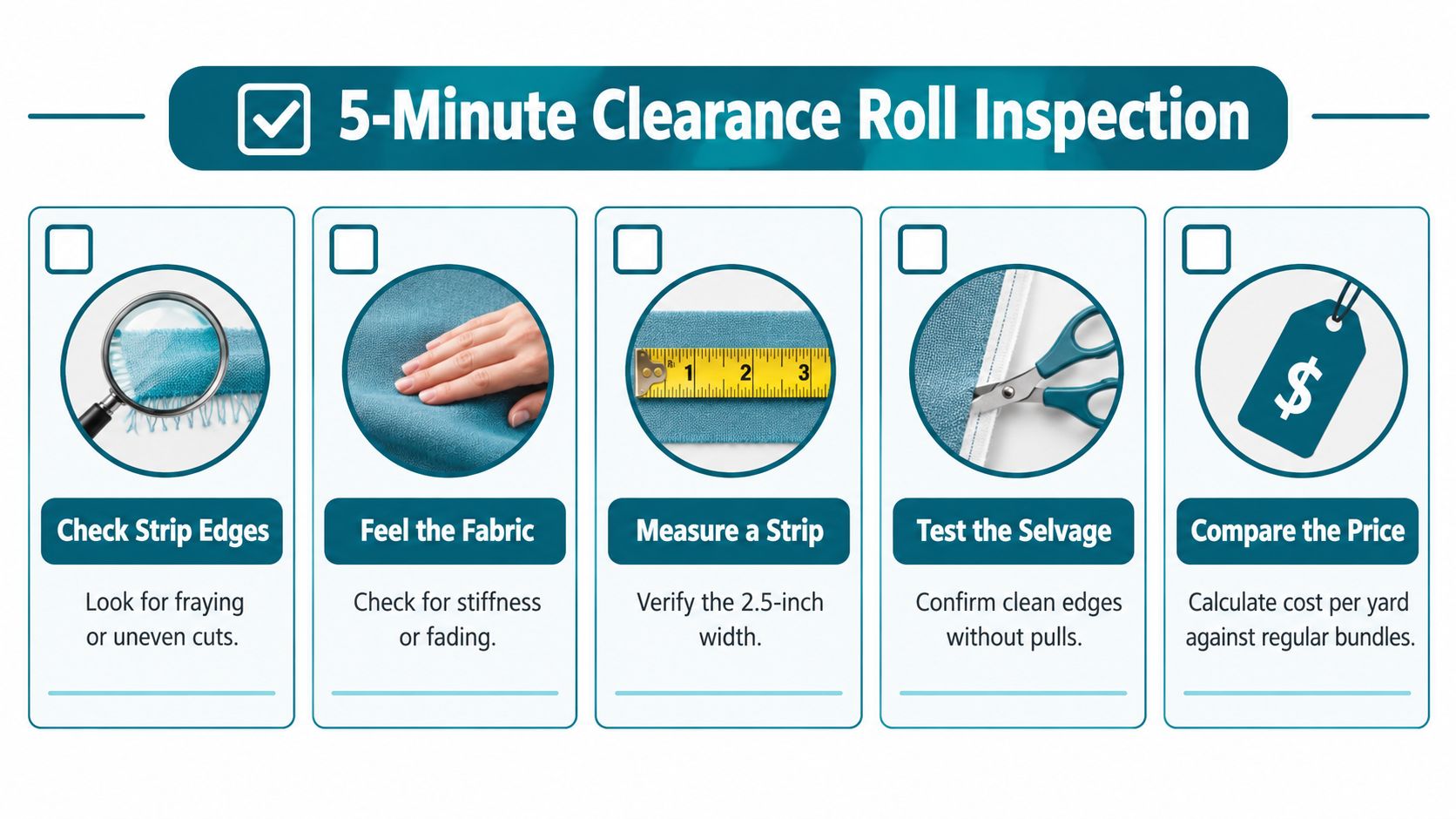
Begin with the inspection routine rather than the sticker price. As covered above, a standard roll contains 40 strips cut at 2.5 by 42 to 44 inches, although manufacturers vary. Any noticeable loss of width or length reduces the projects the bundle can support.
For an incomplete collection, inspect the color balance as well. A roll missing a few prints may still suit string blocks, log cabins, table runners, or scrappy bags. Skip it for a pattern that depends on every fabric in a coordinated sequence.
Quilting cotton can shrink by approximately 3% to 5% after warm washing and tumble-drying. On a 44-inch strip, that removes roughly 1.3 to 2.2 inches of length. The same guidance warns that a 1/16-inch width error repeated across 20 strips can accumulate to about 1.25 inches. Read Handmadelytics' guide to fabric shrinkage and handling before combining clearance strips with prewashed fabric or relying on precise strip-piecing.
Buy intact packaging when possible. Factory-cut convenience depends on consistent width from the first strip to the twentieth.
Leave the roll behind if it has:
A low price cannot repair damaged fabric. Buy the roll only when its usable strips match a project you can make, even if the original collection is incomplete.
A $25 roll with six damaged strips may appear inexpensive. If the package lists 40 strips, the sticker price works out to about $0.62 per listed strip, but the six unusable pieces raise the cost to about $0.74 per usable strip. That difference decides whether the clearance price deserves your money.
Use this calculation:
Effective cost per usable strip = bundle price ÷ strips you can use
Inspect the roll before doing the math. Remove strips with heavy fraying, severe distortion, strong fading, or cuts too narrow for your project. Then compare the remaining fabric with the price of equivalent yardage. A standard jelly roll often contains roughly 40 strips measuring about 2.5 inches by 42 to 44 inches, representing about 2.5 to 2.75 yards, but pack contents vary by manufacturer. Quilt Shop Atlas on evaluating jelly roll value explains why usable content gives a more reliable comparison than the label alone.
A complete, clean roll usually beats an open bundle with a larger markdown. The open bundle can lose value through damaged strips, unwanted duplicates, or off-grain cuts that make accurate piecing harder.
| Offer Type | Strips Included | Usable Yardage Equivalent | Value Per Strip |
|---|---|---|---|
| Complete clearance roll | Full advertised count | Closest to listed bundle value | Usually strongest when the fabric is clean |
| Open bundle with minor issues | Lower effective count after inspection | Reduced by damaged or unusable pieces | Worthwhile only if the usable count supports the price |
| Mixed or incomplete bundle | Varies and may be uncertain | Difficult to compare with yardage | Often less economical than it first appears |
A lower price works when the remaining strips suit what you plan to sew. An incomplete roll can serve well for binding, table runners, string blocks, log cabins, or scrappy bags. A coordinated pattern that depends on every print is a poor match unless the bundle is complete and clean.
Use this quick test:
If the adjusted cost feels too high after you remove weak strips, leave the bundle behind. A loud clearance label cannot restore fabric you cannot sew.
For a broader comparison of jelly roll precuts and fabric strips, evaluate completeness, dimensions, condition, and project fit alongside the sale price. A genuine bargain gives you enough reliable strips for a project you already want to make.
A clearance roll earns its place when the project can handle variation. A coordinated pattern that depends on every print is a poor choice for an incomplete bundle. Choose designs where color, texture, and usable strip count matter more than a perfect collection.
Start by sorting the strips. Group them by light, medium, and dark value, remove damaged pieces, and reserve shorter or narrower strips for small units. This approach also helps when planning with mixed precuts, as explained in The Polka Dot Chair's guide to precut fabrics and project planning.
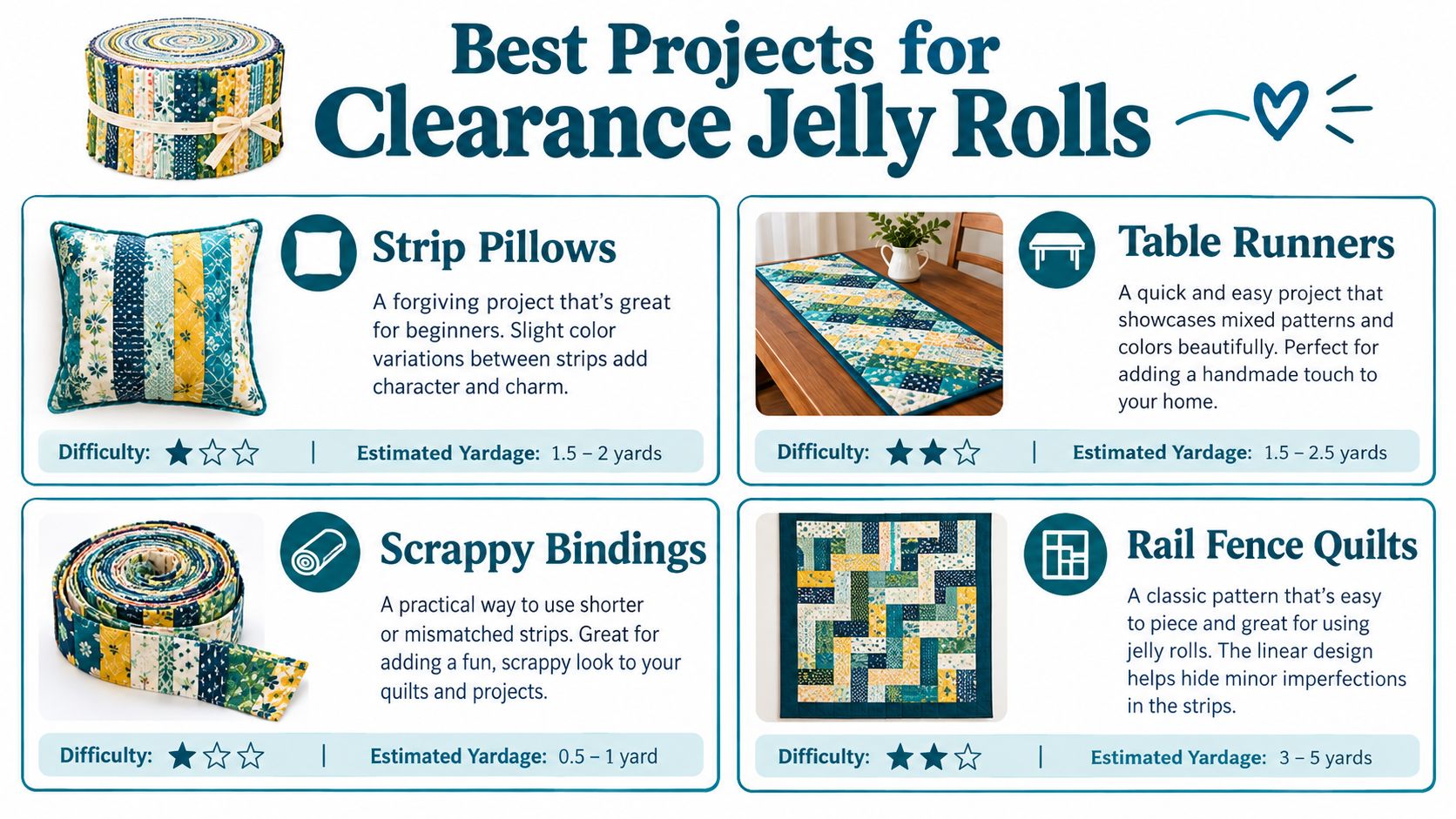
These projects make the best use of clearance rolls:
Plan from usable strips, not the label. For example, a 40-strip roll can provide about 10 binding sets if each set uses four strips, before trimming and seam allowances. The same roll can produce roughly 13 four-strip rail-fence units if each unit consumes three strips, though block size and waste will change the result. Count your clean, full-length strips before choosing the pattern.
A support fabric can turn a partial roll into a cohesive project. A solid blender or background fabric can:
A discontinued collection does not lower the quality of your project. Poor project matching does.
Leave a damaged or incomplete clearance roll for another use if the pattern requires:
Those designs need predictable materials. Clearance rolls work better for flexible projects where you can remove weak strips, rearrange values, and add a background fabric without disrupting the design. Judge the purchase by its cost per usable strip, not by the discount label.
Online clearance saves time and expands your choices. A local quilt shop gives you evidence before you pay. For a clearance jelly roll, that difference affects the cost per usable strip, not just the sticker price.
At a local shop, you can unroll the bundle on the cutting table, count the strips, check their length, and look for fading, odor, fraying, or distortion. You can also see whether the collection works together in person. A quick inspection may reveal that a discounted roll has fewer usable strips than its label suggests, or that several pieces will not suit your planned project.
Local staff can answer practical questions that online photos cannot:
That advice matters when a discontinued collection is incomplete. A shop employee may suggest a coordinating solid, help you replace weak strips, or steer you toward a runner, binding, or small accessory instead of a quilt that depends on exact sequencing. Skilled help often saves the project before you spend more fabric to rescue it.
Online shopping works when the listing gives you enough information to judge fabric rather than packaging. Look for:
If the seller will not confirm the count, condition, or measurements, skip the listing. A low price does not compensate for unusable strips, shipping costs, or a project that no longer fits the bundle.
Buy locally when you need predictable material for a specific quilt top or want help matching substitutes. Buy online when you are building stash or choosing a flexible project, and the listing provides enough detail to calculate usable value.
The right decision depends on what you need to verify. Local inspection protects accuracy. Online clearance can deliver value when the seller provides real details and your pattern allows changes. Judge the roll by its usable strips and project fit, not by the discount label.
A clearance roll earns its place only when it provides usable material for a project you can finish. Use this order before paying:
Walk away if more than 2 of 40 strips are unusable, or if the price per usable strip exceeds full-price yardage. That rule makes clearance shopping a cost-per-usable-strip decision, not a race to the lowest sticker.
Incomplete or discontinued collections suit forgiving projects, including scrappy runners, binding, pillows, bags, and small accessories. Skip patterns that require exact strip sequencing or a complete coordinated set. Buy locally when you need to inspect the roll or match substitutes. Shop online when the listing provides enough detail for the calculation and the project tolerates variation.
For quilting fabric, precuts, and sewing essentials, shop with the project and pass/fail rule ready. A discount is a win only when the usable strips, condition, and project fit justify the purchase.
At High Country Quilts we care deeply about community. With our experiences in retail, we know that a store is not only a place to shop but also a place for the community to gather and share. During this busy...

Hi! We’re Adam and Renee Wheaton, the new owners of High Country Quilts! For more than 40 years, we’ve owned and operated vacuum and sewing businesses. Following in Renee’s father’s footsteps after he retired from All Discount Vacuum and Sewing in Colorado...


Leave a comment