
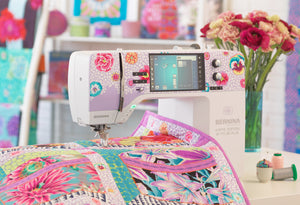

We Love Our Quilting Community
At High Country Quilts we care deeply about community. With our experiences in retail, we know that a store is not only a place to shop but also a place for the community to gather and share. During this busy...


If you want your quilts to look sharp and professional, you have to start with one thing: precision. Forget thinking of quilting rulers as just measuring sticks. They are your single most important tool for getting clean, accurate cuts, which is the bedrock of any good quilt. The basic idea is simple: you line up the ruler's grid with your fabric, hold it down so it doesn't budge, and run a rotary cutter along the edge. That's how you get a perfect cut, every single time.

Walking into a quilt shop and seeing a wall of rulers can be intimidating. There are dozens of shapes and sizes! But here's a secret: you really only need a few to get started and tackle most patterns. Let’s cut through the noise and focus on the workhorses that will form the foundation of your toolkit. Getting these basics right from your very first project will build your confidence and set you up for success.
You'll find that a small collection of core rulers can handle the vast majority of cutting tasks you'll encounter. Think of these three as your non-negotiables.
For general measuring and marking, a simple clear plastic ruler set is also great to have on hand for tasks outside of rotary cutting.
Here's a quick comparison of the three fundamental ruler types, their primary uses, and which sizes are most practical for new quilters.
| Ruler Type | Primary Use | Why It's a Must-Have | Recommended Beginner Size |
|---|---|---|---|
| Long Straight Ruler | Cutting strips from yardage; trimming quilt edges. | Its length makes cutting across folded fabric a one-step process. | 6.5" x 24.5" |
| Square Ruler | "Squaring up" pieced blocks to the correct size. | Guarantees all your blocks are uniform for perfect piecing. | 6.5" x 6.5" or 12.5" x 12.5" |
| Specialty Template | Cutting non-standard or repeating shapes (triangles, hexagons, etc.). | Saves time and ensures complete accuracy for complex designs. | Based on project needs. |
Starting with a long ruler and at least one square will equip you for almost any beginner pattern out there. You can always add specialty rulers to your collection as your skills and project ambitions grow.
Okay, let's talk about all those lines. At first, a quilting ruler can look like a confusing jumble, but those markings are your roadmap to accuracy.
Most rulers are gridded in 1/8", 1/4", 1/2", and 1" increments. The line you'll use most often is the 1/4" mark, as that’s the standard seam allowance for almost all quilting patterns. You'll also spot angle lines, typically at 30, 45, and 60 degrees. These aren't just for show—they are critical for cutting the angled pieces needed for classic quilt blocks like stars and flying geese.
A Quick Tip from Experience: When you measure, always line up the line on the ruler with the edge of your fabric, not the physical edge of the ruler itself. That tiny bit of clear plastic at the ruler's edge isn't part of the measurement. It’s a classic beginner mistake that can throw off your entire block.
It's an exciting time to be a quilter. The craft has seen a huge resurgence, with the global quilt market projected to grow from USD 5.5 billion in 2025 to over USD 7.2 billion by 2032. That's a lot of people discovering the joy of creating with fabric! By investing in a few quality rulers, you're setting yourself up to be part of that vibrant community.

Before you ever make that satisfying zip of the rotary cutter, your most important work has already begun. I've learned over countless projects that a little bit of prep work isn't just a chore—it's the secret ingredient for clean, accurate cuts. Setting up a dedicated and organized space is the first habit every successful quilter masters.
This isn't just about being tidy. It's about building a system that prevents mistakes before they happen. Let’s walk through how to prepare your fabric and your cutting station so you can cut with confidence.
The age-old question: to wash or not to wash? From my experience, the answer is a firm "yes." Always pre-wash your quilting cottons. New fabric can shrink up to 3-5% after its first trip through the laundry, and you want that to happen before you've spent hours cutting it into precise pieces.
Washing also rinses out any factory starches and finishes, which helps prevent color bleeding and gives you a truer sense of the fabric’s hand. Once it’s washed and dried, give it a thorough press with a hot, steamy iron. You’re aiming for a perfectly smooth, flat surface. Trust me, wrinkles are the enemy of accuracy.
Think of it this way: a well-pressed, pre-shrunk piece of fabric is your stable foundation. It's the only way to ensure your ruler and cutter can do their jobs properly.
With your fabric pressed, the next step is to find the grainline. This is just a fancy term for the direction of the threads, and it’s a game-changer for preventing your quilt blocks from stretching and warping.
The lengthwise grain runs parallel to the selvages (the tightly woven edges of the fabric) and has almost no stretch. The crosswise grain runs from one selvage to the other and has a little more give. For stable pieces that hold their shape, you want your cuts to follow these grainlines.
Here’s the simplest way to get a straight, on-grain edge:
This simple fold gives you a reliable starting point for your first cut. It’s a fundamental technique for knowing how to use quilting rulers to create perfectly straight strips that won’t distort when you sew them.
Your physical setup directly impacts your accuracy and, just as importantly, your safety. A functional space makes the process feel calm and meditative, while a cluttered one leads to frustration and mistakes.
Key Elements for a Functional Cutting Space:
Taking the time to set up your space and prepare your fabric properly eliminates most of the variables that cause cutting errors. It frees you up to focus on what matters: using your quilting rulers to get that perfect cut, every single time.
You've got your station ready and your fabric is prepped—now for the fun part. This is where the real magic of quilting rulers happens, turning all that careful measuring into clean, precise cuts. It’s all about the physical technique. A steady hand and a smooth cutting motion are what separate frustrating, wobbly edges from those satisfyingly perfect pieces.
Let's get into the nitty-gritty of how experienced quilters get those flawless results. You'll find it’s less about brute force and more about smart technique.
A ruler that slips mid-cut is probably the biggest culprit behind inaccurate cutting. To prevent this, you need to apply firm, even pressure, and the best way I’ve found to do this is with what we call the "starfish hand."
Instead of clumping your hand in the center of the ruler, spread your fingers out wide. This simple change distributes the pressure and creates way more friction to hold it in place. I like to anchor my pinky and thumb on the cutting mat, right off the ruler's edge. Then, I use my other three fingers to press down firmly on the ruler itself.
Key Takeaway: Always keep your fingertips a safe distance from the cutting edge. The "starfish" spread gives you incredible control without ever putting your fingers in the path of the blade.
This technique is your best defense against a ruler that wants to pivot or slide. It might feel a little strange at first, but trust me, after a few practice sessions, it will become second nature.
Once that ruler is locked in place, your cutting motion should be confident and smooth. The goal is to slice right through the fabric in one fluid pass. If you stutter or have to stop and restart, you’re likely to get little nicks and uneven spots.
Posture and Arm Position:
As soon as you finish a cut—every single time—click that safety guard back over the blade. It's a tiny habit that prevents major accidents. A study on craft-related injuries highlighted that lacerations from sharp tools are incredibly common, and an exposed rotary blade is just asking for trouble. For those looking to take their skills even further, understanding the principles of achieving clean, professional edges with specialized cutting tools can be incredibly helpful across all sorts of materials.
Here’s a piece of wisdom that might sound backward at first: a sharp blade is a safe blade. It’s absolutely true. When your blade is dull, you have to push down much harder, which dramatically increases the chance of slipping and losing control. A dull blade also tends to chew and fray your fabric instead of giving you a clean slice.
How to Know When Your Blade is Dull
| Sign of a Dull Blade | What It Looks Like | Why It's a Problem |
|---|---|---|
| Skipped Threads | You make a cut, but it leaves tiny, uncut threads connecting the fabric pieces. | This creates a ragged edge that will mess up your seam allowance and look messy. |
| Increased Pressure | You realize you’re really bearing down to get the blade through the fabric. | This is a major red flag for slips and puts you at a much higher risk of injury. |
| Jagged Edges | Instead of a crisp, clean line, the fabric edge looks fuzzy or frayed. | This means the blade is tearing fibers apart instead of slicing them cleanly. |
There’s no set rule for how long a blade lasts; it all depends on what you’re cutting and how often you're quilting. The moment you spot any of these signs, it's time to swap it out. And please, dispose of old blades safely. Never just toss one in the trash can. Use a dedicated blade disposal case or, at the very least, wrap the old blade securely in thick tape before you throw it away.
Once you've gotten the feel for your ruler and rotary cutter, it’s time for the fun part: turning that beautiful yardage into the basic shapes that form almost every quilt block. We’re talking about those crisp squares, rectangles, and triangles that are the building blocks of quilting.
The whole process is incredibly satisfying. It starts with creating one perfectly straight edge on your fabric—this is the most important step for accuracy. From that clean line, we'll slice precise strips and then "sub-cut" those strips into the smaller pieces we need. Let’s get cutting.
You simply can’t get accurate pieces if your starting point is crooked. Fabric rarely comes off the bolt with a perfectly straight edge, so our first job is to create one. Quilters call this "squaring up" your fabric, and it creates a reliable line to measure everything from.
First, take your pressed fabric and fold it in half, lining up the two selvage edges (the tightly woven sides that don't fray).
Lay the folded fabric on your cutting mat with the fold nearest to you. Smooth out any wrinkles and make sure those selvages are stacked perfectly. Now, place a long quilting ruler across one side of the fabric. The key is to align one of the horizontal lines printed on your ruler with the fabric's folded edge. This guarantees your ruler is perfectly square to the grain.
With your ruler held firmly, trim a very thin slice off the raw-cut side. This gets rid of any wonky, frayed bits and gives you a brand-new, perfectly straight edge that's at a 90-degree angle to the fold.
With a squared-up edge, cutting uniform strips is a breeze. This is probably the most common cut you'll make as a quilter.
Let's say you need to cut a 2.5-inch strip. Lay your fabric on the mat with your new straight edge on the left (or on the right if you’re a lefty). Place your ruler on top, aligning its vertical 2.5-inch line directly over that clean-cut edge. The bulk of the ruler should be covering the fabric you intend to keep.
Before you cut, do a quick double-check: is a horizontal line on your ruler still running parallel to the bottom fold? This two-point alignment is your secret weapon for a perfectly even strip. Using your "starfish" hand to hold the ruler down, glide the rotary cutter along the ruler's edge. You’ve just cut a perfect strip!
My best advice here is to focus on consistent pressure. It’s so easy to let the ruler drift, especially at the end of a long cut. If you feel it shift even a tiny bit, stop. It's always better to take a moment to realign than to end up with a wobbly strip.
This diagram is a great visual reminder of the "position, press, cut" motion that keeps your ruler from slipping.

Breaking the action down like this—placing your hand, applying firm pressure, then making the cut—really helps build the muscle memory you need for a no-slip grip every time.
"Sub-cutting" is just the quilter's term for cutting your long strips into smaller units. Let's turn that 2.5-inch strip into a stack of perfect 2.5-inch squares.
Unfold your strip and lay it horizontally on your mat. Just like when you squared up your yardage, you need to clean up the short end of the strip first. Place a square ruler on one end, line up one of its horizontal lines with the long edge of the strip, and trim off the very end to make it perfectly square.
Now, to cut your first square, align the 2.5-inch vertical line on your ruler with that newly squared-off end. Make your cut, and you have a perfect 2.5-inch square. Keep moving your ruler down the strip and repeating the cut to create as many squares as you need.
Triangles seem tricky, but your quilting ruler has a secret weapon built right in: the 45-degree line. You’ll find this on almost any square or rectangular ruler.
To Cut Half-Square Triangles (HSTs):
To Cut Quarter-Square Triangles (QSTs):
Getting comfortable with these foundational cuts is truly the key to accurate piecing. If you'd like to build your confidence with some in-person practice, we offer beginner-friendly classes right in our Colorado Springs shop where you can get hands-on help.
Of course. Here is the rewritten section, crafted to sound like it's from an experienced quilter.
We've all been there. You take a deep breath, make your cut, and... it's wrong. A strip that’s just a little bit off, or a block that suddenly won’t play nice. Let me be the first to tell you: cutting mistakes happen to everyone. The goal isn't to be perfect, but to become a great detective and figure out what went wrong.
Think of these little hiccups as puzzles. Once you understand why a cut veered off course, you'll know exactly how to prevent it from happening again. Let’s break down the most common issues I see and the simple fixes that will get your project back on track.
You’ve just cut what you believe is a perfect strip from your gorgeous new fabric. But when you unfold it, it has a gentle, infuriating curve. Welcome to the club! We call this a "banana strip," and it’s probably the most frequent frustration for quilters learning to master the rotary cutter.
Nine times out of ten, this is caused by the ruler slipping or pivoting just a tiny bit while you cut. It usually happens right at the beginning or end of a long cut, where the pressure from your hand is less consistent. You might be pushing down hard in the middle of the ruler, which causes the ends to lift and shift ever so slightly.
How to Fix It:
If the curve is very slight, you can sometimes salvage the strip. A good press with plenty of steam can relax the fabric fibers enough to straighten it out for a less critical piece. But for a noticeable curve, it's better to accept the loss, relegate that piece to the scrap bin, and cut a new, accurate strip.
Here’s a little trick that changed the game for my long cuts: "walk" your hand up the ruler. Start your cut, slice for about 10-12 inches, pause with the blade still in the fabric, and then carefully reposition your non-cutting hand further up the ruler before you continue the cut. This maintains even pressure the whole way.
So what happens when your ruler grip is solid, but the fabric itself seems to be bunching up or sliding around underneath? This is another common headache that can result in a strip that’s narrower on one end.
When this happens, the problem usually isn't your cutting technique, but your setup. The culprit is often the fabric itself or how it’s positioned on your mat.
Common Causes and Solutions:
"Squaring up" is how we make everything right with the world again. It's the essential process of trimming a pieced quilt block down to its perfect, unfinished size after you’ve sewn it. Seams can pull and stretch the fabric slightly, making your block a little wonky. Squaring up is the magic eraser that fixes it.
This is where a good square ruler is worth its weight in gold. Let’s say you’ve pieced a block that’s supposed to be 6.5 inches square. You’ll grab your 6.5-inch (or larger) square ruler to trim it down to size.
Don't just line it up with the edges. Place the ruler over your block and look for key reference points inside the block—a diagonal line, a center seam, or a corner where four patches meet. Align those points with the corresponding markings on your ruler. This ensures your design stays perfectly centered. Trim the top and right sides first. Then, rotate the block 180 degrees, line up your newly cut edges with the 6.5-inch marks on the ruler, and trim the final two sides.
This one step is the secret to getting all your blocks perfectly identical. And when your blocks are identical, your points match up beautifully and your final quilt top lays perfectly flat.
Once you get the hang of the basics, a few nagging questions always seem to pop up. It happens to every quilter! Getting these figured out is often the key to making your piecing sharp and accurate.
Let's walk through some of the most common questions I hear from quilters in our shop and classes. Getting these answers straight will help you cut with more confidence and less frustration.
Ah, the dreaded ruler slip. We've all been there—you're halfway through a cut when the ruler shifts, and just like that, your perfect strip is ruined. It’s hands-down the most common frustration for new quilters.
The best defense is a good offense with your non-cutting hand. Spread your fingers out wide, like a starfish, and apply firm, even pressure. The trick is to anchor the ruler with your fingertips and the heel of your hand, keeping it pinned to the fabric.
If you’re still struggling, or you’re cutting lots of long strips, do yourself a favor and get some ruler grips. These are little sandpaper or silicone stickies you put on the underside of your ruler. They add an incredible amount of traction and are a total game-changer for preventing those wobbly cuts.
You might see that office ruler on your desk and be tempted to use it. Please don't! It’s a recipe for disaster.
Quilting rulers are built for one specific job: to be used with a rotary cutter. They are made from a thick, durable acrylic—at least 1/8-inch thick. This thickness creates a safety wall that guides the rotary blade and, more importantly, keeps it from jumping over the top and cutting your fingers. A thin office ruler offers zero protection.
Beyond safety, quilting rulers have all the markings we need for patchwork.
The thickness isn’t just about safety; it’s for accuracy. That substantial edge helps hold your rotary blade perfectly straight, stopping it from veering off course and giving you a cut you can trust.
There's no magic number here. How often you change your blade depends entirely on how much cutting you're doing. The real answer is: change it the moment you notice your cuts aren't perfect anymore.
The quilting world has exploded in recent years, meaning we have access to incredible tools. You can see just how much the hobby has grown by looking at the industry data. For some fascinating insights, check out the growth of the quilt market on Research and Markets.
Watch for these telltale signs of a dull blade:
Pushing down on a dull blade is not only frustrating but also dangerous. The extra force makes it much more likely your hand will slip.
Absolutely! This is where you really start to unlock your ruler's potential. Take a look at your standard rectangular ruler—see those lines for 30, 45, and 60 degrees? That's your roadmap to cutting perfect triangles, diamonds, and all the pieces for classic patterns like flying geese and stars.
To use them, you just align the printed angle line with the straight edge of your fabric or a previous cut. It takes all the guesswork out of cutting precise geometric shapes. As you get more adventurous, you’ll find specialty rulers designed for cutting curves, circles, hexagons, and more, making even complex patterns totally achievable.
Here at High Country Quilts, we know that having the right tools and a bit of guidance makes all the difference. Whether you need a new ruler, a fresh rotary blade, or just some friendly advice, our team is here to help you on your quilting journey. Come visit us at hcquilts.com to browse our quilting essentials and check out our class schedule.
At High Country Quilts we care deeply about community. With our experiences in retail, we know that a store is not only a place to shop but also a place for the community to gather and share. During this busy...

Hi! We’re Adam and Renee Wheaton, the new owners of High Country Quilts! For more than 40 years, we’ve owned and operated vacuum and sewing businesses. Following in Renee’s father’s footsteps after he retired from All Discount Vacuum and Sewing in Colorado...


Leave a comment