
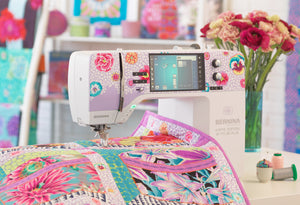

We Love Our Quilting Community
At High Country Quilts we care deeply about community. With our experiences in retail, we know that a store is not only a place to shop but also a place for the community to gather and share. During this busy...


You finish a quilt top, lower the feed dogs, take a breath, and start free-motion quilting. For the first few inches, it feels promising. Then the stitches change size. Some look long and loose, others stack up too tightly, and the graceful design you had in mind starts to look hesitant.
That moment frustrates almost every new free-motion quilter.
The hard part usually isn't the design itself. It's coordinating your hands and the machine at the same time. You're trying to guide the quilt smoothly while also matching machine speed to your movement. A stitch regulator changes that relationship. Instead of managing both jobs at once, you guide the fabric and let the machine respond to your pace.
If you're learning how to use a stitch regulator, the good news is that this tool doesn't require you to become highly technical overnight. It helps translate your hand motion into more even stitches, which makes quilting feel less like a balancing act and more like drawing with thread.
Free-motion quilting gives you freedom that regular stitching doesn't. You can move in curves, loops, pebbles, swirls, and organic fills. But that freedom creates a new challenge. The machine no longer feeds the fabric for you, so your hands take over that job.
Without regulation, stitch quality depends on how well you match two moving parts at once. Your hands move the quilt. Your foot or machine speed drives the needle. If those two motions don't stay in sync, the stitch length changes right away.
Many quilters assume uneven stitches mean they need steadier hands or more talent. Usually, that's not the actual issue. The issue is coordination. Free-motion quilting asks you to develop a new kind of rhythm, and that takes time.
A stitch regulator helps by removing one of the hardest variables. Instead of trying to guess how fast the needle should go, you set the stitch length you want and focus on guiding the fabric.
Uneven stitches aren't always a design problem. They're often a speed-matching problem.
That shift matters. It lets beginners spend more energy learning movement, spacing, and pathing instead of fighting the machine.
Once a regulator is working correctly, quilting tends to feel calmer. You don't have to chase a perfect pedal speed. You can slow down around a curve, speed up in open space, and keep the stitches looking more consistent.
Quilters often describe this as the moment free-motion starts to make sense. The machine stops feeling unpredictable. Your hands start leading.
That doesn't mean a stitch regulator does all the work for you. It doesn't replace practice, and it won't fix every setup problem automatically. But it does make the learning curve much friendlier, especially when you're building confidence on your first few quilt sandwiches.
A stitch regulator works like a speed-matching system between your hands and your needle. As you guide the quilt sandwich under the needle, the regulator monitors that movement and adjusts the machine speed so the stitches stay closer to the size you selected.
That sounds simple. In practice, it solves one very specific free-motion problem.
Without a regulator, your stitch length changes every time your hand speed changes. A quick sweep across an open area can create long stitches. A hesitant curve or point can stack tiny stitches on top of each other. A regulator reduces that mismatch by reacting to movement while you quilt, as explained in this overview of how stitch regulators maintain consistent stitch length.
In free-motion quilting, the machine is no longer feeding the fabric for you. You are the one steering. The regulator tracks how quickly the quilt is moving under the foot, then increases or decreases needle cycling to match that pace.
You can picture it like a dance partner that follows your timing instead of forcing its own. If your hands glide, the needle speeds up. If you slow to travel around a tight curl, the needle slows too.
That is why regulated quilting often feels less jerky for beginners. The machine is still stitching, but it is no longer asking you to guess the perfect foot control speed every second.
A regulator handles stitch length. It does not handle quilting judgment.
You still choose:
That last point trips up many first-time users. A stitch regulator can keep stitches more even, but it cannot correct every problem caused by poor setup. Thick batting, slippery fabric, a dull needle, or settings that are too sensitive for your quilting style can still produce results that look off. That is why learning to adjust the regulator matters almost as much as turning it on.
Many new quilters expect the regulator to produce perfect stitches the moment they start. What usually happens is more realistic and much more useful. The stitches become more consistent, but the quilting still reflects your movement habits.
If your curves are abrupt, the stitching will show that. If you stop and start often, the regulator will respond to those stops and starts. If you are doing micro work on a grippy cotton sandwich, you may need different settings than you would for broad, flowing shapes on a slicker quilt top.
That is the part many basic explanations skip. A stitch regulator is not just an on-off feature. It is a tool you learn to tune. Once that clicks, the technology makes more sense, and the frustration level drops fast.
Practical rule: Let the regulator manage stitch length. You manage movement, path, and setup.
You sit down to quilt a practice sandwich, start a curved line, and realize the machine feels different the moment the BSR is attached. The change is not magic. It is feedback. The BERNINA Stitch Regulator, usually called the BSR, uses an infrared light sensor to read how the fabric moves under the foot and adjusts needle speed as you quilt, as shown in this BERNINA Stitch Regulator video overview.

A good way to understand that sensor is to picture the BSR as a driving instructor watching your speed while you steer. You still decide where to go. The regulator helps the stitching pace keep up with your hands. That is why the BSR often feels calmer than manual free-motion quilting, especially for beginners who are still learning how much pressure and speed to use.
The BSR has three operating modes, and each one suits a different kind of quilting movement.
| Mode | What It Does | Best For |
|---|---|---|
| Mode 1 | Provides continuous regulated stitching and begins with rhythmic needle pulsing to secure threads | General free-motion quilting when you want a steady, flowing feel |
| Mode 2 | Makes single stitches only when the fabric moves | Detailed work such as micro-stippling and areas where you want stitch-by-stitch precision |
| Mode 3 | Creates larger basting stitches | Temporary quilt stabilization and prep work |
Selecting your mode is more significant than many novices realize. When you are quilting long, rounded shapes, Mode 1 frequently feels more fluid because the machine maintains a consistent stitching rhythm. If you are executing tiny pebbles or dense background fill, Mode 2 typically provides greater control because the needle only fires as the quilt moves. Mode 3 focuses less on decorative stitching and serves primarily to secure layers in place before the actual quilting begins.
Fabric and batting can change which mode feels best.
A lofty batting sandwich may feel slightly springy under the foot. A tightly woven cotton with thin batting may feel firmer and easier to control in small detail. Beginners sometimes assume they are doing something wrong when one mode feels great on one project and awkward on another. Usually, the materials are part of the story. The BSR is responsive, but it still reacts to the surface under it.
The BSR removes one layer of guesswork. You no longer have to match foot speed and hand speed all by yourself every second. That frees up your attention for shape, spacing, and direction.
It does not remove the need for control, though. If you jerk the quilt into a sharp turn, the stitches will still reflect that movement. If you pause often while doing tiny motifs, you may prefer a mode and sensitivity setting that feels more deliberate than fluid. That is where many beginners start to make real progress. They stop asking, "Which mode is best?" and start asking, "Which mode fits this fabric, this motif, and the way my hands move?"
At High Country Quilts, that is often the turning point students need. The BSR starts making sense once they treat it like an adjustable tool instead of a single perfect setting.
Choose the BSR mode that matches your quilting goal and your fabric's behavior, not just the mode you started with.
Try each mode on scraps from the same type of quilt sandwich you plan to quilt. The differences are easier to feel than to describe, and that small bit of testing can save a lot of frustration later.
You have the BSR attached, the quilt sandwich under the needle, and your hands are ready to move. Then the first line comes out uneven, or the machine feels hesitant. That moment is common for beginners. In many cases, the problem is not your quilting. It is the setup.

A stitch regulator works a bit like cruise control on a car. It helps maintain consistency, but it still needs the machine and the fabric to start in the right conditions. Good setup gives the sensor a clear read on how your quilt is moving, and that affects how steady those first stitches look.
Start with a small practice sandwich, not a full quilt. A smaller piece is easier to guide, and it lets you notice whether the machine feels responsive or resistant without fighting the bulk of the project.
Work through these basics before you sew:
The sole changes how the quilting area feels under your eyes and hands. Beginners often treat this as a small detail, but it can change your confidence right away.
At High Country Quilts, students often discover that a visibility problem feels like a control problem. If you cannot easily see where the needle is going, your hands tend to hesitate.
This is one of the most missed steps for first-time BSR users.
Set the presser foot height before lowering the foot. Then lower the foot with the needle in the down position. Those first inches of stitching help the regulator read movement, so begin with the same pace and pressure you plan to use through the rest of the design.
A rushed start can create confusing results. The stitches may look uneven, the response may feel jumpy, and beginners often blame their hand speed when the machine did not get a clean start.
If your practice line looks odd, pause and reset instead of pushing through. Check the foot height, return the needle to down, smooth the quilt sandwich flat, and begin again.
One more tip matters here. Test on the same fabric and batting type you plan to quilt. Cotton, slippery synthetics, lofty batting, and dense seams all change how the sandwich moves under the foot. The BSR can help, but you may still need a small adjustment in stitch setting or handling pressure for the fabric in front of you.
You lower the needle, start to move, and for a moment everything feels unfamiliar. The machine is stitching, but the timing between your hands and the regulator has not settled in yet. That early awkwardness is normal. Using a stitch regulator feels a lot like learning to dance with a new partner. You guide the direction and pace, and the machine matches that movement with stitches.
Begin with simple motion, not detailed design. A small practice sandwich is enough. The goal is to learn how the regulator reacts on the fabric and batting you are using, because a flat cotton sandwich glides differently than a lofty or slippery one.
Start with exercises that teach one skill at a time:
Give each shape a full minute or two before switching. Many beginners change patterns too quickly, then assume the regulator is inconsistent when the underlying issue is that their hands never settled into one motion long enough to feel the response.
Place your hands on either side of the stitching area with light, even contact. Too much pressure can make the quilt drag. Too little contact can make your movements look hesitant. At High Country Quilts, students often improve fastest when they stop trying to steer with force and start guiding with gentle control.
The best rhythm feels steady, not fast.
If you have done manual free-motion quilting before, your foot may want to control stitch length out of habit. With regulation turned on, that job shifts. Your main task is to move the quilt in a smooth, even path. The regulator then adjusts the needle speed to match. A shopping cart is a useful comparison here. If you push it in a calm, consistent way, it rolls where you expect. If you jerk it side to side, the wheels still move, but the ride feels rough.
That is why beginners sometimes say, "My stitches are regulated, but the quilting still looks messy." Often the stitch length is fine. The path is what needs practice.
A few cues help the motion feel more natural:
If the machine feels jumpy, do not assume you are doing everything wrong. Sometimes the regulator sensitivity or stitch setting needs a small adjustment for the style you are quilting. Open curves, pebbles, ruler work, and dense background fills all ask for slightly different handling. The regulator helps, but it still needs your movement to be clear and consistent.
One simple practice test works well. Quilt three rows of the same motif. Stitch the first row slowly, the second at a comfortable pace, and the third a little faster. Then compare how the stitches look and how the machine felt under your hands. That small experiment teaches more than trying ten different motifs at once.
When your stitching starts to feel awkward, simplify. Choose a larger curve. Slow your hand motion slightly. Let the machine catch up. Confidence builds from repeatable movement, not from forcing a complicated design before the rhythm is there.
You start a practice line, the regulator is on, and the stitches should look even. Instead, the line looks choppy, the machine feels hesitant, or a few stitches disappear. That moment frustrates many first-time free-motion quilters because it feels like the tool is supposed to solve everything. In practice, a stitch regulator solves one part of the job. The rest comes from setup, fabric choice, and how the machine is responding to your pace.

Start by separating two different problems. One is true stitch-length inconsistency. The other is a line that looks uneven because the path wobbles, corners are abrupt, or the quilt pauses and jumps. Beginners often group those together, but the fix is different.
If the stitch length really is changing, check the basics first. Make sure the quilt sandwich is supported, the foot height is appropriate for the thickness under the needle, and your first few inches begin with steady movement. A regulator reads motion. If the fabric hesitates, bunches, or drags under the foot, the stitching can look inconsistent even when the setting itself is correct.
A quick test helps. Sew a smooth spiral or a row of large C-shapes on scrap using the same fabric and batting as your actual quilt. Simple shapes act like a clear handwriting sample. They make it easier to spot whether the problem is the machine's response, the fabric stack, or your movement.
Skipped stitches often point to a mismatch between speed, sensitivity, and materials. If you move quickly and the regulator is set to react very aggressively, the machine can feel twitchy rather than smooth. On the other hand, thick batting, lofty quilts, or fabrics with more drag can make the machine behave differently than it did on a flat cotton practice sandwich.
A stitch regulator works a bit like cruise control in a car. It can maintain the relationship between your movement and the needle speed, but it still responds best when the road is predictable. Puffy batting, sticky fabric, and ruler work change the road.
One useful place to start is sensitivity. The BERNINA support video below shows how sensitivity adjustment affects the machine's response, especially if your natural quilting pace is faster or more abrupt than the current setting expects.
troubleshooting video on BSR sensitivity adjustment
If the machine feels strained during fast fills or you notice skipped stitches while moving briskly, try lowering sensitivity and testing again. If you quilt tiny details with careful, compact motions, a different sensitivity setting may feel more controlled. The goal is not to find the "best" setting once and keep it forever. The goal is to match the setting to the style of quilting and the fabric under the foot.
Change one variable at a time.
That rule saves a lot of confusion. If you change speed, thread, needle, sensitivity, and batting all at once, you will not know what fixed the issue.
Use this troubleshooting chart as a starting point:
| Symptom | Likely issue to test | What to try |
|---|---|---|
| Stitches look uneven on simple shapes | Inconsistent movement or poor fabric support | Support the quilt better and retest on large curves |
| Skipped stitches during faster quilting | Sensitivity may not match your pace | Lower sensitivity slightly and test the same motif again |
| Machine feels jerky at starts and stops | Fabric is hesitating under the foot or movement begins too abruptly | Start with a smooth glide on scrap, then stitch into the design |
| Stitching changes on lofty batting or textured fabric | Foot height or material thickness is affecting contact | Recheck foot height and test on the same quilt sandwich |
| Ruler work feels jumpy compared with freehand quilting | The quilting style needs a different response setting | Test sensitivity again before assuming the regulator is failing |
Notice how many of these fixes relate to the fabric sandwich itself. That is where beginners get tripped up. A regulator may behave beautifully on a flat cotton sample, then feel completely different on a quilt with high-loft batting, a sticky backing, or dense piecing seams. The machine is still regulating. It is just reacting to a new set of conditions.
If the issue continues after you test sensitivity, confirm foot height, swap in a fresh needle, and try the same motif on a scrap made from the same top, batting, and backing. That gives you a cleaner answer than random trial and error on the quilt itself.
For problems that still do not clear up, machine service or a hands-on lesson can help identify whether the issue is mechanical, setup-related, or a mismatch between settings and quilting style.
You can feel the shift when regulated quilting starts to click. Your hands stop focusing only on stitch length, and your attention turns to texture, spacing, and how the quilting will shape the whole block. That is the stage where a stitch regulator becomes more than a safety net. It becomes a tool you can adjust for different looks.
A good next exercise is echo quilting. Repeating lines around a motif teaches control in a very practical way because your eye has to judge spacing while your hands keep the quilt moving evenly. The clear BSR sole, with its markings, can help you follow the edge of a shape the way a guide line helps with careful handwriting. If your echoes start to wobble, widen the space between lines first. Beginners often try to quilt too close too soon.
Micro-stippling asks for a different approach. Small, dense background fills can make the regulator feel more sensitive because your movements are short and constantly changing direction. Many quilters prefer Mode 2 here since the machine stitches only while the fabric is moving. That gives you cleaner pauses in tight areas and more control around appliqué, points, or curved motifs. On a soft quilt sandwich, though, tiny movements can still feel a little jumpy, so test your sensitivity on a scrap before filling a real background.
Then there is thread painting, and regulated stitching starts to feel almost like sketching with thread. You build lines in layers, adding shading, veins, petals, or feathers one pass at a time. A regulator helps keep those lines tidy, but fabric type matters more here than many beginners expect. A firm cotton top behaves differently from a quilt with loftier batting or a softer base layer, so the same setting may need a small adjustment to keep curves smooth.
As your skills grow, your questions change too. Instead of asking only how to get even stitches, you start asking better design questions.
That last question matters. Some quilting styles ask the regulator to respond to long, flowing movements. Others ask it to handle tiny pivots and frequent pauses. The setting that feels right for feathers may not feel right for pebbles, ruler-guided lines, or thread painting. Treat sensitivity like the tension knob on a radio. Small adjustments can bring the signal into focus.
At High Country Quilts, students often discover that creative progress comes from these small tests, not from pushing through frustration on the quilt itself. A few minutes on scrap can tell you whether you need tighter spacing, a different mode, or a gentler response from the regulator. That is how you move from basic regulated stitching to quilting that looks intentional, polished, and personal.
Learning how to use a stitch regulator is really about learning a new relationship with your machine. You guide. The regulator responds. Once that clicks, free-motion quilting becomes much less intimidating.
Start with a simple setup, practice on scraps, and don't treat troubleshooting as failure. It's part of the learning process. With the right foot, the right settings, and a little patience, you can build the kind of stitch consistency that lets your designs shine.
If you're ready to explore BERNINA machines, accessories, classes, or in-person guidance, visit High Country Quilts to keep building your quilting confidence.
At High Country Quilts we care deeply about community. With our experiences in retail, we know that a store is not only a place to shop but also a place for the community to gather and share. During this busy...

Hi! We’re Adam and Renee Wheaton, the new owners of High Country Quilts! For more than 40 years, we’ve owned and operated vacuum and sewing businesses. Following in Renee’s father’s footsteps after he retired from All Discount Vacuum and Sewing in Colorado...


Leave a comment