
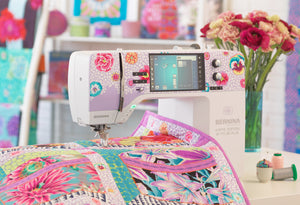

We Love Our Quilting Community
At High Country Quilts we care deeply about community. With our experiences in retail, we know that a store is not only a place to shop but also a place for the community to gather and share. During this busy...


Stitching in the ditch is one of those fundamental quilting skills that, once you get the hang of it, you'll wonder how you ever quilted without it. The whole idea is to sew directly in the "ditch"—that little channel created where two pieces of fabric are seamed together. This technique quilts all your layers together with stitching that's almost completely invisible, letting your beautiful piecing be the star of the show.
It's the secret to getting a clean, professional finish that’s both strong and subtle.

Think of stitching in the ditch as a design choice, not just a way to hold your quilt sandwich (top, batting, and backing) together. Unlike adding a new decorative pattern with your quilting, this method quietly reinforces the patchwork you’ve already created. Your stitches nestle right into the "low" side of the seam, hiding from view.
The end result is a quilt with beautifully defined blocks and shapes that seem to pop. This creates a soft, puffy texture within each fabric piece, which is why it's so popular for traditional quilts where the piecing is everything. But don't count it out for modern projects—it’s a valuable skill no matter your style.
So what’s all the fuss about? Quilters, including our regulars at High Country Quilts classes, turn to this method time and time again for a few very good reasons.
I almost always use ditch stitching as a first pass, even on my most elaborate projects. It creates a stable skeleton for the whole quilt, giving me a solid canvas to build on with more creative, free-form quilting.
Knowing how to stitch in the ditch is half the battle; knowing when is the other. It’s the perfect choice any time you want your patchwork to be the hero. Think of those classic, striking patterns like a Log Cabin, Nine Patch, or Irish Chain, where the geometric design is the whole point.
It’s also an amazing problem-solver. Got a block that’s a little "wonky" or has some extra fullness? Stitching in the ditch around its edges can help tame it and persuade it to lie flat. Once you've contained that fullness, you can add denser quilting inside the block to "quilt out" any remaining excess fabric.
Ultimately, this is a skill that opens up so many doors. Mastering the precision it requires will build your confidence and machine control, preparing you for just about any quilting adventure you want to take on next.

Before you even think about sitting down at your machine, let's talk about what makes a real difference in achieving that perfect, invisible stitch-in-the-ditch finish. It all comes down to your tools. Having the right gear on hand doesn't just make the process easier; it's what separates a frustrating afternoon from a truly satisfying result you can be proud of.
You could try to stitch in the ditch with a standard presser foot, but I’ll be honest—it’s an uphill battle. To get that truly straight, perfectly placed line of stitching, a specialized foot is a game-changer. These feet are built with guides that take all the guesswork and eye strain out of the equation.
There are two main options I always have in my sewing drawer:
The Walking Foot: This is an absolute workhorse for any quilter. Many walking feet come with an optional ditch quilting guide you can attach. It's a small, centered blade that slips right into the seam, keeping your needle on the straight and narrow while the foot itself ensures all three layers of your quilt feed through evenly. No more bunching!
The Edgestitch Foot: This is my personal favorite for absolute precision. Feet like the BERNINA Edgestitch Foot #10 have a built-in metal blade right in the center. As you sew, you just focus on keeping that blade nestled deep in the "ditch" of the seam, and it physically stops the fabric from veering off course.
Using an edgestitch foot almost feels like having guardrails on your project. It gives you the confidence to sew at a steady pace, knowing the foot is handling the alignment. This frees you up to concentrate on guiding the quilt smoothly without worrying about wobbly stitches.
Since the whole point is for the stitching to disappear, your needle and thread are just as critical as your presser foot. The wrong needle can lead to skipped stitches and shredded thread, while the wrong thread can shout for attention instead of blending in.
For needles, you’ll want something sharp that can pierce cleanly through the quilt top, batting, and backing without a fight. My go-to choices are:
I find a size 80/12 or 90/14 works for most projects. If you’re working with particularly heavy fabrics or thick batting, go with the larger 90/14 to prevent your needle from bending or breaking under the strain.
When it’s time to choose your thread, you’ve got two great options for making those top stitches practically vanish.
Before we move on, here’s a quick-reference table of the tools I find absolutely essential.
This table breaks down the go-to tools I rely on for professional-level results. Getting these basics right will save you a world of trouble later.
| Tool | My Recommendation | Why I Use It |
|---|---|---|
| Presser Foot | Edgestitch Foot (#10) or Walking Foot with Guide | The built-in guide is non-negotiable for keeping stitches perfectly straight in the seam. |
| Needle | Quilting or Microtex Needle (Size 80/12 or 90/14) | A sharp, strong needle prevents skipped stitches and fabric damage. |
| Top Thread | 50-wt Cotton or Clear Monofilament | Blends into the seam's shadow or is entirely invisible, making stitches disappear. |
| Bobbin Thread | Standard Polyester or Cotton | Use a color that matches your quilt backing for a clean finish on the back. |
| Basting | Curved Safety Pins or a spray like 505 Spray and Fix | Securely holds the quilt sandwich together, which is your best defense against puckers. |
| Removal Tool | Small Scissors or a Quality Seam Ripper | For the inevitable "oops" moment, a sharp tool makes quick, clean work of removal. |
Having these items ready to go makes the entire process smoother and more enjoyable from start to finish.
Finally, a couple of other items are absolutely non-negotiable for a good result.
Never, ever underestimate the power of thorough basting. Shifting layers are the number one cause of puckers and tucks on the back of your quilt. Whether you prefer curved safety pins or a temporary adhesive like 505 spray, take your time with this step. A securely basted quilt sandwich is your best friend.
And, of course, keep a good pair of small, sharp scissors and a seam ripper within arm's reach. Even the most experienced sewists have to un-sew a section now and then. Having the right tool for the job makes it a quick fix instead of a disaster that could damage your quilt top.
I've said it a thousand times, and I'll say it again: beautiful quilting is 90% preparation. I learned a long time ago that the secret to perfect stitch-in-the-ditch quilting has very little to do with the final stitching itself. It all comes down to the careful work you do before you even sit down at your machine.
Getting this prep right is what makes the whole process smooth and enjoyable, rather than a fight against puckers and shifting fabric. It really boils down to three things: pressing your seams correctly, building a smooth quilt sandwich, and basting it all together securely.
Before you can stitch in the ditch, you have to create one! This crucial step happens at your ironing board. For this technique to work, you absolutely must press your seams to one side. If you press them open, there’s no channel for your stitches to hide in, which defeats the entire purpose.
When you press the seam allowance over, you naturally get a "high" side (where the extra fabric is) and a "low" side. Your needle is going to travel along that low side, sinking your stitches deep into the valley where they'll become virtually invisible. It’s a beautifully clean finish.
Here’s a pro tip: I always press my seams toward the darker of the two fabrics. This simple habit prevents the darker seam allowance from creating a shadow that shows through your lighter fabrics. It’s a small detail that gives your quilt top a much more polished and professional look.
With your quilt top perfectly pressed, it's time to assemble your quilt sandwich. This is simply the term for your three layers stacked together and ready for quilting.
The goal here is smoothness. I lay my backing fabric out on a large, clean floor and use painter's tape to pull it taut at the corners and along the edges—snug, but not stretched. Then, I unroll the batting over it, gently smoothing out any wrinkles with my hands. Finally, the quilt top goes on, and I spend a good amount of time smoothing it from the center outwards. A wrinkle-free start is your best defense against puckers later on.
The feel and behavior of your fabric can make a big difference here. Getting to know the texture of fabrics helps you predict how they’ll behave, making this whole process a lot smoother.
Basting is how you temporarily secure these three layers, and honestly, it’s the most important part of your prep. If the layers shift while you’re quilting—and they will try—you’ll get ugly tucks and puckers on the back of your quilt. It’s a quilter’s worst nightmare!
Taking your time with basting isn't just a suggestion; it's a core principle for good quilting. This patient step is what separates a frustrating experience from a beautiful, flat quilt you'll be proud of.
There are a few ways to get it done, and most quilters eventually settle on a favorite.
Your choice of basting method often comes down to personal preference and the size of your quilt. Here’s a quick rundown of the most common options.
| Method | Pros | Cons |
|---|---|---|
| Pin Basting | Reusable, affordable, and lets you make adjustments on the fly. | Can be tedious; pins can get in the way of your quilting foot. |
| Spray Basting | Very fast and provides a consistent, even hold across the quilt. | Needs good ventilation; can be messy and gum up your needle. |
| Hand Basting | Offers an incredibly secure hold using large, running stitches. | By far the most time-consuming method. |
If you go with pins, I strongly recommend using curved safety pins; they’re so much easier to open and close through the quilt sandwich. I place one pin every 4-5 inches (about the width of my hand), always working from the center out to the edges.
For spray basting, work in small sections and follow the directions on the can to the letter. This will give you the best adhesion without turning your needle into a sticky mess. Whichever you choose, just know that a well-basted quilt is an absolute joy to stitch.
Alright, your quilt is prepped, your machine is humming, and now it's time for my favorite part—getting those stitches perfectly hidden in the seams. This is where all that careful preparation pays off. Let's get you set up and stitching with confidence.
Before you even think about putting your quilt under the needle, a few small tweaks to your machine setup will save you a ton of headaches later.
First things first, get your presser foot attached. Whether you’ve opted for a walking foot with a guide or a specialty foot like the BERNINA Edgestitch foot #10, make sure it's on there good and tight.
Next up is stitch length. This is a setting people often overlook, but it’s crucial. If your stitches are too short, they can pull on the fabric and cause puckering. Too long, and they won't feel secure. I've found that for most quilting projects, a stitch length between 2.5 mm and 3.0 mm is the magic number. It's just long enough to create a smooth line but short enough to be strong.
Finally, and this is the most important adjustment you'll make, you need to set your needle position. The whole point is to have the needle land just to the side of the seam that doesn't have the seam allowance pressed underneath it. I call this the "low" side of the ditch. If you're using an edgestitch foot, the little blade in the center will ride in the ditch, so you'll just need to shift your needle a click or two to the left or right to hit that low side.
Here’s how I double-check it every single time:
This little test takes ten seconds but prevents that sinking feeling of realizing your first seam is stitched on the wrong side.
With the machine ready, it’s time to sew. The key here is to think of yourself as a guide, not a pusher. Your machine’s feed dogs are doing all the heavy lifting; your job is to simply steer the quilt and keep the seam aligned.
Rest your hands lightly on the quilt on either side of the presser foot. You're just there to keep the fabric flat and on course. Whatever you do, resist the urge to push it from behind or pull it through. Fighting the machine is a surefire way to get wonky stitches and puckers.
My Favorite Trick: As a seam is about to go under the needle, I use my index fingers to gently spread the fabric apart. This opens up the "ditch," making it a much wider and clearer path for the foot's guide. It’s a simple move that makes a huge difference in my accuracy.
Try to find a comfortable, steady sewing speed and stick with it. Going from zero to sixty and back again will show in your stitches. A consistent rhythm is your best friend, especially on those long, straight stretches.
All the prep work—pressing, layering, and basting—is what makes this part possible.

A well-basted quilt lies flat and behaves beautifully, letting you focus entirely on your stitching line.
Quilts are never just one long, uninterrupted seam. You’ll have to deal with bulky fabric, tricky intersections, and sharp corners. Here’s how I handle those common scenarios.
The biggest challenge with long seams is simply managing the quilt's bulk. You need to support its weight so it isn't dragging down and pulling on your needle. If you have an extension table, now is the time to use it. If not, get creative! I've used stacks of books and plastic bins to build a level surface to the left and back of my machine.
As you sew, look a few inches ahead of the needle, not directly at it. This gives you time to see what’s coming and make tiny adjustments to stay perfectly in the ditch.
When you get to a spot where two seams cross, you’ll need to make a clean transition. The secret is the pivot.
That needle-down pivot is the only way to get sharp, professional-looking corners.
I can't recommend this enough: before starting on your actual quilt, do a quick "dress rehearsal." Just take a few scraps from your project—top, batting, and backing—and make a mini quilt sandwich with a pressed seam.
Stitch along that practice seam. This is your chance to:
This five-minute warmup builds muscle memory and lets you solve any issues on a scrap, not on your masterpiece. It’s a small bit of insurance that pays off with a beautifully finished quilt.
Alright, let's talk about those moments when things go sideways. Even when you've done everything right, a stitch will skip or your thread will turn into a tangled mess. Trust me, it happens to all of us, no matter how long we've been quilting.
The secret isn't avoiding problems—it's learning how to diagnose them quickly. Most issues boil down to your needle, your thread, or your machine's tension. Once you learn what to look for, you'll be able to solve these little hiccups and get back to sewing in no time.
There's nothing more maddening than a beautiful line of quilting marred by random gaps. When you see skipped stitches, the very first thing to check is your needle. Seriously. In 90% of cases, a skipped stitch is your machine telling you the needle is dull, bent, or just the wrong type for the job.
A needle has one job: to punch a clean hole through all the layers and create a perfect thread loop for the hook to grab. If it's even slightly damaged, that whole process falls apart.
So, run through this mental checklist:
If a brand-new needle doesn't solve it, your next move is to unthread the machine completely—both top and bobbin—and re-thread it from scratch. A tiny bit of lint or a thread that missed a guide can absolutely cause this kind of chaos.
Ah, the dreaded "bird's nest." You're sewing along, everything looks great on top, and then you flip it over to find a giant, tangled web of thread on the back. It’s a classic quilting blunder, and while the mess is on the bottom, the culprit is almost always your top thread.
The number one cause? You forgot to lower the presser foot before starting to sew. When the foot is up, the tension discs that control the top thread are wide open. The machine has no way to control the thread, so it just feeds a massive amount down to the bobbin area, where it tangles instantly.
Before you take a single stitch, make it a habit to ask yourself, "Is my presser foot down?" That one simple check will save you from a world of hurt and a lot of quality time with your seam ripper.
If your foot was down, the problem is likely improper threading. Don't just pull the thread through again. Take the top thread out completely and carefully re-thread, making absolutely sure the thread snaps firmly into the tension discs.
Puckering is the enemy of a flat, professional-looking quilt. It appears when one layer of your quilt sandwich shifts or stretches more than the others, causing those ugly little tucks and bunches in the fabric.
For Puckering: This almost always comes down to two things: how well you basted and how you're handling the quilt at the machine. If your layers aren't secured well, they're going to shift. Your pins should be no more than a hand's width apart. If you use spray baste, make sure your coverage is even.
When you're sewing, focus on guiding the quilt, not pushing or pulling it. Let the machine do the work. This is where a walking foot or a BERNINA with the built-in Dual Feed is your best friend—it actively pulls the top layer through at the exact same speed as the feed dogs pull the bottom.
For Wavy Seams: If your stitching line wanders in and out of the ditch instead of staying perfectly hidden, it's usually a speed or guidance issue. Try slowing down; sometimes we sew faster than our hands can accurately guide the fabric. Make sure the guide on your foot is running deep in the "low" side of the seam, and keep your eyes fixed on that guide, not the needle. A few minutes of practice on a scrap sandwich can make all the difference in finding a comfortable, controlled rhythm.
No matter how thorough a guide is, you’ll always have a few questions when you sit down at your machine to try a new technique. I hear these all the time in my quilting classes, so I’ve gathered the most common ones right here. Think of this as a quick chat with a friend when you hit a little snag.
When it comes to thread, the goal is simple: make it disappear. For your top thread, you can’t go wrong with a fine 50-weight cotton thread. The real trick is to match the thread’s value—its lightness or darkness—to the fabric. This helps it sink right into the shadow of the seam.
Another fantastic choice is clear monofilament thread. Since it’s transparent, it works beautifully over busy, multicolored quilts and saves you from having to change spools. Just know that it can feel a bit slippery and might need a little tension adjustment. For your bobbin, stick with a standard thread that matches your quilt backing to keep the reverse side looking neat and tidy.
Technically, you can try, but I wouldn’t recommend it. Trying to stay perfectly in that narrow seam line with a standard foot is a recipe for frustration. A regular foot gives you no physical guide, so you’re relying completely on your own eyes and a steady hand.
This almost always leads to wobbly stitches that sit on top of the fabric instead of hiding in the ditch. Do yourself a favor and use a specialty foot. An edgestitch foot, like the BERNINA #10, or a walking foot with a quilting guide will give you the precision you need for a truly professional finish.
These feet aren't just fancy add-ons; they're essential tools that provide a physical guide. The blade on the foot literally runs along the seam for you, which takes all the guesswork out of alignment and lets you focus on just guiding the quilt smoothly.
For traditional ditch stitching, yes, this is a must. Pressing your seams to one side is what physically creates the "ditch" in the first place. This gives you a "high" side (where the seam allowances are tucked) and a "low" side.
Your needle needs to stitch right into that low side, letting the thread nestle down and become invisible. If you press your seams open, there’s no ditch to stitch into. Quilting along an open seam is a different technique entirely, often called stitching "beside" the ditch or "in the well."
We’ve all been there. You finish a block, and it’s just a little too big or has some extra fullness. Ditch stitching is actually a brilliant way to tame it! First, stitch in the ditch around the entire perimeter of the block. This will anchor it into place and contain all that extra fabric.
The middle of the block might look a bit puffy, but don't worry. You can then "quilt out" that fullness with a dense design inside the block itself. Things like dense meanders, pebbles, or switchbacks are perfect for eating up that extra fabric and making the block lie flat. It's a fantastic trick for saving a block you'd rather not unpick.
Here at High Country Quilts, we know that mastering foundational skills like this one is the key to unlocking your creativity. Whether you're working through a tricky project or looking for the perfect machine to get started, our team is here to help you. Come explore our full range of BERNINA machines and quilting supplies at https://hcquilts.com.
At High Country Quilts we care deeply about community. With our experiences in retail, we know that a store is not only a place to shop but also a place for the community to gather and share. During this busy...

Hi! We’re Adam and Renee Wheaton, the new owners of High Country Quilts! For more than 40 years, we’ve owned and operated vacuum and sewing businesses. Following in Renee’s father’s footsteps after he retired from All Discount Vacuum and Sewing in Colorado...


Leave a comment