
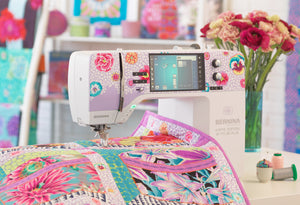

We Love Our Quilting Community
At High Country Quilts we care deeply about community. With our experiences in retail, we know that a store is not only a place to shop but also a place for the community to gather and share. During this busy...


You’ve finished the piecing, quilting, and trimming. The quilt looks good. Then the binding goes on, and suddenly the corners feel like the hardest part of the whole project.
That’s normal.
Corners ask for accuracy at exactly the moment most quilters are ready to be done. A binding corner can pucker, spread open, turn blunt, or get bulky fast. The good news is that the fix usually isn’t complicated. It comes down to a few measured folds, a clean stopping point, and choosing the finishing method that fits your project.
If you’ve been searching for how to sew binding corners without sorting through half a dozen partial tutorials, this is the practical version. It covers the classic machine-stitched mitered corner, the decision between hand and machine finishing, the difference between mitered and square corners, and the inner corners that many tutorials skip.
Binding changes the whole look of a quilt. It frames the piece, protects the edges, and tells the eye whether the finish feels polished or hurried.
Most corner trouble starts before the corner itself. If the binding strip is cut unevenly, if the seam allowance drifts, or if the fold is made a little early or late, the corner will show it. That’s why experienced quilters treat corners as a sequence, not a trick.
A clean binding corner depends on three things working together:
The classic quilt finish is the mitered corner. It gives you that neat diagonal fold most quilters want on bed quilts, wall hangings, table runners, and minis.
Practical rule: If your corners are failing, check your stopping point before you blame your fold.
Beginners often think corners are about hand dexterity. They’re usually about measurement. If you stop too far from the edge, the corner gets floppy. If you stitch past the stopping point, the corner can’t turn cleanly.
In classes, the quilters who get the nicest corners are rarely the ones sewing fastest. They’re the ones who pause, fold carefully, and check the raw edges before taking the next stitches.
That matters whether you’re sewing on a basic domestic machine or a BERNINA with features that make pivoting easier. Needle-down, a walking foot, and a clear quarter-inch guide all help, but none of them replace the habit of stopping and looking.
A good corner doesn’t have to be perfect on the first try. It does have to be built in the right order. Once that clicks, binding corners stop feeling like the last obstacle and start feeling like the finishing touch they should be.
A lot of corner trouble starts at the cutting table, not under the needle. If the binding is cut evenly, joined neatly, and pressed well, both machine-finished and hand-finished corners come together with far less fuss.

Most quilt binding is cut at 2.5 inches or 2.25 inches. Both are common, and both can give a tidy result. As noted by National Quilters Circle’s mitered binding guide, consistent strip width helps the fold behave the same way from corner to corner.
Here’s how I choose between them in class:
This choice also affects your finish. A slightly wider binding is often easier for beginners and for machine finishing on the back, because it gives more coverage. A narrower cut can look sharper, but it leaves less room for error.
Straight-grain binding works well on most square and rectangular quilts. It is stable, efficient, and easy to prepare.
Bias binding is worth the extra effort on curves, scallops, and shaped edges. It also handles stress a little differently around unusual corners. If you are planning square corners, mitered corners, and a standard quilt edge, straight-grain is usually the practical choice. If your project includes inner corners or curved sections, bias may be easier to ease into place without distortion.
Measure all four sides of the quilt and add extra length for joining the tails and turning the corners. I like to give myself at least 10 extra inches so I am not wrestling with a too-short tail at the end.
That extra length matters whether you finish the binding by hand or by machine. Hand stitchers need enough slack to shape a clean fold at the back. Machine finishers benefit from a little more room because the last join often feels tighter and less forgiving.
Diagonal joins reduce bulk better than straight joins. On a bed quilt, that difference is easy to feel with your fingers, and it is especially noticeable if a join lands near a corner.
My usual prep order is simple:
Pressed binding handles better. Unpressed binding twists, and that twist often shows up at the corner folds.
A small set of tools is enough. The right ones save time.
One more practical tip. If you know you want square corners instead of mitered ones, or if the quilt has inner corners, mark those spots before you start attaching the binding. The prep is slightly different, and catching that early prevents a lot of unpicking later.
Good binding corners come from careful setup. The sewing part gets much easier once the binding itself is prepared well.
The machine-stitched mitered corner is the foundation. Once you can do this reliably, every other corner method makes more sense.
Start with the binding attached to the front of the quilt. Align the raw edges of the folded binding with the raw edge of the quilt. Begin on one straight side, not at a corner, and leave a tail free for joining later.
A visual walkthrough helps here.

To achieve a clean mitered corner, attach a 2.25 to 2.5 inch binding strip to the quilt front and stitch with a 1/4-inch seam allowance until you are exactly 1/4 inch from the corner edge, then backstitch, as described in this binding corner method from Stitch Obsessed. That same method reports a success rate of over 95% in preventing seam gaps.
That stopping point matters more than anything else in the corner.
If you sew beyond it, the binding can’t fold into a true miter. If you stop short, the corner may feel loose or leave a soft gap at the point.
After stopping and backstitching:
This is the move many quilters rush. Don’t.
That little pleat is what creates the miter when the binding wraps to the back. If the fold is soft or skewed, the front may still look acceptable, but the back corner often won’t land neatly.
Fold up first. Fold down second. If you try to do both at once, the pleat usually twists.
On a BERNINA, two features are especially helpful for this step:
If your machine has a needle position adjustment or a quarter-inch guide, use it. Binding is one of those jobs where machine features do reduce frustration. They don’t replace technique, but they do make repeat accuracy easier.
When you fold the strip back down, the top folded edge should sit even with the top edge of the quilt. Hold that fold firmly with your fingers or a clip, then begin sewing at the top of the next side.
A few practical checks help:
If the fold shifts as you start, stop immediately and reset it. A crooked start almost never improves as you sew.
Here’s a video reference if you like seeing the movement in real time.
For most quilts, this order keeps the work controlled:
| Step | What to do | Why it helps |
|---|---|---|
| 1 | Start on a straight side | Easier joining at the end |
| 2 | Sew with a steady quarter-inch seam | Keeps the fold depth consistent |
| 3 | Stop exactly a quarter inch from the corner | Creates room for the miter |
| 4 | Backstitch | Secures the corner seam |
| 5 | Fold up, then down | Builds the diagonal pleat |
| 6 | Start the next side carefully | Prevents shifting at the fold |
Several habits cause trouble fast:
If you’re learning, mark the stopping point on all four corners before you sew. That one extra minute can save a lot of seam ripping.
The quilt is bound on the front, the corners are formed, and now the finish you choose will decide how the back looks and how the quilt wears over time. This is the point where many quilters pause, especially on a first quilt, because both methods can work well and both ask for different skills.
Hand finishing gives the cleanest look. Machine finishing gives speed and durability. Neither one is the “better” method in every case.
Hand stitching keeps the front of the quilt quiet. If the thread matches and the stitches are small, the binding looks crisp without a visible line of topstitching crossing the corners.
That matters on heirloom quilts, show quilts, and pieces with detailed quilting near the edge.
A straw needle works well for many quilters because it passes through the fold smoothly, and a fine thread helps the stitches disappear into the fabric. Use a slip stitch or ladder stitch, catch only a few threads from the quilt back, and keep the bite into the folded binding small. I tell students not to chase invisibility at the cost of control. Even stitches matter more than microscopic ones.
Hand finishing also gives you the most control at the corner. You can shape the miter with your fingers, tuck in a bulky fold, and place an extra stitch right at the point if the corner wants to open. On a show quilt, that control is often worth the extra time.
Machine finishing earns its place on quilts that will be used hard and washed often. Baby quilts, donation quilts, table runners, and picnic quilts all do well with a machine finished binding.
The method is straightforward. Wrap the binding to the back, clip or glue-baste it in place, then stitch from the front in the ditch or edge stitch close to the binding so the fold on the back is caught all the way around. The trade-off is accuracy. If the back fold is uneven by even a little, the needle can miss it.
BERNINA users have a real advantage here. Edgestitch Foot #10 or Reverse Pattern Foot #1D gives excellent visibility, and needle position control makes it easier to keep the line where you want it. A stiletto helps at the corners, especially if the quilt has thick batting and the fold wants to creep.
| Method | Best for | Main advantage | Main challenge |
|---|---|---|---|
| Hand stitched finish | Heirloom, show, and gift quilts | Clean look with maximum corner control | Slower process |
| Machine stitched finish | Utility quilts and frequently washed projects | Fast, secure finish | Back fold must stay consistent to avoid missed spots |
Mitered corners are the standard choice because they fold neatly and suit both hand and machine finishing. If you are sewing a traditional quilt binding, this is usually the corner to master first.
Square corners have a different look. They feel more crisp and can suit modern projects, placemats, and some mini quilts, but they show bulk faster and usually need more careful trimming. I prefer hand finishing on square corners if appearance matters, because I can shape the fold more precisely.
Inner corners deserve their own mention. They are less common, but they come up on scalloped edges, notched shapes, and some decorative projects. Hand finishing is often easier there because you can secure the fold exactly where the angle wants to pull. Machine finishing can still work, but it asks for careful clipping, controlled pivoting, and a very stable fold before you sew.
For a wall quilt or a special gift, I usually choose hand stitching. The extra time gives me better control over the corner points and a quieter finish on the front.
For a child’s quilt or a table topper that will head straight into the wash, I usually choose machine finishing. The job goes faster, and the stitching holds up well with regular use.
Choose the finish that fits the quilt, not the finish that sounds more impressive. Good binding comes from control, consistency, and corners that stay flat.
Corners teach you quickly. When something looks off, the corner usually tells you exactly what happened.
Use this guide when a binding corner doesn’t lie flat, looks rounded, or opens at the point.
| Problem | Likely Cause | Solution |
|---|---|---|
| Puckered corner | You stopped too early or too late, or the fold was forced | Remove the corner stitches, restitch to the correct stopping point, and remake the fold slowly |
| Bulky corner | Too much backing or batting left at the edge, or binding is too heavy for the project | Trim the layers neatly before binding and finger-press the fold before wrapping it around |
| Gap at the corner point | The fold wasn’t firm, or the seam wasn’t secured well enough | Refold the pleat sharply and secure the corner during finishing |
| Rounded or blunt point | The corner wasn’t turned fully, or the wrapped binding shifted | Use a point turner, stiletto, or chopstick gently after turning |
| Back corner doesn’t match front miter | Uneven wrap to the back | Reposition the fold on the back and clip before stitching |
A pucker usually means the geometry went off at the stopping point. It’s tempting to smooth it out with pressing alone, but that rarely fixes the structure of the corner.
If the pucker is mild, you may be able to refold and ease it in during the finishing step. If it’s pronounced, taking out that small section and resewing it is usually faster than fighting it.
Many quilters try to press bulky corners flatter. Sometimes that helps a little. Often it just flattens a thick lump.
Better options:
A crisp point isn’t created by yanking the corner out. It comes from a correct fold and a gentle turn.
If you need to force the point, something earlier in the corner probably needs attention.
A point turner helps, but use a light touch. Too much pressure can poke through the fabric or distort the miter.
A quilt can be beautifully pieced and still look unfinished if the corner treatment fights the design. This is the point where many quilters decide whether they want a classic miter, a square finish, or a custom approach for an inside angle.

A square corner gives a cleaner, more architectural look than a miter. I use it on placemats, table runners, baby bibs, and some modern quilts where a diagonal fold would feel fussy against straight graphic lines.
It also changes the construction. Instead of folding a miter at the point, you stop one side, start the next side, and finish the corner as a firm right angle. That makes it easier to control on small projects, but it also creates a sharper appearance that reads less traditional.
Square corners are a good choice for:
The trade-off is simple. A mitered corner hides the turn gracefully. A square corner shows the structure on purpose.
Neither corner is better in every situation. The better choice depends on the project, the loft of the quilt, and the finish you want on the edge.
A mitered corner suits bed quilts, wall quilts, and traditional piecing because it wraps the point neatly and gives that familiar quilted finish. A square corner suits projects with crisp edges and simpler construction. If the quilt has heavy seams, fusible appliqué near the edge, or extra batting at the corners, a square corner can reduce bulk.
BERNINA users often get especially clean square corners by using precise needle positioning and needle-down to control the stop point. That accuracy matters because square corners show every wobble.
Inner corners, also called concave corners, show up on notched edges, tree skirts, cathedral-style shapes, and some custom quilt outlines. They are less forgiving than outside corners because the binding has to spread into the angle rather than wrap around it.
The method changes in one important way. The binding needs room to open at the notch.
A practical approach looks like this:
Clip carefully. Too little clipping makes the corner pull. Too much clipping weakens the corner and can show through after turning.
For machine finishers, I recommend basting the fold in place first, especially on steep inner angles. For hand finishers, a couple of tiny anchoring stitches right in the notch usually gives better control than trying to hold everything with clips alone. On a BERNINA, needle-down and the Hover function, if your model has it, make these pivots much easier because the quilt stays put while you adjust the fold.
Corner style and finishing method affect each other more than many beginners expect.
With hand finishing, mitered and inner corners are easier to refine after the binding is attached. You can shape the fold with your fingers, bury stitches where they disappear, and adjust the back for a sharper result.
With machine finishing, square corners are often more predictable, and inner corners benefit from pre-folding, glue basting, or clips before the final pass. Machine stitching is faster and durable, but it leaves less room for correction once the seam is visible.
If I want the cleanest possible inner corner on a show quilt, I finish that area by hand. If I am binding a utility quilt that needs to hold up to regular use, I often machine-finish it and accept a slightly firmer, more structured look.
A strained inner corner almost always means the binding was pulled too tight into the notch. Let it relax, refold it, and secure the shape before finishing.
A few questions come up in nearly every class. These are the ones worth keeping close when you’re finishing a quilt.
| Question | Answer |
|---|---|
| Should I press my binding before attaching it? | Yes. Press the strips after joining, then press the full binding in half lengthwise. Pre-pressed binding feeds more evenly and folds more predictably at corners. |
| Do I really need a walking foot? | Need is too strong, but it helps. A walking foot is especially useful if the quilt sandwich shifts or the binding and quilt edge don’t feed evenly together. |
| What thread should I use for binding? | Use a good-quality thread that suits the finish you want. For hand finishing, many quilters choose a thread that blends into the binding or backing. For machine finishing, pick a thread that looks clean from the front because that’s where the stitching line usually shows most. |
| Where should I start attaching the binding? | Start on a straight side, not at a corner. That gives you more control when you join the beginning and ending tails. |
| How do I join the binding tails neatly? | Leave enough unsewn space to manipulate the tails comfortably, then join them with the same diagonal seam you used for the binding strips. Accuracy matters here more than speed. |
| Why do my corners look good on the front but messy on the back? | The front seam may be correct, but the wrapped fold on the back is often uneven. Clip or hold the back fold in place before finishing, especially at the corner. |
| Is hand finishing always better? | No. It’s quieter visually, but machine finishing is durable and practical. Choose based on the quilt’s use, not guilt. |
If you’re still building confidence, practice on a placemat, mug rug, or mini quilt first. Small projects give you all the same corner lessons without the weight of a large quilt in your lap.
If you’d like help refining your binding technique, choosing the right tools, or finding the right BERNINA setup for smoother finishing, visit High Country Quilts. Their team in Colorado Springs supports quilters at every stage, from first bindings to advanced finishing classes.
At High Country Quilts we care deeply about community. With our experiences in retail, we know that a store is not only a place to shop but also a place for the community to gather and share. During this busy...

Hi! We’re Adam and Renee Wheaton, the new owners of High Country Quilts! For more than 40 years, we’ve owned and operated vacuum and sewing businesses. Following in Renee’s father’s footsteps after he retired from All Discount Vacuum and Sewing in Colorado...


Leave a comment