
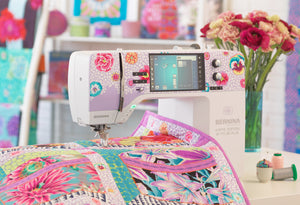

We Love Our Quilting Community
At High Country Quilts we care deeply about community. With our experiences in retail, we know that a store is not only a place to shop but also a place for the community to gather and share. During this busy...


Learning how to sew a lined tote bag is one of those projects that looks tricky but is actually wonderfully straightforward. It all boils down to a few simple stages: cutting your fabric, putting together the outer bag, building the lining, and then nesting them together for a clean, professional finish.
That lining? It’s the secret sauce. It’s what takes a simple fabric sack and turns it into a durable, polished bag you’ll be proud to carry.
So, you want to make a lined tote that looks like you bought it at a high-end boutique? You've come to the right place. This guide is all about the little details that make a huge difference. A good lining does more than just hide your inside seams (though that’s a great perk!). It gives the bag structure, prevents it from sagging, and makes it strong enough to handle your laptop, groceries, or library books.
This is a fantastic project whether you're just starting your sewing journey or you're a seasoned pro looking for a quick and satisfying make. It’s also a great way to tap into a huge creative movement. The demand for handmade goods is bigger than ever, and the global tote bag market is expected to hit a staggering $33,160 million by 2034. Your hobby is part of a massive trend, and you can learn more about the sewing market's growth to see just how valuable these skills are becoming.
Think of me as your sewing coach, guiding you through every step. We’re going to build your confidence and show you that a gorgeous, high-quality tote is completely within your reach.
Here are the key skills we’ll focus on:
By the time we're done, you won't just have a new favorite bag. You’ll have a solid set of sewing skills that you can use on all sorts of future projects.

The choices you make before you even thread your needle are what truly make or break a project like this. Picking the right materials isn't just about looks—it's about creating a bag that holds up to real life and is a joy to sew. Let's get everything you need lined up.
Your outer fabric is what everyone will see, but it also does all the heavy lifting. Think about what this tote will be doing. Will it be your go-to for grocery runs, or a catch-all for library books? For that kind of work, you'll want something sturdy. I almost always reach for cotton canvas, denim, twill, or even a nice, thick corduroy. These fabrics have a tight, durable weave that can handle being stuffed and carried around all day.
For a deeper dive into fabric options, it's worth exploring different weaves and materials. For instance, understanding what jacquard fabric is can open up new possibilities for creating a truly unique and textured bag.
When it comes to the lining, you can go for something much lighter. A standard quilting cotton is perfect. It adds virtually no bulk and comes in every print imaginable, giving you a fun pop of personality every time you open your bag.
Here's a pro-tip that many beginners miss: interfacing is what gives a homemade bag that professional, structured look. Without it, your tote will likely feel a bit flimsy and won't hold its shape. It’s a non-negotiable for me.
There are two main kinds you'll find at the fabric store:
For this particular project, a medium-weight interfacing will give you the perfect balance of structure and softness.
Before you start cutting, it’s a great idea to pull all your tools together. There’s nothing worse than getting into a sewing groove only to realize you have to hunt down your seam ripper.
My Golden Rule: Always start a new project with a fresh sewing machine needle. A dull needle is the number one cause of skipped stitches and snagged fabric. For tough materials like canvas or denim, use a 90/14 or 100/16 needle.
Here is a quick checklist to make sure you have everything you need right at your fingertips.
Use this checklist to gather the right fabrics, interfacing, and tools before you begin.
| Item | Recommended Type | Quantity/Notes |
|---|---|---|
| Exterior Fabric | Canvas, Denim, Twill, Corduroy | 1/2 yard (0.5 meter) |
| Lining Fabric | Quilting Cotton | 1/2 yard (0.5 meter) |
| Fusible Interfacing | Mid-weight (e.g., Pellon SF101) | 1 yard (1 meter) |
| Webbing for Straps | Cotton or Polypropylene | 2.5 yards (2.3 meters) |
| All-Purpose Thread | Polyester or Cotton | Coordinating colors |
| Sewing Machine | Any standard machine | With a straight stitch |
| Needles | Size 90/14 or 100/16 | For heavy-duty fabrics |
| Cutting Tools | Fabric Scissors or Rotary Cutter & Mat | Sharp is key! |
| Marking Tool | Chalk Pencil or Water-Soluble Pen | For tracing patterns |
| Measuring Tools | Clear Ruler or Tape Measure | For accurate cuts |
| Pins or Clips | Sewing Clips are great for thick layers | ~50 clips or pins |
| Iron & Ironing Board | A must-have for pressing seams | And for fusible interfacing |
Once you have your station set up with these essentials, you're ready to start measuring and cutting. Let's get to it
Alright, you've gathered your beautiful fabrics and you're ready to start sewing. But hold on a second! The work you do before you ever sit down at your machine is what truly sets a polished, professional-looking bag apart from a homemade one.
I can't stress this enough—taking your time to be precise now will save you a world of frustration later. Think of it as laying the foundation for a house. If your cuts are wonky, the whole bag will be off-kilter.
First things first: press your fabric. All of it. Don’t even think about cutting until you’ve ironed both your main and lining fabrics until they are perfectly smooth. Wrinkles are little liars; they throw off your measurements and lead to pieces that simply won't match up.
For a fantastic, do-it-all tote bag, I have a go-to size that never fails. It’s roomy enough for a trip to the market or to haul your work essentials, but it won’t feel like you’re carrying around a giant sack.
You’re going to cut:
For the straps, cut two (2) pieces of fabric measuring 4 inches wide by 22 inches long. This length gives you a comfortable drop for carrying the bag on your shoulder.
Here’s a step that many beginners skip, but one that pros swear by: squaring up your fabric. Fabric rarely comes off the bolt with a perfectly straight edge. Squaring it up means you're creating a true 90-degree corner to measure from, guaranteeing your pieces are perfect rectangles, not slightly-off parallelograms.
Grab a large clear ruler (like a quilter's ruler) and a rotary cutter. Lay your fabric on a cutting mat. Align one of the ruler's horizontal lines with the selvage (the tightly woven edge of the fabric), and make a clean cut along the side to create a perfectly straight edge. Now, you have a true corner to measure your 18x14 inch pieces from.
Pro Tip: Here’s a little trick I’ve learned over the years. When you cut your two lining pieces, trim about 1/4 inch off the top (the 18-inch edge) of each one. Making the lining just a tiny bit shorter is the secret to preventing it from peeking out over the top of the finished bag. It gives you a much cleaner, high-end look.
Now it’s time to give your bag some body. That floppy cotton needs some help to stand up on its own, and that’s where fusible interfacing comes in. Cut two pieces of interfacing to the exact same 18x14 inch size as your exterior panels.
Lay your exterior fabric piece wrong-side-up on your ironing board. Place the interfacing on top, with the rough, bumpy (adhesive) side facing down onto the fabric.
Check the manufacturer's instructions for the specific heat setting, but you'll generally use a hot, dry iron. Instead of sliding the iron around, press and hold it in one spot for 10-15 seconds. Then, lift it and move to an adjacent spot, overlapping slightly. Work your way from the center out to the edges. This method prevents bubbles and ensures a strong, even bond. You'll feel the difference immediately—your fabric will go from flimsy to structured and ready to sew.
Alright, this is where the real fun begins. Your flat, perfectly cut pieces of fabric are about to become an actual, three-dimensional bag. It’s an almost magical process, and the skills you pick up here will serve you well on just about any bag project you tackle in the future.
Before we dive in, here’s a little something to think about. Every time you make one of these, you’re creating something people genuinely want and use. In 2022, an astonishing 1.8 billion tote bags were sold worldwide, and North America made up over 35% of that market. It just goes to show that turning a yard or two of fabric into a durable, reusable bag is a seriously valuable skill. You can see the full tote bag market breakdown for yourself.
First up, let’s assemble the outer part of the bag. Grab your two exterior fabric pieces—the ones you fused interfacing to—and place them with the right sides of the fabric facing each other. Pin or clip them together along the two long sides and the bottom. The top edge stays open, of course; that's where everything will go!
Now, head to your machine. Using a 1/2-inch seam allowance, sew down one side, pivot at the corner, stitch across the bottom, pivot again, and sew up the final side. I prefer a 1/2-inch seam for totes because it gives the bag a lot more strength and durability than a smaller seam would.
Don't Forget to Backstitch! Seriously, this is the most important habit to build. A few stitches in reverse at the start and end of every seam locks everything in place. It’s what keeps your bag from falling apart after a few trips to the grocery store.
Next, you're going to do the exact same thing with your two lining pieces. Pin them right sides together and sew the sides and bottom with that same 1/2-inch seam allowance. There’s one crucial difference here: on the bottom seam of the lining, you need to leave a 4-5 inch opening right in the middle. This isn't a mistake! It's your turning gap, and we'll use it later to pull the whole bag right-side-out. Just be sure to backstitch on both sides of the gap to keep those stitches secure.
Getting this stage right really comes down to the prep work you did earlier.

This next step is what takes your project from a flat pouch to a structured tote that can actually stand up on its own. It might look tricky, but I promise it's one of those techniques that makes you feel like a sewing genius once you get it.
That's it! You've boxed a corner. Now just do the same for the other bottom corner of the exterior, and then repeat the entire process for the two bottom corners of the lining.
Time for the handles. Let's make some straps that are strong and look professionally made.
Grab one of your long strap pieces. Fold it in half lengthwise with the wrong sides of the fabric together, and give it a good press with your iron. This creates a guideline right down the center.
Now, open it back up. Fold each of the long, raw edges in to meet at that center crease you just made, and press it all flat again.
Finally, fold the entire strip in half along that original center crease. All the raw edges will be tucked away inside, leaving you with a crisp, four-layer strap that should be about 1-inch wide.
To finish it off, topstitch along both long edges, sewing close to the edge. This not only closes the strap but adds a ton of strength and a clean, finished look. Do the same for your second strap piece.
With your straps ready, grab the exterior bag shell (which should still be inside-out). Measure in 4 inches from each side seam along the top raw edge of the bag. This is where your straps will go. Pin one end of a strap at the 4-inch mark and the other end at the other 4-inch mark on the same side of the bag, making sure the strap isn't twisted. The raw ends of the strap should line up with the raw edge of the bag top.
To keep them from shifting, I like to baste the straps in place with a quick 1/4-inch seam. This holds them securely for the final assembly step.

Alright, this is where the magic really begins. You’ve done the hard work of cutting and piecing, and now you have two separate "bags": your sturdy exterior shell and your finished lining. It's time to bring them together into one beautiful, professionally finished tote.
The technique we’re about to use is a favorite among bag makers because it hides all the raw seams, giving you that clean, store-bought look.
First, take your exterior shell and turn it right-side-out, so it looks like the finished bag. Leave your lining shell inside-out for now.
Now, take the right-side-out exterior and slide it inside the inside-out lining. It will feel a little strange, but you want the "right" side of your exterior fabric touching the "right" side of your lining fabric. Trust the process!
Your main goal here is to carefully line up the top raw edges of both the exterior and the lining.
The most important trick for a perfect finish is to match the side seams of the exterior with the side seams of the lining. This is a non-negotiable step for me—it’s what ensures your bag hangs straight and the lining doesn't twist inside.
Once you’ve aligned those side seams, use plenty of sewing clips or pins to secure the top edge all the way around. Double-check that your straps are tucked down neatly between the two layers, pointing towards the bottom of the bag. You don't want to accidentally catch them in your seam!
With a 1/2-inch seam allowance, go ahead and sew all the way around that top opening. Don't forget to backstitch at the beginning and end to lock in your stitches.
Ready for the big reveal? This part always feels like a magic trick.
Reach your hand through the 4-5 inch gap you left in the bottom of the lining. Find the exterior bag and start gently pulling it through the hole. Take your time and ease the fabric through until the entire bag has been turned right-side-out.
Now you have a nearly finished tote with just one small task left: closing that opening in your lining. For a truly invisible finish, the ladder stitch (sometimes called an invisible stitch) is your best friend.
Tuck the raw edges of the opening into the seam, press it flat, and use a needle and thread to sew the opening shut with tiny, neat stitches. This hand-sewing detail elevates the craftsmanship of your tote bag.
Finally, push the lining down into the bag, making sure to poke it neatly into the corners. To get that crisp, professional edge and stop the lining from peeking out, give the top edge a good press with your iron. I like to roll the seam slightly so the lining is just inside the top edge.
To finish, topstitch 1/8 to 1/4 inch from the top edge all the way around the bag’s opening. This simple line of stitching is the hallmark of a beautifully made tote—it locks the lining in place and gives your bag a fantastic, durable finish.
You’ve done it! You've conquered the lined tote bag, and it looks fantastic. But don't put that sewing machine away just yet—the real fun is about to begin. Think of that basic tote as your starting point.
The first upgrade I almost always recommend is adding a simple interior pocket. I can't tell you how many times a quick patch pocket has saved me from digging around for my keys or phone. It’s incredibly easy—just hem a small fabric rectangle and topstitch it onto one of your lining pieces before you sew the lining shell together.
Once you’re comfortable with the basic construction, you can start playing with all sorts of details to make your bags truly unique. Here are a few ideas I've used over the years that really make a difference.
Making your own reusable bags is more than just a hobby; it’s a small but powerful way to push back against single-use plastics. When California banned plastic bags, for example, it led to a 70% drop in their use. Your handmade tote is part of that positive change.
This shift away from disposables has made quality reusable totes more popular than ever. Your sturdy bag, with its strong boxed corners, can easily handle 20-30 pounds of groceries or books, lasting far longer than any cheap, mass-produced alternative. The demand is real, and you can read more about the tote bag market's growth to see just how big this trend is.
So what's next? Show off your work! Post a picture of your finished tote in an online sewing forum or, if you're in our area, bring it to a Famcut workshop in Atlanta. Sharing your projects is the best way to get inspired, pick up new tricks, and keep the creative momentum going.
As you get started on your first lined tote, a few questions are bound to pop up. Trust me, we’ve all been there! Let's walk through some of the things we hear most often from fellow makers to get you sewing with confidence.
My go-to recommendation for anyone just starting out is always a sturdy, medium-weight woven fabric. Think cotton canvas, classic denim, or a nice twill for the outside of your bag. These fabrics are a dream to work with because they don't slip and slide around, and they’re tough enough for a bag you'll use every day.
For the lining, you can't go wrong with a standard quilting cotton. It’s lightweight, comes in endless fun prints, and is super easy to handle.
A little piece of advice from my own early sewing days: save the silky, slippery, or stretchy fabrics for a future project. Sticking with stable cottons will help you build your skills and avoid a lot of frustration.
Ah, the dreaded baggy lining—this is probably the most common hiccup people run into! The best way to deal with it is to prevent it from happening in the first place.
When you cut your fabric, make your lining pieces just a tiny bit smaller than your exterior pieces. A difference of about 1/4 inch narrower and shorter is usually perfect. This little adjustment gives the lining room to sit nicely inside the bag without bunching up.
After you've sewn the bag and are turning it right-side out, a good press is your secret weapon. Carefully press the top seam so the lining naturally rolls just a little to the inside. Then, a clean, crisp topstitch along the upper edge will lock that lining in place for good.
Honestly, yes. While you could technically skip it, interfacing is the magic ingredient that takes a tote from a floppy sack to a beautifully structured bag. It's what gives it that professional-looking body and helps it stand up on its own.
For a tote bag that feels substantial and durable, I always use a mid-weight fusible interfacing on the back of my exterior fabric pieces. It truly makes a world of difference in the final look and feel of your project.
At High Country Quilts we care deeply about community. With our experiences in retail, we know that a store is not only a place to shop but also a place for the community to gather and share. During this busy...

Hi! We’re Adam and Renee Wheaton, the new owners of High Country Quilts! For more than 40 years, we’ve owned and operated vacuum and sewing businesses. Following in Renee’s father’s footsteps after he retired from All Discount Vacuum and Sewing in Colorado...


Leave a comment