

We Love Our Quilting Community
At High Country Quilts we care deeply about community. With our experiences in retail, we know that a store is not only a place to shop but also a place for the community to gather and share. During this busy...


Believe it or not, making your first quilt is much easier than you think. The whole secret is breaking it down into four simple parts: picking your tools and fabric, cutting and sewing your blocks, putting the quilt layers together, and finally, finishing the edges. When you focus on just one thing at a time, you can create something beautiful and handmade without feeling totally overwhelmed.
Welcome to the wonderfully creative (and slightly addictive) world of quilting! If you've ever looked at a beautiful handmade quilt and thought, "I wish I could do that," you're in exactly the right place. I wrote this guide to pull back the curtain and show you how to make easy quilts by breaking the process down into simple, manageable steps.
We're going to skip the intimidation and jump right into building your confidence with a project that's genuinely fun and rewarding. We'll walk through all the essentials, from the must-have tools to the fun part—choosing fabrics that make your quilt sing.
The pure joy of making something unique with your own hands is incredible. It connects you to a rich history and a huge community of people who love creating just as much as you will. You're not just learning a new skill; you're becoming part of something much bigger.
Quilting isn't just about stitching fabric together. It’s about telling a story, creating something cozy, and carrying on a tradition of craftsmanship. Every quilt you make becomes a little piece of your own legacy.
As you get started, you'll find there are countless ways to play with fabric. Some people even get creative with printing their own designs, like when you make a blanket with pictures, which is another fantastic hands-on project.
Whether you're starting with a simple patchwork square or a classic block pattern, the basic steps are always the same. This guide is here to give you that solid foundation. Let's start your quilting adventure together.
Before we dive into the fun part—choosing fabrics—let's get your toolkit sorted. Trust me, having the right gear is the secret ingredient that turns quilting from a potential frustration into a truly joyful process. Good tools are what give you those clean, straight cuts and accurate seams that make a quilt look polished and professional.
You don't need a studio full of every gadget imaginable. Just a few key items will set you up for success and make all the difference.

If you take away one thing, let it be this: the combination of a rotary cutter, mat, and ruler is non-negotiable. While it might be tempting to just use sewing scissors, you'll quickly find it leads to wonky edges and mismatched pieces. Precision is born on the cutting mat.
One of the biggest mistakes I see beginners make is trying to cut their quilt pieces with scissors. Investing in a good rotary cutter and mat will save you hours of frustration and dramatically improve your accuracy.
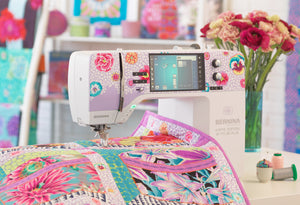
Just about any reliable sewing machine will get the job done, but a few features can make your quilting life a whole lot easier. Here at High Country Quilts, we’re big fans of BERNINA sewing machines because their precision is fantastic, especially for new quilters who are still getting a feel for things.
Having a quarter-inch presser foot is a true game-changer. It helps you sew that perfect 1/4" seam that quilting patterns rely on. Another feature to look for is a "needle down" function; it keeps your needle in the fabric when you stop, which is perfect for pivoting at corners without shifting your pieces.
Here is a quick checklist of the must-have tools to get you started.
| Tool/Supply | What It's For | Beginner Tip |
|---|---|---|
| Rotary Cutter | For making straight, clean cuts through fabric layers. | A 45mm blade is the most versatile size. Keep extra blades on hand! |
| Self-Healing Mat | Protects your work surface and the rotary blade. | An 18" x 24" mat is a great starting size for most projects. |
| Acrylic Ruler | For measuring and guiding the rotary cutter. | A 6" x 24" ruler is perfect for cutting strips across the width of the fabric. |
| Sewing Machine | For piecing your quilt top and quilting the layers. | Look for a machine with a 1/4" presser foot for accurate seams. |
| Cotton Thread | For piecing and quilting. | Start with a neutral 50-weight cotton thread in gray or cream. |
| Pins or Clips | To hold fabric pieces together for sewing. | Wonder Clips are fantastic for beginners—no pricked fingers! |
| Seam Ripper | For undoing stitches when mistakes happen (and they will!). | Don't be afraid to use it! It's a tool, not a sign of failure. |
| Iron & Ironing Board | For pressing seams flat, which is critical for accuracy. | A hot, dry iron works best. Press seams, don't scrub back and forth. |
Once you have these tools lined up, you’re officially ready to start your first quilt with confidence. Now, let’s talk fabric
Alright, this is where the real fun begins. Walking into a quilt shop for the first time is an experience—an absolute explosion of color and pattern that can be both thrilling and a little bit intimidating. Let's talk about how to navigate those aisles (or web pages) and pick out materials that will make your first quilting project a joy, not a headache.
The single most important piece of advice I can give any new quilter is to stick with 100% high-quality quilting cotton. Seriously, don't be tempted by that pretty home decor fabric just yet. Quilting cotton is designed specifically for what we do. It’s stable, it presses beautifully, and it doesn't have a lot of stretch, which means your carefully cut pieces will actually stay the size you cut them. This is a game-changer when you're just learning.
Want an inside tip that will save you a ton of time and stress? Start with pre-cuts. These are bundles of fabric from a single collection that are already cut into standard sizes. They take all the guesswork out of coordinating prints and colors, giving you a designer look right out of the package.
Using pre-cuts gets you to the sewing machine faster, which is what it's all about.
A quick word of encouragement: Don't get paralyzed trying to find the "perfect" fabric. Just pick something that makes you happy. Your excitement for the colors and patterns is the fuel that will get you across the finish line.
Choosing fabric really is a huge part of the quilting process. It’s where your personal style starts to shine through. Interestingly, this initial planning stage can take a couple of hours, and it's not just about standing in a shop anymore. A recent study found that 41% of quilters now use digital tools to help them visualize and choose their palettes. It’s a cool blend of tradition and tech. You can read more about how quilting is evolving in this in-depth analysis on MichaelAnnMade.com.
Once you've got your fabric in hand, you need a simple, solid pattern. Don't dive into something with a million tiny pieces just yet. Start with one of these classics to build your skills and your confidence.
1. The Rail Fence Quilt This pattern is as easy as it gets, but the final result looks surprisingly complex. It's built entirely from fabric strips, making it the perfect project for a Jelly Roll.
2. The Nine Patch Block This is a cornerstone of quilting. The Nine Patch is exactly what it sounds like: a block made of nine small squares arranged in a 3x3 grid. It’s a fantastic skill-builder.
Both of these patterns are incredibly forgiving. They'll teach you the fundamentals—like sewing a consistent seam and matching corners—without the frustration. Nailing one of these will give you a beautiful quilt and the confidence to tackle your next project.
Alright, you’ve picked out your fabrics—now for the fun part. This is where those beautiful bolts of cloth start becoming a real quilt. I always say that precision is your best friend at this stage. If you can focus on making accurate cuts and sewing consistent seams, you'll save yourself a ton of headaches down the road.
Let’s get into the skills that turn a simple stack of fabric into a gorgeous quilt top.

As you can see, choosing your fabric and pattern is just the beginning. It all leads to this moment: cutting your pieces and assembling them with care.
Your rotary cutter and ruler are about to become extensions of your hands. But first, safety! I can't stress this enough: always cut away from your body and get in the habit of retracting the blade the second you finish a cut.
To get that perfectly straight edge to work from, lay your fabric on the mat. Line up one of the horizontal lines on your ruler with the fabric's selvedge (the tightly woven edge) or a clean, folded edge. Spread your non-dominant hand on the ruler to hold it down firmly—keeping your fingers safely away from the edge—and glide the rotary cutter smoothly alongside it. This fresh, clean edge is now your "zero line" for cutting all your strips and squares.
Welcome to the golden rule of quilting: the quarter-inch (1/4") seam allowance. Just about every quilt pattern ever written is built on this measurement. It's not just a guideline; it’s the magic ingredient that ensures all your blocks finish at the right size and your points meet up perfectly.
Many modern machines, like the BERNINA models we carry at High Country Quilts, have a specialty quarter-inch presser foot. It has a little metal guide that your fabric snugs up against, making it almost foolproof to sew a perfectly straight seam. If your machine doesn't have one, no problem! A little stack of sticky notes or a piece of painter's tape placed 1/4" from your needle makes an excellent DIY guide.
I tell every student in my beginner classes the same thing: if your blocks are coming out wonky, the first thing to check is your seam allowance. Even a tiny variation, when multiplied across a whole quilt, can throw the entire project off.
Once you've got that quarter-inch seam down, you can really start flying. Here are two simple techniques that will make your piecing faster and more accurate—total game-changers when you're learning how to make easy quilts.
This trick is a massive time-saver. Instead of sewing two pieces together, stopping, and cutting the thread, you just feed the next pair of pieces right behind the first one without lifting the presser foot. You'll end up with a long "chain" of pieces linked by thread.
When you're done sewing all your pairs, just take a minute to snip the connecting threads. Easy!
This is the secret to getting those crisp, perfect points where four corners meet. It's all in the pressing. When you press the seams of your pieced rows, press the seams in one row to the left and the seams in the next row to the right.
Now, when you lay those two rows right-sides-together to join them, the seams will "lock" into each other. You can literally feel them nestle together. This little trick holds everything in place and guarantees your corners will line up flawlessly.

You've done the creative work of piecing your quilt top, and now it's time for the magic that turns it into an actual quilt. We're going to build what's affectionately known as the "quilt sandwich"—the three layers that make a quilt a quilt: your pieced top, the soft batting, and the backing fabric.
This step is all about getting those three distinct layers to behave as one. A good "baste" is what keeps everything flat and smooth, preventing any annoying bunching or puckering when you start the final quilting stitches.
Basting is just a temporary way to hold the sandwich together while you work. First things first, you need a large, flat surface. A big dining table works great, but don't be afraid to clear some space on a clean floor.
Lay your backing fabric down first, with the pretty side facing the floor. Smooth out every single wrinkle. Next, center the batting right on top of it. Finally, place your quilt top, right-side up, over the batting. Here’s a crucial tip: make sure your backing and batting are at least 4 inches bigger than your quilt top on all sides. This extra margin is a lifesaver.
For beginners, there are two fantastic ways to get this done:
No matter which technique you pick, the golden rule is to always work from the center out to the edges. This smooths everything out and pushes any trapped air or wrinkles to the perimeter, giving you a perfectly flat surface to quilt on.
Once your quilt is basted, you're ready for the final stitching that holds it all together for good. This is the "quilting" that gives the craft its name! For a first project, you can't go wrong with simple, clean straight lines. It's a modern look that’s incredibly forgiving.
If you have a sewing machine, a walking foot is your best friend for quilting. It’s a special presser foot that grips and feeds all three layers of your quilt sandwich through the machine evenly, which is key to avoiding puckers.
A great starting point is to "stitch in the ditch," which just means quilting right along the seam lines you've already created. It adds a lovely, subtle texture that makes your piecing pop.
Another fantastic option is to quilt a simple grid. You can quilt straight lines both horizontally and vertically across your top. To keep them neat, use a Hera marker to press a temporary crease into the fabric or simply lay down a strip of painter's tape as a visual guide. Easy and effective.
If you’re in the area and want to see these techniques in person, the quilting classes at High Country Quilts are a wonderful way to build your confidence with hands-on help.
This is it—the final, most satisfying step in making your quilt. The binding is like the frame on a picture; it gives your beautiful work a clean, durable edge that will hold up through years of snuggles. It might look a little tricky, especially those sharp corners, but the process is surprisingly simple once you learn a few key tricks.
Finishing your quilt this way provides a professional look that truly elevates the entire project. This is the moment your pieced top officially becomes a finished quilt.
First things first, let's figure out how much fabric you'll need. The math is easy: just measure the perimeter of your quilt in inches and add an extra 15 inches or so. That little bit of extra length gives you plenty of room to work with for joining the ends and turning the corners.
Most of us cut our binding strips between 2.25" and 2.5" wide. I find that this width gives you the perfect amount of fabric to fold over for a sturdy, double-fold binding.
Here’s how to get your strips ready:
And just like that, you have a beautiful, long strip of double-fold binding ready to go.
The secret to a perfect binding is consistency. Using your sewing machine—I highly recommend a walking foot for this part—start sewing the raw edge of your binding to the raw edge of the quilt top. Make sure to leave about a 10-inch tail at the beginning; we'll come back to that later. I usually stick to a 1/4" to 3/8" seam allowance.
As you get close to a corner, stop sewing about 1/4" from the edge. Backstitch a little, then take the quilt out from under the needle.
The magic to a crisp, mitered corner is all in the fold. Take the binding strip and fold it straight up, which creates a 45-degree angle with the quilt edge. Then, fold it right back down along the next side of the quilt. You'll see a neat little triangular fold of fabric underneath, and that's what creates the perfect miter.
Begin sewing again from the very top of that new edge. Do this for all four corners.
Once you’ve gone all the way around, it's time to join the beginning and end tails together. After they're connected, stitch that final section of binding down.
All that's left is to flip the folded edge of the binding to the back of the quilt. I love to hand-stitch it down with an invisible stitch—it's a classic, clean finish that's totally worth the time.
When you're just starting out, a few questions always seem to come up. Let's tackle them head-on so you can start your first project with total confidence and sidestep some of those classic beginner hiccups.
Ah, the great debate! Honestly, while you'll find quilters on both sides of this fence, I almost always recommend pre-washing your fabric. It’s a simple step that really pays off.
Washing pre-shrinks the cotton, which means you won't get that dreaded puckering and distortion after you've spent all that time piecing your quilt and wash it for the first time. Plus, it rinses out any extra dye that might otherwise bleed onto your lighter-colored fabrics. Trust me, preventing a red-splotched-white-fabric disaster is worth the extra 30 minutes.
My advice? Just toss it in the wash on a gentle cycle, tumble dry on low, and give it a good press with a hot iron. You'll be setting yourself up for a much smoother quilting process.
It's tempting to jump right into a king-sized masterpiece, but I'd suggest starting a bit smaller.
A baby quilt (usually around 36" x 52") or a lap quilt (about 50" x 65") is the perfect size for a first project. These are large enough that you'll get to practice all the essential skills—cutting, piecing, quilting, and binding—but not so big that you'll feel completely overwhelmed by a mountain of fabric.
Ready to turn that fabric stash into a finished quilt with some friendly, expert guidance? The classes at High Country Quilts are a fantastic way to learn the ropes. Check out the schedule and find your next class.
At High Country Quilts we care deeply about community. With our experiences in retail, we know that a store is not only a place to shop but also a place for the community to gather and share. During this busy...

Hi! We’re Adam and Renee Wheaton, the new owners of High Country Quilts! For more than 40 years, we’ve owned and operated vacuum and sewing businesses. Following in Renee’s father’s footsteps after he retired from All Discount Vacuum and Sewing in Colorado...


Leave a comment