
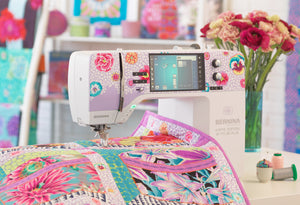

We Love Our Quilting Community
At High Country Quilts we care deeply about community. With our experiences in retail, we know that a store is not only a place to shop but also a place for the community to gather and share. During this busy...


So, you’re thinking about learning to sew. That's fantastic! There's a special kind of magic in taking a flat piece of fabric and turning it into something real and useful with your own two hands. It's a journey that begins with that first stitch, and trust me, it’s an exciting one.
If you’ve ever admired a handmade quilt or wished you could tailor your own clothes for that perfect fit, you're in exactly the right place. The thought of getting started can feel a little overwhelming—the machine, the jargon, the fear of wonky seams—but it’s really just a series of small, fun steps.
This isn’t about chasing perfection or becoming a master seamstress overnight. It’s about the simple joy of creating. We'll walk through this together, focusing on what truly matters when you're just starting out:
It might feel like you're starting from scratch, but you're stepping into a huge and welcoming community. The passion for DIY projects and home sewing is absolutely booming.
You can see it in the numbers. The global market for sewing machines, which is often the first big purchase for a new sewist, was valued at $5.5 billion back in 2022 and is expected to hit $7.45 billion by 2030. Here in the U.S., the home sewing machine market alone was a $450 million industry in 2022. If you're curious about the data, you can explore more sewing industry statistics on gitnux.org. All this growth is fueled by people just like you, discovering the fulfillment of making things themselves.
Sewing is more than just a skill; it’s a rewarding hobby that connects you to a vibrant community of fellow creators. It’s about the process, the learning, and the pride in saying, "I made this."
Think of this guide as a friendly chat with someone who's been there. We'll give you practical advice and encouragement for every step. From demystifying your machine to helping you find local classes and events at community hubs like High Country Quilts, we’ve got your back.
Ready to get started? Let’s thread the needle.

Before you ever stitch a single seam, you'll need to gather your gear. Walking into a sewing store for the first time can be a bit of a sensory overload—there are walls of gadgets and gizmos. But don't worry. You absolutely don't need one of everything to get started.
The key is to begin with a small, curated set of quality tools. Think of it like cooking: you can make amazing meals with just one good knife, a cutting board, and a solid pan. It’s the same with sewing. Investing in a few key essentials will make the learning process a pleasure instead of a source of frustration. Let's break down exactly what you need.
Accuracy is everything in sewing, and it all starts with how you measure and cut your fabric. Shoddy cuts lead to wonky seams, and that's a headache no beginner needs. This is one area where spending a little extra on quality from the get-go pays off big time.
Your fabric scissors are a sacred tool. There's a running joke in the sewing community about hiding your good scissors from family members. We laugh because it's true—protecting those blades is the secret to clean, satisfying cuts every single time.
Once you have your cutting tools sorted, you'll need a few more items to mark your fabric, hold it in place, and—yes—fix the occasional mistake. The table below outlines the absolute must-haves that will round out your kit.
| Tool | What It's For | Beginner's Tip |
|---|---|---|
| Glass Head Pins | Holding fabric pieces together before and during sewing. | Choose glass heads over plastic. They won't melt if you accidentally hit them with a hot iron. |
| Pincushion or Magnetic Dish | A safe, convenient place to store your pins while you work. | A magnetic dish is fantastic for quickly picking up spilled pins from your table or floor. |
| Fabric Marker or Chalk | Transferring pattern markings (like darts and dots) to your fabric. | Always, always test your marking tool on a scrap of your project fabric first to make sure the marks come out easily. |
| Seam Ripper | Carefully removing stitches without tearing the fabric. | Don't think of this as a mistake-fixer; it’s a standard-issue sewing tool. Every sewist, at every level, has one and uses it. |
Think of your seam ripper as your "undo" button. Seeing it in your toolkit shouldn't be a source of anxiety. It's a sign that you're a real sewist, ready to make adjustments and learn as you go.
Finally, what holds it all together? Thread! The endless wall of colors can be mesmerizing, but for now, focus on quality and type.
Your workhorse will be an all-purpose polyester thread. It’s strong, durable, and has just enough give to work with a huge variety of fabrics, from crisp quilting cottons to wovens with a bit of stretch. Brands like Mettler or Gütermann are always a reliable choice.
To start, just grab a spool of white, black, or a neutral gray. These will blend with almost anything while you're practicing. You can always buy perfectly matched thread for specific projects down the line.
As you build your kit, nothing beats seeing the tools in person. Pop into a dedicated shop like High Country Quilts where you can actually hold the scissors and talk to people who sew every day. The hands-on advice you'll get is priceless and will ensure you start your journey with tools you'll love using for years to come.
Walking into a sewing machine shop for the first time can be overwhelming. There’s a whole wall of them, all shiny and promising, and it's hard to know where to even begin. Let's cut through the noise. Your mission is to find a machine that feels good to you, has room to grow, and doesn't completely blow your budget.
I see so many beginners think they need a machine with a million different stitches and features. You don't. The single most important quality in a first machine is reliability. A simple, sturdy machine that makes a beautiful, consistent stitch is worth its weight in gold. It’s far better than a complicated one that’s always giving you trouble.
The first real fork in the road is deciding between a mechanical and a computerized machine. There's no right or wrong answer here—it really boils down to your personality and how you prefer to work.
Mechanical machines are the classic workhorses. You control everything with satisfying clicks and turns of physical dials. One knob for the stitch type, another for its length, and maybe one for the width. They have a reputation for being incredibly durable, and their simpler inner workings can sometimes make for an easier fix if anything goes awry.
Computerized machines, on the other hand, have a little LCD screen and use push-buttons for everything. You want a zigzag stitch? You just press a button for stitch #14, and the machine automatically sets the ideal length and width for you. They often pack in some really helpful features that can make the early days of sewing much less frustrating.
To make it a little clearer, here’s how they stack up:
| Feature | Mechanical Machine | Computerized Machine |
|---|---|---|
| Controls | Manual knobs and dials | LCD screen and push-buttons |
| Stitch Selection | Limited, typically 10-30 stitches | Extensive, often 50-200+ stitches |
| Complexity | Simple, direct operation | More features to learn over time |
| Beginner Aids | Fewer built-in aids | Often includes speed control, needle up/down |
| Cost | Generally more affordable | Can be more expensive for entry-level models |
It might sound counterintuitive, but for a lot of new sewers, a good computerized machine is actually easier to learn on, precisely because it automates some of the finicky adjustments for you.
When you're comparing models, try to ignore the sheer number of stitches. Most of those are decorative ones you won't use for a long time. Instead, keep an eye out for these three game-changing features. I promise, they make all the difference.
A quick word of advice: investing in a quality brand from a dedicated dealer pays off big time. Brands like BERNINA are famous for their Swiss engineering and long-lasting performance. Buying from a place like High Country Quilts means you get real human support, classes, and expertise to back you up—something you just can’t get from a big-box store.
Okay, you got it home. The box is open. Now what? Don't be intimidated! Before you can sew your first seam, you just need to learn two simple tasks: winding the bobbin and threading the machine.
The bobbin is that little spool that provides the thread for the bottom of the stitch. Your machine has a built-in winder; you’ll just wrap the thread from the main spool onto the bobbin by following the diagrams in your manual. It’s a quick and easy process.
Threading the machine sounds complicated, but modern machines make it almost foolproof. They have a numbered path printed right on the machine's body that guides the thread through all the right channels and levers. Just follow the numbers.
Once you’re threaded, grab a piece of scrap fabric—and I mean it, never sew without fabric under the needle!—and just play. Sew some straight lines. Sew some zigzags. Turn the handwheel toward you and watch how all the parts move in sync. This isn't about making a project. It’s about demystifying the machine and getting a feel for it, turning it from a scary appliance into a tool you can control.
Alright, your machine is threaded, your tools are at the ready, and now it’s time for the fun to begin. This is where the magic happens—where you stop learning about sewing and actually start sewing.
For now, forget about patterns or big projects. Your only goal is to get a feel for the machine and build that all-important muscle memory. It’s a lot like learning to drive a car; before you merge onto the freeway, you spend time in an empty parking lot practicing turns and getting a feel for the pedals. That’s exactly what we’re doing here. Grab some scrap fabric—quilting cotton is perfect because it’s stable and easy to work with—and let’s make some stitches.
Believe it or not, every beautiful quilt or perfectly tailored shirt is built from straight seams. Mastering this one skill is truly 90% of the battle. It sounds easy, but sewing a perfectly straight line takes practice to get your hands, eyes, and foot pedal working together.
Here's the secret: don't watch the needle. Staring at the needle bobbing up and down is the fastest way to get a wobbly, uneven line. Instead, fix your eyes on the seam guide on your machine’s needle plate. Those are the little lines etched into the metal, marked with measurements like 1/2" or 5/8". Pick a line, and make it your mission to keep the edge of your fabric perfectly aligned with it as you sew.
So you've sewn a beautiful line. How do you keep it from pulling apart? The answer is the backstitch. This is a non-negotiable step. By sewing backward for two or three stitches right over the beginning and end of your seam, you lock the thread in place.
Every single seam you sew should start and end with a backstitch. Find the reverse button or lever on your machine—you’ll press and hold it to go backward. Practice sewing a few short lines, adding a backstitch at the start and finish, until it feels like second nature.
The infographic below walks through the decisions you'll make when picking a machine, the first major step before you even get to this point.

It’s a great visual reminder of the journey from choosing between a simple mechanical model and a computerized one to the all-important step of test-driving it yourself.
As you practice your straight lines, let’s introduce two concepts that will make your projects look polished and professional: seam allowance and pressing.
Seam allowance is simply the space between your stitch line and the fabric's raw edge. This is crucial for making sure your project pieces fit together. Most commercial garment patterns use a 5/8 inch (1.6 cm) seam allowance. In quilting, you'll almost always see a 1/4 inch (0.6 cm) allowance. Consistency is everything. If a pattern calls for a 5/8" seam and you sew it at 1/2", the final piece won't come out right. This is why learning to watch your seam guide is so important from day one.
Your iron is just as important as your sewing machine. Pressing your seams as you go is the secret to a crisp, professional finish. It sets the stitches and flattens the seam allowance, creating a look you just can’t get by skipping this step. Make it a habit: sew a seam, press it.
What about sharp corners, like on a pillow or a tote bag? The technique for this is called pivoting, and it’s one of those things that looks tricky but is incredibly simple once you try it.
Just sew straight until you get to the point where you want to turn. Stop, but make sure the needle is down and in the fabric. This acts as an anchor. With the needle down, lift your presser foot. Now you can pivot the fabric 90 degrees (or whatever angle you need) around the needle. Once you have it positioned, just lower the presser foot and continue sewing along the new edge.
That’s it! That’s how you get those satisfyingly sharp corners. If your machine has a needle up/down button, it makes this even easier. Practice on a scrap square a few times. Once you’ve combined straight stitches, backstitching, and pivoting, you have all the skills you need for a whole world of fantastic starter projects.

Alright, you've put in the practice time and gotten comfortable with your machine. Now for the really fun part: making something! Turning a flat piece of fabric into a real, three-dimensional item is an incredible feeling, and it’s what keeps us all coming back to the craft. This is where all that learning clicks into place.
We're going to start with three projects that I personally recommend to every new sewist. Each one builds on the last, adding a new skill or two without ever feeling overwhelming. The goal here isn't perfection. It's about enjoying the process and ending up with something you made yourself.
For all these projects, I can't recommend medium-weight quilting cotton enough. It behaves beautifully, doesn't slip around, and presses like a dream. It’s the perfect training-wheels fabric. You can find an incredible selection at places like High Country Quilts, so you can pick a print that truly gets you excited to start.
The envelope pillow cover is a classic first project for a very good reason. It’s all straight lines and simple pressing, but you end up with a gorgeous, functional piece for your home. It’s a quick win that proves you’ve got this!
You won't need much to get started, which is part of its beginner-friendly charm.
The real beauty of this project is its clever construction. You cut one piece for the front and two for the back. The back pieces overlap, creating that "envelope" opening to slide the pillow form in—no zippers or buttons needed. You’ll get great practice measuring and cutting accurately, sewing long, straight seams, and pressing everything crisp and neat.
This is a huge confidence booster. You're basically just hemming three rectangles and stitching them together. That moment you slip the finished cover over the pillow form is pure magic.
Feeling good after that pillow? Let's tackle a simple tote bag. This project builds on what you just did but adds a couple of new skills to your toolkit. Plus, you’ll end up with something you can actually use for groceries, library books, or even to haul your sewing supplies to a class.
Here’s what you’ll need to put it together:
Just like the pillow, you'll be sewing straight lines and pivoting at the corners. But this time, we're adding two game-changing techniques: boxing the corners and topstitching. Boxing the corners is a simple trick that creates a flat bottom for your bag, so it can actually stand up. Topstitching is that visible line of stitches you see along the top edge of store-bought bags; it adds strength and a really professional-looking finish.
Making your first garment is a massive milestone, and pajama pants are the absolute best place to start. The fit is wonderfully forgiving, the construction is surprisingly simple, and you get something super comfy to wear at the end. It might seem like a big jump, but it’s really just a few simple steps stitched together.
Let's gather the materials for your new favorite lounge pants.
| Material | Description | Why It's Good for Beginners |
|---|---|---|
| Fabric | 2.5 yards of a soft, woven fabric like flannel, quilting cotton, or cotton lawn. | These don't stretch, which makes them much easier to cut and sew. Flannel is extra cozy and does a great job of hiding any little stitching wobbles. |
| Simple Pattern | A beginner-friendly pajama pants pattern. Look for one with just a few main pieces. | A pattern is your roadmap. It takes all the guesswork out of cutting and construction. |
| Elastic | 1-inch wide elastic, enough to fit comfortably around your waist. | An elastic waistband is the simplest you can sew—no fussy zippers or buttonholes to worry about. |
| Matching Thread | A good quality all-purpose thread. | You want strong seams that will hold up to lots of wear and washing. |
With this project, you'll learn how to read and use a basic sewing pattern, which is a key skill for any future clothing projects. You'll lay out the pattern pieces on your fabric, cut them out, and then sew the main seams, including the crotch curve. That curve can look a little intimidating on paper, but if you just go slow and gently guide the fabric, you'll find it's much easier to sew than you think.
The final step is making the waistband casing—essentially a "tunnel" for your elastic. You'll just fold the top edge over, stitch it down, and then feed the elastic through. The first time you pull on a pair of pants you made yourself is an empowering moment. It opens up a whole new world of what you can create.
Finishing those first few projects feels incredible, doesn't it? That buzz of creating something with your own hands is truly just the start. The skills you've picked up are a solid launching pad, and now the real fun begins as you decide where to go next.
Staying motivated is so much easier when you're not sewing in a bubble. The sewing world is one of the most supportive, generous communities you'll ever find, filled with people who are genuinely excited to share their knowledge. Getting connected is probably the single best thing you can do to keep learning and stay inspired.
One of the most rewarding things you can do is find other people who love to sew. While online groups are fantastic, nothing beats connecting in person. Your local sewing shop is usually the heart of that community.
For instance, a place like High Country Quilts is so much more than a store—it's a hub of creative energy. They host classes, workshops, and social events that are perfect for meeting other makers. Popping into one of these gatherings can be a complete game-changer.
I’ve seen it time and time again: a sewist will learn more in a two-hour class, surrounded by other beginners and a patient teacher, than they would in weeks of trying to figure it out alone. It’s not just the skills; it’s the camaraderie.
These events are the perfect place to ask all your questions, see how different techniques work up close, and get that hands-on help you just can't get from a video. You might even discover your dream machine at a great price by checking out a BERNINA demo at High Country Quilts.
With the basics down, you can start dipping your toes into skills that will unlock a whole new universe of projects. Don't feel overwhelmed by all the options! Think of it as a skill-building menu where you get to pick whatever sounds most exciting to you right now.
Here are a few things that are great to tackle next:
Your sewing education is a journey, not a race. Stay curious, give yourself permission to make mistakes, and remember that every seam you have to rip out is a lesson learned. By finding your community and trying new things, you'll make sure this hobby is a fulfilling one, packed with friendship and the amazing satisfaction of making things yourself.
When you're just starting out, it feels like there are a million questions. That's a good thing! It means you're curious and ready to learn. Let's tackle some of the big questions I always hear from new sewists.
Honestly, you can go from zero to finishing your first simple project in a single weekend. Seriously. Getting comfortable with your machine and sewing a straight line happens faster than you'd think with a little focused practice.
The real journey comes with mastering the finer points, like confidently reading a commercial pattern or tailoring a garment to fit you perfectly. Those skills take several months of consistent sewing. The secret is to enjoy the process. Start with small wins—a pillowcase, a simple tote bag—and let your skills build naturally from there.
Absolutely not, and don't let anyone tell you otherwise. The best machine for a beginner is a reliable one that isn't overwhelming. You just need a solid, entry-level machine that can create a good, even stitch.
A lot of new sewists actually have an easier time with a simple mechanical machine. It's far better to have a sturdy workhorse with a few essential stitches (straight, zigzag, and a backstitch) than a computerized model with hundreds of options you won't touch for years.
Stick with stable, medium-weight woven fabrics. You want something that won't stretch, slide, or fray all over the place while you're trying to cut and sew. This makes your first projects much less frustrating.
Your new best friend is quilting cotton. It's the go-to for a reason:
Other great starter fabrics include flannel, chambray, and easy-going linen blends.
Ready to explore the fabrics and machines that will kickstart your creative journey? Come visit us at High Country Quilts, where our friendly team can answer all your questions and help you find the perfect supplies. Dive into our selection at https://hcquilts.com.
At High Country Quilts we care deeply about community. With our experiences in retail, we know that a store is not only a place to shop but also a place for the community to gather and share. During this busy...

Hi! We’re Adam and Renee Wheaton, the new owners of High Country Quilts! For more than 40 years, we’ve owned and operated vacuum and sewing businesses. Following in Renee’s father’s footsteps after he retired from All Discount Vacuum and Sewing in Colorado...


Leave a comment