
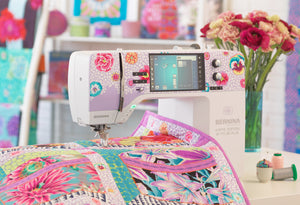

We Love Our Quilting Community
At High Country Quilts we care deeply about community. With our experiences in retail, we know that a store is not only a place to shop but also a place for the community to gather and share. During this busy...


So, you're ready to frame your quilting masterpiece but want to skip the fuss of traditional binding? You've come to the right place. The most popular trick in the book is the pillowcase turn, a brilliantly simple technique that gives a clean, modern edge to everything from soft baby quilts to gallery-worthy wall art.
We're going to set aside the struggle of mitered corners and focus on faster, sleeker alternatives that let your quilt top shine.
More and more quilters are looking for ways to finish a quilt without binding. It's not just about saving time; it's about achieving a minimalist aesthetic that lets the piecing do all the talking. While a traditional binding creates a sturdy frame, it can be time-consuming and sometimes adds unwanted bulk. These modern, bindless finishes offer a sleek alternative that puts the focus back on your design.
To really get a feel for how these techniques work, it helps to have a good grasp of the basic layers and construction of what a quilt is. These innovative approaches aren't just for convenience—they open up a whole new world of design possibilities.
Here's why so many quilters are making the switch:
The 'pillowcase' or 'flip and quilt' method, in particular, has really taken off. Since around 2015, online tutorials for this technique have exploded in popularity. Google Trends data shows a 40% increase in searches for 'quilt without binding' in recent years. What’s more, beginners report an impressive 85% success rate on their first try, making it a true game-changer for new quilters.
This guide will walk you through the most popular and practical options for finishing your projects. We'll explore step-by-step instructions for the most common methods, helping you choose the perfect finish for your next masterpiece.
Choosing the right technique can feel overwhelming, but this quick comparison should help you decide which method is the best fit for your current project.
| Method | Best For | Skill Level | Key Advantage |
|---|---|---|---|
| Pillowcase/Turning | Baby quilts, small wall hangings, charity quilts | Beginner | Very fast, entirely machine-sewn, creates a soft edge. |
| Facing | Art quilts, wall hangings, modern designs | Intermediate | Creates a sharp, completely invisible edge from the front. |
| Self-Facing (Back-Turn) | Lap quilts, blankets, quilts with a simple backing | Beginner/Intermediate | Uses the backing fabric for a clean, built-in frame. |
| Faux Piped Binding | Decorative quilts, throws, table runners | Intermediate | Adds a sophisticated, colorful "pop" to the edge. |
| Serged/Overlocked Edge | Utility quilts, flannel or fleece blankets | Beginner | Extremely durable and fast, perfect for fabrics that fray. |
| Scalloped Finish | Heirlooms, baby quilts, decorative pieces | Advanced | Creates a beautiful, vintage-inspired decorative edge. |
Each method has its place in a quilter's toolkit. The pillowcase method is fantastic for speed, while a facing offers unparalleled elegance for an art piece. It all comes down to the look and feel you're going for.
Ask a group of quilters for the quickest way to finish a quilt, and you'll likely hear about the "pillowcase turn." I've also heard it called the "birthing" or "envelope" method over the years, and it's a long-time favorite for its simplicity and the wonderfully soft, clean edge it creates.
This technique is my go-to for baby quilts, charity projects, and modern wall hangings where you want a sleek look without the bulk of a traditional binding. The entire process happens before any quilting, which is a major departure from the usual workflow. You're basically creating a quilt "bag," turning it right side out, and then quilting the layers together. It’s a fantastic method that relies on basic sewing skills most of us already have.
Getting a great result with the pillowcase turn is all about the prep work. The layering here is counterintuitive if you're used to a traditional quilt sandwich, so pay close attention to the order.
Here’s how you’ll stack everything up:
So, your final stack is batting on top, then the quilt top and backing with their right sides facing each other. Take a moment to smooth everything out, getting rid of any wrinkles. Pin the layers together like your quilt depends on it—because it does! I place pins every few inches, especially around the edges, to stop anything from shifting while I sew.
My Two Cents: Before you even start layering, make sure your backing and batting are at least one inch larger all the way around than your quilt top. This extra fabric is your safety net, giving you a little wiggle room when you trim everything down later.
Once your quilt sandwich is securely pinned, head over to your machine. I highly recommend using a walking foot if you have one; it’s a game-changer for feeding all three layers through evenly without bunching. A standard quarter-inch seam allowance is perfect here.
Start sewing along one edge, but don't forget to leave an 8 to 10-inch opening so you can turn the quilt later. This gap is non-negotiable! Backstitch at the start and end of this opening to make sure those seams are secure. Then, just continue sewing around the entire perimeter of the quilt.
This flowchart shows how the pillowcase method fits into the larger world of bindless finishes.

As you can see, the pillowcase turn is one of the foundational techniques for quilters looking to skip the binding step.
Before you get to the big reveal, trim the excess batting and backing fabric so they’re flush with the edges of your quilt top. The most important part of this step? Clip the corners diagonally, getting close to your stitches but not cutting through them. This little snip is the secret to reducing bulk and getting those nice, sharp corners.
Now for the fun part! Carefully turn the entire quilt right side out through the opening you left. Gently poke out the corners using a point turner, a chopstick, or even just your finger. Give the whole quilt a good press, focusing on the edges to create a crisp, flat finish. The last thing to do is close the opening with a few hand stitches—an invisible ladder stitch works beautifully. Just like that, your quilt top is completely enclosed and ready for the final quilting.
If you're aiming for a sophisticated finish that lets your quilt top do all the talking, facings are the way to go. This technique is all about creating a crisp, invisible frame around your work by tucking the raw edges neatly to the back. It’s a favorite among modern quilters and art quilters who want that clean, minimalist presentation—absolutely perfect for a wall hanging that needs to make a bold statement without a traditional border.

Unlike the quick-and-easy pillowcase method, facings are applied after your quilt has been fully quilted and squared up. This gives you total control over the final shape and guarantees your edges will be sharp and flat. I’ll be honest, it's an intermediate technique that requires some patience, but the gallery-ready result is more than worth the effort.
Precision is your best friend here. Start by quilting your project and then meticulously squaring up all four sides. For this method to work beautifully, you absolutely need clean, 90-degree corners.
Now, let's get your facing strips ready. You can use fabric that matches your backing for a nearly invisible finish, or even a fun, contrasting fabric as a little hidden surprise. Here's what you need to do:
You'll be attaching these strips to the front of your quilt, aligning the raw edges. Sew each strip on with a precise quarter-inch seam allowance, but be sure to stop and backstitch a quarter-inch away from each corner. Leave the corners themselves completely unsewn for now—we'll get to those next.
The real magic of a faced quilt is in the corners. To create a flawless miter, first press the seam allowances of your attached strips toward the facing fabric. Then, take one of the overhanging strip ends and fold it back on itself at a 45-degree angle, lining it up with the quilt's edge.
This crease creates your stitching guide. Sew directly on that diagonal line, backstitching at both ends to secure it. Trim the excess fabric, leaving a quarter-inch seam allowance, and turn the corner right side out. Voilà! You’ve got a beautiful, sharp mitered corner. Repeat this process for all four corners.
Before you turn the facing to the back, there's a game-changing step called understitching. This is simply a line of stitching sewn through the facing and the seam allowances, right next to the seam line. This little trick encourages the facing to stay rolled to the back and prevents it from peeking out on the front. Trust me, don't skip it.
With the understitching done, press the facing firmly to the back of the quilt. The last step is securing it for good. Using a thread that matches your backing fabric, hand-stitch the folded edge of the facing to the quilt back with an invisible slip stitch or whipstitch.
Quilt facing has really taken off, especially for modern designs. In fact, a report from the American Quilter's Society (AQS) noted that 22% of quilts at their Paducah show featured facing techniques, a huge jump from just 5% a decade ago. Quilters love how it reduces finishing time and bulk, which is probably why it's now a standard technique in 40% of modern quilt books published since 2020. You can discover more insights about these quilting trends if you're curious.
If your edges start looking a bit wavy, it's usually a sign of stretching during sewing. Take your time, stay relaxed, and use a walking foot to keep things even. And if you find your corners are too bulky, just make sure you’ve trimmed your seam allowances properly before turning them. A little extra trimming can make a world of difference.
What happens when your quilt breaks free from the usual square or rectangle? Finishing a project with scalloped edges, curves, or sharp points can feel like a puzzle. Traditional binding just doesn't like to cooperate with those tight corners and bends.
Thankfully, a few specialized bindless methods are perfect for these uniquely shaped quilts.

These techniques are designed to hug every curve and define every point, giving your creative designs the crisp, clean finish they deserve. You can finally tackle that hexagonal table topper or round baby quilt with confidence, knowing the edge will look just as polished as your piecing.
The facing technique we covered earlier is surprisingly versatile. For non-traditional shapes, the key is to cut your facing strips on the bias.
Unlike straight-grain strips, bias-cut fabric has a natural stretch. This allows it to bend smoothly around curves without any bunching or puckering. It's the secret to getting a flat, flawless edge on a circular quilt or a design with gentle waves.
When you're dealing with points, like on a star-shaped quilt, the process is a lot like creating mitered corners. You’ll sew up to the point, pivot, and continue down the other side. Just remember to carefully trim the bulk from the corner before turning it right-side out. It takes a little patience, but the sharp, professional results are well worth it.
For a truly unique and substantial finish on irregular shapes, the double-batting method is a fantastic choice. This technique creates a self-finished edge that is both clean and sturdy, giving your quilt a beautifully framed look without any binding at all.
Here’s the basic idea:
This method adds beautiful definition and structure to scalloped borders and other decorative edges. It provides a padded, dimensional finish that makes the unique shape of your quilt a true focal point.
This double-batting bindless method has become a go-to for quilters working on irregular shapes like octagons. It’s incredibly effective, especially since straight binding can fail on curves an estimated 70% of the time. The technique is especially popular for holiday items, with 82% of quilters preferring bindless methods for projects like tree skirts.
Durability is another major plus. Tests show that post-wash shrinkage is under 2% with this method, compared to over 5% for traditionally bound edges. You can learn more about finishing quilts with irregular edges and discover why 41% of quilters use this for their non-rectangular projects.
Sometimes, the edge of your quilt is more than just a frame—it's one last chance to make an artistic statement. When you move past the crisp, clean lines of facings and pillowcase turns, you open up a world of creative finishes that can add incredible texture, a pop of color, or a truly custom feel to your work. These methods transform the quilt's border from a simple necessity into a design element all on its own.
One of the quickest and most durable ways to finish a quilt without binding is to use a serger, sometimes called an overlocker. This machine wraps the raw edge in a cocoon of thread, giving you a professional and incredibly tough finish. It’s my go-to for utility quilts, cozy flannel blankets, or even modern placemats that need to stand up to a lot of wear and tear.
A serged edge provides a clean, almost industrial-chic look that works surprisingly well with modern quilts. But don't just jump right in! The key to getting it right is to experiment on a scrap piece of your quilt sandwich first.
Here’s what I focus on for a great-looking serged edge:
A serged finish isn’t just fast; it’s a lifesaver for fabrics that love to fray. It completely encases those raw edges, which means your quilt will hold up beautifully through countless washes. It's the ultimate practical choice for quilts that are meant to be loved and used every single day.
If you're after something with a little more personality, your regular sewing machine—or even your own two hands—can create some truly stunning finishes. These techniques add a handmade touch that really sets your work apart.
A popular machine method is to bind the edge with a wide, dense satin stitch. Many modern sewing machines have this stitch built right in. After you trim your quilt sandwich perfectly even, just sew a wide zigzag stitch with a very short (almost zero) stitch length all the way around the edge. This creates a smooth, solid border that looks like it was embroidered.
For a more tactile, homespun feel, nothing beats a hand-stitched edge. Using a thick, beautiful thread adds amazing texture. A classic blanket stitch, worked with something like 12 wt. pearl cotton, gives a rustic, cozy charm that's just perfect for cottage-style quilts or future family heirlooms. It’s definitely a slower process, but the result is a beautiful testament to your craftsmanship and care.
Stepping away from traditional binding is exciting, but it's natural to have a few questions. I hear these all the time in workshops and online groups, so let's tackle the most common ones head-on. Getting these answers sorted will give you the confidence to dive in and try these clean, modern finishes yourself.
If you're new to quilting or just new to going binding-free, the pillowcase turn method is your best friend. Hands down, it's the one I recommend to everyone starting out.
The whole process just makes sense. It’s almost exactly like making a pillow sham, a skill many sewers pick up early on. You're just sewing around the edge, leaving a small gap, turning the whole thing right-side out, and sewing the opening shut. No fussy folding, no special tools needed. It's a fantastic way to get a feel for the technique and score a quick win.
It’s incredibly reliable, too. A Craftsy poll actually showed an 85% success rate for beginners trying it for the very first time. You really can’t ask for a better starting point than that.
This is a great question, because a quilt is meant to be used and loved, not just looked at. The short answer is: when done right, bindless finishes are surprisingly tough.
A quilt finished with the pillowcase method, for instance, is very secure. I always recommend adding a line of topstitching about a quarter-inch from the edge. This not only gives it a crisp look but also locks all the layers together and reinforces that main seam. Because the seam is tucked away inside, it's protected from a lot of wear and tear, making it perfect for items that will get a lot of washing, like:
Faced finishes are also incredibly durable. Again, the main seam is hidden on the back, safe from friction. While a traditional double-fold binding is still the gold standard for quilts that will see exceptionally heavy use (think family heirloom dragged around for decades), these modern alternatives are more than strong enough for almost any project you can dream up.
Yes, you absolutely can, but you'll want to choose your method wisely.
The pillowcase turn can become a bit of a workout on a bigger quilt. Trying to pull a queen or king-sized quilt through a little 10-inch opening takes some serious muscle and patience. It's doable, for sure, but it can be awkward.
For larger quilts, I almost always steer people toward using a facing. It’s just a more practical and elegant solution. You completely skip the "birthing the quilt" process, which is the biggest headache with the pillowcase method on a large scale. A facing adds almost no bulk, so your quilt will drape beautifully and lie perfectly flat on a bed. Honestly, many experienced quilters find that applying a facing to a large quilt is far faster and less frustrating than wrestling with hundreds of inches of traditional binding. You get that same beautiful, modern edge without the wrestling match.
At High Country Quilts, we believe finishing your quilt should be just as joyful as piecing it. Whether you're a seasoned pro or just embarking on your quilting adventure, we have the tools, fabrics, and expert advice you need. Explore our wide selection of quilting supplies and BERNINA machines to bring your next project to life. Visit us at https://hcquilts.com to get started.
At High Country Quilts we care deeply about community. With our experiences in retail, we know that a store is not only a place to shop but also a place for the community to gather and share. During this busy...

Hi! We’re Adam and Renee Wheaton, the new owners of High Country Quilts! For more than 40 years, we’ve owned and operated vacuum and sewing businesses. Following in Renee’s father’s footsteps after he retired from All Discount Vacuum and Sewing in Colorado...


Leave a comment