

We Love Our Quilting Community
At High Country Quilts we care deeply about community. With our experiences in retail, we know that a store is not only a place to shop but also a place for the community to gather and share. During this busy...


Choosing the right fabric for a quilt is about more than just pretty colors. You're making a series of decisions—from the fiber itself to the weight, weave, and scale of the pattern—that all come together to create a beautiful, long-lasting piece. For most quilts, 100% quilting cotton is the go-to, and for very good reason.
The first, and arguably most important, decision you'll make is about the fabric's fiber content. This choice will define how your quilt feels, how it holds up over time, and what it’s ultimately used for. For nearly every quilting project I can think of, from a simple nine-patch to a complex heirloom, 100% quilting cotton is the undisputed champion.
Why cotton? It’s a workhorse. It breathes, it’s strong, it holds a crisp press for accurate piecing, and it’s just plain easy to work with. Think about who you're making the quilt for. If it’s a baby quilt destined for countless cycles in the washing machine, cotton is your best friend. It can handle all that love and wear. The same qualities that make cotton great for quilts are why it's so popular for other items needing comfort and strength, as explained in this piece on 100% cotton sleepwear benefits and care.
Of course, there are other options. If you’re creating a decorative wall hanging, something like a linen-cotton blend could add a gorgeous texture and drape. Just be aware that blends can be a bit fussy, as different fibers might shrink or stretch at different rates. For quilt backs, a wide-back fabric like a natural muslin cotton fabric is a game-changer. It saves you the headache of piecing a backing, which means less time matching seams and more time quilting.
The love for cotton in the quilting world isn't just a hunch; the numbers back it up. It remains the top choice for its reliability and feel. The market for cotton quilting fabric was estimated to be USD 2.5 billion in 2025 and is projected to grow at a rate of 6% through 2033. This boom is tied directly to the renewed passion for quilting and the desire for beautiful, handmade items in our homes.
Quilter's Tip: When you're in a quilt shop, always do a quick "feel test." A good quality quilting cotton will feel smooth and substantial, not thin, papery, or stiff. Hold it up to a light source; you shouldn't see right through it. A tight, dense weave is a tell-tale sign of quality.
This infographic is a great way to visualize how your quilt's final purpose should guide that initial fabric choice.
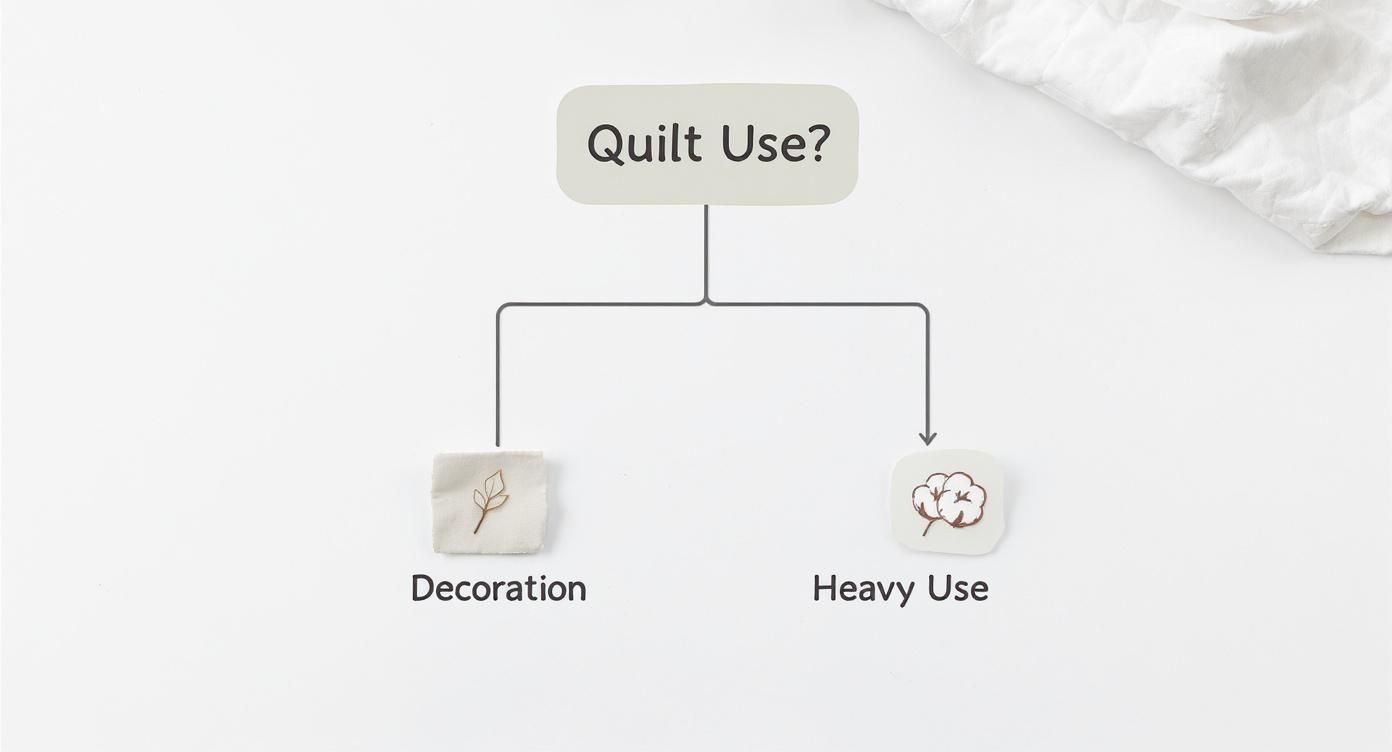
As you can see, a quilt meant for snuggling on the couch points straight to cotton, while a purely decorative piece gives you more room to play with other fibers. Start with the end in mind, and you’ll be on the right track from the very first cut.
To help you decide, here’s a quick-glance comparison of the most common fabric types used in quilting. This table breaks down their best uses, pros, and cons to help you make an informed choice for your next project.
| Fiber Type | Best For | Pros | Cons |
|---|---|---|---|
| Quilting Cotton | All-purpose quilting, from baby quilts to bedspreads and wall hangings. | Easy to cut and sew, holds a press well, durable, breathable, wide variety of prints. | Can shrink (pre-washing is key!), can wrinkle. |
| Cotton Flannel | Cozy quilts for cold weather, rag quilts, baby quilts. | Extremely soft and warm, forgiving with seams, creates a plush feel. | Prone to shrinking and fraying, can be bulky, sheds lint. |
| Linen/Cotton Blend | Decorative quilts, wall hangings, table runners, modern quilts. | Beautiful texture and drape, strong, gets softer with each wash. | Wrinkles easily, can be slippery to cut, more expensive. |
| Minky/Cuddle Fabric | Quilt backings, especially for children's quilts. | Incredibly soft and plush, warm, doesn't fray. | Stretchy and slippery (requires pins!), can't be ironed on high heat. |
Ultimately, the best fabric is the one that fits the purpose of your quilt and that you enjoy working with. While cotton is a fantastic and reliable starting point, don't be afraid to experiment as you gain more confidence
Color gets all the glory when we're picking out quilt fabrics, but it's the quiet hero, value, that truly does the heavy lifting. Simply put, value is just how light or dark a color is. It's what creates the contrast and depth that makes a quilt pattern pop instead of turning into a flat, muddled mess.
Picture a quilt made only with medium-value fabrics—a medium blue, a medium red, a medium green. Step back, and the individual blocks would just blur together. There’s no contrast to define the shapes. Now, toss in some light sky blues and deep navy, some pale pinks and rich burgundies. See? The design suddenly has life.
Learning to see value is a skill that will completely change your quilting game. And one of the best tools for the job is probably sitting in your pocket right now: your smartphone.
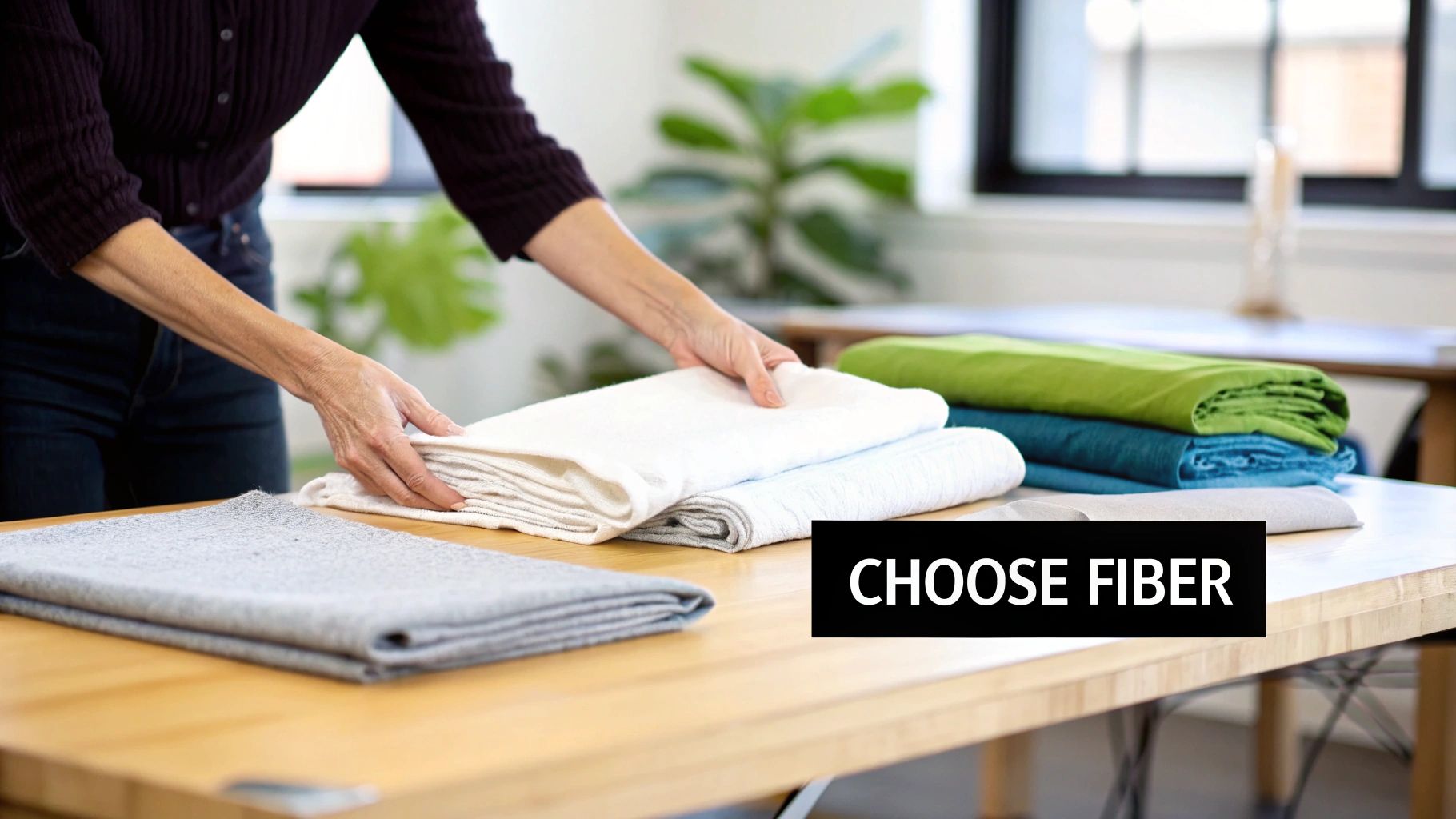
Here's a trick I use all the time. Lay out your potential fabric choices, snap a picture, and then edit that photo to be black-and-white. This simple step strips away all the color and instantly reveals the true values. You'll see right away if you have a good mix or if everything is stuck in the mid-range.
You're aiming for a healthy variety of:
A well-balanced quilt relies on a strong value structure. Without a clear distinction between light, medium, and dark fabrics, even the most beautiful colors can fall flat and create a "muddy" appearance where the pattern is lost.
Once you get the hang of value, you can really start having fun with color relationships. If you want to go deeper, our guide on Color Basics for Makers Understanding the Rainbow is a fantastic place to build your foundation. Seriously, understanding the fundamentals is key, and a simple guide to color theory for beginners can be invaluable.
A great way to start is by choosing a "focus fabric"—usually a large-scale print that you've fallen in love with. From there, you can pull all your supporting colors directly from that print. Let's say your focus fabric has a navy background with coral flowers and sage green leaves. Boom, you've got your core palette: a dark, a medium-bright, and a medium-muted color.
Now you can build out your fabric pull by finding lighter corals, darker greens, and a whole range of blues to create that depth we talked about. This approach helps your quilt feel cohesive and thoughtfully curated, even if you're mixing prints from a dozen different designers. Always lay your fabrics out together and squint your eyes. If they blend into each other, their values are too close. Keep auditioning fabrics until the whole combination sings.
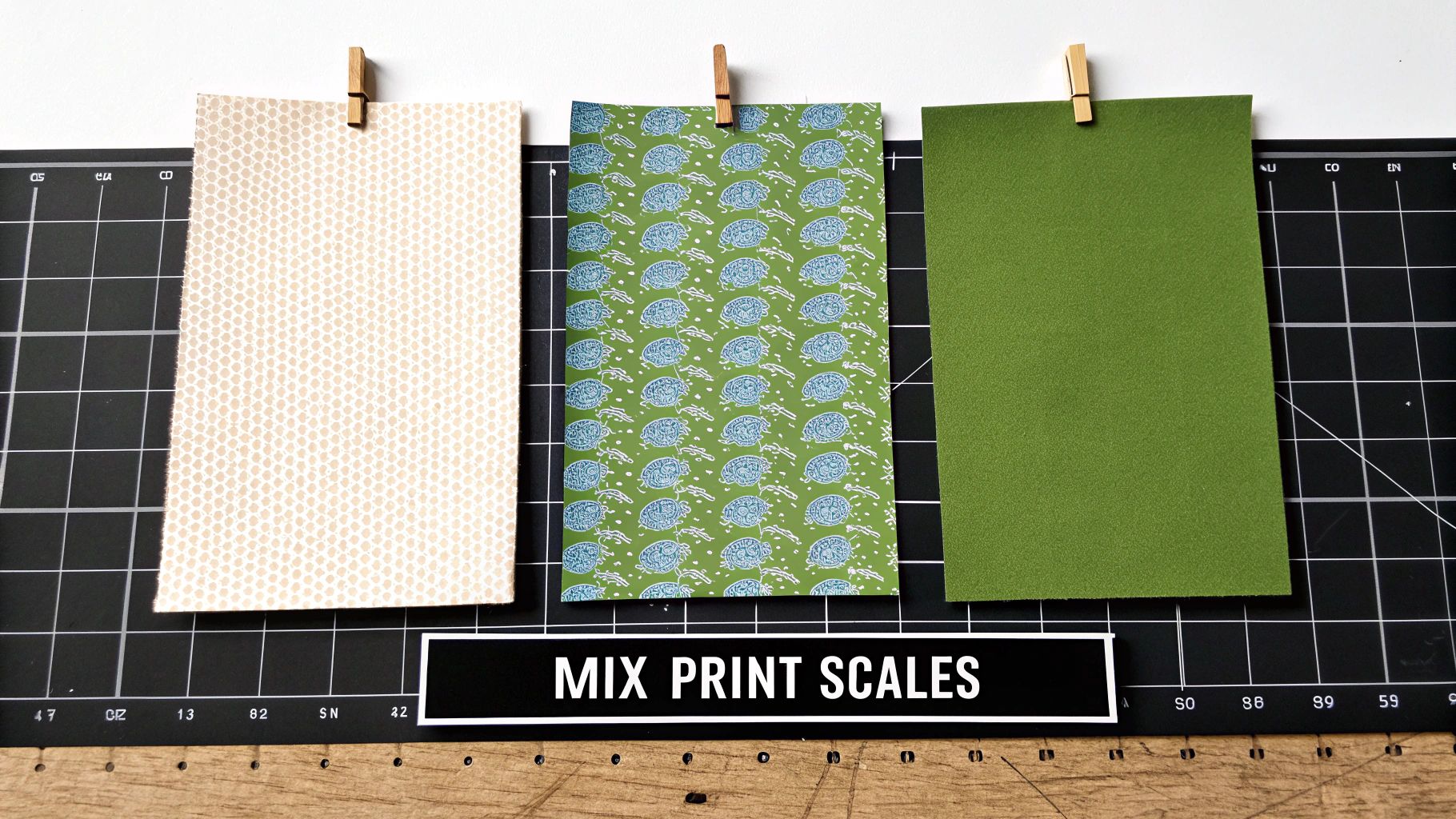
Walking into a fabric shop and seeing all the prints is easily the most exciting part of starting a new quilt. It's also where a lot of us get completely overwhelmed. The secret to a quilt that looks beautifully curated, not chaotic, isn’t just about picking pretty fabrics. It’s all about balancing the scale of the prints.
Think of your quilt as a stage play. Every fabric you choose has a role to play. You've got your leading lady, the supporting cast, and the quiet background characters. For the story to work, you need all of them.
Let's say your quilt pattern calls for big, 12-inch blocks. A gorgeous, large-scale floral would look absolutely stunning in a piece that size. But what happens if you try to chop that same huge floral into tiny 2-inch squares? You'll completely lose the design. The beautiful motif gets diced into unrecognizable confetti.
On the flip side, a tiny dot print that looks perfect in those 2-inch squares might feel totally lost and bland if it’s the only thing filling a 12-inch block. It’s a classic mismatch. The scale of the print has to work with the scale of your quilt blocks.
A fantastic way to visualize this without cutting is to "audition" your fabrics. Using a tool like the Swatch This! fabric window lets you isolate a small section of a print, giving you a sneak peek of how it will look once it's cut down to size.
With the global quilt market projected to reach USD 1,156.12 million by 2030, it’s clear that more people are embracing the craft. This has led to an explosion of modern fabrics, making it more important than ever to understand how to combine them thoughtfully. You can read more about these market trends on giiresearch.com.
Pairing different styles, like a floral with a geometric, can feel a little scary at first. But a few simple guidelines can make it a breeze. The trick is to vary both the scale and the density of the prints.
If you’ve fallen in love with a large, busy floral, don't pair it with another busy print. Instead, reach for a simple medium-scale stripe or a subtle small-scale geometric. The clean, straight lines of a stripe create a wonderful visual break from the organic, flowing lines of the floral, making the whole combination feel balanced and exciting.
Pro Tip: When you're pulling fabrics for a new project, try to get a mix of at least three different scales. A good starting point is one dominant large-scale print, two or three medium-scale prints to support it, and a handful of small-scale blenders to pull everything together. This simple strategy is my go-to for creating quilts with real depth and a clear visual story.
You've spent hours planning your quilt—the perfect pattern, the ideal color palette. The last thing you want is for all that work to be ruined by fabric that frays, fades, or falls apart in the wash.
This is where a few simple, hands-on checks at the fabric store can save you a world of heartache. It’s what separates the seasoned quilters from the rookies. You don’t need any fancy gadgets, just your hands and your eyes. These quick tests will help you feel the difference between a quality quilting cotton and a cheaper fabric that just won't last.
The first thing I always check is the fabric's weave. A good quilting cotton should have a tight, even weave with a high thread count. This density is what keeps the fabric from fraying like crazy and ensures it can handle all the stitching you're about to throw at it without puckering.
Here’s an easy way to check: Unfold a corner of the fabric and hold it up to a light. Can you see a lot of light peeking through the threads? That’s a sign of a loose, low-quality weave. You want a fabric that looks more solid and opaque.
Next, just feel it. A quality fabric feels smooth and substantial in your hands. It shouldn't feel flimsy, papery, or artificially stiff—that stiffness often comes from sizing agents used to make cheap fabric feel better than it is. Getting these basics down is a game-changer, and if you're looking to build up your skills, diving into some free sewing lessons can really help.
Nothing will ruin a quilt faster than bleeding colors. It's a quilter's worst nightmare. While you can't truly know until you pre-wash, there are definitely red flags you can spot right in the store.
Give the fabric a good, vigorous rub. Take a light-colored part and rub it against a dark, saturated section. If you see any color transfer—this is called crocking—put that bolt back immediately. That dye is not stable, and it's practically guaranteed to run in the wash.
Insider Tip: I sometimes bring a small, damp cotton ball with me to the shop. I'll ask for permission, of course, then gently rub it on the corner of a rich color like a deep red or navy. If any color comes off, I know to stay away.
The demand for great fabric is only going up. The global quilt market was valued at USD 5.32 billion and is projected to hit USD 9.26 billion by 2034, largely because so many of us are seeking out beautiful, natural fibers. With more options than ever, taking a few minutes to do these quality checks is absolutely essential for picking the best materials for your project.
Spending that little bit of extra time touching and inspecting your fabric ensures your quilt will not only be beautiful but durable enough to become a cherished heirloom. It's these small habits that truly elevate your craft.
Ask ten quilters if they pre-wash their fabric, and you'll likely get ten different answers. It’s one of the most hotly debated topics in the quilting world, and for good reason—both sides have valid points. There's no single "right" way, but knowing the pros and cons will help you decide what’s best for your project.
So, why do so many quilters swear by it? The biggest reason is shrinkage. Almost all cotton fabrics will shrink a bit in the wash, usually around 3-5%. By washing first, you get that shrinkage out of the way before you start cutting and piecing. This prevents your finished quilt from puckering or distorting later on.
Another huge benefit is getting rid of excess dye. This is especially important if you're working with deeply saturated colors—think rich reds, navy blues, or vibrant purples. These are notorious for bleeding. A quick wash cycle can save you the absolute heartbreak of seeing your stunning red-and-white quilt turn into a splotchy pink one.
While it often comes down to personal preference, there are a few times when pre-washing is pretty much non-negotiable if you want great results.
Don't make the common mistake of assuming that "quilt shop quality" means a fabric is 100% colorfast. It’s always smart to test a small scrap of any deeply saturated fabric. Just toss it in a bowl of hot water or wash it with a color catcher sheet before you commit.
With all those good reasons to wash, why would anyone skip it? Well, many quilters love the crisp, stable feel of fabric right off the bolt. It has a factory finish, often called sizing, that makes rotary cutting and piecing incredibly precise. Once you wash it, the fabric gets softer and can be a little more prone to stretching.
There’s also the aesthetic to consider. Some quilters adore that slightly crinkly, vintage texture a quilt gets when it shrinks up after its very first wash. This "crinkle factor" gives a quilt an instantly cozy, well-loved feel that many people are after.
Ultimately, the choice is yours. It depends entirely on your project, your fabrics, and the final look you want to achieve.
If you do decide to pre-wash, you can minimize fraying by serging the raw edges or running a quick zig-zag stitch along them. Afterward, a good press with a quality iron, like a handy Oliso M3Pro Mini Iron, will bring back a lot of that crispness, giving you the best of both worlds.
Even after you've got a plan, a few nagging questions can pop up right as you're about to make that first cut. I've been there! Let's clear up some of the most common things quilters ask so you can move forward with total confidence.
Your pattern is always your best friend here. It's done the math for you and will list the exact yardage you need for each size. But what if you're flying solo and designing your own quilt? A simple sketch and some quick calculations for your blocks, sashing, and borders will get you the numbers you need.
Here’s a piece of advice I give every single quilter, new or experienced: always buy a little extra. Seriously. Plan on grabbing at least an extra 1/4 to 1/2 yard more than you think you need. This little bit of insurance is a lifesaver when you miscut a piece (it happens!), when fabric shrinks in the pre-wash, or when you just decide you want to swap something out mid-project.
A Quick Tip on Backing Fabric: When you're buying your backing, make sure it's at least 4 inches larger than your quilt top on all four sides. This extra fabric is essential whether you're sending it to a longarmer or wrestling it through your own machine. It gives you (or your quilter) the room needed to clamp it down and keep everything smooth and pucker-free.
You absolutely can, but I'd file this under an "advanced" technique. When you start mixing fabric types—say, tossing some cozy flannel or a nice linen-cotton blend in with your standard quilting cottons—you're introducing a lot of new variables.
The two biggest hurdles are different shrinkage rates and conflicting care instructions. If you're set on mixing your substrates, pre-washing everything is 100% non-negotiable. This helps you get most of the shrinking out of the way before you sew, preventing your beautiful, flat quilt top from turning into a wavy, distorted mess after its first trip through the laundry.
If you're just starting out, my best advice is to stick with 100% quilting cotton from the same collection. This way, you know all your fabrics will play nicely together, letting you focus on honing your piecing skills without any extra drama.
This is such a great question, and the answer makes a huge difference in the final quality of your quilt. They might look similar sitting on the bolt, but they are worlds apart in how they're made.
Quilting cotton is specifically woven to withstand everything we quilters throw at it. It has a high thread count and a very tight, stable weave. This dense construction means it won't fray as easily when you're cutting and handling it, and it has the strength to hold up to thousands of stitches without falling apart.
On the other hand, the "regular" cotton you often find in big-box stores, usually called broadcloth, is a different animal. It's typically much lighter with a looser, less substantial weave. While it's fine for a shirt or a simple dress, it just doesn't have the guts to become a quilt that's meant to be loved, used, and washed for years.
Think of it this way: buying quilt-shop quality cotton is an investment in your own time and effort. It’s what turns your hard work into an heirloom that lasts.
Ready to find the perfect fabrics for your next masterpiece? At Famcut.com, we offer a curated selection of high-quality quilting cottons, tools, and inspiration to bring your vision to life. Explore our collection and start your creative journey today at https://famcut.com.
At High Country Quilts we care deeply about community. With our experiences in retail, we know that a store is not only a place to shop but also a place for the community to gather and share. During this busy...

Hi! We’re Adam and Renee Wheaton, the new owners of High Country Quilts! For more than 40 years, we’ve owned and operated vacuum and sewing businesses. Following in Renee’s father’s footsteps after he retired from All Discount Vacuum and Sewing in Colorado...


Leave a comment