

We Love Our Quilting Community
At High Country Quilts we care deeply about community. With our experiences in retail, we know that a store is not only a place to shop but also a place for the community to gather and share. During this busy...


Before you even start browsing machines online, the first and most important step is to look inward. Ask yourself a few simple questions: what do I actually want to make, how often will I use this thing, and where am I starting from skill-wise? Figuring this out creates a personal roadmap that steers you toward the right machine, saving you from the siren song of flashy features you'll never touch.
Let's get one thing straight: the perfect machine for a quilter could be a nightmare for someone wanting to stitch up heavy-duty backpacks. Getting crystal clear on your goals right from the start is the best way to avoid overspending on a machine that’s overkill, or worse, buying one that sputters out on your dream project.
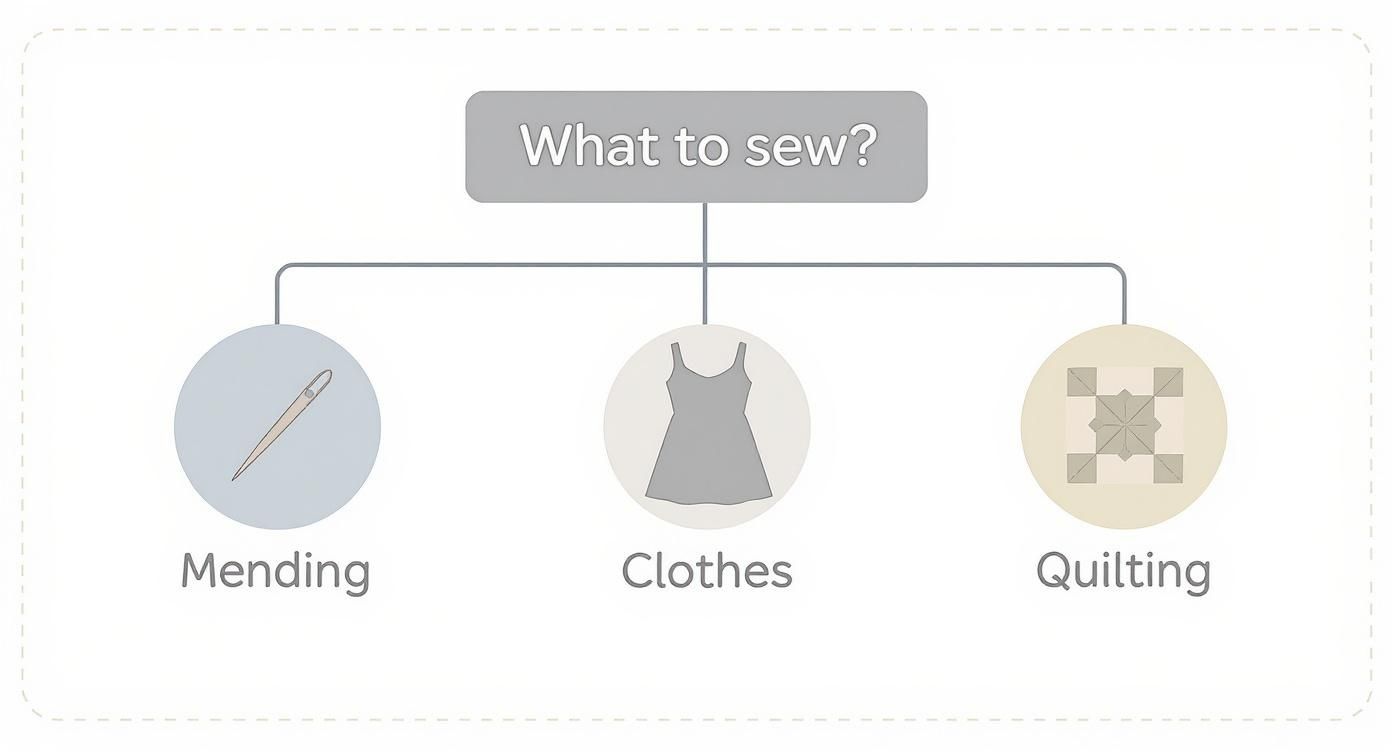
Think about the projects that really get you excited. Do you envision a closet full of handmade clothes? Are you dreaming of creating beautiful, intricate quilts? Or are you just looking for a reliable partner for hemming pants and fixing the occasional rip? Each of these paths leads to a very different kind of machine.
The materials you plan to sew will dictate so much about your machine choice. Working with delicate fabrics like silk or chiffon demands a machine with superb tension control and a gentle feed system. On the flip side, if you’re itching to make rugged canvas totes, denim jackets, or even leather accessories, you’ll need a beast with a powerful motor and a solid metal frame to punch through thick layers without a fight.
Someone sewing soft cotton knits for baby clothes has completely different needs than a person reupholstering a vintage chair with thick, stubborn fabric. Be realistic about what you’ll be doing most often.
And for those tiny, on-the-go fixes that don’t require setting up a full machine, a good portable sewing kit is an absolute lifesaver to have around the house.
Here's a little secret from years of experience: The biggest mistake beginners make is getting mesmerized by a high stitch count. The truth is, most sewers use the same 5-10 utility stitches 95% of the time. Focus on how well the machine makes those core stitches, not how many fancy decorative ones it has.
How much time will you and your new machine be spending together? If you’re launching a home business and plan to sew every day, you need a durable workhorse built for the long haul. But if this is a casual, once-a-month hobby, a more modest and budget-friendly machine will serve you just fine.
Your current experience level is also a huge piece of the puzzle. It’s wise to get a machine you can grow into, but a beginner can quickly get discouraged by a complicated, high-end computerized model. If you’re new to this, you can get up to speed much faster with a bit of guidance—our collection of free sewing lessons is a great place to start building those foundational skills. An intuitive machine with clear, simple controls will make your sewing journey a whole lot more fun.
Alright, you've got a good handle on what you want to sew. Now, let's match those dreams to the right machine. Walking into a sewing machine shop or browsing online can feel like a lot—so many models, so many promises! But really, most machines fall into a few main categories.
Think of this as finding your perfect dance partner. Some are straightforward and reliable, others are flashy and can do all the complex moves. Let's break down the main players so you can find the one that fits your rhythm.
A mechanical machine is the classic, no-fuss option. You control everything with physical knobs and dials—one for stitch selection, one for length, another for width. There are no screens, no menus, just direct, tactile control.
Their biggest advantage? They are incredibly durable and straightforward. With fewer electronic parts, there’s less that can go wrong, and they are often easier and cheaper to service. A good mechanical machine that’s well taken care of can truly last a lifetime. This makes them a fantastic starting point for beginners or anyone who just needs a reliable machine for mending, hemming, and basic projects.
Step into the world of computerized machines, and you’ll find a whole different experience. These are the tech-savvy partners that use LCD screens and push-button controls to make your sewing life easier. They take the guesswork out of things by automatically setting the ideal stitch length and width for you.
What's the real draw?
If your sewing ambitions involve intricate quilt patterns, custom embroidery, or complex clothing, a computerized machine gives you the precision and features a mechanical one just can't offer.
As you can see, once your projects start getting more detailed, the features packed into a computerized machine become a huge asset.
To help you visualize the best fit, here’s a quick side-by-side look at the different machine types.
| Machine Type | Best For | Key Features | Price Range |
|---|---|---|---|
| Mechanical | Beginners, mending, simple projects, budget-conscious sewers. | Manual knobs and dials, heavy-duty metal frame, basic essential stitches. | $150 - $400 |
| Computerized | Quilters, garment makers, anyone wanting creative options. | LCD screen, push-button controls, large stitch library, automatic functions. | $300 - $2,000+ |
| Embroidery | Monogramming, custom designs, decorative art. | Embroidery hoop, built-in designs, USB connectivity for custom patterns. | $500 - $10,000+ |
| Serger/Overlocker | Professional-looking seams, knit fabrics, finishing raw edges. | Uses 3-4 threads, trims and encloses seam in one step, differential feed. | $250 - $1,500 |
This table should give you a clearer idea of where you might land based on your goals and budget.
First, let's clear something up: a serger doesn't replace your regular sewing machine. It's a specialist that works alongside it. Its main job is to create those clean, durable, and stretchy seams you see on store-bought clothes. In one quick pass, a serger stitches a seam, trims the extra fabric, and finishes the raw edge with an overcast stitch.
A serger is the absolute best friend of anyone who wants to sew with knit fabrics. It creates seams that stretch with the fabric, so you don't have to worry about popped stitches on your t-shirts and leggings.
If making professional-grade garments is your goal, a serger is a must-have. While it’s another machine to buy and learn, the speed and quality it brings to your work are incredible. For anyone ready to take the plunge, having a handy guide like our Essential Serger Reference Tool can make getting the hang of it much faster.
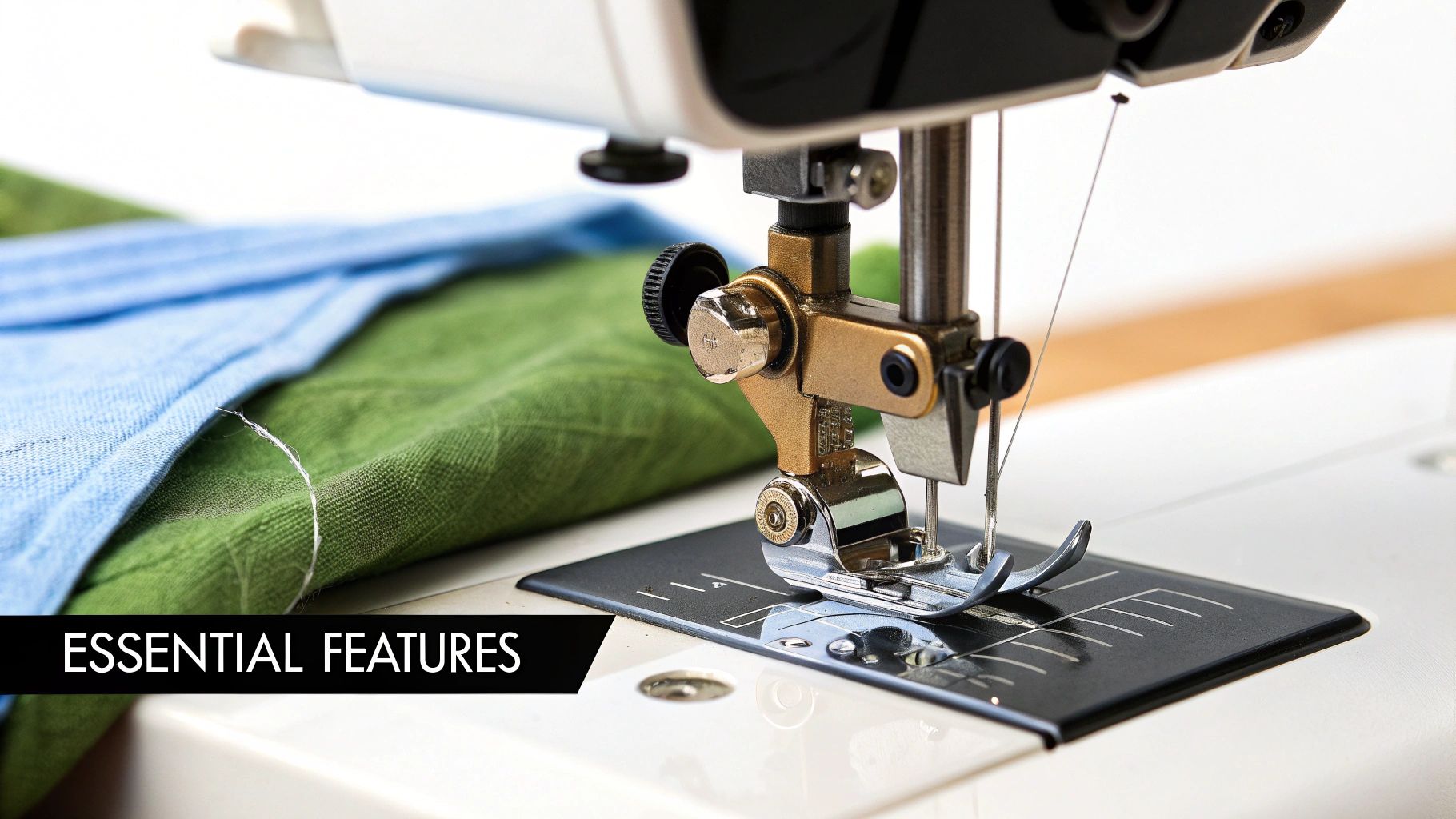
Alright, you've figured out what kind of machine you probably need. Now comes the fun part—looking at the actual features. This is where you move past the big categories and start digging into the details that will shape your sewing experience day in and day out.
It's easy to get wowed by a machine that boasts 250+ stitches. But I'll let you in on a little secret: you’ll probably only use a handful of them regularly. The real test of a great machine isn’t the sheer number of fancy stitches; it's how well it handles the absolute essentials.
The backbone of any sewing project is a small set of fundamental utility stitches. Before you get distracted by decorative script fonts or floral patterns, make sure the machine you’re considering nails these basics.
Honestly, a machine that executes these four stitches with perfection is infinitely more valuable than one with hundreds of flimsy decorative options. These are the stitches that create strong, professional-looking projects.
Let's look under the hood. The parts you can't always see—the motor, feed system, and bobbin—are what truly determine a machine's power and longevity. Getting this right is a huge part of learning how to choose a sewing machine that won’t let you down.
The motor is the heart of the operation. Ever tried to sew over a thick jeans seam and had the machine grind to a halt? That’s a weak motor. A strong one will provide the piercing power you need to go through multiple layers of denim, canvas, or upholstery fabric without skipping a beat.
Next up are the feed dogs. Those are the little metal teeth beneath the presser foot that grip your fabric and pull it through. A solid feed system ensures the fabric moves evenly, which prevents those frustrating puckered or wavy seams. Some machines have more advanced systems with more points of contact, a real bonus if you're a quilter or work with slippery fabrics like silk.
Pro Tip: Keep an eye out for a "drop feed" function. This lets you lower the feed dogs so they don't touch the fabric, which is essential for free-motion quilting, darning, or any technique where you're guiding the fabric by hand.
The bobbin system can also make or break your sewing flow. I almost always recommend a top-loading bobbin (also called a "drop-in" bobbin) for beginners. They typically have a clear plastic cover, so you can easily see how much thread you have left. No more running out of bobbin thread halfway through a long seam!
Okay, beyond the core mechanics, some features are just so genuinely helpful they become must-haves once you've used them. Think of these as quality-of-life upgrades that cut down on frustration.
A one-step buttonhole function is a game-changer. On older or more basic machines, making a buttonhole can be a clunky, four-step process. A one-step function does the whole thing automatically, perfectly sized to your button, in one smooth operation. If you're making clothes, this feature will save you so much time and agony.
Adjustable presser foot pressure is another one of those unsung heroes. It lets you change how firmly the presser foot holds down your fabric. You can lighten it for delicate fabrics to avoid leaving marks or tighten it for bulky materials to keep everything feeding through smoothly.
If you’re a quilter or plan to tackle big projects like drapes or coats, pay close attention to the throat space—that's the distance from the needle to the machine's body. More space gives you more room to maneuver bulky projects without having to wrestle with them.
For those venturing into complex projects, like elaborate costumes, having the right machine is everything. If you're tackling something ambitious, our guide on how to make cosplay armor can show you what it takes to work with materials that will truly test your machine's capabilities.
Finally, think about your sewing space. If you're dreaming of a dedicated sewing table with a built-in machine, you'll need to make sure your choice is compatible. Not all models can be mounted, so if that's in your plans, you'll specifically need a sewing machine for cabinet installation.
https://www.youtube.com/embed/xx4ViRzVVPg
Alright, let's talk about the elephant in the room: the price tag. Figuring out what sewing machine to choose often boils down to what you can comfortably afford. And with models ranging from under $200 for a simple mechanical machine to well over $5,000 for a top-of-the-line embroidery beast, setting a realistic budget is your first major step.
The good news? You absolutely do not need to spend a fortune to get a durable, reliable sewing machine. For most hobbyists and people just starting out, the sweet spot for a machine that will last for years is typically in the $300 to $800 range. Machines in this category usually have a solid metal frame, a stronger motor, and truly useful features like a one-step buttonhole and a great selection of stitches.
Knowing what to expect at different price points is key to matching your budget with your sewing goals. Think of it in tiers, where each level unlocks more functionality and durability.
The real value isn’t just the sticker price; it’s the total cost of ownership. Spending a little more upfront for a machine from a reputable brand can save you a ton on repairs and replacements down the road. A well-built machine, with a bit of care, can easily be your sewing partner for decades.
Your budget doesn't end the day you bring the machine home. To really get started on the right foot, you'll want to factor in a few other essential costs.
First up is annual servicing. Just like your car, your sewing machine needs a professional tune-up every year or two to keep it humming along perfectly. This usually runs between $75 and $150, but it’s a non-negotiable investment if you want your machine to last.
You’ll also need to set aside a little for some key accessories that might not be in the box. Most machines come with basic presser feet, but you’ll quickly want specialized ones, like a walking foot for quilting or a zipper foot for garments. Don't forget the recurring costs of quality thread, extra bobbins, and sharp machine needles. Even a simple tool like a quick desk needle threader can be a small but mighty purchase that saves you a world of frustration.
It's also interesting to see where the industry is heading. The global sewing machine market is growing fast, with projections suggesting it could hit USD 11 billion by 2030. This growth is driven by everything from a booming textile industry to new automated technologies. For us, this means more innovative options are always hitting the market, but it also highlights why it’s smart to pick a machine that will serve you well for years to come. You can dig into these market trends from Cognitive Market Research to learn more.
You wouldn’t buy a car without taking it for a spin, right? The same logic absolutely applies to a sewing machine. It’s a real investment in your creativity, and how a machine feels when you're using it is just as important as any feature listed on the box. Getting that hands-on feel is the single most important step in finding a machine you'll love for years to come.
An online product page can’t tell you if the motor hums along smoothly or if it clatters like an old train. It won't reveal if the foot pedal is responsive and intuitive or jumpy and hard to control. These are the little details that make the difference between joyful creating and frustrating work.
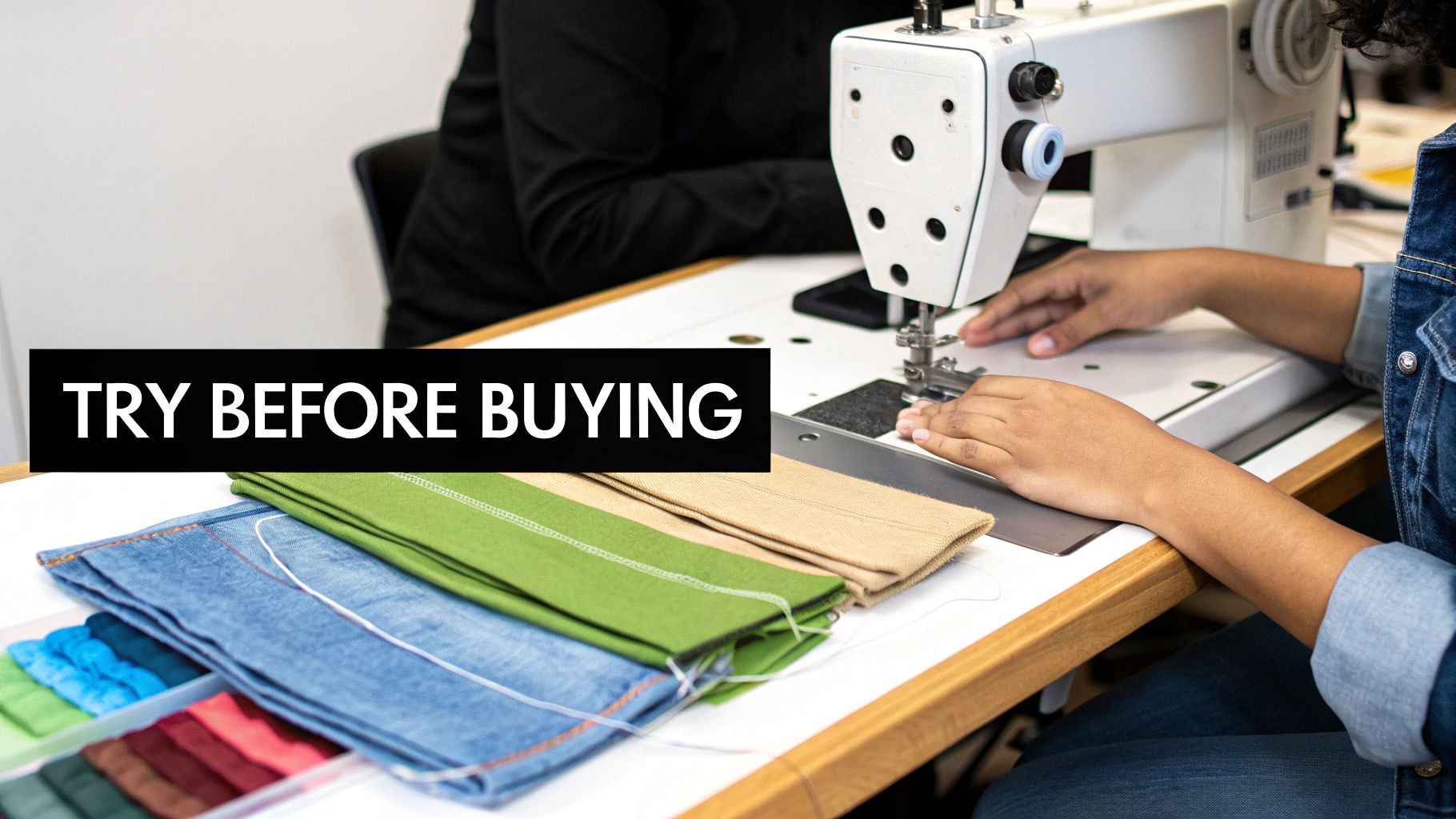
This is where your local sewing machine dealer becomes your best friend. They offer something you’ll never get from a big-box online store: the chance to actually sit down and sew.
Walking into a dealership without a plan can feel a bit overwhelming with all the options. To make your visit count, put together a small "test drive kit" before you go. Think of it as your secret weapon for making a truly informed choice.
Your kit should be filled with fabric swatches that represent what you actually want to make. Don't just bring a piece of easy-to-sew quilting cotton. You want to see how the machine performs when things get tricky.
My Go-To Fabrics for a Test Kit:
When you sit down at a machine, take a deep breath and slow down. This isn't a race. You're there to see if this machine could be your new creative partner.
As you start to sew, use all your senses. The sound and feel of a machine tell you a ton about its quality and construction. A well-built machine generally runs with a smooth, quiet, and satisfying sound, even when you put the pedal to the metal.
Listen to the motor. Does it sound powerful and steady, or does it start to whine when you hit that folded-up denim swatch? A struggling motor is a dead giveaway that it might not have the piercing power you need for tougher projects.
Next, focus on how the machine feels to use. Go through the motions you'll be doing over and over again on any project.
This hands-on process uncovers all the subtle but crucial details about a machine's design that you'll never find on a spec sheet.
Choosing to buy from a local shop offers so much more than just the machine itself. You might save a few bucks online, but the long-term value of having local support is priceless. Many dealers even include free introductory classes to make sure you know how to use all the bells and whistles on your new machine.
Plus, when you eventually need a tune-up or have a weird question a manual can't answer, having a real expert you can talk to is a game-changer. They provide reliable repairs, smart troubleshooting, and a sense of community you just can't get from a website. For more great advice, check out our collection of sewing tips and tricks. Taking the time to test drive a few machines at a local dealer is the best way to ensure you're choosing a partner that truly fits your creative style.
Even after doing all your homework, a few questions always seem to linger. That's completely normal! Here are some straight answers to the things sewers really want to know when they're on the hunt for a new machine.
Think of this as that final chat with a seasoned sewing friend to clear up any last-minute doubts before you make a decision. Getting this right means years of happy, creative sewing ahead.
For anyone just starting out, the two most important words are simplicity and reliability. It's so easy to get dazzled by a machine that boasts 200+ stitches, but trust me, you'll probably only use a handful of them. The goal is to build a strong foundation, not get overwhelmed.
Look for a machine with a solid metal frame. It might not sound exciting, but it makes a massive difference in how stable the machine is and how long it lasts. You'll also want a good set of basic utility stitches—a straight stitch, zigzag, blind hem, and maybe a stretch stitch for knits. That's your core toolkit.
A one-step buttonhole function is a total game-changer, especially if you want to make clothes. It automates a process that can be incredibly frustrating to do manually, giving you perfect, consistent buttonholes every single time. It's a lifesaver.
Also, a top-loading (or drop-in) bobbin is far less fussy than the front-loading kind. Other features that make life easier for beginners are adjustable speed control—so you can slow things down and stay in control—and a built-in needle threader to save your eyes and your patience.
This one really comes down to what you want to do and how comfortable you are with a little tech. There’s no right or wrong answer, just what’s right for you.
Mechanical machines are the classic workhorses. They're known for being incredibly durable, easy to operate with simple dials, and generally cheaper. They're also easier for a local shop to service. If you're looking for a dependable machine for making clothes, hemming pants, or doing general repairs, a good mechanical model might be all you ever need.
Computerized machines, on the other hand, are all about convenience and creative options.
If your sewing dreams involve intricate quilting, embroidery, or complex projects, investing in a computerized machine from the get-go is a smart move.
You don't have to break the bank to get a fantastic, reliable sewing machine. For most beginners and hobbyists, the sweet spot is somewhere between $200 and $500.
In this range, you’ll find quality machines from trusted brands built with that all-important metal frame and all the essential features you need to tackle a ton of different projects. I'd be wary of machines under $200; they often rely on plastic internal parts that just don't stand the test of time and can lead to a lot of frustration.
Once you start looking at machines over $600-$800, you're entering the territory of advanced features for serious quilters, embroiderers, or professional sewists. Your budget should match your ambition and how much you see yourself sewing. It's almost always a better long-term investment to get a solid mid-range model than a cheap one you'll outgrow or that will break down in a year.
At Famcut.com, we believe in empowering creators with the right tools and knowledge. Explore our resources and find everything you need to start your next project with confidence. Find your perfect sewing companion today at https://famcut.com.
At High Country Quilts we care deeply about community. With our experiences in retail, we know that a store is not only a place to shop but also a place for the community to gather and share. During this busy...

Hi! We’re Adam and Renee Wheaton, the new owners of High Country Quilts! For more than 40 years, we’ve owned and operated vacuum and sewing businesses. Following in Renee’s father’s footsteps after he retired from All Discount Vacuum and Sewing in Colorado...


Leave a comment