


Free Fabric All Year: Our 2027 Fabric Punch Card
November 2–25 only: buy a $200 gift card in either store and get a free yard of fabric every month of 2027.

Last Updated: November 11, 2026
Quick Summary
Backing fabric should be larger than the quilt top on every side, usually by 4 to 10 inches per side. Measure the quilt top in inches, add your overhang to each dimension, then choose fabric width and divide by 36 to convert inches to yards.
Figuring out how much backing fabric for a quilt is one of the first math problems every quilter faces, and it is easy to get wrong. A common mistake is to measure the quilt top, buy exactly that much fabric, and then find the backing comes up short once it is loaded on the frame. The fix is to plan for extra fabric from the start.
The rule is simple. A backing needs to be bigger than the quilt top on every side, so it can be stretched and secured during quilting. Most quilters add 4 to 10 inches to each dimension, depending on how the quilt will be finished. That extra border is called overhang, and it is what keeps the quilt sandwich from shifting.
Start by measuring the finished quilt top. Lay it flat on a clean surface, then measure the length and width in inches at the widest and longest points. Measure at the center as well as the edges, because a quilt can stretch or grow slightly as it is pieced.
Write both numbers down before you do anything else. Those two measurements drive every calculation that follows.
A common mistake is measuring a quilt that is still folded or rolled. Lay it out fully flat first, or your numbers will come out wrong.
The overhang you choose depends on how you plan to quilt the piece. A 4-inch allowance per side works well for many home machine projects, where the quilt will be guided through a standard sewing machine. It keeps the fabric use modest while still giving you enough material to hold on to.
A 10-inch allowance per side is more common for longarm quilting. Longarm machines need extra fabric at each edge to clamp and roll the quilt sandwich smoothly.
Here is a quick way to decide:
Always confirm the requirement with your longarm quilter. Local providers sometimes have their own rules for how much backing they need, so check their guidelines before you buy.
Fabric is sold in two common widths in the United States. Standard quilting cotton is typically 42 to 44 inches wide, while wideback fabric is usually 108 inches wide. The width you buy determines how many panels you need, and the number that matters is not the label width but the usable width after you account for selvages and any width loss from prewashing.
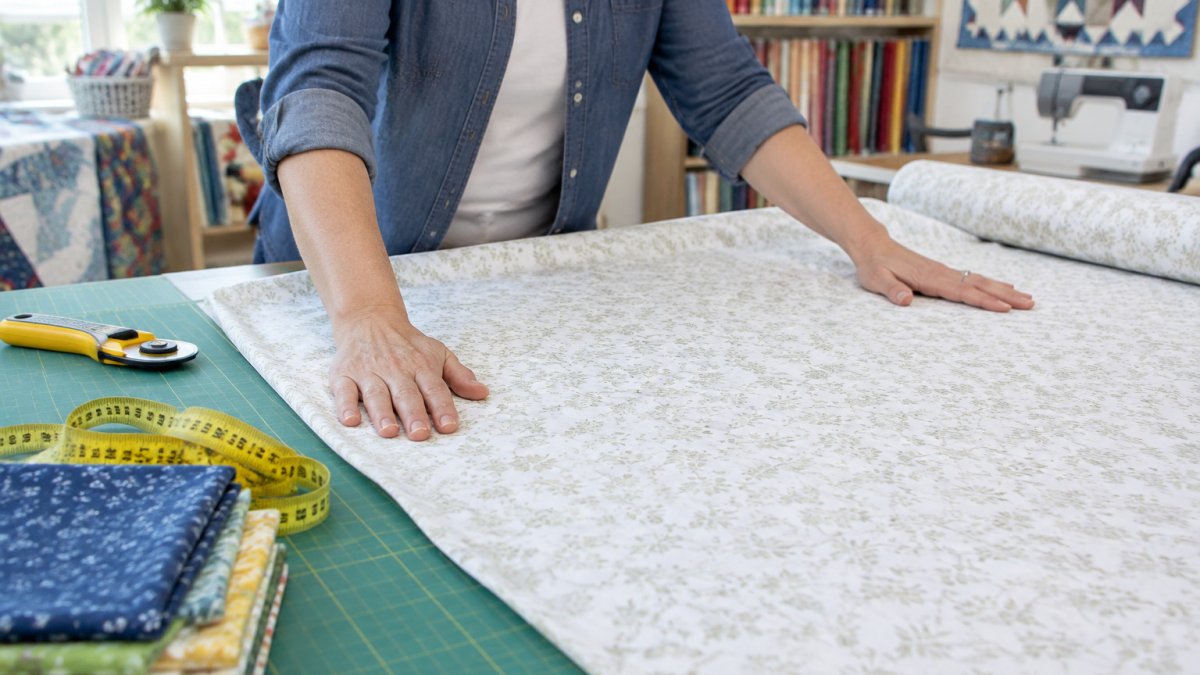
For 42-inch fabric, start by subtracting about 1 inch from the stated width to set aside the selvage edges, leaving roughly 41 inches of usable width. Divide your required backing width by that usable width and round up to find the number of panels. Each seam between panels also consumes fabric, so add about 1 inch of width for every seam to keep the finished backing at full size.
For 108-inch wideback fabric, check whether one panel covers both dimensions of the backing. Lay the backing size over the fabric width and length, and if the width fits within 108 inches and the length fits within the yardage you buy, you can often cut a single panel with no seam.
Here is a practical method:
Watch out: many quilters convert inches to yards before adding seam allowance, which leaves them short. Finish all inch-based additions first, then divide by 36.
If the backing is longer than one wideback panel can cover, you will need to join two panels. Plan the seam so it runs across the shorter dimension, which keeps the join in a single line and reduces the number of seams that show on the finished quilt.
The examples below show how the same overhang produces different yardage depending on fabric width and panel layout. Each uses a 4-inch overhang per side, which adds 8 inches to each dimension, and compares 108-inch wideback with 42-inch standard cotton so you can see the trade-off.
Lap quilt, 50 by 60 inches
Throw quilt, 60 by 72 inches
Queen quilt, 90 by 108 inches
The pattern to remember is that the number of panels depends on dividing the backing width by usable fabric width, and the yardage depends on the cut length multiplied by that panel count. Always round up, because a small surplus costs far less than a short backing on the frame.
The worked examples show how the same overhang produces different yardage depending on fabric width and panel layout.
| Quilt size | Backing size | Yardage needed (108-inch wideback vs 42-inch cotton) |
|---|---|---|
| Lap quilt, 50 by 60 in | 58 by 68 in | About 2 yards, no seam vs roughly 3.8 yards, one seam |
| Throw quilt, 60 by 72 in | 68 by 80 in | About 2.25 yards vs roughly 4.5 yards |
| Queen quilt, 90 by 108 in | 98 by 116 in | Roughly 6.5 yards, two panels joined vs roughly 9.7 yards, three panels |
A quilt backing calculator can speed up the math, but it only works well when you give it accurate inputs. Enter your exact quilt top measurements in inches, and choose the overhang that matches your quilting method. Double-check that the calculator uses the fabric width you plan to buy.
Many calculators assume a specific allowance, so read the fine print. If the tool does not say what overhang it uses, do not trust the result until you confirm it.
Use a calculator as a starting point, then verify the output by hand. Our quick check is to add the overhang to each dimension, then compare the result with the calculator's answer. If the numbers differ, recheck your inputs before you buy.
Cotton fabric can shrink, and that can throw off your yardage. Decide whether you will prewash the backing before you cut. Prewashing removes excess dye and shrinkage, but it also reduces the usable width, so buy a little extra if you choose to wash.
Directional prints need extra thought too. If the pattern has a clear up and down, you may need to run the design in one direction across the whole backing. That can increase the yardage, especially for wideback fabric with a large print.
Seam placement matters as well. Plan where any seams will fall so they do not land in awkward spots on the finished quilt. A center seam is common, but some quilters prefer a seam that runs along a visual break in the design.
Once you know your yardage, you are ready to shop. The Grey Dove Speckled Metallic Cotton Wideback Fabric, priced at $20.29 per yard, is a 108-inch wideback option that suits quilt backs.
If you are still learning the math, the product guide to quilt charts and formulas is a handy reference to keep near your sewing table. For a ready-made option that saves you from piecing, you can browse pre-pieced quilt backs for ideas.
Add the overhang to each side of your quilt top, then divide by the fabric width. For a 60 by 72 inch top with a 4 inch overhang per side, the backing needs to be 68 by 80 inches. On 42 inch wide fabric, you would need 2 panels of 80 inches each, so about 2 1/2 yards. On 108 inch wide fabric, one 80 inch length covers the 68 inch width, so you need about 2 1/4 yards. Round up to the nearest eighth of a yard and add extra if your fabric has directional prints.
A queen quilt top is commonly about 90 by 108 inches. With a 4 inch overhang on each side, the backing measures about 98 by 116 inches. On 108 inch wide fabric, you cut one 116 inch length and need about 3 1/4 yards, rounded up to 3 1/2 yards for safety. On 42 inch fabric, you would piece three panels, so plan for about 9 yards. Confirm your exact measurements before buying, since quilt sizes vary by maker.
Yes. Wide-back fabric measuring 108 inches across is designed for quilt backs and often eliminates piecing entirely for quilts up to about 100 inches wide. Measure your backing width before buying, and prewash the fabric to check shrinkage. Because wide backs are sold by the yard, a 108 inch fabric for a throw quilt can cost less than piecing several narrower panels, which also removes seams from the back.
Most quilters add 4 inches per side for a standard quilt, which is enough for basic longarm quilting, and 10 inches per side if the quilt will be loaded on a frame that needs more grip. Ask your longarm quilter which allowance they require before you cut, because requirements differ by provider. Measure your own quilt top carefully, since the backing is calculated from its actual size, not the pattern size.
November 2–25 only: buy a $200 gift card in either store and get a free yard of fabric every month of 2027.

Serger and BERNINA Mastery classes, longarm training, bag-of-the-month, Kids Sewing Club and a Highlands Ranch retreat. Here's what's on the calendar in November.

Free gifts, included packages and special pricing on the BERNINA 790 ULTRA, 990, Liberty Editions, L 890 serger and Q Series longarms, now through December 31.


Leave a comment