
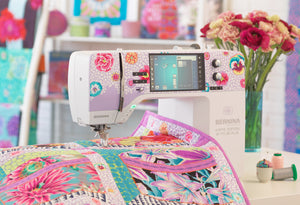

We Love Our Quilting Community
At High Country Quilts we care deeply about community. With our experiences in retail, we know that a store is not only a place to shop but also a place for the community to gather and share. During this busy...


So, you're planning a new quilt and have your eye on those tempting stacks of 5-inch squares. The big question is, how many charm packs do you actually need? For a good-sized lap quilt, a common project for many of us, you're typically looking at needing 4 to 5 charm packs. This gives you a great starting point for a cozy throw, but the final number will always depend on your specific pattern and whether you decide to add sashing or borders.

Starting a new project is always a thrill, but let's be honest, the fabric math can be a bit of a drag. That’s where charm packs come in. These little bundles of 5-inch precut squares are a quilter's secret weapon, letting you skip the hours of rotary cutting and jump right into the fun part: sewing.
A standard charm pack usually comes with 42 squares of 5x5 inch fabric. They're one of the most popular precuts on the market for a reason—they're incredibly versatile. You can use them for simple patchwork, whip up a bunch of half-square triangles, or incorporate them into more complex quilt blocks.
Think of a charm pack as a curated "tasting menu" of an entire fabric collection. You get a little piece of each print and colorway without having to commit to buying yards of everything. This built-in variety is perfect for achieving that scrappy, yet beautifully coordinated, look we all love.
Here’s what makes them so great:
To put it in perspective, one charm pack gives you the equivalent of about ¾ of a yard of fabric. If you're aiming for a classic throw quilt around 50x65 inches—perfect for chilly evenings—you'd need about 5 charm packs. For more project inspiration, you can find a ton of charm pack calculations and ideas for quilting.
To help you get started, I've put together a handy cheat sheet for the most common quilt sizes. This chart is for a straightforward quilt top made just from squares, with no sashing or borders. It also accounts for the standard ¼-inch seam allowance, which means your 5-inch squares will finish at 4.5 inches in the quilt top.
Quilter's Tip: I always recommend grabbing one more charm pack than you think you’ll need. Think of it as a "quilter's dozen." It’s your insurance against any cutting oopsies and gives you a few extra squares to make a matching pillow sham or a fun, pieced backing.
This table is your jumping-off point. It simplifies the initial guesswork and helps you figure out how much fabric to grab for your next masterpiece. Later on, we’ll get into the nitty-gritty of custom calculations for projects with sashing and borders.
This quick-reference chart shows the estimated number of standard 42-piece charm packs required for common quilt sizes, based on a simple grid layout.
| Quilt Size | Approximate Dimensions (Inches) | Number of 4.5" Finished Squares Needed | Total Charm Packs Required |
|---|---|---|---|
| Baby | 36" x 54" | 96 squares (8x12) | 3 packs |
| Lap/Throw | 54" x 63" | 168 squares (12x14) | 4 packs |
| Twin | 72" x 90" | 320 squares (16x20) | 8 packs |
| Full/Double | 81" x 99" | 396 squares (18x22) | 10 packs |
| Queen | 90" x 108" | 480 squares (20x24) | 12 packs |
| King | 108" x 108" | 576 squares (24x24) | 14 packs |
Remember, these numbers are a great starting point for planning. Your final count might change a bit based on your specific design choices, but this should get you heading to the fabric store with confidence

While my quick-reference chart is a fantastic starting point for standard quilt sizes, the real fun begins when you want to design a quilt with your own custom dimensions. Maybe you've got a specific nook you want to fill or a funky-sized antique bed to cover. This is where a little bit of simple math puts the design power right in your hands.
Don't worry, this isn't high-school geometry. We're going to walk through a super straightforward formula that anyone can use. It all hinges on one crucial number: 4.5.
Every 5-inch charm square has a little secret: it shrinks after you sew it. When you stitch your squares together with a standard quarter-inch (¼") seam allowance, you lose a half-inch from both the width and the height. Why? Because you're sewing a ¼" seam on each of the four sides.
This means your 5" x 5" fabric square becomes a 4.5" x 4.5" finished square once it’s sewn into your quilt top. This is, without a doubt, the most important number you need. Forgetting this will throw off all your calculations and leave you scrambling for more fabric mid-project.
My Two Cents on Seams: I can't stress this enough—a consistent ¼-inch seam is everything. If your seams are too wide, your quilt will end up smaller than you planned. Too narrow, and it might be bigger. A quarter-inch presser foot is a quilter's best friend for a reason!
Ready to do some quilt math? Let's break it down with a real-world example. Imagine you want to create a custom lap quilt that finishes at 49.5 inches wide by 58.5 inches long. That’s a great, generous size for cuddling on the couch.
Here’s the simple, three-part process I use every time:
And just like that, you know the exact number of squares your custom quilt top requires. Now, let’s turn that number into charm packs.
With your total square count in hand, the last bit of math is the easiest. All you need to know is that a standard charm pack typically contains 42 squares.
Simply divide your total squares by the number of squares in a pack:
Since you can’t buy a fraction of a charm pack, you always round up to the next whole number. In this case, you'd need to buy 4 charm packs to finish your custom lap quilt. This gives you all 143 squares plus a few extras for those "oops" moments or for playing around with your layout.
This formula works for any project, from a tiny doll quilt to a massive California King. For instance, scaling up to a popular twin-size quilt at 70x90 inches would require 8 charm packs. This is a fantastic option for bedding, especially when you consider the time saved by using precuts from shops like High Country Quilts. That project is roughly 6 yards of fabric, but using charm packs saves quilters around 40% of their prep time versus cutting from yardage. If you want to learn more, you can dive deeper into the time-saving benefits of quilting with charm squares and see just how much it streamlines the process.

Alright, you’ve got the basic formula down. Now for the fun part: let’s see how those numbers play out in the real world with actual quilt sizes. This is where the magic happens, and you start to see just how quickly a beautiful quilt top can come together using precuts.
We'll walk through the most common quilt dimensions, from a sweet little baby quilt to a magnificent king-sized bedspread. Think of these as reliable starting points you can tweak for your own projects.
There’s nothing quite like making a baby quilt. They’re small, satisfyingly quick to finish, and always become a treasured keepsake. A typical baby quilt is around 36 x 54 inches—perfect for the crib or for tummy time on the floor.
So, how many squares is that?
Since a standard charm pack has 42 squares, you’ll need 3 charm packs (96 / 42 = 2.28, rounded up). You'll have plenty of extra squares to play with the layout or even whip up a matching burp cloth.
Lap quilts are my absolute favorite gift to make. They’re cozy and generous without being a massive undertaking—you can easily finish one in a weekend. A good size for a throw quilt is about 54 x 63 inches.
Let’s run the numbers:
This works out perfectly: 168 squares divided by 42 is exactly 4. You'll need 4 charm packs with no pesky leftovers! Of course, grabbing a fifth pack is never a bad idea if you want more wiggle room for your design.
I often use five charm packs for a slightly larger throw, which gives me enough fabric for a 14x15 block layout (210 squares). The extra size makes it just a bit more luxurious for snuggling on the sofa.
Once we get into bed quilts, charm packs become a serious time-saver. A standard twin mattress is 39 x 75 inches, but for a nice drape, the quilt should be larger—around 72 x 90 inches.
Here’s the breakdown:
To get 320 squares, you'll need 8 charm packs (320 / 42 = 7.6, so we round up).
For a full-size bed, you'll want a quilt around 81 x 99 inches to get good coverage on all sides. Tackling a project this size from yardage can feel a little intimidating, but thinking in terms of 5-inch squares makes it so much more manageable.
Let’s do the math:
This means you’ll need to buy 10 charm packs (396 / 42 = 9.42, rounded up) to complete your quilt top. The extras are perfect for making matching pillow shams!
Queen beds are the most popular size out there, and a quilt measuring about 90 x 108 inches will give you a beautiful, graceful drape.
Here’s what you’ll need for the layout:
This comes out to 11.43 packs, so you’ll need to grab 12 charm packs. This is equivalent to about 9 yards of fabric, but precuts make handling all those different prints a breeze. For more inspiration, check out these favorite charm square quilt projects from other quilters.
And finally, the king of all quilts! For a standard king-size bed, your quilt top should be around 108 x 108 inches. It’s a huge project, but charm packs make the patchwork assembly surprisingly straightforward.
Let’s break it down one last time:
To get enough fabric, you'll need 14 charm packs (576 / 42 = 13.7, rounded up). With those, you’ll be well on your way to creating a stunning masterpiece for your bed.
To help put these numbers into perspective, this table shows how charm packs translate into yardage and gives a rough idea of how long each project might take a beginner.
| Quilt Size | Charm Packs | Equivalent Yardage (approx.) | Estimated Beginner Time |
|---|---|---|---|
| Baby | 3 packs | 2.25 yards | 1-2 weekends |
| Lap/Throw | 4-5 packs | 3 - 3.75 yards | 2-3 weekends |
| Twin | 8 packs | 6 yards | 4-6 weekends |
| Full | 10 packs | 7.5 yards | 5-8 weekends |
| Queen | 12 packs | 9 yards | 6-10 weekends |
| King | 14 packs | 10.5 yards | 8-12+ weekends |
Keep in mind that these time estimates are just for the quilt top assembly and can vary a lot based on your individual sewing speed and available time

So far, our math has focused on a simple patchwork top where all the squares are stitched edge-to-edge. But let’s be honest, some of the most beautiful quilts get their personality from the "in-between" spaces. This is where sashing and borders come in, and they definitely change your charm pack math.
Adding these elements does so much more than just make your quilt bigger; it completely transforms the design. Sashing gives your charm squares a little breathing room and makes the individual prints pop, while a well-chosen border acts as the perfect frame for your masterpiece. The good news? Adjusting your calculations is easier than you think.
Sashing is simply the strips of fabric you sew between your quilt blocks. It’s a fantastic way to introduce a solid color, create a secondary pattern, and give the eye a place to rest. But here’s the key takeaway for your shopping list: sashing almost always reduces the number of charm packs you need.
Think about it—those fabric strips take up real estate. That means you need fewer charm squares to fill the same amount of space. This is a brilliant little trick for stretching a precious, out-of-print charm pack a little further or staying on budget.
Let’s go back to our lap quilt example that was shooting for a finished size around 54" x 63". Without sashing, we needed a 12x14 grid, which meant 168 squares and a total of 4 charm packs.
Now, what if we add 2-inch finished sashing between each of those blocks?
Suddenly, you might find that a 10x12 grid of charm squares (120 squares total) gets you to a very similar final dimension once the sashing is added. That new layout only requires 3 charm packs (120 / 42 = 2.85, so you round up). You just saved yourself from buying an entire pack!
A Quick Tip: Your sashing fabric is almost always cut from yardage, not from the charm squares themselves. I recommend picking a coordinating solid or a subtle, low-volume print that complements your charm pack without competing with it.
Borders are the final frame for your quilt, tying the whole design together. Unlike sashing, which gets worked in as you build your quilt top, borders are added at the very end.
For this reason, I always tell people to plan for and purchase border fabric separately from their charm packs. It's practically impossible to piece a smooth, stable border from 5-inch squares. You really need long, continuous strips cut from yardage to ensure your quilt lays flat and doesn't get those dreaded wavy edges.
Most patterns will tell you exactly how much yardage you need, but a good rule of thumb is to plan for anywhere from ½ yard to 2 yards of fabric, all depending on how wide and how many borders you want to add.
Even when your math is perfect, I always recommend buying one extra charm pack. It’s my "quilter's dozen" rule. This little bit of insurance has saved me more times than I can count.
It's a buffer for all the things that can happen in the real world:
And what if you have a few squares left over? That’s not a problem—it’s a creative opportunity! Those precious 5-inch squares are quilting gold.
Don't let them go to waste! You can use them to:
Thinking this way ensures you get the most value out of every single fabric purchase, making your quilting journey both more creative and a little easier on the wallet.
Knowing how many charm packs you need is just the starting line. The real magic happens when you know how to use them effectively to bring your quilt to life. Let's move past the basic math and get into some of the practical, real-world strategies that will help you shop smarter, sew with more confidence, and finish with a quilt you absolutely love.
First up: become a label detective. While 42 squares is the industry standard, it’s not a guarantee. I've seen specialty or designer collections with fewer, so it pays to take a quick peek at the count before you commit. It’s a simple habit that can save you from a major headache later.
Also, take a look at the print distribution. Some charm packs give you one of every single print in a collection, perfect for a varied, "scrappy" look. Others include duplicates or even triplicates. Knowing what you're getting helps you plan your layout and ensures the quilt you pictured in your head is the one you end up with.
This is a question I hear all the time, especially from newer quilters: should you pre-wash your charm packs? My answer, and the advice of most seasoned quilters, is a firm no, don't do it!
Those little 5x5 inch squares with their pinked edges are just not built for a trip through the washer and dryer. You're almost guaranteed to end up with a frayed, shrunken, and tangled mess. Thankfully, modern quilting fabrics have very minimal shrinkage and are quite colorfast, so the risk of bleeding is pretty low.
My Go-To Trick: Instead of washing, I give my charm squares a quick press with a hot, dry iron and a bit of spray starch before I start cutting or sewing. This gives the fabric some body, making it crisp and stable. It’s a game-changer for accurate seams.
So, you've opened your beautiful new charm packs. Now what? The goal is to create a layout that feels balanced and intentionally "random"—which, funnily enough, takes a bit of planning.
A common mistake is to just start laying out squares one by one. Before you know it, you've got clumps of dark colors here and patches of light colors there. For a much more balanced design, give this a try:
This method gives you control over the flow of color and print, preventing any one area from feeling too heavy or washed out.
Here’s a piece of advice I can't stress enough: when you find a charm pack from a collection you absolutely adore, buy more than you think you need. Fabric lines are often seasonal and can be incredibly difficult—if not impossible—to find again once they sell out.
Grabbing an extra pack or two means you'll have enough for a bigger quilt down the road or for coordinating projects like pillows or a table runner. This is especially true if you’re planning a specific pattern like the beautiful "Summer Spools" quilt from Fig Tree & Co., which uses two charm packs to create distinct color stories. Having that extra fabric on hand gives you creative freedom and saves you from the frustration of a fruitless search later.
As you get ready to start a new quilt, a few last-minute questions always seem to surface. It's totally normal! Getting these details ironed out beforehand can save you a ton of headaches and give you the confidence to dive in. Think of this as our little sit-down to chat through those common "what ifs."
Let's tackle some of the most frequent questions that come up when working with these handy little squares.
You absolutely can! A single 42-piece charm pack is the perfect size for a small, satisfying project. Think baby quilts, doll quilts, or even a cute little wall hanging. It's a fantastic, budget-friendly way to make something beautiful, especially if you're short on time.
For example, arranging all 42 squares in a 6 by 7 grid gives you a quilt top that finishes at around 27" x 31.5". You'll find plenty of free patterns out there, like the classic Lattice Baby Quilt, that are specifically designed for a single charm pack. They're a wonderful starting point for new quilters.
While 42 squares is the standard set by Moda Fabrics, you'll sometimes find packs from other designers or shops with a different count. It’s always a smart habit to double-check the label before you buy.
No worries if your pack is a little smaller, though. You just need to tweak your math. Take the total number of squares your pattern calls for and divide it by the number of squares in your pack. Always round up to the next whole number—this ensures you have enough fabric to finish the job without any last-minute panic.
A Little Friendly Advice: There's nothing worse than running out of a specific fabric, especially since collections are often limited and sell out for good. It's always better to buy an extra pack and have a few squares left over than to be a few short.
I get this question all the time, and my answer is almost always no, it's not a good idea. Those little 5-inch squares with their pinked edges are notorious for fraying, shrinking, and tangling into a giant, unusable knot in the washing machine.
Thankfully, most of today's high-quality quilting cottons are very stable and colorfast, so you don't really need to wash them first. Instead, a great trick is to press the squares with a bit of spray starch or a starch alternative before you start cutting or sewing. This gives the fabric a little extra body and makes your piecing much more accurate.
Charm packs, layer cakes, and jelly rolls are all part of the "precut" family—bundles of coordinated fabrics cut into standard sizes to save you time. The main difference is simply their shape and size:
Each precut is a superstar for different types of patterns. Charm packs are my go-to for traditional patchwork, easy half-square triangles, and any project with smaller blocks. They offer so much versatility in a tiny, affordable package.
At High Country Quilts, we know that the right fabric can spark a world of creativity. We have a huge selection of beautiful charm packs and quilting supplies ready and waiting for your next project. Start your quilting journey with us today!
At High Country Quilts we care deeply about community. With our experiences in retail, we know that a store is not only a place to shop but also a place for the community to gather and share. During this busy...

Hi! We’re Adam and Renee Wheaton, the new owners of High Country Quilts! For more than 40 years, we’ve owned and operated vacuum and sewing businesses. Following in Renee’s father’s footsteps after he retired from All Discount Vacuum and Sewing in Colorado...


Leave a comment