
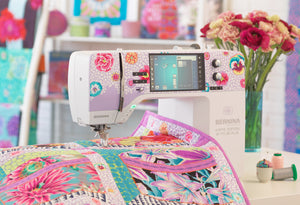

We Love Our Quilting Community
At High Country Quilts we care deeply about community. With our experiences in retail, we know that a store is not only a place to shop but also a place for the community to gather and share. During this busy...


There’s something truly special about hand quilting. It’s a craft that feels both mindful and deeply creative, a chance to slow down and make something beautiful and lasting. The process is simple at its core: using just a needle and thread, you stitch together three layers—a decorative top, a soft batting center, and a fabric backing—to create a textured, one-of-a-kind quilt.
 Welcome! If you're looking for a creative escape that lets you unplug and work with your hands, you’ve come to the right place. Hand quilting is so much more than a sewing technique. It’s a quiet journey into a craft that began as a household necessity but has blossomed into a beloved modern art form.
This guide will walk you through everything, showing you exactly why so many people find hand quilting to be the perfect entry into the world of sewing. Forget feeling intimidated—this is a joyful path to creating heirlooms you'll treasure for years.
The real magic of hand quilting is in its simplicity and the personal story woven into every stitch. Unlike quilting with a machine, it requires very few tools to get started and you can do it almost anywhere, from your favorite armchair to a park bench. Many people find the rhythmic motion of the needle incredibly meditative; it's a wonderful way to unwind.
For a beginner, the benefits are clear:
You’re joining a thriving, supportive community at the perfect time. The global quilt market is growing fast, with some projecting it to hit US$ 8.3 billion by 2032. Handmade quilts are a huge part of that trend, proving just how much people still value items made with care. Here in the US, more than 10 million people quilt every year, and beginners like you make up a huge part of that number. You can dive deeper into these trends with this detailed quilt market report.
The journey of hand quilting isn't just about learning a few stitches. It's about connecting with a rich tradition, joining a vibrant community, and earning the pride that comes from saying, "I made this."
Local shops are an absolute goldmine for anyone new to the craft. Here at our shop, High Country Quilts in Colorado Springs, we love helping people get started. With expert advice, hands-on classes, and a collection of beautiful fabrics and supplies, we make it easy to start your own quilting adventure.

Walking into a craft store can be overwhelming. There are aisles of shiny gadgets, all promising to make you a better quilter. But here’s a little secret from someone who's been at this for a while: you don’t need it all. Not yet, anyway.
Great hand quilting starts with a small, curated set of tools that do their job perfectly. Let's build a toolkit that sets you up for success, focusing on the essentials that will make your first stitches feel intentional and joyful, not frustrating.
Let's start with the heart of it all. The connection you feel to your project comes directly through your needle and thread, so choosing the right ones is more than just a technicality—it's about making the process comfortable.
Your average sewing needle isn't going to cut it here. You're looking for needles specifically called "Betweens" or "Quilting Needles." They are shorter, stronger, and more stubborn than their sewing counterparts, designed to push through three layers (top, batting, and back) without bending. That short shaft gives you incredible control, which is the key to those tiny, even stitches we all covet. They're sized with a "higher number equals smaller needle" system. A size 8 or 9 is a fantastic place to start.
As for thread, the classic choice is 100% cotton. It has a lovely matte finish that settles into the fabric beautifully, and it wears at the same rate as your cotton quilt top. You might see some beautiful, strong polyester threads, but they can actually be too strong and cut through the cotton fabric over decades. For a more visible, rustic stitch, you can try a thicker 12 wt. thread. Just be sure to pair it with a needle that has a bigger eye to avoid a world of frustration and fraying.
A little tip I give all my students: start with a neutral thread in cream or dove gray. It will blend into almost any fabric, letting you focus on the rhythm of your stitching without worrying about a color that screams for attention.
Ever seen a quilt with baggy, loose stitches? That's usually a tension problem. This is where a hoop or frame becomes your best friend. By keeping the quilt sandwich taut, a hoop lets you focus on your stitch length, not on wrestling with the fabric. A round 14-inch or 18-inch hoop is a great, versatile starting point.
And please, please use a thimble. It might feel clumsy at first, but it's the only thing protecting the middle finger of your pushing hand from becoming a human pincushion. Finding "the one" is a personal journey.
The last bits of your starter kit are all about preparation. Clean cuts and clear lines are the foundation of a polished finished project.
For marking your quilting design, you need something that will vanish without a trace. I swear by water-soluble pens and air-erasable markers. The most important rule? Always test on a scrap of your project fabric first! You want to be 100% sure the marks will disappear. For a no-ink option, a simple hera marker is brilliant; it just creates a sharp crease in the fabric for you to follow.
Finally, guard your fabric scissors with your life. A good pair of 8-inch dressmaker's shears should be used for fabric and fabric alone—never paper! Alongside those, keep a small, sharp pair of thread snips right by your side as you quilt. There’s nothing more satisfying than that clean little snip at the end of a line of stitches.
To make it easier, I've broken down what you absolutely need to start versus what can wait. It's easy to get caught up, but these essentials are all it takes to begin your hand-quilting journey.
| Tool | Category | Why You Need It (Or Might Want It) |
|---|---|---|
| "Betweens" Needles | Essentials | Shorter and stronger for better control and piercing multiple layers. Sizes 8-9 are ideal for beginners. |
| 100% Cotton Thread | Essentials | The classic choice. It wears well with cotton fabric and creates a traditional, soft look. |
| Quilting Hoop | Essentials | Keeps fabric taut for even tension and prevents puckering. A 14-inch or 18-inch size is a great start. |
| Thimble | Essentials | Protects your finger from the needle. Find one that fits comfortably—it's non-negotiable! |
| Fabric Scissors | Essentials | A sharp pair dedicated only to fabric ensures clean, non-frayed cuts. |
| Marking Tool | Essentials | A water-soluble or air-erasable pen to draw your quilting lines. Always test on a scrap first! |
| Thread Snips | Nice-to-Have | While not strictly essential (you can use your big scissors), a small pair is much more convenient for trimming threads as you work. |
| Hera Marker | Nice-to-Have | An excellent ink-free alternative for marking. It creates a temporary crease in the fabric to follow. |
| Needle Threader | Nice-to-Have | A lifesaver for small needle eyes, especially when using finer threads or if your eyesight isn't perfect. |
| Rotary Cutter & Mat | Nice-to-Have | Essential for machine piecing, but for a hand-quilting-only start, scissors will do. A huge time-saver down the line. |
With these core items in hand, you’re not just buying supplies; you’re setting up a little station for creativity. You're ready for the next step: bringing your quilt sandwich together.
Every beautiful quilt starts with a strong, stable foundation. We call this the "quilt sandwich," and getting it right is probably one of the most important things you'll do. It might sound like a funny term, but it's just the simple act of layering your backing, batting, and quilt top together before you start stitching.
If you take a little extra care here, you'll save yourself a world of frustration later. A well-made sandwich prevents those annoying puckers and folds, making the whole quilting process feel smooth and joyful.
I like to think of this step like making a bed—you want every single layer to be perfectly smooth. The best place to do this is on a large, flat surface. A clean floor works great, or you can push two tables together.
First, lay your backing fabric down, wrong side up. Grab some painter's tape and secure the corners and edges to your surface. You want it taut, but don't stretch the fabric so much that it gets distorted.
Next, gently unroll your batting over the backing. Use your hands to smooth out any wrinkles, working from the center outwards.
Finally, lay your beautiful quilt top on top, right side up. You'll want the backing and batting to stick out about 3-4 inches beyond the quilt top on all sides. This extra room is your safety net—it gives you plenty of space to work and ensures nothing shifts out of place as you quilt.
The real secret to a pucker-free quilt isn't just about smoothness; it's about getting even tension. As you place each layer, always smooth it from the center out to the edges. This little motion pushes out any trapped air and gets everything perfectly flat for your stitches.
"Basting" is just a temporary way to hold all three layers together while you quilt. It’s the glue of your sandwich, and it's absolutely essential for preventing the layers from wiggling around. There are a few ways to do it, and each has its own perks.
For your first project, I can't recommend safety pin basting enough. It's quick, easy, and incredibly forgiving.
Another option you’ll see is thread basting. This means using a long needle and thread to sew big, loose stitches across the quilt. It takes a bit more time, but it’s fantastic for really large quilts where pins can sometimes feel bulky.
Pin basting is more than enough for something like a lap quilt, which can take anywhere from 20-40 hours of stitching. It’s interesting—while hand quilting in the U.S. was a craft of necessity during the 1930s Great Depression, today it's a way to relax. In fact, 40% of sewing enthusiasts are starting to hand quilt for its therapeutic benefits. Thanks to modern tools, we can cut our prep time by as much as 50%, letting us get to the fun part faster. If you're curious about the craft's comeback, you can learn about the craft's modern resurgence on researchandmarkets.com.
Once your quilt sandwich is basted, you're so close to the first stitch! But there’s one more tool that will completely change your game: a quilting hoop.
A hoop holds the small area you're working on nice and tight. This tension is what helps you create those beautiful, even stitches without the fabric bunching up. Think of it as your secret weapon for stitch consistency.
How to Use a Quilting Hoop Correctly
As you quilt, you'll simply loosen the hoop and move it to the next area. This simple tool is one of the best investments you can make as a beginner. It gives you the control you need to find your rhythm and create stitches you'll be proud of.
Alright, let's get down to the best part of quilting—the actual stitching. All the planning and preparing your quilt sandwich has led to this moment. This is where your quilt starts to come alive, where you add the texture, character, and love that makes it uniquely yours.
Don't get hung up on making every stitch perfect from the get-go. Nobody does! The goal is to find a comfortable rhythm and build muscle memory. I always tell new quilters to make a small "practice sandwich" with some scraps. It’s a fantastic, no-pressure way to get the feel of your needle and thread before you even think about touching your main project.

As you can see, you’re just layering your backing, batting, and a top piece of fabric. This little mock-up is the perfect playground for practicing your stitches.
Before you make a single stitch, you need a knot that won’t pull through your fabric. A simple, everyday knot is just too small and will slip right through the weave, which is incredibly frustrating. The quilter's knot is your best friend here; it’s designed to be bulky enough to anchor your thread securely within the batting.
Here’s how I make mine:
It feels a bit awkward the first few times, but I promise it will become second nature pretty quickly.
The running stitch is what most people picture when they think of hand quilting—that lovely, classic dashed line that gives quilts so much charm. Your aim is to create stitches and spaces that are as even as you can manage.
You’ll start by "popping" that quilter's knot you just made. Push the needle up from the back of your quilt, but don't push it all the way through the top layer just yet. Stop when the knot is against the backing fabric. Now, give the thread a firm but gentle tug. You'll feel a satisfying little pop as the knot pulls through the backing and gets nestled inside the batting. Your knot is now completely hidden.
Now for the rocking motion, the true secret to efficient and beautiful hand quilting.
This is how you load multiple stitches onto your needle at once:
This rhythmic motion is what so many people find meditative about hand quilting. It’s a huge reason why 60% of quilters begin with hand methods. It's not just about nostalgia; there's a real appreciation for the craft. While the quilting market was valued at USD 4,730.7 million in 2023, traditional methods still command the largest share. In fact, studies show that 75% of beginners feel more satisfied with their hand-stitched projects, valuing their unique feel. You can dive deeper into these trends in this global quilting research report on marketresearch.com.
While the running stitch is perfect for quilting lines, the backstitch is your workhorse for strength. It creates a solid, unbroken line that looks almost like it was done on a machine. I use it for outlining shapes or in any area that needs a little extra durability.
To make a backstitch, bring your needle up from the back. Take a small stitch backward from where your thread came out. Then, bring the needle up again one stitch length ahead of your starting point. This constant backward-and-forward motion locks the stitches in place, creating a very secure line.
The ladder stitch is pure magic for finishing your quilt. You’ll use it to close the final opening in your binding, and it creates a seam that is practically invisible. It’s one of those techniques that gives your work a truly polished and professional look.
You’ll be working between the two folded edges of your binding.
When you gently pull the thread, the "rungs" of the ladder vanish, and the two edges pull together perfectly. It’s such a satisfying final step to completing your beautiful hand-quilted project.
You’re almost there! The last few steps in making a quilt are, for many of us, the most rewarding. After all the hours you've poured into your stitching, this is where you get to frame your work with a beautiful, sturdy finish that will last for years.
This final stage is also where some little frustrations can pop up. But please, don't worry. Every single person who quilts has faced these same challenges, myself included. Think of them less as "mistakes" and more as the final lessons your quilt has to teach you.
The binding is like the frame on a picture. It’s a simple fabric strip that wraps around the raw edges of your quilt, protecting it from fraying and giving it a crisp, polished look. Getting the binding right takes patience, but it’s what separates a nice handmade project from a truly hand-crafted heirloom.
First things first, you need to trim the extra batting and backing fabric away from your quilted piece. For the cleanest, straightest edges, a long quilting ruler and a sharp rotary cutter are your best friends. Take your time to make sure your corners are squared up to a perfect 90-degree angle.
Now it’s time to make the binding itself. You'll cut fabric strips, usually 2.5 inches wide, and sew them together end-to-end to create one long piece. You then fold this strip in half lengthwise and give it a good press with an iron. This creates the double-fold binding that will hug your quilt's edge. You'll stitch one raw edge of the binding to the front of your quilt, then wrap the folded edge around to the back and stitch it down by hand.
Honestly, that final hand-stitching on the binding is my favorite part. There's something so meditative about using a tiny, invisible ladder stitch to close it all up. It’s the quiet, final step that says, “I’m done, and I made this.”
As you quilt, you’re going to run into a few snags—sometimes literally. Learning how to navigate them is what will build your confidence and keep you from wanting to throw the whole thing in a corner. Hand quilting is a journey, and every challenge is just a chance to get better.
And remember, the goal isn't machine-like perfection. The tiny quirks and variations are what breathe life and character into a hand-quilted piece.
One of the first things every new quilter struggles with is stitch consistency. Some of your stitches might be long, some short, and some might even form little loops on the top or bottom. This is hand quilting for beginners 101.
Puckering is that annoying bunching of fabric around your stitches that creates a bumpy surface. A little bit of crinkle after a quilt is washed is a wonderful, cozy thing. But puckers that form while you're still quilting are a sign that something is off.
This can happen for a couple of reasons. Maybe your quilt top was a hair larger than your backing, or the layers shifted as you worked. But most often, it's a simple case of pulling your stitches too tight. Your thread is literally gathering the fabric with every stitch.
To fix it, consciously relax your hands and ease up on how tightly you pull the thread. If an area is already badly puckered, the only real solution is to unpick the stitches in that section, smooth everything out, and re-quilt it with a much looser tension.
Nothing kills your quilting rhythm faster than a tangled bird's nest of thread on the back of your work. It's a universal frustration for anyone who works with a needle.
Now that you've got the feel for those basic stitches, it’s time for the fun part: making something! The best way to fall in love with hand quilting is to create something you can hold, use, and feel proud of, no matter how simple.
My best advice for anyone starting out? Don’t try to tackle a king-sized quilt right out of the gate. Think smaller. You'll build confidence with a quick, satisfying finish, which is the best motivation to keep going.
A chic table runner is a fantastic first project, giving you plenty of practice with straight lines on a manageable scale. A set of charming placemats or a small wall hanging are also wonderful choices that won't overwhelm you.
Another truly rewarding option is a cozy baby quilt. They’re small enough to finish relatively quickly, and there's nothing quite like the feeling of gifting a handmade quilt. These projects aren't just for practice; they’re your first steps into the entire quilting process, from choosing fabric to that final, satisfying stitch.
Here are a few other ideas I’ve seen beginners have a lot of success with:
Ultimately, the best first project is one that genuinely excites you. When you're looking forward to the finished piece, you’ll find the motivation to learn and enjoy every step of the process.
The most important part of starting your hand quilting journey isn't the project itself, but the connection you build with the craft and the people who share your passion. A supportive community turns a solitary hobby into a shared adventure.
And that’s where we hope to come in. At High Country Quilts, we truly believe quilting is about more than just fabric and thread—it’s about connection and community. We absolutely love helping beginners find their way and fall in love with this timeless art form.
We'd be thrilled if you came to visit us at our shop in Colorado Springs. There's just no substitute for seeing the vibrant colors in person, feeling the different fabric textures, and getting real advice from people who live and breathe quilting. We can help you find the perfect fabric for that first project or show you a tool that will make all the difference.
If you’re looking for a more hands-on experience, our beginner hand quilting classes offer a friendly, encouraging space to learn. We also put together 'Quilt-As-You-Go' kits that are a dream for newcomers. They take all the guesswork out, so you can just focus on the simple joy of stitching. Consider this guide your starting point, and our front door your next step. We can't wait to welcome you into our creative family.
As you get ready to thread your needle, a few questions are bound to pop up. It happens to everyone! Let’s tackle some of the most common ones I hear from new quilters so you can start with confidence.
Ah, the great quilting debate! Honestly, there isn't a single right answer here; it really comes down to the look you're going for.
Pre-washing your fabric does two key things: it preshrinks the cotton and it gets rid of any extra manufacturing chemicals or dyes. If you're using high-contrast colors—think a deep, bold red right next to a crisp white—pre-washing is your best friend. It’s a simple step that can save you the heartache of colors bleeding all over your hard work.
On the other hand, many quilters (myself included!) absolutely love the crinkly, lived-in texture that happens when a quilt shrinks up a bit after its very first wash. By skipping the pre-wash, you let the fabric and batting shrink together, creating that wonderful, cozy effect naturally.
My Personal Takeaway: If you're using bold, saturated colors against a light background, play it safe and pre-wash. For almost everything else, don't be afraid to skip it and embrace the crinkle!
Choosing batting can feel a bit overwhelming since it’s the "stuffing" that gives your quilt its warmth and feel. For your first project, you really can’t go wrong by sticking to one of these two workhorses.
You'll also see wool or bamboo batting, which are lovely and warm, but they tend to be a bit pricier. My advice? Start with a simple cotton or an 80/20 blend. You'll get a great feel for the process without breaking the bank.
You’ve poured so much time and love into this piece, so let's make sure it lasts a lifetime. For that very first wash, I always toss a "color catcher" sheet in with the quilt—it’s cheap insurance against any surprise dye bleeds.
Wash your quilt on a gentle cycle using cold water and a mild detergent. When it comes to drying, you can tumble dry on the lowest heat setting, but I often just lay my quilts flat to air dry. It puts less stress on the hand stitches and helps preserve the quilt for years and years of snuggling.
At High Country Quilts, we're passionate about helping you succeed. Whether you visit us in the shop or check out our online classes, you'll find everything you need for your quilting journey at https://hcquilts.com.
At High Country Quilts we care deeply about community. With our experiences in retail, we know that a store is not only a place to shop but also a place for the community to gather and share. During this busy...

Hi! We’re Adam and Renee Wheaton, the new owners of High Country Quilts! For more than 40 years, we’ve owned and operated vacuum and sewing businesses. Following in Renee’s father’s footsteps after he retired from All Discount Vacuum and Sewing in Colorado...


Leave a comment