
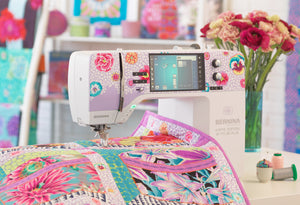

We Love Our Quilting Community
At High Country Quilts we care deeply about community. With our experiences in retail, we know that a store is not only a place to shop but also a place for the community to gather and share. During this busy...


You've pieced the top. The blocks line up, the colors sing, and for a brief moment you feel finished. Then the quilt sandwich enters the room, and suddenly everything feels risky.
That's where many beginners freeze.
I see it all the time in first-time workshops. A quilter can choose fabric with confidence, sew a beautiful top, and then stop cold at quilting because free motion quilting feels like a different craft entirely. The fear usually sounds like this: “What if I ruin it now?” That's a real feeling, and it deserves respect.
The good news is that free motion quilting is not magic, and it isn't reserved for people with naturally steady hands. It's a motor skill. You learn it the same way you learned piecing, binding, or using a rotary cutter. One clear step at a time, with a little patience and a lot less pressure than you think.
A beginner named Anna once brought a freshly pieced quilt top to class and kept smoothing it with both hands like she was apologizing to it. She loved every fabric in that quilt. She'd spent evenings choosing prints, matching seams, and pressing carefully. But when I asked if she was ready to quilt it, she laughed and said, “Absolutely not.”
That reaction is common.
Piecing feels orderly. Free motion quilting feels exposed. The machine is moving, your hands are moving, and the stitches are visible in a whole new way. Many quilters decide the quilt top is safe, but quilting is where mistakes become permanent. So they fold the top, set it on a shelf, and promise they'll come back when they feel more ready.
You do not need to feel ready before you begin. You need a safe place to practice.
That's the shift that matters. Your first goal is not to quilt your favorite top. Your first goal is to learn what the machine feels like when you guide fabric freely under the needle. Once you understand that rhythm, the mystery starts to disappear.
Think of free motion quilting like learning to write with your non-dominant hand. At first, the movement feels awkward and overly deliberate. Then your muscles start recognizing the path. The skill grows from repetition, not talent.
If you're nervous, you're in the right place. Fear usually means you care about the project. A good first lesson turns that fear into motion, and motion is what builds confidence.
A beginner's first supply list should feel small and clear. If the table is covered with gadgets, free motion quilting starts to look harder than it is.

For your first lesson, gather the tools that help you control fabric, see your stitches, and practice safely. Everything else can wait until your hands and machine start to feel like a team.
Start with a free motion foot, sometimes called a darning foot. This is the foot that gives you freedom. A regular presser foot expects the machine to feed fabric straight ahead. A free motion foot lets you guide the quilt in any direction, which is the whole point of FMQ.
Next, make a practice sandwich from a simple top fabric, batting, and backing. Keep it plain and low-pressure. Scrap fabric is perfect. A small sandwich works like a sketchbook page for a new artist. You are testing movement, not creating a masterpiece. If you want a visual example of a beginner practice piece, this starter meander lesson shows the idea clearly.
Choose contrasting thread for practice. Beginners often want thread that hides mistakes, but hidden stitches are hard to learn from. Thread that stands out lets you see where your line drifted, where your curves tightened, and whether your tension needs attention.
Add quilting gloves if you have them. Many first-time FMQ students are surprised by how much grip matters. Gloves help you hold the fabric with less squeezing, and less squeezing usually means smoother movement.
Nice-to-haves are tools that can improve comfort, but they aren't required on day one.
If you sew on a BERNINA, you may have access to features that make practice feel calmer, such as steady stitch formation and optional stitch regulation on some models. Those features help, especially in the zero-to-one stage when everything feels new. They do not replace practice, but they can make the learning curve feel less steep.
If you are buying supplies for your first FMQ session, keep one question in mind: does this tool help me learn control?
| Tool | Why it matters first |
|---|---|
| FMQ foot | Lets you move fabric in any direction |
| Practice fabric and batting | Gives you a safe place to learn |
| Contrasting thread | Makes stitch path and problems easy to see |
| Quilting gloves | Improves grip and reduces hand strain |
Practical rule: Buy for control first, comfort second.
One more tip from the classroom. Store these supplies together in one small bin or basket, so practice feels easy to start. If your sewing area tends to collect tools and fabric quickly, this ultimate guide for crafters offers smart ways to organize craft supplies without turning setup into a scavenger hunt.
Your quilt top is finished. You sit down to quilt it, lower the needle, and within seconds the fabric feels heavy, the stitches look uneven, and your shoulders creep up toward your ears.
That reaction is common for first-time FMQ students.
The problem often starts before you sew a single curve. If the quilt is pulling off the table, the machine needs cleaning, or your practice piece is too big to control, free motion quilting can feel much harder than it really is. A good setup gives your hands a fair chance to learn.

Start with the machine itself. Attach your free motion foot. Lower or cover the feed dogs, depending on what your machine requires. Check your manual if you are unsure. On many machines, stitch length is no longer the main control once the feed dogs are out of the way, because your hand movement and machine speed now work together to form the stitch.
Put in a fresh needle, too. Beginners often blame themselves for skipped stitches when the culprit is a dull or slightly bent needle.
Then clean the bobbin area. Lint works like a tiny roadblock inside the machine. It can interrupt stitch formation and make tension look inconsistent, even when your threading is correct.
If you sew on a BERNINA, some models offer features that can make this zero-to-one stage feel steadier, such as consistent stitch formation and optional stitch regulation. Those features help you learn control, but they still work best with a thoughtful setup and regular practice.
Free motion quilting is much easier when the quilt stays level with the machine bed. If part of the quilt hangs off the table, your hands have to push fabric and carry weight at the same time. That is a lot to ask of a beginner.
A flat setup works like an air hockey table for fabric. The quilt sandwich glides instead of dragging.
An extension table is helpful, but you can still create support with a sturdy table, extra surface space around the machine, or temporary risers that keep the quilt from dipping. Before you begin, clear away anything that can catch a corner or tug on the fabric.
If your sewing area is crowded or hard to reset between projects, this ultimate guide for crafters can help you organize tools and supplies so practice is easier to start.
A level quilt is easier to guide, and easier to guide means easier to learn.
This is not the moment to wrestle a full quilt.
Start with a small practice sandwich that fits comfortably under your hands and inside your machine throat space. Keep the backing and batting slightly larger than the top layer so everything stays covered as you move near the edges. Plain fabric helps your stitching show clearly, and contrasting thread makes tension problems easier to spot on both sides.
Many beginners improve faster when they divide that practice piece into smaller areas and treat each one like a mini lesson. One section can be for straight-ish meanders, another for loops, and another for simple curves. That keeps practice focused and lowers the pressure.
Use this quick setup check before you sit down to stitch:
A calm workspace will not make you perfect on day one. It will make learning feel possible, and that is exactly what your first FMQ session needs.
You sit down with your first practice sandwich, lower the needle, press the pedal, and wonder, "What if I ruin it in the first three seconds?" That feeling is normal. Nearly every new free motion quilter feels a little clumsy at the start, because this is a new hand skill, not a test of talent.
Your first goal is simple. Get a clean start, keep the quilt moving, and stitch one easy path all the way through.
Bring the bobbin thread to the top before you begin quilting. That small step prevents the messy knot of thread that often forms underneath when beginners start too quickly. It also lets you begin with both threads under control, which makes the back of your practice piece easier to read.

Set both hands on the practice sandwich with your fingers relaxed and spread. Lower the needle into the fabric. Take one stitch. Then raise the needle and pull gently on the top thread until the bobbin thread pops up through the quilt. Hold those thread tails for the first few stitches so they do not get pulled into a nest underneath.
Now start moving.
A beginner often expects free motion quilting to feel like steering with strength. It feels more like guiding a tray of water across a room. Fast, jerky motions create splashes. Calm, steady movement gives you control. Your foot sets the needle rhythm. Your hands guide the fabric. Smooth stitches happen when those two motions begin to cooperate.
That is the whole zero-to-one lesson in one sentence. Needle speed and hand speed need to become friends.
If the machine is stitching quickly while your hands barely move, the stitches stack up and get tiny. If your hands race ahead while the needle moves too slowly, the stitches stretch out and look uneven. Both problems are normal on day one. They do not mean your machine is wrong, and they do not mean you are bad at FMQ. They mean your timing is still learning.
If you are quilting on a BERNINA, the advantages of good setup become clear. Features like a steady motor response and clear visibility around the needle can make it easier to keep that rhythm consistent while your hands are still learning what to do.
For a first design, choose a meander. It is the quilting version of taking a quiet neighborhood walk instead of hiking straight up a mountain.
A meander is a wandering line of soft curves that changes direction often without crossing over itself. It works well for beginners because it asks for flow, not perfection. You do not need sharp points, exact spacing, or a memorized motif. You just keep traveling forward, curving around, and leaving enough room to continue.
Keep the shapes open enough that you can steer comfortably. If the path gets too tight, your hands tense up and the quilt becomes harder to move. Rounded turns are your friend here.
Cursive writing is a useful comparison. The line keeps going. Your hand stays in motion. The shape matters less than the steady travel.
Try this order on your first practice area:
This short demo can help you see the hand motion in real time:
Loops are a smart second step because they teach you to return smoothly without making a sharp corner. Many beginners relax once they reach loops, because the movement feels playful and continuous.
Start large. Small loops ask for tighter control, and tight control usually creates tension in the shoulders, wrists, and fingers. Large loops give you time to coordinate your hands with the needle. Once that feels easier, you can gradually make them smaller and closer together.
If your loops look uneven, keep going for a few more inches before judging them. The first loop is usually the stiffest. By the third or fourth, your hands often settle down.
Success on the first day is not a perfect practice sandwich. Success is bringing up the bobbin thread, stitching a simple path, and finishing one section without freezing.
You might learn that your stitches improve when you keep the machine speed a little steadier. You might notice that meanders feel easier than loops, or that loops help you relax your hands. You might see one messy spot on the back and finally understand what a tension hiccup looks like.
That is real progress.
Keep quilting through a wobbly line or an awkward curve. Beginners improve faster when they collect a little mileage under the needle instead of stopping every few seconds to judge the result. Your first stitches are supposed to look like first stitches. That is how skill begins.
You sit down to practice, stitch for forty minutes, get tired, and start wrestling the quilt instead of guiding it. The next time you look at your machine, it already feels hard again.
Beginners usually learn faster with short, regular practice.
Free motion quilting is a coordination skill. Your foot, hands, eyes, and machine all have to keep a steady rhythm together. That gets easier through frequent, low-pressure repetition, much like learning to write with your non-dominant hand. A little often teaches your muscles more than an occasional long session.
Ten calm minutes is plenty for a first lesson.
Your goal is not to produce a beautiful sample every time you sit down. Your goal is to make the motion feel more familiar. That shift matters. It takes practice from "I have to do this well" to "I am teaching my hands a new path."
That is how beginners stop freezing.
If you sew on a BERNINA with speed control, this is a good time to use it. A capped speed can keep the machine steady while your hands learn the movement. It is like practicing piano slowly enough to hit the right keys on purpose.
Random practice usually creates random results. A simple plan keeps your brain from trying to solve five problems at once.
Try a session like this:
One shape per session is enough.
The hardest part for many beginners is not the quilting itself. It is getting set up. If you have to gather batting, thread a needle, clear a table, and hunt for gloves every time, practice starts to feel like a project.
Keep a small stack of practice sandwiches nearby. Leave a needle, thread, and foot ready if your machine setup allows it. The lower the starting effort, the more likely you are to sit down and stitch a few lines, which is exactly how skill grows.
Small, steady sessions build smoother stitches.
Even with a good setup, problems show up. That's normal. The trick is to diagnose the simplest cause first instead of assuming the machine has suddenly become impossible.

| Problem | First things to check |
|---|---|
| Thread nest underneath | Bring bobbin thread to top, re-thread machine, hold thread tails at the start |
| Skipped stitches | Change needle, reinsert needle correctly, check thread path |
| Uneven stitch length | Adjust hand speed and pedal speed so they match better |
| Fabric dragging | Improve table support, use gloves, reduce quilt pull |
| Eyelashes or messy tension | Re-thread and test again on scrap before changing too many settings |
Thread nests under the quilt often happen right at the beginning. If that's happening, go back to your starting sequence. Pull the bobbin thread up first and keep thread tails controlled for the opening stitches.
Skipped stitches often point to a needle issue. Change it before you do anything more complicated. A fresh needle solves a surprising number of FMQ headaches.
Some issues look like tension but are really movement problems. If your stitches are long in one area and tiny in another, the likely cause is coordination. Your hands and machine speed aren't in sync yet.
If the fabric seems to bounce up and down with the needle, beginners sometimes call that a machine problem. Often it's a support and technique issue. Make sure the quilt is lying flat, the correct foot is attached, and your hands are guiding rather than lifting.
Use this mental sorting tool:
When in doubt, simplify. Re-thread. Replace the needle. Clean the bobbin area. Test on scrap. Then stitch again.
Most FMQ hiccups are fixable. They feel dramatic in the moment because they interrupt your rhythm, but they are part of learning, not proof that you can't do it.
If you're ready to move from reading to stitching, High Country Quilts can help you choose the right machine, quilting tools, and beginner-friendly supplies. Explore High Country Quilts for sewing support, BERNINA expertise, and the kind of guidance that makes your first free motion quilting session feel possible.
At High Country Quilts we care deeply about community. With our experiences in retail, we know that a store is not only a place to shop but also a place for the community to gather and share. During this busy...

Hi! We’re Adam and Renee Wheaton, the new owners of High Country Quilts! For more than 40 years, we’ve owned and operated vacuum and sewing businesses. Following in Renee’s father’s footsteps after he retired from All Discount Vacuum and Sewing in Colorado...


Leave a comment