

We Love Our Quilting Community
At High Country Quilts we care deeply about community. With our experiences in retail, we know that a store is not only a place to shop but also a place for the community to gather and share. During this busy...


You're standing in front of a wall of fabric bolts, and every floral is prettier than the last. One has big painterly roses. Another has tiny scattered blossoms. A third seems perfect until you hold it next to the first and suddenly everything looks busy, mismatched, or just confusing.
That moment happens to almost every new quilter.
Floral fabric has a way of pulling you in and second-guessing you at the same time. You know what you like, but it's harder to know what works together. If you've ever walked away with one flower fabric pattern you loved and no idea what to pair with it, you're in good company. Before you start choosing colors, it can even help to gather visual inspiration from outside the quilting aisle. If you enjoy mood boards, garden palettes, or seasonal color ideas, this roundup of top sites for spring images 2026 can help you notice the kinds of florals, spacing, and color moods you naturally gravitate toward.
You pull one bolt with large roses, another with tiny scattered blossoms, and a third with leafy stems. Each fabric is lovely on its own. Put them together, and it can suddenly feel like too many voices talking at once.
That feeling is normal for new quilters.
Floral fabric asks you to notice a few things at the same time: the size of the flowers, how tightly they are packed, and whether the colors share the same mood. Once you learn to spot those cues, mixing florals gets much easier. It starts to feel less like guessing and more like arranging flowers in a vase. You want variety, but you also want the whole bouquet to feel like it belongs together.
Florals have been part of textile design for centuries, which helps explain why they feel so at home in quilts, clothing, and home decor. If you like gathering visual inspiration before you shop, this roundup of top sites for spring images 2026 can help you notice the flower shapes, spacing, and color combinations you naturally prefer.
Many beginners hear one simple tip: pair florals with solids. That advice is useful, but it only gets you so far. A beautiful quilt can combine several flower prints and still feel calm, balanced, and clear. The trick is having a repeatable way to choose them.
That is what makes floral quilting enjoyable. You do not need to memorize a long list of rules. You need a beginner-friendly framework that helps you compare prints side by side, trust your eye, and build combinations that look intentional.
A floral fabric can look busy or calm, formal or playful, old-fashioned or fresh, before you even notice the color. That reaction usually comes from three design traits working together: motif, scale, and density.

If you can read those three traits, you can compare florals with much more confidence. That matters when you want to mix flower prints with each other, not just soften them with solids.
Motif is the kind of floral you are looking at. Roses read differently from tiny meadow flowers. Trailing vines feel different from bold cabbage roses. Stylized petals can feel crisp and modern, while leafy sprays often feel softer and more traditional.
A few floral families show up often in quilting cotton:
These styles did not appear out of nowhere. Floral textiles have a long design history, and European fabric traditions included large decorative floral patterns in luxury cloth, as described in textile history references on European floral fabrics.
Scale is the size of the flowers and leaves in the print.
Large florals usually ask for attention first. Medium florals help carry the design across the quilt. Small florals often read like texture from a few steps back.
A room-decor comparison helps here. A large floral works like a statement chair. A medium print works like the curtains or lampshade. A tiny floral works like a woven basket or pillow with a subtle print. Each piece can be lovely, but they play different roles.
This is one of the easiest ways to avoid a muddled fabric pull. If every floral is shouting at the same volume, your eye has nowhere to rest.
Density is the spacing between motifs. It answers a simple question. How much breathing room does the print have?
Two fabrics can both have pink flowers on a cream background and still behave very differently. One may have blossoms floating with plenty of open space. The other may be packed edge to edge with petals, leaves, and stems. The first often feels quieter. The second feels fuller and busier.
Beginners often miss density because they focus on color first. Try squinting at the fabric bolt from a few feet away. If the print starts to look like a soft texture, it has one kind of density effect. If it still looks packed and detailed, it has another.
A quick reference makes this easier to spot:
| Element | What to notice | What it does in a quilt |
|---|---|---|
| Motif | Rose, daisy, vine, abstract bloom | Sets the mood |
| Scale | Large, medium, small | Creates hierarchy |
| Density | Open, balanced, crowded | Controls visual calm or busyness |
Practical rule: Florals usually cooperate better when they differ in scale, density, or both. If two prints are too similar in those traits, they often compete.
That one rule gives beginners a solid starting point. You do not need to ask, “Do these two florals match perfectly?” A better question is, “Do they each have a different job?”
You are standing in the quilt shop with three floral bolts in your arms. Each one is pretty on its own. Set them together, though, and the group can feel a little uncertain. That usually happens because the fabrics have not been given clear jobs yet.
The easiest way to choose florals with confidence is to sort them into three roles: hero, companion, and blender.

Your hero print is the fabric that catches your eye first and sets the mood for everything else. It may have big roses, airy wildflowers, or painterly blooms in several colors.
Choose the one you genuinely enjoy looking at. You will see it while cutting, pressing, piecing, and quilting, so it needs staying power.
Hero prints also need room to breathe. If the flowers are large and detailed, they usually look better in blocks or sections big enough to show a full bloom instead of a chopped-up petal. A close look at this guide to floral fabric scale in quilts explains why scale and block size need to work together.
If you love a statement floral, keep your project in mind while you shop. A bold print can be beautiful, but it needs enough space in the pattern to show what makes it special.
Your companion print is like a good singing partner. It harmonizes with the lead instead of trying to take over the song.
Start with color. Pull one or two shades from the hero print and look for a second floral that repeats them. The companion does not need the same flowers, and it usually works better if it does not. A rose print can pair nicely with a vine floral, a meadow print can sit well beside a tidy calico, and loose watercolor blossoms often mix well with a smaller tossed print.
This is the part many beginners find surprising. Matching florals do not need to be twins. They need a relationship.
A helpful way to check that relationship is to ask two simple questions:
If the answer to both is yes, you are on solid ground.
Your blender gives the eye a resting place. In a floral quilt, that matters just as much as the star prints.
A blender can be a tiny floral, a soft dot, a narrow stripe, or any low-contrast print that reads almost like texture from across the room. It separates the stronger florals and keeps the quilt from feeling packed from edge to edge.
Beginners often assume a blender has to be a solid. It does not. A subtle print can do this job beautifully, and it often feels warmer beside florals than a flat solid would.
One easy shortcut helps here. Use the hero print as your color recipe. If the hero includes cream, sage, and blush, your companion and blender can borrow from those same shades. That keeps the mix connected even when the prints themselves look quite different.
A quick visual demo can help if you learn best by seeing fabrics compared in real time.
Before you head to the cutting table, hold your fabrics together and do one last check:
If you can answer yes to all three, you have a beginner-friendly floral mix that is much more likely to sew into a quilt that feels balanced.
Many floral pulls go off track for one reason. The fabrics are all trying to do the same job at the same volume.
You have three floral fabrics you love. Then you start cutting, and suddenly the prettiest bloom is split across a seam while the busiest prints end up side by side, all asking for attention at once. That is where a few simple techniques can turn a nice fabric pull into a quilt that feels settled and intentional.
Two methods help beginners right away: fussy cutting and strategic placement. One helps you choose what each block shows. The other helps you decide where those blocks should go. Together, they give your florals room to shine without making the quilt feel busy.
Fussy cutting means choosing exactly which part of the print lands inside your patch. Instead of cutting wherever the ruler falls, you pause and frame a motif on purpose.

It works like cropping a photo. A small shift can move the focus from a chopped-off petal to a full bloom centered neatly in the block. That is especially helpful when your hero print has one motif you want to repeat across the quilt.
Try this with a floral that has clear, distinct shapes:
If this feels slow at first, that is normal. Beginners often rush the first few cuts because the fabric is pretty and they are eager to sew. A minute of careful looking usually saves a lot of regret later.
Placement is the part many new quilters skip, but it is often the difference between "these fabrics match" and "this quilt works." After you have a hero, a companion, and a blender, placement helps each one keep its job.
A good way to picture it is a conversation. If every fabric speaks at the same volume in the same spot, the quilt feels noisy. If the strongest floral gets the main speaking parts and the quieter prints support it, the whole top feels easier to read.
Large florals usually do best in areas where you want attention to gather. Smaller prints and softer florals can fill the spaces around them. Repeating one quieter print throughout the layout also helps connect the blocks, much like the same background note repeating in a song.
A few placement choices make that easier:
| Placement choice | Result |
|---|---|
| Large florals in feature blocks | Builds a clear focal point |
| Smaller or softer prints nearby | Keeps the hero print from competing with equals |
| One blender repeated across the quilt | Adds rhythm and visual rest |
Fabric quality matters here too, especially if you plan to fussy cut and trim accurately. As noted earlier, quilting cotton with a stable hand is easier to square up, presses more cleanly, and is less likely to shift while you sew.
One beginner-friendly habit ties both techniques together. Before stitching, lay out a few blocks on a table or floor and step back. If your eye jumps smoothly from one floral to the next, the mix is working. If one area feels crowded, swap in a quieter piece or move the strong print farther apart.
The quickest way to improve a floral quilt is not a harder pattern. It is choosing what each print should show, and where it should sit.
You are standing in front of your fabric stack with three florals you love, and the question is no longer, “Are these pretty?” It is, “What can I make so they still look pretty once they are cut?” That is the right question. A beginner-friendly floral project gives each print a job and enough space to do it well.
The easiest projects are the ones that support your fabric choices instead of fighting them. If you are practicing the hero, companion, and blender framework from earlier, these patterns give you a clear place for each role.
Large squares or rectangles are often the safest starting point for a bold flower fabric pattern. They act like picture frames. You can clearly see the blossom, the leaves, and the movement of the print instead of reducing everything to tiny fragments.
This project works especially well when you have one hero floral, one smaller companion print, and one quieter blender. Alternate them in a simple grid and let the scale difference create interest. For a new quilter, that is a reassuring way to mix florals because the pattern stays easy even while the fabric mix looks thoughtful.
A Disappearing Nine Patch is a good next step if you want more variety without a complicated pattern. You begin with a basic nine-patch, then cut and rearrange the block. The result has movement, but the sewing itself is still approachable.
It also teaches an important lesson about mixing florals. Not every print needs the same amount of space. Use your larger or busier floral in positions that stay more visible after the block is cut. Put smaller-scale florals or softer blenders where pieces will end up narrower. That simple choice helps the finished quilt feel lively instead of crowded.
Trip Around the World is helpful for beginners who love several different florals but are unsure whether the flower shapes “match.” In this pattern, color does most of the organizing. If your florals share a color family, the layout can pull them together even when one print has roses, another has daisies, and a third is more leafy than floral.
A useful rule from floral quilt design still applies here. Let the main floral hold the eye, and keep companion prints calmer in value or detail so they support rather than compete, as demonstrated in this floral quilt design video.
One small test can save a lot of second-guessing. Before you cut the whole quilt, make one sample block or lay out a few fabric pieces in the pattern shape. If your eye lands on the hero print first and then moves comfortably to the others, your mix is on the right track.
If you want a simple shopping checklist, start here:
If choosing every piece still feels like a lot, quilt kits can simplify the decisions so you can focus on learning how the florals work together once you start sewing.
The biggest shift for most beginners is realizing that floral quilting isn't about finding perfect fabrics. It's about learning how fabrics behave together.
When you can spot the hero print, notice scale, and choose one supporting fabric plus one calmer blender, the whole process gets easier. You stop buying random pretty pieces and start building combinations with purpose. That matters because beginner-focused help on mixing multiple florals is still surprisingly rare, especially for audiences around machine brands like BERNINA, where education often leans more toward machine features than design decision-making, as noted in this discussion of floral project guidance gaps.

You don't need a complicated pattern to make a floral quilt that feels polished. You need a clear approach, a few reliable tools, and permission to trust your eye a little more each time you shop.
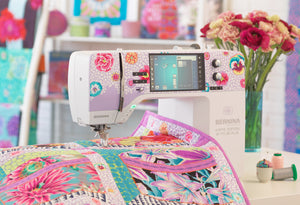
If you're local, seeing fabrics in person can make scale and color much easier to judge. If you're shopping online, start with a smaller project, save the prints you love, and build from one hero fabric outward. If you use a BERNINA machine, floral projects are also a great way to practice neat piecing, decorative stitching, and thoughtful fabric handling on prints you're excited to sew.
If you're ready to turn inspiration into a real project, visit High Country Quilts to explore floral fabrics, beginner-friendly supplies, and classes designed to help new quilters build confidence. If you're in Colorado Springs, stop by the shop for hands-on guidance. If you're browsing from home, the online store is a great place to start gathering your next floral quilt pull.
At High Country Quilts we care deeply about community. With our experiences in retail, we know that a store is not only a place to shop but also a place for the community to gather and share. During this busy...

Hi! We’re Adam and Renee Wheaton, the new owners of High Country Quilts! For more than 40 years, we’ve owned and operated vacuum and sewing businesses. Following in Renee’s father’s footsteps after he retired from All Discount Vacuum and Sewing in Colorado...


Leave a comment