
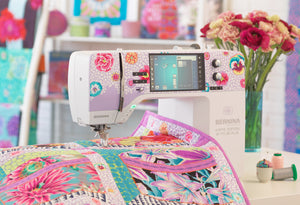

We Love Our Quilting Community
At High Country Quilts we care deeply about community. With our experiences in retail, we know that a store is not only a place to shop but also a place for the community to gather and share. During this busy...


You’ve probably stood at the cutting table with a sewing-machine print in one hand and a safe solid in the other, wondering if the themed fabric is the fun choice or the practical one. I hear that question all the time in the shop.
A fabric with a sewing theme can do both jobs. It can make you smile every time you press a seam, and it can become part of a quilt, tote, machine cover, or wall hanging that holds up beautifully if you choose and care for it well. The trick is knowing what you’re buying, how the print will behave in a project, and when to treat it as a star fabric instead of a background player.
One of my favorite quilting moments is watching someone pick out fabric for their own sewing room. They start with practical plans. A small basket. A machine mat. Maybe a wall quilt over the ironing board. Then they spot a print with thread spools, scissors, vintage machines, or little measuring tapes and everything changes. Suddenly the project feels personal.
That’s why these fabrics matter. They don’t just cover a surface. They say something about the maker.
A sewing-themed print often works like a little badge of identity. If you sew, quilt, mend, embroider, or collect notions, you recognize the language right away. Needles, pins, pattern marks, pincushions, buttons, and machines all read like an inside conversation among makers.
Sewing prints often feel special because they reflect the craft back to the person using them.
They’re also wonderful gift fabrics. If you’re making for a quilting friend, a retreat buddy, a guild member, or the person who taught you how to sew, these prints carry meaning before the first stitch is made.
Sewing isn’t a tiny niche tucked into the corner of craft culture. The broader Cut and Sew Apparel Manufacturing industry represents a $26 billion total addressable market with a 3.2% compound annual growth rate, and its roots stretch back to the 1850s. Isaac Singer’s mass-produced machines had captured 80% of the U.S. market by 1860, a shift that helped make sewn goods far more accessible and laid groundwork for the sewing culture we still recognize today in fabric, tools, and design language (Cut and Sew Apparel Manufacturing industry data).
That history gives sewing-themed fabric a little extra charm. A print with a vintage machine isn’t random decoration. It nods to a long line of people who made clothing, household goods, quilts, and keepsakes with skill and patience.
A good sewing-themed stash usually includes a mix, not just one dramatic print.
If you keep that combination on hand, you’re ready when the perfect project shows up.
Some sewing prints feel antique and cozy. Others look crisp and graphic. A few are downright playful. If you know how to sort them, choosing gets much easier.

Retailers describe the appeal of sewing-themed fabrics as hobbyist self-identification. In plain language, that means makers enjoy fabrics that visibly reflect the craft they love. These prints are commonly produced on cotton substrates using high-resolution printing, and cotton’s absorbency supports strong dye acceptance, with color fastness ratings that typically exceed 4-5 on the AATCC scale (sewing-themed fabric notes from Missouri Star Quilt Co.).
That’s useful in two ways. First, the fabric feels emotionally right for the project. Second, it behaves like quilting cotton should.
These are the prints many quilters notice first. Think black cast-iron machines, dress forms, old-fashioned shears, wooden spools, and muted labels that feel borrowed from an antique pattern drawer.
They pair beautifully with reproduction fabrics, soft florals, tiny checks, and warm neutrals.
These prints lean cleaner and brighter. You’ll see stylized scissors, bold thread cones, simplified needles, graphic tape measures, and strong color blocks.
If your sewing room has a fresh, organized look, this style usually fits right in. It also works well for zip bags, bins, aprons, and machine accessories.
Some prints don’t try to be elegant at all. They’re cheerful. Buttons with faces. Tossed pincushions. Cartoon-like rulers. Playful typography.
These are excellent for gifts, retreat swaps, and projects meant to make someone grin.
This group includes quilt blocks, pattern markings, measuring guides, seam diagrams, stitch icons, and text-based sewing references.
They can read a little busier from a distance, but they’re terrific when you want a project to feel unmistakably maker-made.
Most of the time, a fabric with a sewing theme comes on quilting cotton. That’s good news for quilters because it presses well, sews predictably, and blends easily with the rest of a cotton stash.
When you evaluate one, check these basics:
Practical rule: If the charm of the print depends on seeing the whole sewing machine or a full spool cluster, don't cut it into tiny units.
You spot a fabric covered in tiny scissors and cheerful spools, and for a moment it feels perfect. Then you picture it on the actual project. Will those motifs still read once the pieces are cut? Will the cloth hold up to zippers, pressing, washing, and daily use in the sewing room? Those questions lead to better choices than color alone.
The best pick starts with performance. A sewing-themed print should suit the job, wear well, and still look like itself after the project is finished.
A wall quilt and a project bag ask very different things from fabric. Wall pieces need good color and clear design, but they do not face the same abrasion, handling, and washing as a tote, apron, or machine cover.
I use four questions at the cutting table:
That last question matters more than many sewists expect. A print can look charming on the bolt and still lose its personality once it is stitched into small units.
| Fabric Type | Common Weight | Best For | Feel & Drape |
|---|---|---|---|
| Quilting cotton | Light to medium | Quilts, patchwork bags, machine covers, wall hangings | Crisp, stable, easy to press |
| Cotton canvas | Medium to heavy | Totes, bins, aprons, sturdy covers | Firmer body, less drape |
| Flannel | Soft medium | Cozy accents, soft organizers, quilt backs | Plush, softer, slightly fuller |
| Cotton blend | Varies | Select decor or utility projects | Depends on blend, can feel smoother or less crisp |
Use the table as a starting map, not the final answer. Fabric behaves a bit like batting choices in a quilt. The fiber and weight change the finished feel more than the print ever will.
For quilting and most sewing-room accessories, 100% cotton is usually the safest choice. It presses cleanly, feeds evenly, and shrinks in a more predictable way than many blends.
If you combine a novelty cotton with canvas or a mixed-fiber lining, test the pairing in your hands first. One layer may relax while the other stays firm, which can lead to twisting, bubbling, or a pouch that never quite sits straight.
Weight affects durability as much as appearance. Quilting cotton works beautifully for piecing, but a frequently used tool caddy or tote may wear better in canvas or in cotton reinforced with interfacing.
Here is a useful rule from the shop. The more rubbing, stuffing, folding, and washing a project will see, the more support the fabric needs. Sometimes that means choosing a sturdier base cloth. Sometimes it means adding interfacing and a lining so the print is protected instead of strained.
Large motifs need breathing room. A full sewing machine, dress form, or tape measure cluster often looks best on a bag panel, a pillow front, or a broad border.
Small allover prints are easier to cut and easier to live with. They hide wear a little better, too, which makes them practical for zip pouches, binding, and organizers that are handled often.
If you are unsure, fold the fabric to the size of the patch or panel you plan to cut. That quick test shows whether the design still makes sense.
Color choice is not only about coordination. It also affects how a project ages.
Light backgrounds can look fresh and airy, but they may show grime sooner on handles, edges, and machine covers. Very dark grounds can fade along folds if the fabric receives strong sun or repeated washing. Mid-tones and small scattered prints often forgive everyday use better, especially in busy sewing spaces.
When a customer is torn between two sewing-themed prints, I suggest a three-part check.
First, step back a few feet. If the fabric turns into visual static, it may feel busy in a finished quilt or bag.
Second, scrunch and smooth a corner. Good quilting cotton should recover nicely and still feel pleasant, not brittle or papery.
Third, picture care before purchase. If the project will be washed, prewash the fabric the same way you plan to wash the finished piece. That helps you catch shrinkage, excess dye, and changes in hand before they become a problem in the final project.
Pretty matters. Practical matters just as much. The sweet spot is a sewing-themed fabric that keeps its charm after pressing, stitching, carrying, and washing.
Some fabrics tell you what they want to become. A sewing-themed print nearly always does. The challenge isn’t finding one project. It’s narrowing the list.

The easiest wins are often the projects you will use in your sewing space.
A machine cover is a classic choice. It gives a larger print enough room to show off and turns a practical object into part of the room’s personality.
Project bags are another favorite. A sewing print on the outside makes it easy to spot your handwork, binding scraps, paper piecing supplies, or class materials.
Then there are the cheerful extras:
These smaller pieces also make excellent gifts for guild friends and retreat exchanges.
Not every quilt pattern flatters a novelty print. Sewing motifs often need simpler piecing than florals or geometrics do.
Try these approaches:
If a print is doing the storytelling, the piecing doesn’t need to compete with it.
That’s especially true with fabrics featuring text, machines, or measuring tools. Too many tiny seams can turn a charming print into visual clutter.
National Sewing Month has been celebrated for over 15 years, and it reliably inspires themed makes, swaps, and challenge projects. It’s also a reminder that makers actively seek patterns and projects to showcase creative fabric choices. The same source notes that sewing enthusiasts spent an average of $38 on patterns in a year, often looking for designs that highlight novelty fabrics in garments and quilts (history of National Sewing Month).
That makes sewing-themed fabric perfect for:
If you’d like to see a project idea in motion, this bag tutorial is a fun place to start.
A vintage machine print makes a lovely sewing-room valance.
Bright spool fabric belongs on a roomy market tote.
Tiny scissors and pins are wonderful in binding or zipper tabs.
And if you have one fabric you can’t bear to cut, don’t. Mount it as a small wall hanging, add borders, quilt it lightly, and enjoy it every day.
The most common mistake with a fabric with a sewing theme is trying to make every fabric in the project talk at once. A novelty print usually looks better when the rest of the quilt gives it some breathing room.

Choose one focus print first. That’s the fabric with the machines, notions, text, or playful tools. Everything else should support it, not challenge it.
A good supporting cast often includes:
That combination feels balanced without becoming flat.
Start by looking at the smallest colors inside the print, not just the obvious background. A spool print might have a navy outline, a soft aqua thread, and tiny red pinheads. Pulling one of those accent colors often creates a more polished result than matching the cream background.
Try this method when you audition fabrics:
| Design move | What it does |
|---|---|
| Add a solid | Gives the eye a resting place |
| Use a blender | Softens the transition between busy prints |
| Pair with a stripe or check | Adds structure without stealing attention |
| Repeat one accent color | Makes the palette feel intentional |
Large motifs pair best with smaller supporting prints. If your main fabric has full sewing machines, don’t surround it with another oversized novelty. Use tiny dots, subtle houndstooth, mini florals, or low-volume text instead.
That contrast in scale helps the featured fabric stay readable.
A coordinated quilt doesn’t need matching fabrics. It needs fabrics that know their roles.
One more tip from the cutting table. If you’re uncertain, lay the novelty print flat and place possible coordinates on top of it one at a time. The right partners usually become obvious quickly. The wrong ones make the fabric look louder, not better.
This is the part too many fabric guides skip. Sewing-themed prints are fun, but fun fabric still has to survive real life.
Care and durability are a major gap in existing fabric content. Quilters regularly ask about fading and shrinkage, and standard cotton can shrink 3-5% on the first wash. Retailers often sell the print without giving much guidance about wash performance over time, which matters for quilts, totes, and anything handled often (care and durability discussion for sewing fabric).
That doesn’t mean every sewing print is fragile. It means you shouldn’t assume all novelty fabric will behave exactly the same.
If a project will be washed often, I usually prewash. That includes table toppers, tote bags, kids’ quilts, appliance covers, and anything likely to pick up dust or handling in a sewing room.
If I’m making a tightly pieced quilt with many fabrics and I want the crispest possible cutting, I might skip prewashing but wash the finished quilt carefully later. The key is making that choice on purpose.
Here’s the method I recommend for quilting cottons with detailed prints:
If you’re ever unsure about a finished item’s tag, reviewing common laundry care symbols can help you decode what the manufacturer intended.
A quilt made with sewing-themed fabrics doesn’t need exotic treatment. It needs consistent treatment.
Test a small swatch first if you have any concern about color movement, especially with dark backgrounds and sharp contrast prints.
That one small step can save a lot of heartache later.
You pull a sewing-themed print off the shelf for a project you have been excited to start. Up close, the colors read a little differently than they did in your mind, and the hand of the fabric tells you even more. One quilting cotton feels crisp and stable for piecing. Another feels softer and better suited to a pouch, a pillow, or a tote lining. That in-person moment often saves time, protects your budget, and leads to a project that still looks good after regular use and washing.
That is part of the pleasure of shopping with people who sew. At High Country Quilts, you can compare motif scale, fabric weight, color direction, and print clarity before you cut into anything. For sewing-themed fabrics, those practical details matter. A tiny spool print can disappear in a busy block. A dark novelty print may need a colorfastness test before it goes into a high-contrast quilt. A fabric that feels too loose for sharp piecing may still be perfect for a machine cover or project bag.
The fun is in the theme, but the staying power comes from the choices behind it.
A local shop also gives you the kind of help that is hard to get from a screen. You can ask whether a print is likely to fray, whether it will pair well with a blender or stripe, or whether a pattern calls for a steadier fabric base. If you are trying something new, classes, machine support, and sewing events create a comfortable place to learn, test ideas, and avoid small mistakes that can shorten the life of a finished project.
If you are ready to turn a sewing-themed fabric into something beautiful and durable, visit High Country Quilts to explore fabrics, notions, classes, and BERNINA support for your next project.
At High Country Quilts we care deeply about community. With our experiences in retail, we know that a store is not only a place to shop but also a place for the community to gather and share. During this busy...

Hi! We’re Adam and Renee Wheaton, the new owners of High Country Quilts! For more than 40 years, we’ve owned and operated vacuum and sewing businesses. Following in Renee’s father’s footsteps after he retired from All Discount Vacuum and Sewing in Colorado...


Leave a comment