
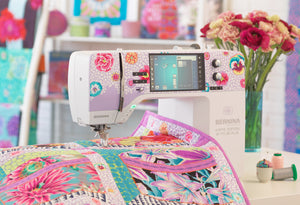

We Love Our Quilting Community
At High Country Quilts we care deeply about community. With our experiences in retail, we know that a store is not only a place to shop but also a place for the community to gather and share. During this busy...


When you're trying to decide between an embroidery machine vs a sewing machine, the core difference really comes down to one thing. Sewing machines are built for construction—the nuts and bolts of piecing quilt blocks, assembling garments, and finishing edges. Embroidery machines, on their own, are all about decoration, adding beautiful, automated designs onto the surface of your fabric.
Figuring out the main job you need the machine to do is the best first step you can take. A sewing machine is the real workhorse in your sewing room. It's what you'll use to create the seams that bring a quilt top to life or to sew the darts that give a dress its shape. It’s all about building the project from the ground up.
An embroidery machine, on the other hand, is more like the artist. It uses a hoop to hold the fabric perfectly still and tight, while an automated arm moves around to stitch out designs you've loaded from a digital file. This is how you get those flawless, repeatable patterns—from intricate floral motifs on a quilt block to a crisp, custom monogram on a tote bag.
For quilters and sewing lovers, seeing the main purpose of each machine side-by-side makes the choice much clearer. This quick table highlights their primary functions and what they do best.
| Capability | Sewing Machine | Embroidery Machine |
|---|---|---|
| Primary Function | Construction and assembly of fabric pieces | Applying decorative, automated stitch designs |
| Best Use Cases | Piecing quilt tops, garment construction, hemming | Personalized quilt labels, monogramming, in-the-hoop projects |
| Fabric Control | You guide the fabric with your hands and the feed dogs | The machine moves the hooped fabric automatically |
| Stitch Type | Primarily functional (straight, zigzag, buttonhole) | Primarily decorative (satin, fill, running stitches) |
This table gets to the heart of it: one builds, the other beautifies.
This decision tree is a great visual for figuring out which machine fits your immediate goals.
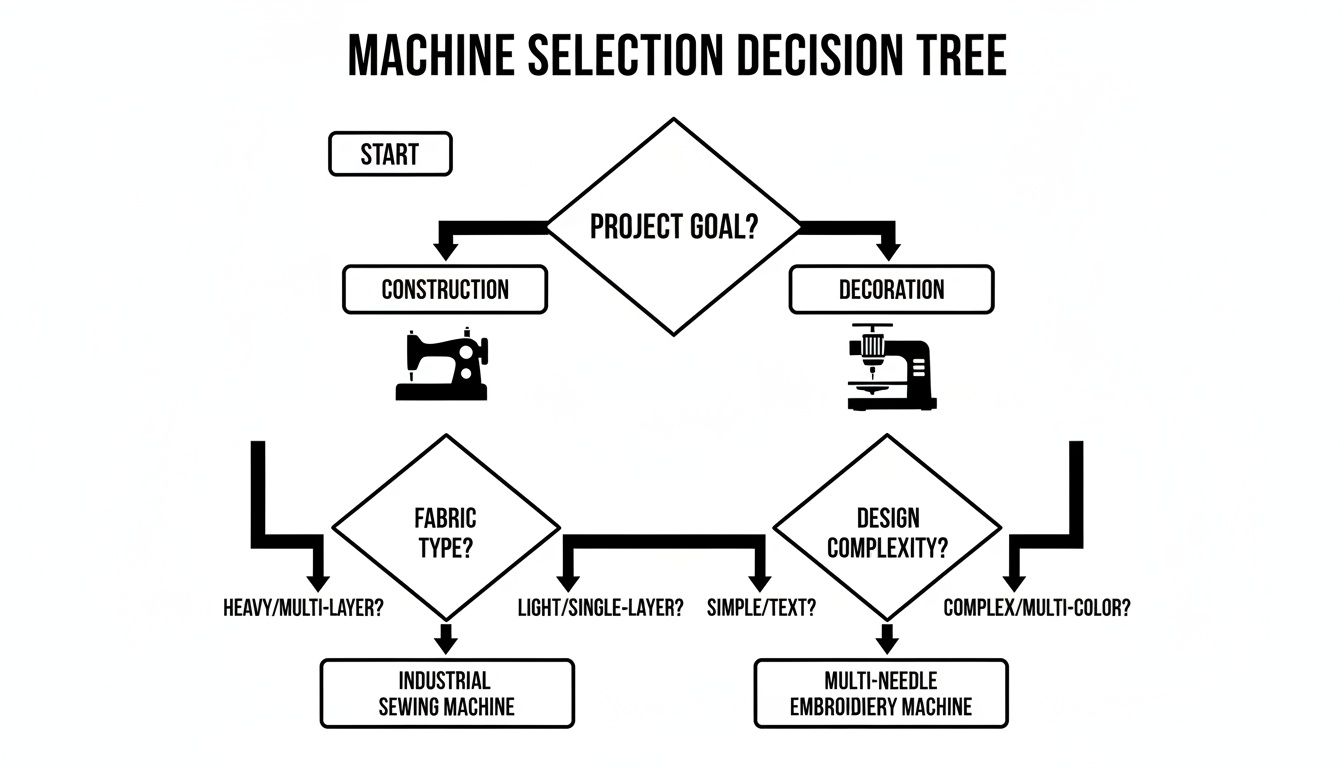
As the chart shows, it all starts with one question: are you trying to build something or decorate something? Answering that will point you directly to the right tool for the job.
Key Insight: Even though both use a needle and thread, how they work is fundamentally different. With a sewing machine, you move the fabric under a stationary needle. With an embroidery machine, the machine moves a hooped section of fabric around the needle to create the design.
This fundamental difference is pretty clear when you look at the market. The global sewing machine industry was valued at $4.71 billion in 2025, holding a massive 65% market share compared to the more niche embroidery sector. It just goes to show how essential sewing is to all fabric crafts, while embroidery acts as a powerful, but separate, specialty for adding that decorative flair. If you're interested, you can read the full research about sewing machine market trends to learn more.
To really get to the heart of the embroidery vs. sewing machine debate, you have to look at how they're built. Their internal workings are engineered for completely different jobs, and that mechanical design is what shapes everything from piecing a quilt top to adding a perfect monogram.
The biggest difference comes down to one simple thing: who controls the fabric. A sewing machine is a team effort. You guide the fabric, while the feed dogs—those little teeth under the needle—pull it forward. It’s a system designed for creating strong, straight seams, fast. This is exactly what you want when you're chain-piecing dozens of quilt blocks.
An embroidery machine flips that entire concept on its head. The feed dogs are dropped or don't exist at all. Instead, your fabric is stretched tight in a hoop, and a robotic arm moves that hoop around for you, precisely positioning it under the needle. The needle just goes up and down; the machine does all the directional work, creating intricate designs by moving the fabric itself.
The Bottom Line: With a sewing machine, you move the fabric. With an embroidery machine, the machine moves the fabric. This single distinction is the key to understanding why they do what they do.
Because of those mechanical differences, the stitches they produce are worlds apart. A sewing machine comes loaded with utility stitches—your workhorses like the straight stitch, zigzag, and blind hem—plus a handful of simple decorative options. You're in charge of the stitch length and width, but the machine's main goal is to create functional seams that hold your project together.
Embroidery machines, on the other hand, are all about the art. Their stitches are purely for decoration. They use complex combinations of satin, fill, and running stitches to build a picture. The machine reads a digital design file and executes thousands of stitches with an accuracy you could never dream of matching by hand. You aren't just picking a stitch type; you're telling the machine to paint with thread.
Another practical difference you’ll notice right away is the free arm. On a sewing machine, it’s that narrow part you get when you slide off the accessory tray. It’s absolutely essential for sewing in the round—think hemming a pair of jeans, setting in a sleeve, or finishing the binding on a mini quilt. It’s all about giving you room to maneuver on smaller, circular projects.
A dedicated embroidery machine doesn’t have a free arm because it doesn’t need one. Its whole world is the flat, hooped area. Even on the combo machines that do both, you have to physically remove the embroidery unit to get back to the sewing machine's free arm for any construction work.
The engines driving these machines are also tuned for different kinds of performance. A good sewing machine motor, especially one built for quilting like you’ll find in a BERNINA, is made for endurance at high speeds. It needs to power through yards of seams without faltering, which is crucial when you're in the zone.
An embroidery motor is built for torque and precision. Speed isn't the priority. It needs the brute force to punch the needle through dense layers of fabric and stabilizer, over and over, without missing a single step. It’s constantly starting, stopping, and changing direction, so reliability and pinpoint accuracy are what matter most. This is one of those behind-the-scenes differences that truly defines each machine's specialty.
It's one thing to have a great machine, but the real magic happens when you pair it with the right tools. When we talk about an embroidery machine vs. a sewing machine, the accessories aren't just nice-to-haves; they completely define what you can create. These attachments are what turn a good machine into a true creative partner.
For a sewing machine, especially one used for quilting, the universe revolves around presser feet. They do way more than just hold your fabric down. Each foot is specially engineered for a specific job, giving you the precision you need for everything from piecing to binding. A great collection of feet is what lets you tackle any project with professional-looking results.
If you're a quilter, there are a few presser feet you simply can't live without. These are the tools designed to handle the unique challenges of working with multiple layers of fabric, batting, and thread.
The Walking Foot: This is the absolute MVP for any quilter. It has its own set of feed dogs on top that work in perfect harmony with the machine's feed dogs below, gripping and pulling the entire quilt sandwich through evenly. No more frustrating shifting or puckering when you're doing straight-line quilting.
The Quarter-Inch Foot: Piecing is all about precision, and this little foot is your secret weapon for a perfect 1/4" seam allowance. It has a tiny metal guide on the side that you run your fabric edge against, ensuring every single seam is dead-on accurate.
The Free-Motion Quilting Foot: Sometimes called a darning foot, this is where your artistry comes alive. It floats or "hops" over the fabric, giving you the freedom to move your quilt in any direction. This is how you "draw" with thread to create gorgeous stippling, feathers, and custom motifs.
These three feet are the foundation of a quilter's toolkit, transforming a standard sewing machine into a quilting powerhouse.
Now, let's shift gears to an embroidery machine. Here, the conversation isn't about feet; it's all about embroidery hoops. The hoop is the single most important accessory, responsible for holding your fabric perfectly taut and stable while the machine works its magic.
The size and style of your hoop directly determine the scale of your embroidery project.
Key Insight: Think of the embroidery hoop as your canvas. A large hoop opens the door to big, intricate designs stitched in one go. Smaller hoops are your go-to for adding monograms or tiny details in hard-to-reach spots.
Most embroidery machines come with a couple of standard hoop sizes, but the world of specialty hoops can take your projects to the next level. For quilters, magnetic hoops are a game-changer because they can secure a thick quilt sandwich without leaving "hoop burn" marks. And for really ambitious projects, mastering re-hooping—the skill of moving the hoop to stitch out a design larger than your machine's embroidery field—unlocks a world of possibility.
The accessories for each machine serve distinct, critical functions. Sewing feet guide the fabric under your control, while embroidery hoops hold the fabric for the machine to control. This table breaks down the essentials.
| Accessory Type | Sewing Machine Focus | Embroidery Machine Focus |
|---|---|---|
| Fabric Handling | Presser Feet (Walking, 1/4", Free-Motion) | Hoops (Standard, Magnetic, Specialty Sizes) |
| Needles | Specialized for fabric type (Quilting, Denim, Stretch) | Specialized for thread (Embroidery, Metallic, Topstitch) |
| Thread | Cotton, Polyester, Blends for construction | Rayon, Polyester, Variegated for decorative finish |
| Stabilizer | Batting (Cotton, Wool, Poly) for quilting structure | Tear-away, Cut-away, Wash-away for embroidery support |
| Bobbins | Standard bobbins with construction thread | Often use lighter weight bobbin thread for less bulk |
| Design Source | You! (Following patterns, improvising) | Digital files (.EXP, .PES, .JEF, etc.) |
As you can see, even when using similar items like needles or thread, the purpose is completely different, guiding your creative process in two very distinct directions.
The final major difference lies in how you get your instructions to the machine. A modern sewing machine might have a simple digital screen for selecting stitches, but that's usually where the high-tech stuff ends.
An embroidery machine, on the other hand, is basically a computer that sews. It lives and breathes in the digital world, functioning a lot like a printer that uses thread instead of ink.
This digital workflow is what embroidery is all about. The ability to tap into an almost endless online library of designs and bring them to life on fabric is what makes the craft so powerful and personal.
All the technical specs and feature lists in the world don't mean much until you sit down with a project. The real test in the embroidery machine vs. sewing machine debate is knowing which one to reach for when inspiration strikes. Let's walk through a few common projects to get a feel for how this plays out in a real sewing room.
Think about it: the machine you choose from the get-go shapes your entire creative process, from the first piece of fabric you cut to that final, satisfying stitch.
When you’re constructing a quilt top, especially one full of tricky blocks and points that need to match up perfectly, a sewing machine isn't just the best tool—it's the only tool for the job. This is all about construction and precision, the very heart of what a sewing machine does.
You’d pop on a quarter-inch foot and chain-piece dozens of half-square triangles, confident that every single one has a perfect 1/4" seam allowance. The machine's feed dogs give you that steady, consistent control you need for long, straight seams, preventing any stretching or wonkiness. This is the foundational work of quilting, and it's 100% sewing machine territory.
Okay, now that gorgeous quilt top is finished. You want to add a personal label with your name and the date. This is the moment the embroidery machine gets to shine. Sure, you could try to fiddle with a sewing machine's built-in decorative stitches, but it will never come close to the crisp, professional finish of automated embroidery.
With an embroidery machine, you simply hoop a small piece of fabric with stabilizer, load a font or a little design file, and hit "go." The machine stitches it out flawlessly. The result is a clean, custom tag that adds a high-quality, meaningful touch that a sewing machine just can't replicate.
Key Takeaway: The best tool is always the one made for the task at hand. A sewing machine builds the structure, while an embroidery machine adds the beautiful, artistic details. One is for construction; the other is for embellishment.
This functional split is even reflected in the global market. In 2024, the sewing machine sector was valued at $7.1 billion, while the embroidery market was projected to be $2.29 billion by 2026. Sewing machines hold a massive 65% share of the combined market simply because they handle the core construction needs for almost every project. You can dive deeper into these sewing and embroidery market reports to see how these trends shape the machines we use.
Let's imagine you have a plain, pre-made canvas tote bag that’s begging for a little personality. Here, your goal is purely decorative.
This is a perfect example of how an embroidery machine can transform an everyday item into a piece of personalized art with very little hands-on effort.
So, what if you want to piece a quilt, embroider the label, and add custom quilting in the hoop? This is exactly why combination machines, like a BERNINA 7 Series with its embroidery module, are so popular. For the quilters we work with at High Country Quilts, these machines offer the ultimate creative freedom.
With a hybrid model, you can piece your quilt top with absolute precision, then easily attach the embroidery module to add custom details. You’re not forced to choose between construction and decoration. You get a world-class sewing machine and a powerful embroidery machine all in one elegant package, ready for absolutely any project you dream up.
So, you’re trying to decide between an embroidery machine and a sewing machine. It can feel like a huge decision, but it really boils down to one simple thing: what do you love to create? Instead of getting lost in a sea of features, let's figure out which machine is the right partner for the projects you're excited to make. Here at High Country Quilts, we’ll help you do just that.
The best way to get clear on your choice is to ask yourself a few honest questions. When you match your main creative outlet to a machine's core purpose, you can feel truly confident in your investment.
First things first, think about how you spend your time in your sewing room—or how you want to be spending it. Are you all about piecing intricate quilt tops and sewing garments, or do you get a thrill from adding that final, decorative touch?
Let's break it down into a few simple paths:
A Little Expert Insight: The right machine is the one that gets out of your way and lets you create. Don’t get caught up in features you might use someday. Focus on the functions that will bring your current ideas to life.
The numbers back this up. While the combined sewing and embroidery market hit $6.15 billion in 2024, the split is interesting. Industrial sewing machines held a massive 69.63% revenue share in 2025, which really shows how vital they are for pure construction. For our quilting community, this confirms that BERNINA's legendary sewing precision is non-negotiable, while the growing excitement for personalization makes their versatile combo machines an amazing choice. You can dig deeper into the growth of the sewing and embroidery market to see how these trends are playing out.
This is where the fun starts! We love helping people at High Country Quilts connect their creative dreams to a specific BERNINA. It’s so much easier to choose when you see how different machines are built for different tasks.
For instance, a quilter who lives for piecing would feel right at home with the BERNINA 475 QE (Quilter's Edition). This machine is an engineering marvel for precision. With the famous BERNINA Stitch Regulator and the perfect amount of throat space for piecing and smaller quilting projects, it’s a focused, powerful tool built for one thing: making incredible quilts.
But what if you love the construction and the embellishment? That’s where a BERNINA 7 Series machine with an embroidery add-on shines. You could spend your morning piecing a quilt top with flawless stitches, then pop on the embroidery module in the afternoon to add gorgeous, custom-quilted motifs right in the hoop. It’s a hybrid approach that gives you the best of both worlds without a single compromise.
At the end of the day, buying a machine is just the first step. When you purchase your BERNINA from High Country Quilts, you’re not just taking home a box; you’re joining a family. We provide hands-on, expert new-owner training to make sure you’re comfortable with every button and feature. Our team is always here for you, and our classes offer a constant stream of inspiration for whatever you want to make next. That ongoing support is what turns a great machine into a creative partner for life.
When you're trying to decide between an embroidery machine and a sewing machine, a lot of practical questions naturally come up. Let's walk through some of the most common ones I hear from fellow creators. Answering these can help clear up any lingering confusion and give you the confidence to choose the right machine for your passion.
Think of this as the final step in making your decision. These answers will lock in the key differences we've covered and give you some straightforward, practical advice.
Yes, but it's a specific kind of quilting. An embroidery machine is absolutely fantastic for a technique called “in-the-hoop” quilting. This is where the machine stitches out intricate, gorgeous quilting patterns onto your quilt sandwich, one block at a time.
This method gives you flawless, repeatable designs with a precision that’s incredibly difficult to achieve by hand. It's a game-changer for detailed work. But—and this is a big but—an embroidery machine isn't built for piecing your quilt top or for traditional, large-scale free-motion quilting. The hoop size physically limits your quilting area, and constantly re-hooping a large quilt can get slow and tedious.
When it comes to the fundamental construction of a quilt—sewing the blocks, adding sashing, and attaching the binding—a sewing machine is still your essential workhorse.
For many quilters and sewists, a combination machine is an absolutely brilliant investment. You're getting the full power of two specialized machines in a single footprint, which is a huge win for saving both space and money.
High-quality combo models, like the ones from BERNINA, deliver exceptional performance in both sewing and embroidery modes with very little compromise. You get the powerful, precise sewing machine you need for construction, plus all the artistic freedom of a feature-rich embroidery machine.
Expert Recommendation: A combination machine is perfect for the creator who is passionate about both building projects and adding those personalized, decorative touches. If you love both crafts equally, it offers the ultimate creative flexibility without cluttering your sewing room with two separate machines.
A basic sewing machine is generally much easier to pick up. Most people can get the hang of a straight stitch and start on simple projects within just a few hours. Of course, advanced sewing techniques take practice, but the initial hurdle is quite low.
An embroidery machine, on the other hand, usually involves a steeper learning curve, mostly because it’s so digital. You'll need to get comfortable managing design files, using the software interface to position and edit your designs, choosing the right stabilizers for different fabrics, and handling thread changes for multi-color patterns. To really understand what makes these machines different, it helps to grasp the core concept of What is embroidery.
Here at High Country Quilts, we know there's a learning process. That’s why we offer comprehensive new owner classes to help you master your BERNINA with confidence, whether it’s for sewing, embroidery, or both.
Yes, a computer is pretty much essential to unlock the full creative power of a modern embroidery machine. While most machines come with a nice library of built-in designs, the real magic happens when you start using designs you've purchased online or even created yourself.
You'll need a computer for several key tasks:
Without a computer, you’d be stuck with only the pre-loaded designs, which really limits what you can create. This digital workflow is at the heart of modern machine embroidery and opens up a world of endless personalization.
Ready to explore the world of high-quality sewing and embroidery? Visit High Country Quilts in Colorado Springs or check out our selection online to find the perfect BERNINA machine that will bring your creative visions to life. https://hcquilts.com
At High Country Quilts we care deeply about community. With our experiences in retail, we know that a store is not only a place to shop but also a place for the community to gather and share. During this busy...

Hi! We’re Adam and Renee Wheaton, the new owners of High Country Quilts! For more than 40 years, we’ve owned and operated vacuum and sewing businesses. Following in Renee’s father’s footsteps after he retired from All Discount Vacuum and Sewing in Colorado...


Leave a comment