

We Love Our Quilting Community
At High Country Quilts we care deeply about community. With our experiences in retail, we know that a store is not only a place to shop but also a place for the community to gather and share. During this busy...


If you're just starting out, the best first quilt you can make is a simple one. I always recommend a patchwork square or a strip quilt to my new students. Why? Because these designs let you get the hang of the absolute basics—cutting fabric, sewing straight lines, and keeping your seams consistent—without getting tangled up in a complicated pattern.
The whole point is to finish with a beautiful quilt that makes you feel proud and excited to start the next one. A simple project sets you up for that win.
Jumping into quilting can feel a little overwhelming at first, but your first project should be pure joy, not a stressful exam. This is supposed to be fun! The goal is to make something you love, which is exactly why starting simple is the best advice any seasoned quilter will give you. An overly ambitious pattern is a fast track to frustration, but an achievable one builds confidence and makes you want to keep going.
Think of it like this: you wouldn't try to run a marathon the first day you decide to start jogging. Quilting is no different. An easy beginners quilt, like a classic patchwork square design, lets you really concentrate on the core skills every quilter relies on.
By picking a straightforward pattern, you’re giving yourself room to breathe and really nail the essentials. This isn’t about taking shortcuts; it's about building a solid foundation for every quilt you'll make from here on out. A patchwork or strip quilt is the perfect training ground for these key techniques:
Once you have these skills down, you'll be ready to tackle more intricate designs with total confidence.
Every single quilt, from a simple baby blanket to a king-sized masterpiece, is made of three layers. We call this the "quilt sandwich," and getting to know it is your first step.
Your first project is all about embracing the process. Don't chase perfection. Instead, focus on learning and enjoying the incredible feeling of making something warm and wonderful with your own two hands.
And remember, you're in great company! Quilting has seen a huge surge in popularity, with recent surveys showing that a whopping 18% of quilters are brand new to the craft. Many beginners are learning from online tutorials and local shops like ours. In fact, 64% of quilters still prefer to buy their supplies in person where they can see and feel the fabric. If you're curious, you can find more of these quilting trends over at the Craft Industry Alliance.
Walking into a quilt shop for the first time is pure magic—all those colors, textures, and possibilities! But I know it can also feel a little overwhelming. Let's cut right to the chase and build your perfect starter kit for your first quilt.
The goal isn't to buy every gadget on the wall. It’s about getting a few key items that will make quilting fun and help you get clean, accurate results right from the start.
For your first project, 100% cotton fabric is the way to go. Trust me on this one. It's the gold standard for a reason: it’s stable, presses like a dream, and doesn't fight you under the sewing machine needle. Starting with good cotton is a huge confidence booster.
For a cozy lap-sized quilt (around 50" x 60"), here’s a simple fabric recipe to follow:
This gives you plenty of material to work with, plus a little extra for any "oops" moments. We all have them!
Want to skip the stress of matching fabrics? Precut bundles are a beginner's best friend. These are curated collections of fabric, already cut into standard sizes, that take all the guesswork out of building a beautiful color palette.
Here at High Country Quilts, we can’t get enough of the vibrant precut collections from designers like Ruby Star Society or Moda Fabrics. They make it so simple to create a stunning quilt top.
Okay, let's talk tools. You don't need a lot, but investing in a few quality basics will make a world of difference in how much you enjoy the process.
These three tools work together to give you perfect, accurate cuts every time.
My Biggest Safety Tip: Get into the habit of closing your rotary cutter blade immediately after every single cut. It’s a simple move that prevents nasty accidents and keeps that blade from getting nicked.
Before you start any project, it's always a good idea to have your materials in order. Getting organized is half the battle! Here's a handy shopping list to get you started.
| Item | Quantity / Size | High Country Quilts Recommendation |
|---|---|---|
| Quilt Top Fabric | 2.5 - 3 yards total | A "fat quarter bundle" or a "jelly roll" is a perfect starting point. |
| Backing Fabric | 3.5 yards | Choose a fun print that coordinates with your top! |
| Binding Fabric | 1/2 yard | A striped fabric looks amazing for binding, but any solid or print works. |
| Batting | Crib Size (45" x 60") | We recommend a low-loft 100% cotton or an 80/20 cotton blend. |
| Rotary Cutter | 45mm blade | Olfa or Martelli are excellent, ergonomic brands. |
| Cutting Mat | 24" x 36" | Look for a mat with clear grid lines. |
| Acrylic Ruler | 6" x 24" | A must-have! Creative Grids rulers have a non-slip backing. |
| Thread | 1 spool, 50wt | Aurifil or Mettler 100% cotton thread is fantastic for piecing. |
| Sewing Machine Needles | Size 80/12 Universal | Schmetz or Organ are reliable brands. Start with a fresh needle! |
| Straight Pins | 1 box | Glass head pins are great because you can iron over them. |
| Iron & Ironing Board | 1 of each | A good steam iron makes all the difference for crisp seams. |
This list covers all your bases for creating a beautiful first quilt from start to finish.
You don't need a fancy machine with hundreds of stitches. Your workhorse is the simple straight stitch.
For your first quilt, pop in a fresh 80/12 universal needle. This size is ideal for piecing together standard quilting cottons. Pair it with a quality, 100% cotton thread (like Aurifil 50wt) to create strong seams that don't add a lot of bulk.
If you’re sewing on one of our BERNINA machines here at High Country Quilts, try these settings:
These small tweaks are what help your blocks line up so beautifully.
Finally, remember that you're joining a massive, welcoming community. There are an estimated 9 to 11 million active quilters out there! Local shops are the heart of this craft, with 64% of quilters preferring to buy their essentials in-store. It’s an exciting time to jump in.
And as your supplies grow, knowing how to organize craft supplies like a pro will be a lifesaver. A tidy space keeps you focused and makes the whole creative process feel so much smoother.
This is where the magic really starts. You've picked out your fabrics, gathered your tools, and now it’s time to turn that lovely stack of cotton into the heart of your quilt. Seeing your design come together, piece by piece, is one of the most rewarding parts of the whole process.
For this project, we're making a simple and classic patchwork square quilt. It’s the perfect first-timer project, and by the end of this section, you'll have a beautiful quilt top that’s flat, square, and ready for quilting.
I can't stress this enough: accurate cutting is the single most important thing you can do at this stage. When your pieces are cut just right, everything that follows—sewing straight seams, matching corners, getting a flat finish—becomes so much easier. This is where your rotary cutter, mat, and ruler become your best friends.
For our cozy lap-sized quilt, we'll be cutting 6.5" x 6.5" squares. It's a great size for beginners—big enough to be easy to handle, yet small enough to create that gorgeous patchwork look. That extra half-inch is for our seam allowances (a quarter-inch on each of the four sides).
Here’s my tried-and-true method for cutting perfect squares every time:
A Quick Word on Safety: The moment you finish a cut, retract the blade on your rotary cutter. Make it a habit. It’s a simple move that will save you from nasty accidents and keep your blade sharp. Treat that tool with respect!
The whole process is quite simple when you break it down: prepare the fabric, cut it into pieces, and then sew it all together.
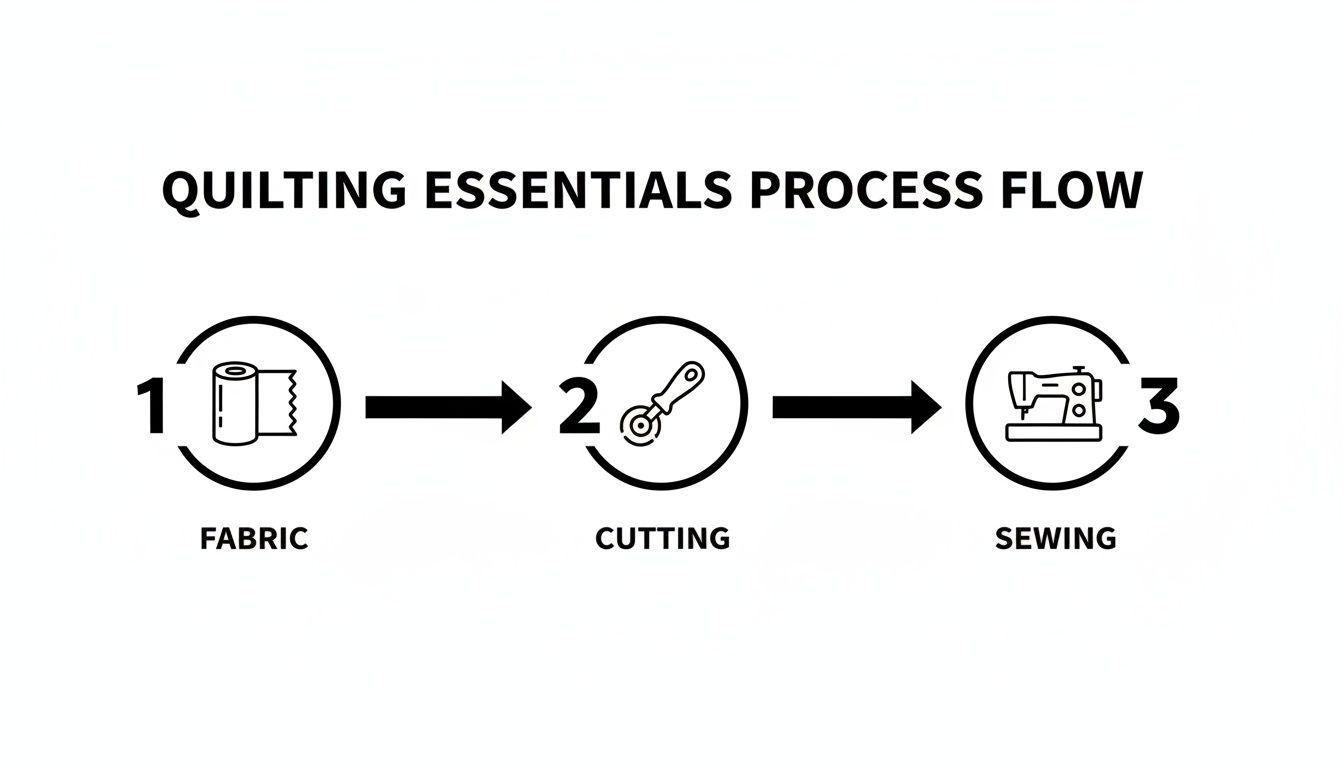
This little guide is a great reminder that quilting is just a sequence of simple, manageable actions that build on each other.
With a neat pile of perfectly cut squares, you're ready to head to the sewing machine. But first, the fun part—arranging your design! Spread your squares out on the floor or a design wall if you have one. Move them around, play with the colors and patterns, and just have fun with it until you land on a layout you love.
There's no right or wrong here, just what looks good to you. For a nice lap quilt, a layout of 8 squares across by 9 squares down is a great size.
Once you’re happy with the arrangement, it's time to sew the squares into rows.
The quarter-inch seam allowance is the absolute foundation of patchwork. Getting this consistent is everything. The easiest way to nail it every time is to use a quarter-inch presser foot on your machine. It has a little metal guide on the side that you'll keep your fabric edge snug against as you sew.
As you feed your squares through, let the machine do the heavy lifting. Your only job is to gently guide the fabric, making sure those edges stay perfectly aligned with the presser foot guide. Whatever you do, don't push or pull the fabric through—that’s a surefire way to stretch it and end up with wavy, wonky seams.
Want a pro tip that will save you a massive amount of time and thread? It's called chain piecing. Instead of sewing two squares, stopping, cutting the thread, and starting the next pair, you just sew them one after another without a break.
This trick is not only way faster, but it also helps stop the corners of your fabric from getting chewed up by the machine when you start a seam.
Pressing your seams properly is what separates a homemade-looking quilt from a professional, flat work of art. Please, don't skip this step!
The golden rule here is to press your seams toward the darker fabric. This simple trick keeps the darker seam allowance from peeking through the lighter fabric on the front of your quilt. When you press, use your iron to "set" the seam flat first (just press it as it was sewn). Then, open the two fabric pieces and press the seam allowance over to one side. Avoid scrubbing back and forth with your iron; that will distort your carefully cut squares. A simple up-and-down motion is all you need.
For an even flatter finish that will make matching your rows a breeze, press the seams in alternating directions for each row.
This technique is called "nesting seams," and it's a total game-changer. When you go to sew your rows together, the seam allowances will lock into each other perfectly, making it incredibly easy to get those sharp, matching points where the corners meet. Once all your rows are sewn and pressed, you'll join them together to complete your beautiful quilt top
Your quilt top is pieced and looking fantastic! Now for the magic trick: turning that flat patchwork into a real, three-dimensional quilt. This is where we create the "quilt sandwich"—your beautiful top, a fluffy layer of batting in the middle, and the fabric backing.
To hold it all together while you work, we’ll baste the layers. Think of this as a temporary step that ensures nothing shifts or puckers while you do the final quilting. Getting this part right is the secret to a smooth, professional finish.
First things first, you need to prep your layers. Your backing fabric and batting should both be cut about 4-6 inches larger than your quilt top on all four sides. This extra room is your safety net, giving you plenty of space to work with and trim down later.
You'll need a large, clean floor for this part. Here’s how to stack it all up:
When you're done, you should have a neat, three-layer stack with an even border of batting and backing peeking out from all around your quilt top.
With your sandwich made, it's time to pin it all together. For an easy beginners quilt, you've got two great options. Neither one is "better"—it really just comes down to personal preference.
A little insider tip: Many quilters find pin basting more forgiving when they're starting out. If you get a wrinkle, you can just unpin and smooth it out. Spray adhesive can be a bit more stubborn to reposition once it’s down.
Once everything is basted, you're ready to add the stitches that officially turn this project into a quilt. This is what permanently joins the three layers and adds all that wonderful texture. When you're quilting on a home sewing machine for the first time, simple is always the way to go.
The biggest challenge here is wrangling the bulk of the quilt. Just roll up the side you aren't working on and rest it on your shoulder or in your lap. This keeps the weight from pulling on your needle and distorting your stitches. Go slow and take your time.
Here are a couple of straightforward techniques that look great and are perfect for a first project. For either of these, you absolutely want to use a walking foot on your sewing machine. This specialized foot has feed dogs on the bottom, which helps pull all three layers through at the same rate to prevent ugly puckers.
If you feel like adding a personal, handmade touch, you can even incorporate some simple hand quilting. Using a thicker thread like perle cotton and a slightly bigger needle, you can add simple, decorative running stitches along a few of the main seam lines.
You don't have to hand quilt the whole thing! Even just a few thoughtfully placed rows can add a lovely, traditional texture and make your easy beginners quilt feel extra special.
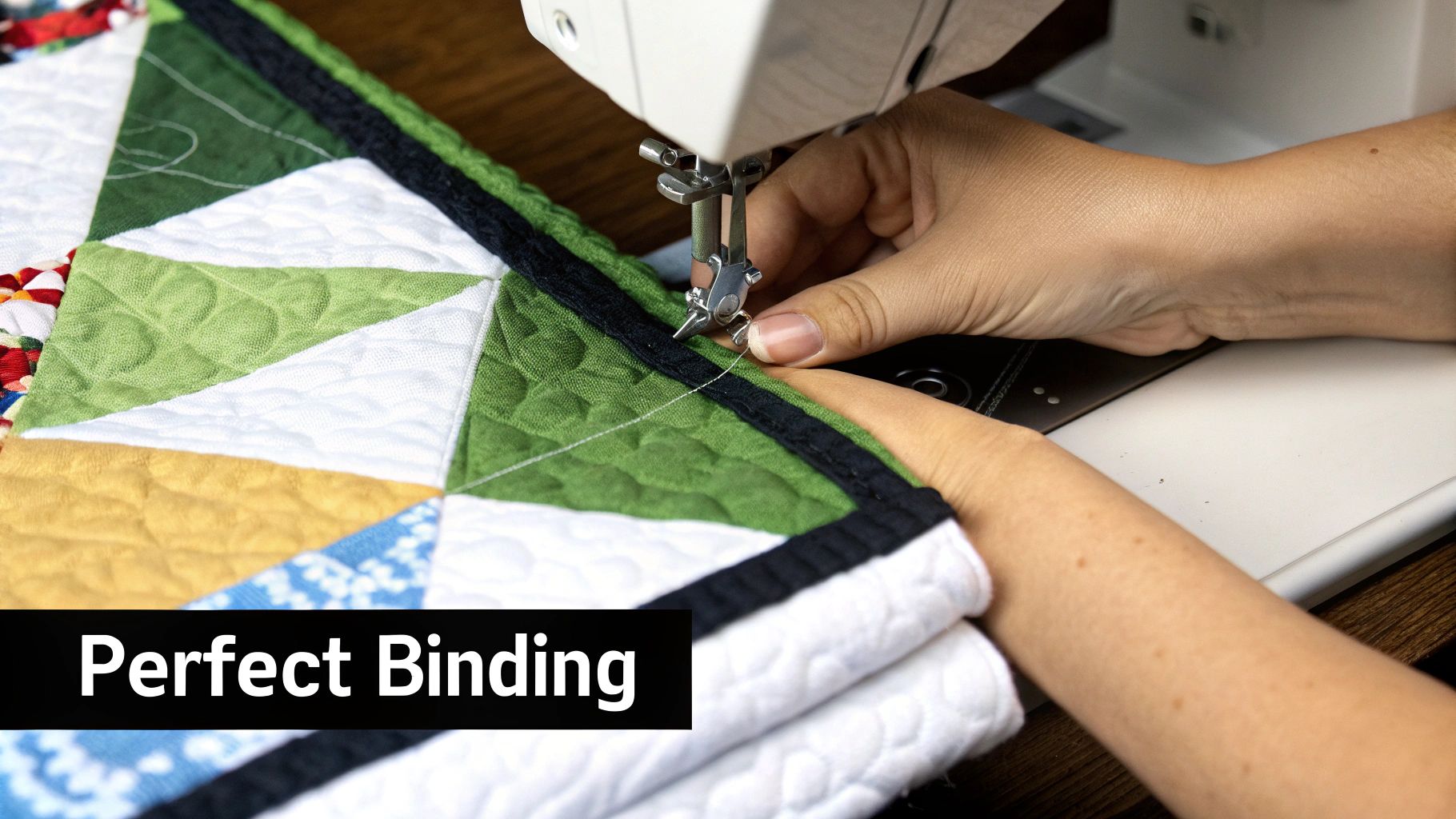
This is it—the final frame for your masterpiece! The binding is what encloses all the raw edges, giving your quilt a durable and beautifully polished finish. I know it can seem a little intimidating, but we’ll break it down into simple, manageable steps.
Honestly, this is your victory lap. Take a deep breath and get ready for one of the most satisfying parts of making an easy beginners quilt.
Before you can sew the binding on, you have to actually make it. This just means cutting several long strips of fabric and sewing them together to create one continuous piece that’s long enough to wrap all the way around your quilt.
First, you'll need to figure out how much fabric you need. Just measure the perimeter of your quilt (that’s length + length + width + width) and then add an extra 10-15 inches just to be safe. For a typical beginner's lap quilt, you'll probably cut five to six strips of fabric from selvage to selvage.
Here’s my go-to method for cutting and joining them:
The diagonal seam is a small detail that makes a huge professional difference. It might feel a little strange at first, but once you try it, you’ll see how beautifully it melts into the edge of your quilt without adding extra thickness.
With your binding all prepped and pressed, it’s time to sew it to the quilt. We'll attach it to the front with the machine first, then wrap it around to the back for the final stitches.
Find a spot about halfway down one side of your quilt to begin. Start sewing, but leave an 8-10 inch tail of binding unsewn at the beginning—you'll need this little tail later to connect the ends neatly. Line up the raw edges of your folded binding with the raw edge of your quilt top and sew it on using a quarter-inch seam allowance. A walking foot is your best friend here, as it will help feed all those layers through your machine evenly.
Those sharp, professional-looking corners are the hallmark of a well-finished quilt, and you'll be surprised at how simple they are to create.
As you get close to a corner, stop sewing a quarter-inch from the edge of the quilt and backstitch. Take the quilt out from under the needle. Now, fold the binding strip straight up and away from the quilt, which creates a 45-degree angle. Keeping that fold in place, fold the strip back down along the next side of the quilt, making sure its raw edge is lined up with the new raw edge of the quilt top.
Pop the quilt back under your needle and start sewing right from the very top edge of this new side. That simple fold is what magically creates that perfect mitered corner on the front.
Once you’ve sewn the binding all the way around, stop when you get about 12 inches away from where you started. You should now have two long tails. Overlap them, trim them so they fit together perfectly, and then sew the two ends together to close the loop. All that's left is to stitch down that last open section of binding to the quilt.
Now that the binding is fully attached to the front, you just need to wrap the folded edge around to the back and stitch it down. You can finish it by machine for a fast, durable edge, or by hand for that classic, invisible look. Hand-stitching with a simple whipstitch is a wonderfully relaxing way to end the project—perfect for doing while curled up on the couch.
And one last thing: don't forget to add a label! A simple patch of fabric with your name and the date, stitched onto the back, is what turns your beautiful quilt into a true family heirloom.
When you're just starting out, it's totally normal to have a million questions swirling around. Trust me, here at High Country Quilts, we've heard every single one! Let's tackle some of the most common ones so you can dive into your first project with confidence.
This is the big one, isn't it? The honest-to-goodness answer is... it depends! For a straightforward lap-sized quilt made from simple squares or strips, a good estimate is somewhere between 15 to 25 hours. That's from the very first cut to the very last binding stitch.
But here’s the thing: don't get hung up on the clock. Quilting is supposed to be relaxing. Some people love a good weekend marathon and can knock out a quilt top in a couple of days. Others prefer to chip away at it for a few weeks, enjoying an hour here and there. It's your quilt, your time. Find a rhythm that works for you.
My Best Advice: Don't try to eat the whole elephant at once. Break it down. Spend one session just cutting your fabric. The next time you sit down, just focus on sewing a few rows together. This keeps it from feeling overwhelming and makes the whole process so much more fun.
If you're looking for the absolute best place to start, you can't go wrong with a classic patchwork square quilt. Seriously. It's all straight cuts and straight seams, which means you can really focus on getting the fundamentals right. You’ll get tons of practice with the three skills that are the foundation of everything else:
Once you’ve got a patchwork quilt under your belt, a Rail Fence or a simple strip quilt are fantastic follow-ups. They introduce you to strip piecing, which is a wonderfully efficient technique you'll use forever.
Listen, every single quilter makes mistakes. I still do! Think of them as part of the learning process. But, if I can help you sidestep a few common beginner hiccups, I will.
Making an easy beginners quilt is a journey, not a race. Embrace the little quirks and imperfections—they're what make it yours. Have fun, celebrate your progress, and enjoy the feeling of creating something beautiful and cozy with your own two hands.
Ready to start your quilting adventure? Stop by High Country Quilts in Colorado Springs or visit us online to find the perfect fabrics, beginner-friendly patterns, and expert advice for your first project! Find all your quilting essentials at https://hcquilts.com.
At High Country Quilts we care deeply about community. With our experiences in retail, we know that a store is not only a place to shop but also a place for the community to gather and share. During this busy...

Hi! We’re Adam and Renee Wheaton, the new owners of High Country Quilts! For more than 40 years, we’ve owned and operated vacuum and sewing businesses. Following in Renee’s father’s footsteps after he retired from All Discount Vacuum and Sewing in Colorado...


Leave a comment