

We Love Our Quilting Community
At High Country Quilts we care deeply about community. With our experiences in retail, we know that a store is not only a place to shop but also a place for the community to gather and share. During this busy...


Welcome to the unsung hero of every sewing and quilting project: the thread. We often obsess over fabric choices, but the different types of threads—from natural fibers like cotton and silk to workhorse synthetics like polyester and nylon—are what truly hold our creations together. Picking the right one is every bit as crucial as picking the right fabric.
Think of thread as the backbone of your project. The wrong choice can lead to all sorts of frustrations—puckered seams, snapped stitches, or even damaged fabric. But the right thread? It ensures your project is not only beautiful but durable enough to withstand the test of time, whether it’s a beloved quilt or a favorite handmade dress.
This guide is here to help you navigate the aisles of spools with total confidence. We’ll break down why a delicate silk thread is perfect for fine appliqué, while a sturdy polyester is the go-to for quilting on a BERNINA machine. Understanding these differences is what takes your work from looking homemade to looking professional.
You might not think about it, but that little spool is part of a massive global industry. The global sewing thread market was valued at an incredible USD 3.66 billion and is expected to climb to USD 4.91 billion by 2035. This boom, driven by everything from fashion to footwear, means we get more choices than ever before—specialty polyesters, strong nylons, and beautiful cotton blends are constantly hitting the market. Read more about the sewing thread industry's growth.
All that variety is fantastic, but it can also feel a bit overwhelming. The good news is that you only need to understand three core concepts to make a great choice every single time.
Master these three pillars, and you'll be able to confidently choose the perfect thread for any seam, decorative stitch, or intricate quilting design. Let’s unravel the secrets to flawless stitching, one spool at a time.
To really get a handle on the different types of threads, you have to start with their DNA. Just like picking the right fabric for a project, choosing the best thread comes down to two things: the fiber it's made from and its construction. These two elements are what give a thread its strength, its shine, and ultimately, how it behaves in your sewing machine.
Think of the fiber as the raw ingredient. It might be something natural like cotton, which comes from a plant, or a synthetic like polyester, which is engineered. Every fiber type brings its own unique qualities to the table, making some threads a perfect match for certain jobs and a terrible choice for others.
We've been using natural fibers for centuries, and they're still popular for good reason. At the same time, synthetics offer modern solutions for challenges like high-speed machine stitching or the need for serious durability.
Here’s a quick rundown of the most common fibers you'll find on a spool:
To see how different fibers and weaves impact the final material, check out this guide to curtain cloth types, which covers everything from sheer to blackout. Understanding the base material is always the first step.
Beyond the fiber itself, the way the strands are put together—their construction—is a huge deal. Think about making a rope. You wouldn't use just one thin piece of twine, right? You’d twist smaller fibers together to build strength. Thread construction works on the very same principle.
A thread's construction is just as important as its fiber. It determines how smooth the thread is, how strong it is, and how much lint it leaves behind in your machine. All of this directly impacts your sewing experience and the final look of your stitches.
This concept map breaks down how fiber, construction, and weight are the three pillars of thread selection.
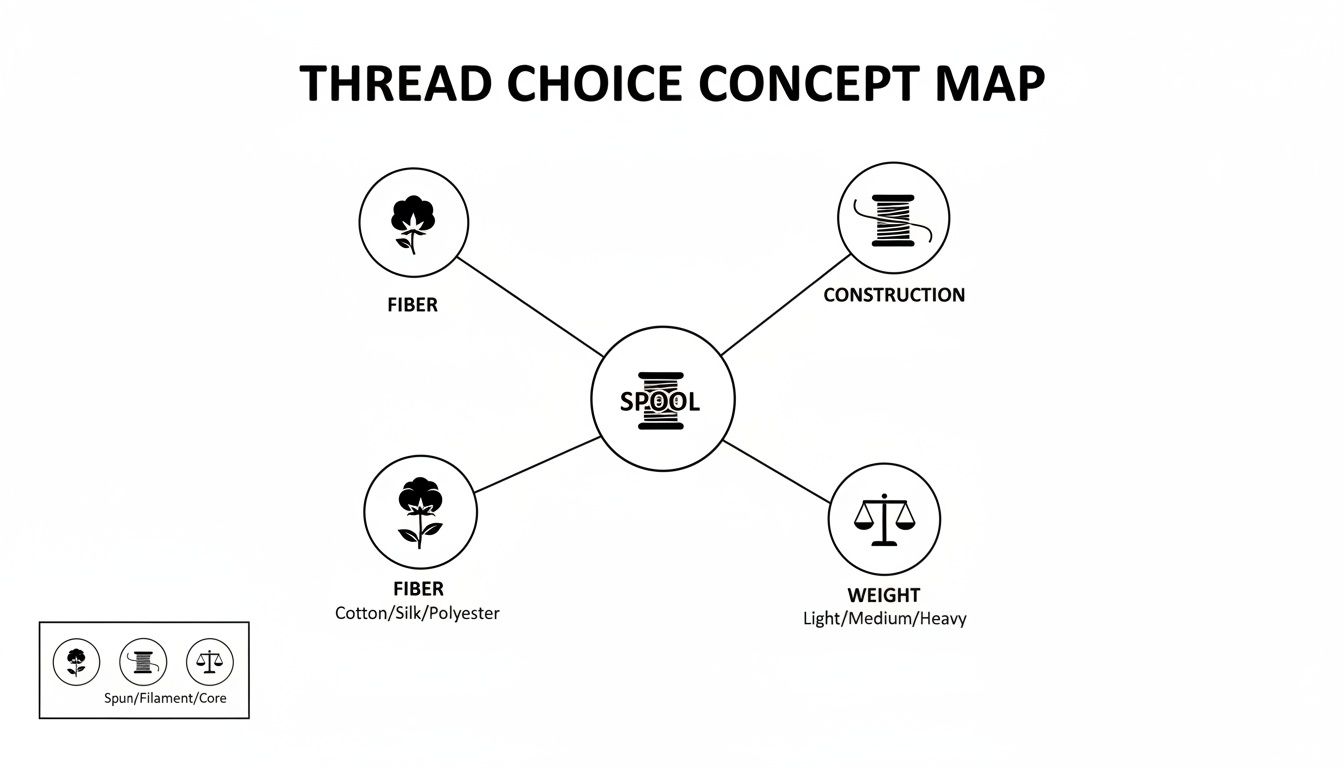
As you can see, these three factors don't work in isolation. They combine to define what a thread is truly good for.
There are three main ways thread is constructed, and each one offers a different balance of strength, smoothness, and cost.
Spun Thread: This is what most of us use day-to-day. It’s made by taking short, staple fibers (like you find in cotton) and twisting them together into a single strand. It’s a lot like how yarn is made, just on a much finer scale. Spun thread is affordable and versatile, but it can sometimes create a bit more lint.
Filament Thread: This type is made from one long, continuous strand (a filament) or several of these long strands twisted together. Silk, polyester, and nylon are often made this way. The result is an incredibly strong, smooth, and low-lint thread, which is why it’s a favorite for machine quilting and embroidery.
Core-Spun Thread: This is the hybrid that gives you the best of both worlds. It starts with a strong polyester filament core, which is then wrapped in spun cotton or polyester fibers. This gives you a thread with the raw strength of polyester but the look and feel of cotton. It’s a premium all-purpose choice for a reason.
When you're piecing a quilt on your BERNINA, a high-strength polyester thread can be a game-changer. This durable thread market was valued at USD 358 million and is projected to hit USD 472 million by 2032. This stuff is defined by its incredible tensile strength—often 30% stronger than standard polyester—making it perfect for heavy-duty work. Quilters love how it resists abrasion and UV light, and new core-spun versions can boost seam strength by 25-40%, which means fewer frustrating thread breaks on high-speed machines.
Getting these basics of fiber and construction under your belt is the key. It demystifies why some threads feel slick and others feel soft, and why some snap under pressure while others glide through fabric like a dream.
Walking into a quilt shop and staring at a wall of thread can feel like trying to read a foreign language. The numbers on the spools—40wt, 50wt, Tex 30—are more than just labels. They're the code to understanding a thread's thickness, strength, and what it’s actually good for. Cracking this code is the secret to matching the perfect thread to your project every single time.
Think of thread weight like different types of pencil leads. You wouldn't grab a thick, bold marker for fine, detailed drawing, and you wouldn't try to fill in a large area with a delicate 0.3mm mechanical pencil. Thread works the same way: its thickness, or "weight," dictates its role in your sewing.
The system you’ll see most often in quilting and sewing shops is the Weight (wt) system. This is where things can feel a bit backward at first, but the rule is simple once you get it.
In the Weight (wt) system, a higher number means a finer, thinner thread. A lower number indicates a thicker, heavier thread.
So, a 50wt thread is much finer than a 30wt thread. This system is actually based on length; the "weight" number tells you how many kilometers of that thread it takes to weigh one kilogram. It takes 50 kilometers of a fine 50wt thread to equal one kilogram, but only 30 kilometers of a much thicker 30wt thread.
While the weight system feels a little upside-down, other systems work the way you'd expect. These are known as "direct" systems, and they are much more intuitive.
The Tex system is a universal standard you’ll often see on industrial spools and serger threads. The logic here couldn’t be simpler: the Tex number is the weight in grams of 1,000 meters of thread.
It's that easy. A Tex 60 thread is twice as heavy (and thick) as a Tex 30 thread. This direct relationship makes comparing threads a breeze, with no mental gymnastics required.
Another direct system is Denier, which you'll probably encounter on filament threads like rayon or polyester used for machine embroidery. It works just like Tex, measuring the weight in grams of a set length—in this case, 9,000 meters. And just like Tex, a higher denier number means a thicker, stronger thread.
Understanding these sizing systems isn't just about knowing trivia; it directly impacts how your projects turn out. If you use a thread that’s too thick, you can end up with bulky, ugly seams or even damage delicate fabrics. On the other hand, if you use a thread that’s too fine, it might not be strong enough to hold a high-stress seam on a bag or a pair of pants.
By knowing how to read the numbers on the spool, you’re in control. You can confidently grab a fine 50wt cotton for perfect piecing, a durable 40wt polyester for quilting, and a bold 12wt for that stunning decorative topstitch that makes your project truly yours.
Okay, we've covered the nitty-gritty of how thread is made—the fibers, construction, and weight systems. Now for the fun part: putting it all together and picking the perfect thread for what you’re actually making. This is where all that technical knowledge becomes a practical skill.
Think of it like being a chef. You wouldn't use the same spice for every single dish, would you? The right thread, like the right seasoning, can take a project from "good enough" to truly exceptional. Getting this choice right means your seams will be strong, your decorative stitches will pop, and your finished piece will last for years to come.
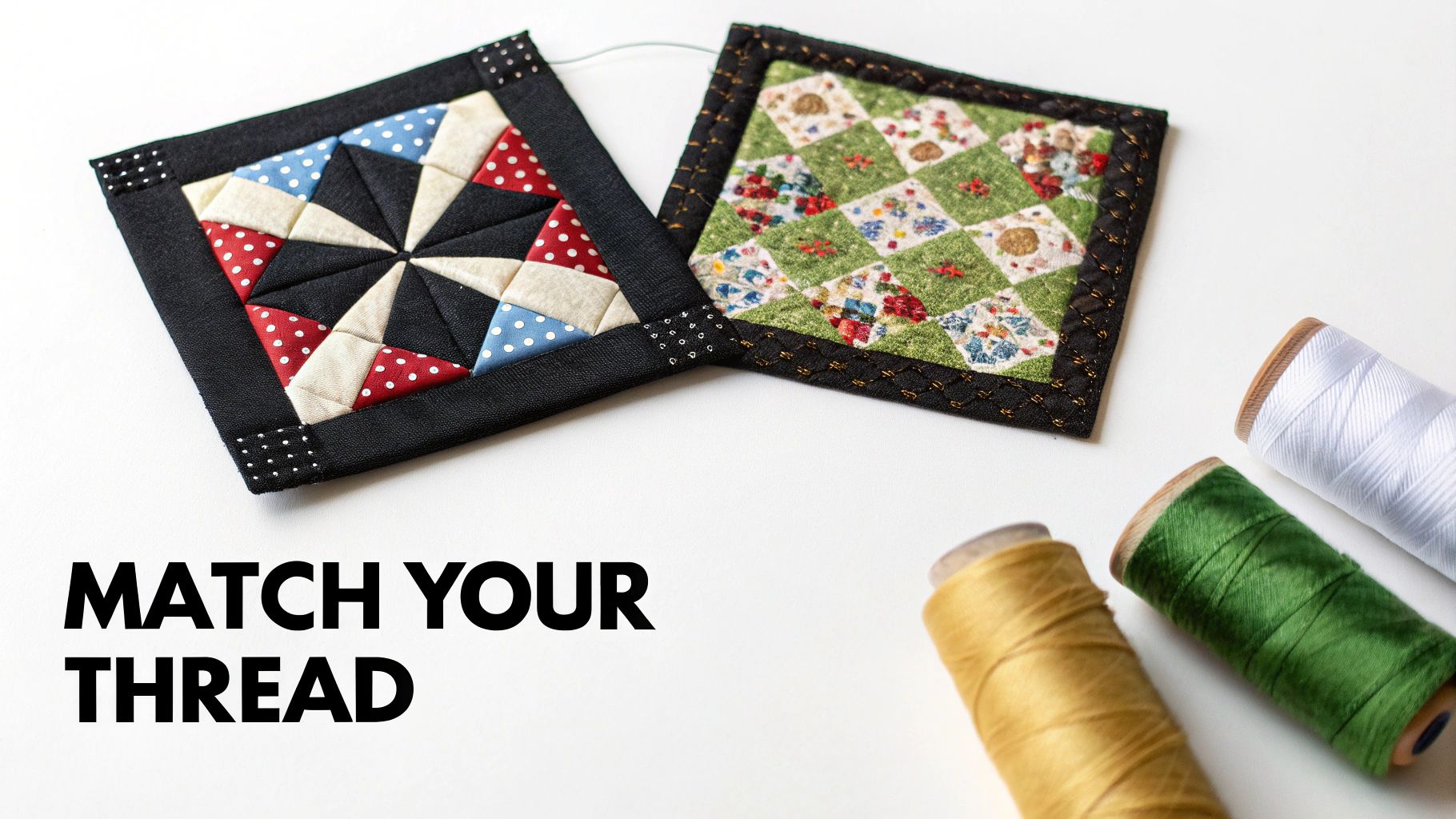
If you have just one type of thread in your sewing box, it's probably this one. All-purpose thread is the dependable workhorse you can count on for most jobs. It's usually a medium-weight polyester or a cotton-wrapped poly, typically around 40wt or 50wt.
This is your go-to for general garment construction, piecing quilts, hemming pants, and all sorts of everyday sewing tasks. It’s strong, has just a little bit of give, and plays nicely with a huge range of fabrics. While it might not be the absolute best choice for highly specialized projects, it’s an indispensable staple for every sewer.
When you're quilting, your thread has two very different but equally important jobs. First, it has to create perfectly flat, non-bulky seams when you're piecing the quilt top. For this, a 50wt 100% cotton quilting thread is the gold standard. It sinks right into the fabric and presses beautifully.
Then, for the actual quilting—the stitching that goes through the quilt top, batting, and backing—you need strength. Many quilters stick with cotton (maybe a slightly thicker 40wt) because it wears at the same rate as cotton fabric. Others prefer a strong polyester for its durability and subtle sheen, which can really highlight modern quilt designs.
Pro Tip: Match your thread fiber to your fabric fiber whenever you can (cotton thread on cotton fabric, for example). This ensures that everything shrinks, stretches, and ages together, which is key to making a quilt that will stand the test of time.
Sometimes you don't want your stitches to just hold things together—you want them to be the main event. That's when you reach for embroidery thread. Designed specifically for machine embroidery, its job is to shine and be seen. The two most common players here are rayon and polyester.
Rayon Embroidery Thread: This one is all about the high-gloss, silky finish. It comes in a dizzying array of brilliant colors and gives designs a gorgeous, lustrous look. It’s beautiful but just a tad more delicate than its polyester cousin.
Polyester Embroidery Thread: If you need your embroidery to be bulletproof, this is your thread. It’s incredibly strong, won’t fade, and can handle hot water washes and even bleach. The shine is fantastic (though a little less glassy than rayon), making it perfect for things that get a lot of wear and washing, like kids' clothes, towels, and tote bags.
The thread market itself is booming, growing from USD 108.37 billion to a projected USD 138.77 billion by 2029. For us home sewers, that means an explosion of amazing options. Sustainable fibers now make up 15% of the market, and brands engineer threads so precisely that using the right one for a high-end machine like a BERNINA can cut project failure by as much as 20%. If you're curious, you can discover more insights about the expansive yarn and thread market.
Your serger (or overlocker) is a different beast altogether. It stitches at incredible speeds and uses multiple threads at once to trim and enclose a seam. This high-demand job calls for a special serger thread.
It’s much finer than your all-purpose thread and comes on giant cones because your serger will devour it quickly. It’s almost always polyester, designed to be smooth and strong to withstand those high speeds without snapping. You can use regular thread spools in a pinch, but you’ll likely get bulkier seams and be changing them out constantly.
Beyond these core types, there’s a whole universe of specialty threads designed for very specific jobs.
Topstitching Thread: This is a heavy-duty thread, usually around a 30wt, made to be seen. Use it for the classic gold stitching on jeans or for adding a bold, decorative outline to bags and jackets.
Bobbin Thread: When you’re machine embroidering, you need a very fine thread in the bobbin (think 60wt or even finer). This bobbin thread keeps the back of your design from getting stiff and bulky, letting the top thread be the star.
Hand Sewing Thread: This thread often has a special glaze or wax coating. That coating is a lifesaver—it helps the thread glide through fabric without twisting into a tangled, knotted mess, which is perfect for hand appliqué or finishing work.
Once you start seeing thread not just as a fastener but as a key ingredient, you can make choices that truly elevate your projects. You’re no longer just sewing—you’re engineering for strength, beauty, and longevity.
Choosing the right thread is a massive step toward a beautiful, lasting project, but it's really only half the story. The other half is all about how you use it. Getting your machine's settings dialed in for the specific thread you’re using is what separates a frustrating sewing session from one that produces flawless, professional-looking stitches.
Think of your thread, needle, and sewing machine as a team. For them to work together without a hitch, every piece has to be perfectly suited to the others. When they’re all in sync, you get beautiful, even stitches. When they're not, you get skipped stitches, shredded thread, and a whole lot of headaches.
If there’s one relationship you need to get right in sewing, it’s the one between your thread and your needle. The thread absolutely must pass smoothly through the eye of the needle without getting snagged or strained. A thread that’s too thick for the needle’s eye is going to shred and break, while a needle that’s too big for the thread will punch distracting, oversized holes in your fabric.
The rule of thumb is simple: thicker threads need a needle with a larger eye, and finer threads need one with a smaller eye.
Here’s a quick reference to get you started:
Always, always start a new project with a fresh needle. A dull, bent, or nicked needle is the number one cause of skipped stitches and damaged fabric. For something as important as a quilt, this tiny step makes a world of difference.
Once your thread and needle are a perfect match, it's time to look at your machine’s tension. Tension is all about the tug-of-war between the top thread and the bobbin thread. When the tension is perfect, the two threads meet and lock neatly right in the middle of your fabric layers.
But when you switch to a much thicker or thinner thread, your machine's default tension setting (usually around 4) is probably going to need a little tweak.
Using a Thicker Top Thread (e.g., 30wt Topstitch): A thick top thread has more "pulling power" on the bobbin thread. To get things back in balance, you’ll likely need to decrease your top tension to a lower number, like 2 or 3.
Using a Thinner Top Thread (e.g., 60wt Bobbin): A fine top thread has less pull. To keep it from looping on the back of your fabric, you may need to increase your top tension to a higher number, like 5 or 6.
Before you ever touch your main project, test your stitches on a scrap piece of the exact same fabric. That five-minute check can save you hours of ripping out messy seams later on. Trust me on this one.
I know it’s tempting to grab that bargain bin of cheap, unbranded thread, but it's almost always a mistake that costs you more in the long run. Low-quality thread is weaker, sheds way more lint (which clogs up your machine), and is often full of slubs and inconsistencies that cause tension nightmares and constant breakage.
Investing in thread from reputable brands is an investment in your project and your sewing machine. Good thread is smoother, stronger, and more uniform, which means better stitch quality and a happier, healthier machine. You’ll spend less time troubleshooting and more time actually creating.
Finally, think about where you keep your thread. Keep spools out of direct sunlight, which can weaken the fibers and fade the colors over time. Storing them in a covered container also protects them from dust, which can get pulled right into your machine’s tension discs and cause all sorts of problems. A little care goes a long way in making sure your thread is strong and ready for your next masterpiece.
Once you start to get a feel for different threads, the real-world questions always pop up right in the middle of a project. To help you build confidence and get ahead of those little snags, I've gathered some of the most common questions we hear from fellow sewers and quilters. Think of this as your go-to guide for those "what if" moments at the machine.
Working through these common hurdles is just part of the creative process. Getting the right answer can turn a moment of frustration into a real learning opportunity, making sure your projects stay on track and turn out just the way you imagined. Let's dive in.
Absolutely. In fact, it’s what most people use. All-purpose thread, which is usually a 40wt or 50wt polyester or a cotton-poly blend, is a fantastic choice for the piecing stage of quilting—sewing all your individual fabric blocks together. It’s strong, has just a little bit of give, and creates durable seams that can easily handle the quilting process.
But when it comes to the actual quilting—the stitches that go through all three layers of your quilt sandwich—many quilters have a strong preference for 100% cotton thread. Why? The main reason is that cotton thread wears at the same rate as cotton fabric, which helps create a more authentic, cohesive heirloom over the decades. However, if you're making a quilt that will get a lot of love and heavy use, like a child's blanket, a high-quality polyester quilting thread is a great choice for extra durability and a beautiful, subtle sheen.
Ah, the dreaded metallic thread snap. This is probably one of the most common frustrations I hear about, but it's almost always fixable with a few simple tweaks. The problem usually boils down to friction, speed, and tension. Metallic thread is delicate by design—it's a shiny filament wrapped around a stronger core (like nylon or polyester), which makes it prone to shredding and snapping.
Here’s a quick troubleshooting checklist that almost always solves the problem:
A little patience and the right setup are the secrets to success with metallics. It might take an extra minute to get started, but that stunning decorative finish is always worth it.
Yes, in most cases, it makes a huge difference. For a truly professional-looking stitch, the goal is to have your top and bobbin threads meet perfectly in the middle of your fabric. This makes the bobbin thread invisible from the top, and the top thread invisible from the bottom.
If your tension is even a tiny bit off, you might see little dots of the bobbin thread peeking through on top. Using a matching bobbin thread makes these minor imperfections completely disappear. When quilting, a great trick is to match your bobbin thread to your backing fabric for a seamless look on both sides. Don’t have a perfect match? A neutral gray, beige, or off-white in the bobbin blends surprisingly well with almost any color on top.
The big exception here is machine embroidery. It’s standard practice to use a special, fine bobbin thread (usually 60wt or finer) in white or black. This keeps the back of the embroidered design soft, flexible, and less dense.
While thread doesn't have a formal expiration date, it definitely doesn't last forever. Over time, fibers can dry out and become brittle, leading to constant breaking and a whole lot of frustration. Old thread also sheds a lot more lint, which can clog up your machine's sensitive parts.
The easiest way to check is with a simple "snap test." Unwind about a foot of thread, hold it between your hands, and give it a sharp tug. If it snaps with almost no effort, it's too old and weak for your sewing machine.
Sunlight and dust are the biggest enemies of thread, so storing it properly is the key to making it last. Those beautiful vintage wooden spools are lovely to look at, but they’re often best left for decoration or very gentle hand-sewing, not for a major seam on your next project.
At High Country Quilts, we believe that the right thread is the foundation of every beautiful project. Whether you're piecing a family heirloom or trying machine embroidery for the first time, our expert team is here to help you find the perfect spool for your needs. Explore our extensive selection of high-quality threads, fabrics, and BERNINA machines to bring your creative vision to life. Visit us in-store or online today at https://hcquilts.com.
At High Country Quilts we care deeply about community. With our experiences in retail, we know that a store is not only a place to shop but also a place for the community to gather and share. During this busy...

Hi! We’re Adam and Renee Wheaton, the new owners of High Country Quilts! For more than 40 years, we’ve owned and operated vacuum and sewing businesses. Following in Renee’s father’s footsteps after he retired from All Discount Vacuum and Sewing in Colorado...


Leave a comment