
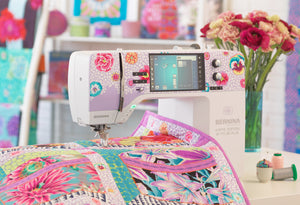

We Love Our Quilting Community
At High Country Quilts we care deeply about community. With our experiences in retail, we know that a store is not only a place to shop but also a place for the community to gather and share. During this busy...


You know the moment. The binding is on, the corners are neat, and you finally hold the quilt up at arm's length and think, “It's finished.”
Then you spot the blank space on the back and remember the last job that many quilters put off. The label.
That small piece matters more than it looks. A good label turns a beautiful finish into a documented handmade piece with a name, a date, and a story that stays with the quilt long after it leaves your sewing room. For anyone making gifts, keeping family records, or selling handmade work, custom quilt labels for handmade items are part of the project, not an optional extra.
A quilt label isn't just decoration. It helps preserve provenance, meaning the record of where the quilt came from and what belongs with its story. According to Homemade Emily Jane's quilt labeling guide, labels can record the maker, recipient, date, pattern, technique, and care instructions, making the quilt's history traceable over time.
That matters because quilts travel. They go to college dorms, nurseries, guest rooms, and memory chests. They get washed, borrowed, folded, loved, and eventually inherited. Years later, a label may be the only reason someone knows who made it and why.
When students ask me what belongs on a label, I suggest thinking in layers.
A quilt without a label can still be beautiful. A quilt with a label stays connected to its maker.
There's also a practical side. The same source notes that a label can be as small as a 4 in × 2 in design, and many makers leave about 1.5 inches of margin around embroidery before trimming and pressing a 1/2-inch seam allowance, which shows that label-making has become a regular finishing step rather than an afterthought in many sewing rooms. If you've ever wondered whether labels are “extra,” that detail answers it nicely. They're part of the finish.
Usually, it's not because they don't care. It's because they're unsure about three things:
If you've had those same questions, you're not behind. You're asking the right ones.
For makers who sew more than quilts, some of the same durability thinking shows up in advice on durable garment labels from Quote My Wall. The materials are different, but the principle is familiar: if a label is supposed to stay readable through use and washing, the construction choice matters.
A quilt label has to do two jobs at once. It needs to belong with the quilt visually, and it needs to stay readable after years of handling, washing, or display. That second part often gets less attention than it deserves, especially with newer materials such as vegan leather.
As noted by Dutch Label Shop's discussion of custom quilt labels, longevity is often overlooked in quilt label tutorials. For heirloom work, that matters. A beautiful label is only successful if it still looks intentional years from now.

Start by matching the label to the quilt's real life, not just its style.
A baby quilt usually benefits from a soft label that bends, washes well, and does not feel stiff against the backing. A wall quilt can carry a more structured label because it will not go through the same wear. A gift quilt with a modern look may be a good place to try vegan leather, cork, or another plant-based option that gives crisp edges and a clean finish.
The easiest way to judge a label material is to compare it to binding fabric. Some materials behave like quilting cotton and forgive small mistakes. Others behave more like paper with a fabric backing. They look polished, but every needle hole counts. That is why sampling matters so much on a BERNINA. Once you stitch through some vegan leather surfaces, the punctures may remain visible if you remove the seam.
| Material | Source | Sew-ability | Durability | Best For |
|---|---|---|---|---|
| Cotton fabric | Woven natural fiber | Easy to mark, press, and stitch | Familiar choice for quilts that need a soft finish | Traditional quilt backs, handwritten or printed labels |
| Cork fabric | Plant-based surface with fabric backing | Usually stable under a machine and easy to topstitch carefully | Holds shape well and gives a crisp, modern look | Contemporary quilts, tote-style handmade items, structured labels |
| Pineapple-based vegan leather | Plant-based alternative | May need testing with needle, thread, and stitch length | Good when you want a sleek label with an animal-free feel | Gift quilts, modern branding details |
| Apple-based vegan leather | Plant-based alternative | Often benefits from slower stitching and fewer punctures | Useful when appearance matters as much as feel | Boutique handmade pieces |
| Recycled polyester label fabric | Synthetic recycled content | Often consistent and easy to produce repeatedly | Helpful for repeatable label runs | Small handmade brands and batch sewing |
| Organic hemp or similar sustainable woven fabric | Natural plant fiber | Can vary in texture, so test before final use | Nice for makers who want a rustic, earthy finish | Utility quilts, heritage-inspired projects |
Cotton is forgiving. You can press it, fold it, unpick a seam, and usually try again without much evidence.
Vegan leather and cork ask for a more deliberate approach. They often cannot be pressed with the same heat as cotton, and repeated stitching in the same spot can weaken the surface or leave a dotted line behind. For BERNINA users, this is good news as much as a caution, because precise stitch control helps a great deal here. A machine that starts cleanly, feeds evenly, and lets you fine-tune stitch length gives these modern materials a much more polished result.
A few points are worth testing on scraps first:
Here is the practical rule I teach in workshops at High Country Quilts. Match the label material to the quilt's use first, then to its style.
If the quilt will be washed often, choose a material that bends easily and can handle repeated stitching lines without cracking or separating. If the quilt is commemorative or decorative, a structured vegan leather label can add a modern signature without competing with the piecing.
If you also sew bags, aprons, or guild projects, patch-style construction can offer useful design ideas. Some quilters borrow border and edge-finishing concepts from Dirt Cheap Product custom patches when they want a label that reads clearly and has a defined, graphic outline.
For many BERNINA owners, vegan leather is the material that feels unfamiliar at first. That hesitation is normal. Treat it like auditioning thread for quilting. Stitch a small sample, fold it, scratch it lightly with a fingernail, and see how it responds before you cut the final label. A ten-minute test can save a beautiful quilt back from a label that looked good on the table but not after stitching.
A label can be tiny and still ask a lot from your machine. You are stitching through a material that may not recover from extra needle holes, then attaching it to a quilt that still needs to drape well and lie flat. Good results come from a controlled setup, not from sewing harder or faster.
One helpful overview from Swoodson Says' quilt label ideas roundup shows how many directions quilt labels can take, from embroidery and printed fabric to handwritten and pieced labels. For this project, our focus is narrower. We are setting up a BERNINA for modern label materials, especially vegan leather, so the finished label looks clean now and stays secure over time.

Keep your toolkit simple and specific.
This setup works like choosing the right batting for a quilt. The material itself matters, but the support underneath changes the result.
Presser foot choice affects control, visibility, and stitch accuracy. On a BERNINA, that choice often matters as much as the stitch setting.
Many quilters are surprised by how different vegan leather feels under the foot. Cotton compresses and forgives. Vegan leather records every puncture more clearly, so accuracy matters from the first stitch.
If your BERNINA model allows presser foot pressure adjustment, test a slightly lighter setting. Too much pressure can make the material drag or leave feed impressions. If the label shifts instead, return toward the default setting and test again. Small changes are enough.
Use scraps that match the final combination as closely as possible: label material, thread, needle, and quilt back. Treat this like making a quilting swatch before a large allover design. A two-minute test can answer questions that are hard to fix later.
A professional-looking label usually comes from restraint. Straight stitching, matched thread, and even spacing often age better than dense decorative stitching on materials that do not self-heal.
High Country Quilts also offers BERNINA presser feet and accessories, along with a custom quilt label service for makers who want personalized names, dates, messages, or logos prepared for them.
You finish quilting, turn the piece over, and the back corner still feels unfinished. A small label fixes that, but on vegan leather, every needle hole is permanent, so the order of operations matters. The good news is that this is a very manageable BERNINA project. Small scale lets you slow down, check your spacing, and get a polished result without wrestling a full quilt under the machine.

Start with a simple rectangle, especially for your first one. It is easier to trim accurately, easier to align with the quilt back, and easier to stitch evenly with the edge of a BERNINA foot as your visual guide. A size around 1 1/2 by 3 inches or 2 by 3 1/2 inches gives you room for a name and date without overwhelming the quilt.
Cut with a ruler and a sharp craft knife or rotary cutter reserved for nonwoven materials. Scissors can work, but they often leave slight waves on coated surfaces. On vegan leather, a clean cut edge reads like a cleanly pieced seam. You notice it right away.
If your material has a fabric backing, test your marking tool on a scrap first. Some backings accept chalk or removable marker well. Others hold marks more stubbornly than quilting cotton. That is one reason sustainable label materials need their own workflow. They behave well over time when you avoid unnecessary handling and keep the piece as simple as possible.
If your label includes printed text on a fabric-backed base, freezer paper can help stabilize it during the writing or printing stage. Shannon Fraser Designs shows a detailed label method using freezer paper for support, followed by added backing and careful edge finishing. For vegan leather, the takeaway is the sequence. Stabilize first, add any support second, then do the final stitching.
Keep the wording brief and readable. A label is a signature, not a full diary page. Name, date, and occasion are usually enough.
Good examples include:
Before you commit to the final label, place the text on a paper mock-up cut to the same size. This works like auditioning fabric in a block. You can tell quickly if the lettering feels crowded, off-center, or too small to read comfortably.
If you are using ink, paint, stamping, or a specialty marker, let it cure fully according to the product directions before stitching. Set the finish before attachment if the product calls for heat or steam. On coated materials, rushed handling can lead to smudges or surface marks that do not disappear later.
The edge treatment gives the label its finished look and affects how well it wears through use and washing. Vegan leather does not fray like quilting cotton, but it can stretch, crease, or show every misplaced stitch. Fewer punctures usually age better than dense decorative stitching.
A narrow topstitched perimeter is a strong first choice. Set the stitching line far enough from the edge to hold securely, but not so far in that the label looks heavy. About 1/8 inch is a useful starting point. If your corners feel bulky, round them with a small template before stitching. Curves often feed more smoothly than sharp points on thicker label materials.
On a BERNINA, reduce your speed and let the machine feed the label evenly. A straight-stitch foot can help you see the line clearly, and the foot edge works like a fence for consistent spacing. If your machine has needle stop down engaged, use it at every pivot. That keeps the corner anchored while you lift the presser foot and turn the label.
Give the finished piece one careful review before it goes anywhere near the quilt.
If something looks off, recut the label and stitch a fresh one rather than resewing through the same line. Vegan leather is forgiving in many ways, but it does not self-heal like woven fabric. Treat the final pass like topstitching on a binding. Slow, deliberate, and done once with confidence.
High Country Quilts carries practical notions quilters often use for this step, such as markers, interfacing, and small precision tools that help keep label work tidy.
A good label should feel like it belongs to the quilt from the start. On a well-finished piece, your eye lands on it naturally, the way a signature settles into the corner of a painting.

For many quilts, the lower back corner remains the easiest and neatest choice. It is easy to find, easy to read, and it stays out of the way of the quilt top design. A centered back label can suit a wedding, anniversary, or memorial quilt, especially if the label includes a longer message.
Check the quilt's real use before you attach anything. A wall quilt may need the label shifted away from the hanging sleeve. A baby quilt that will be washed often benefits from placement where corners are less likely to be tugged during handling.
Lay the quilt on a flat surface and let the backing relax fully before pinning or clipping the label. If the backing is stretched while you sew, the label can ripple later, even if the stitching line looked straight at the machine.
Fabric labels and vegan leather labels behave differently over time. Fabric can soften, shrink, and fray. Vegan leather usually keeps a crisp edge, but repeated needle holes stay visible and some finishes can stiffen or crack if they are forced through a dense seam line.
That is why attachment method matters.
For a fabric label, a perimeter stitch or neat hand stitching still works well. For vegan leather, use fewer holes and a clean, deliberate seam path. A narrow topstitch close to the edge often gives the best balance of hold and appearance. On a BERNINA, stitch slowly, keep needle stop down on for corners, and test on a scrap layered over quilt backing first so you can check whether the label stays flat without tunneling.
If you make quilts as gifts or keepsakes and want the label details to stay organized from project to project, some makers borrow ideas from personalized gifting workflow platforms for creators to track names, dates, and presentation details before the final stitch goes in.
A label is the quilt's memory card. It needs to stay readable years from now, not just look tidy on finish day.
Use care habits that match the least durable part of the label. If you wrote on cotton with a fabric-safe pen, protect the ink from long sun exposure. If you used stamped or painted vegan leather, avoid hard folding directly across the label. Repeated creasing is harder on coated surfaces than gentle rolling or flat storage.
A few practical habits help:
Thread choice matters here too. A fine thread can disappear into the edge of a fabric label, while a slightly heavier topstitch can frame vegan leather cleanly and hold up to handling. High Country Quilts carries specialty quilting threads and finishing supplies many quilters use for labels, binding details, and other final stitching tasks.
A few years from now, someone may unfold your quilt and turn it over before they study the piecing. That small label often becomes the first clue about who made it, why it was made, and what deserves extra care. A well-made label does quiet work. It records the story, and it helps the quilt stay understood as it changes hands.
Photograph the label along with the full quilt, the binding, and any special quilting details. That habit is especially helpful if you are testing newer materials such as vegan leather and want a visual record of how they age over time. For BERNINA users, this can become a useful notebook in photos. You can compare thread choice, stitch length, presser foot selection, and placement from one project to the next and see what holds up best after use.
Sharing labels with other quilters is worthwhile too. A front photo shows color and design. A back photo shows decision-making. You may notice that one maker topstitches a vegan leather label close to the edge for a crisp frame, while another leaves a wider margin to reduce stress at the corners. Those small choices are where confidence grows.
If you make quilts as gifts, a repeatable planning system helps. Some makers borrow ideas from personalized gifting workflow platforms for creators to keep names, dates, occasions, and presentation notes organized before they sew the final label in place. The quilting version can be very simple. A paper project sheet or a note on your phone is often enough.
Local practice still matters most. In a class, you can test how a BERNINA feeds cotton, cork, or vegan leather, then adjust one setting at a time until the stitch looks clean and the label lies flat. That process works like making a sample block before cutting into your favorite fabric. It removes guesswork.
If you want help choosing materials, refining your BERNINA setup, or making custom quilt labels that look polished and last, High Country Quilts offers supplies, machine support, and in-person learning for quilters who want every finished piece to carry its story well.
At High Country Quilts we care deeply about community. With our experiences in retail, we know that a store is not only a place to shop but also a place for the community to gather and share. During this busy...

Hi! We’re Adam and Renee Wheaton, the new owners of High Country Quilts! For more than 40 years, we’ve owned and operated vacuum and sewing businesses. Following in Renee’s father’s footsteps after he retired from All Discount Vacuum and Sewing in Colorado...


Leave a comment