

We Love Our Quilting Community
At High Country Quilts we care deeply about community. With our experiences in retail, we know that a store is not only a place to shop but also a place for the community to gather and share. During this busy...


At its heart, the choice between a computerized and a mechanical sewing machine is all about control. Are you someone who prefers the solid, tactile feedback of a manual machine, or do you crave the automated precision and creative freedom that a computerized model offers? There’s no right answer—it’s about finding the right partner for your projects.
Choosing a new sewing machine isn't just about buying a tool; it's about investing in a creative companion. Your machine should feel like a natural extension of your hands and mind, matching your skill level and fueling your ambitions. Mechanical and computerized machines get the job done in very different ways, and figuring out which philosophy suits you best is the first step toward making a purchase you’ll love for years.
Think of mechanical machines as the classic, cast-iron workhorses of the sewing world. They are celebrated for their simplicity and incredible durability. You’re in the driver's seat, using physical dials and levers to adjust stitch length, width, and tension. This hands-on approach gives you a real feel for how a stitch is formed, a skill that many sewists find essential for truly mastering the craft.
Computerized machines, on the other hand, are the high-tech precision tools of modern sewing. They handle many of the time-consuming tasks for you, from threading the needle to cutting the thread at the end of a seam. With an internal computer, an LCD screen, and a vast library of stitches at your fingertips, they unlock a world of possibilities for intricate quilting, detailed embroidery, and flawless garment construction.
To really see how they stack up, let's break down the key differences.
This table offers a quick, high-level summary of the core differences, giving you an immediate understanding of what sets these two machine types apart.
| Feature | Mechanical Sewing Machine | Computerized Sewing Machine |
|---|---|---|
| Primary Control | Manual dials and levers | Digital buttons and an LCD screen |
| Stitch Selection | Limited selection of basic utility stitches | Extensive library of utility and decorative stitches |
| Key Advantage | Unmatched durability and direct, hands-on control | Automation, precision, and creative versatility |
| Ideal User | Beginners, heavy-duty sewists, and budget-conscious buyers | Quilters, embroiderers, and advanced garment makers |
This quick comparison should give you a starting point. Now, let’s dig deeper into how these differences play out in real-world sewing situations.
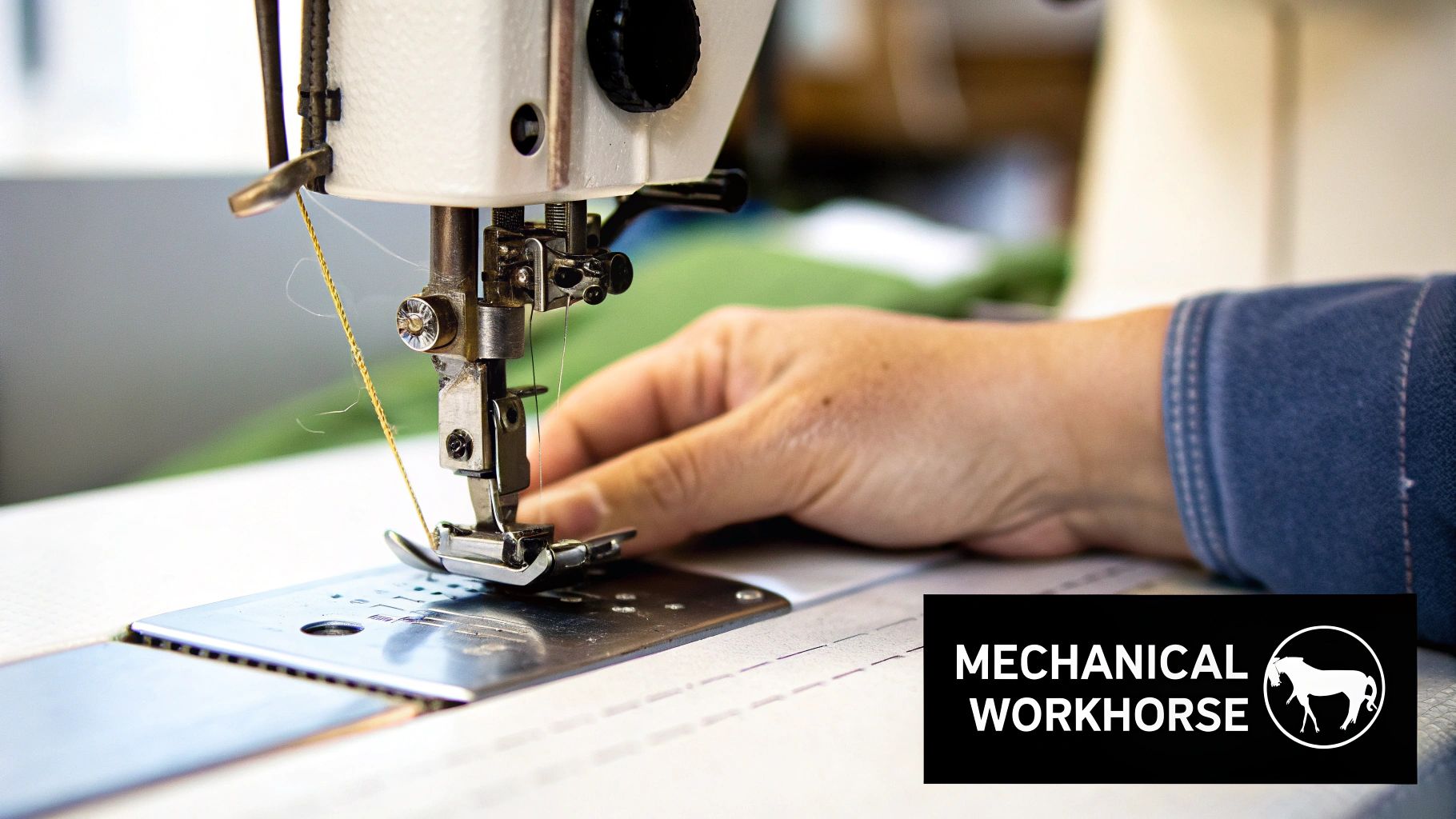
Even as sewing technology leaps forward, the mechanical sewing machine holds its ground as a tried-and-true workhorse. Its charm is in its simplicity and the very direct, hands-on connection you get with your project. You won't find any digital screens or complicated menus here; every single adjustment is a physical turn of a dial or flip of a lever.
There's something incredibly satisfying about turning a solid knob to select your stitch and hearing that definite click. That tactile feedback is central to the mechanical experience. When you adjust the tension or change the stitch length, you are physically moving the machine's internal parts, which gives you a much deeper feel for how a perfect stitch comes together. It’s this direct cause-and-effect that really helps you learn how different fabrics and threads behave.
This hands-on control is more than just a feeling—it’s a powerful way to achieve precision. The foot pedal gives you a raw, unfiltered connection to the motor's power. You can feel the needle drive through the fabric, allowing you to intuitively slow down for tricky corners or power over thick seams. You are completely in command, and the machine responds instantly to you.
If there's one thing mechanical machines are famous for, it's their sheer durability. Many of these machines, particularly the heavy-duty models, are built with all-metal internal frames and components. This isn't just for looks; it translates directly into raw power and a machine that can last for decades.
A mechanical machine with a beefy motor and solid frame can chew through tough materials without a second thought. Whether you're hemming a pair of stiff denim jeans, piecing together multiple layers of canvas for a bag, or working on an upholstery project, it just powers through. This is exactly why many seasoned sewists keep a mechanical machine around specifically for these demanding jobs.
The real beauty of a mechanical sewing machine is its simplicity. Fewer electronic parts mean fewer things that can go wrong, giving them a rock-solid reputation for reliability. Plus, they're often much easier to maintain over their long life.
This straightforward engineering also means that routine upkeep, like cleaning out lint and oiling the moving parts, is something you can usually handle yourself. For many owners, this means lower maintenance costs and less time waiting for repairs, so you can keep your projects moving.
A mechanical machine might not have hundreds of fancy decorative stitches, but that's actually one of its strengths. It gives you a curated set of the essential stitches you'll need for almost any project you can think of, from making clothes to mending heavy-duty gear.
This focused approach strips away the distractions and lets you master the fundamental techniques of good sewing. The handful of stitches on a mechanical machine are all you need to create strong, durable seams and a clean, professional finish.
Core Stitches and Their Applications:
In the end, choosing a mechanical machine is about valuing simplicity, durability, and that direct, hands-on control. It’s the perfect partner for a sewist who loves the process and wants a dependable machine that can tackle any essential sewing task with pure power. The computerized sewing machines vs mechanical debate often begins right here, with the undeniable appeal of this timeless workhorse.
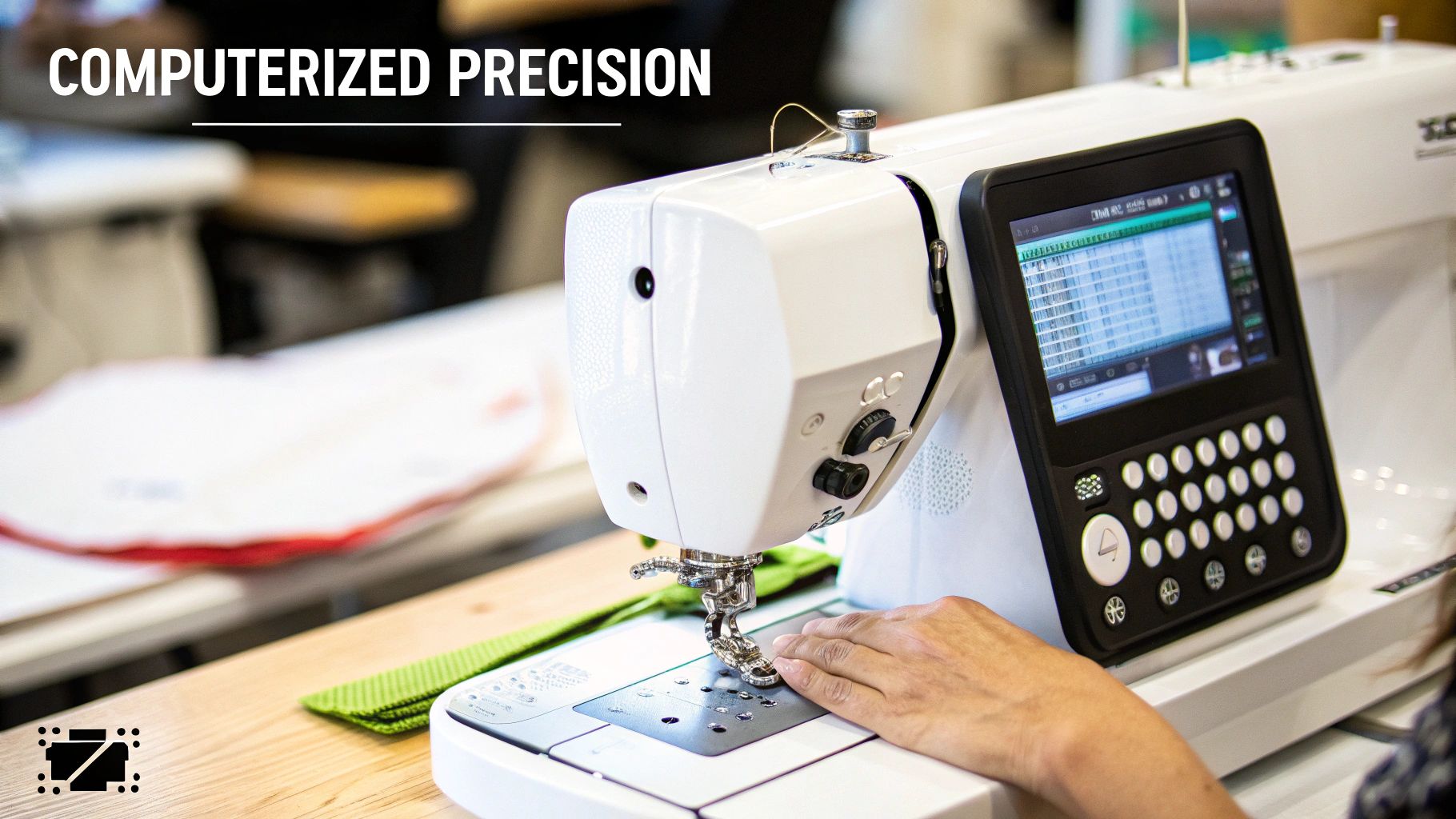
While mechanical machines offer that direct, hands-on connection to your craft, computerized sewing machines are a whole different world of precision and creative freedom. Instead of physical dials and levers, these machines are run by an internal microprocessor—basically, a tiny computer. This "brain" talks to advanced motors to give you flawless, consistent results, stitch after stitch.
This technology really changes how you approach sewing. You're no longer manually tweaking every single setting. Instead, you'll be using an LCD screen and push-button controls to access a huge library of stitches and automated features. The machine takes care of the technical perfection, so you can pour all your energy into the design.
The first thing you’ll notice is the suite of automated features. And trust me, these aren't just minor conveniences; they are powerful tools that cut down on frustration, save a ton of time, and build confidence, especially if you're just starting out.
Take the automatic thread cutter. With a simple press of a button, the machine snips both the top and bobbin threads, leaving you with clean ends. This feature alone can save you hours on a big project like a quilt, where you're sewing hundreds of short seams.
Another game-changer is precise speed control. Using a simple slider, you can cap the maximum sewing speed. This is incredibly helpful for beginners still getting the feel of a foot pedal or for experts navigating tricky curves on delicate fabrics. The machine keeps a perfectly steady pace, preventing those accidental speed bursts that can ruin a seam.
A computerized sewing machine isn't about replacing your skill; it's about enhancing it. By automating repetitive tasks, it frees up your mental energy to focus on artistry, pattern placement, and achieving a professional finish.
This focus on streamlining the process is a huge factor in the computerized sewing machines vs mechanical debate. The goal is to remove any friction between your idea and the finished piece.
This is where computerized machines really pull ahead of their mechanical cousins. A mechanical model will give you a solid set of essential stitches, but a computerized machine can come loaded with hundreds of built-in stitch options.
These stitches are all neatly organized and displayed on the screen, letting you scroll through a massive menu of:
This incredible variety empowers you to add custom details that elevate your projects from simply handmade to professionally crafted. You can embellish a dress hem with a beautiful vine pattern or add a child's name to a blanket, all with push-button ease. The market has definitely noticed this demand for more features; industry data shows that computerized machines captured a dominant revenue share, with one report putting it as high as 44.7%. You can explore more market data about this sewing technology shift and its projected growth.
Beyond the stitch library, computerized machines bring advanced functions to the table that make complex techniques feel simple. The one-step automatic buttonhole is the perfect example. You just pop your button into a special foot, and the machine's sensor measures it and stitches a perfectly sized, balanced buttonhole in one go.
On top of that, features like programmable stitch sequences let you combine and save your own custom decorative patterns, giving you unlimited design potential. Add in the needle up/down function for perfect pivots and automatic tension adjustment, and you have a machine that consistently delivers professional-grade results, helping you push your creative boundaries.
So, what really separates a computerized sewing machine from a mechanical one? Beyond the obvious screen vs. dials, the difference is in the experience—the tactile feel of making an adjustment versus the precision of a digital command. It’s about how you, the sewer, interact with the machine to bring your ideas to life.
Let's break down the core functions, one by one, to see how these two philosophies play out in the sewing room. This will help you get a gut feeling for which machine’s workflow is a better match for your creative style.
The first and most fundamental difference is how you choose and tweak your stitches. With a mechanical machine, it’s a very physical, hands-on process.
You'll turn a solid dial, often with a satisfying click, to line up an indicator with a picture of the stitch you want. To change the stitch length or width, you turn other dedicated knobs. There’s a direct, tangible connection here; you can almost feel the machine's gears shifting as you make adjustments. This is fantastic for building a real, intuitive sense of how a stitch is formed.
A computerized machine offers a completely different world. You’re working with a digital LCD screen that can display a library of hundreds of stitches. You just tap a button to select one, and the machine instantly sets the ideal length and width for that stitch. If you do want to customize it, you use arrow keys to fine-tune the settings with surgical precision, often down to a fraction of a millimeter.
That kind of digital accuracy is a game-changer for things like decorative topstitching or embroidery, where even the slightest inconsistency would stick out like a sore thumb.
This is where computerized models really pull ahead. They are packed with features designed to handle the tedious, frustrating parts of sewing, freeing you up to focus on the fun part—the actual creating.
Take threading the needle. On a mechanical model, it’s all on you. You need a steady hand, good eyes, and decent light. But many computerized machines come with a built-in automatic needle threader. You just press a lever, and a tiny hook cleverly swoops through the needle's eye, grabs the thread, and pulls it right through for you.
The same goes for thread tension. With a mechanical machine, you have to dial it in yourself, stitching on scrap fabric over and over until you get a perfectly balanced stitch. A computerized machine often features automatic tension control. An internal sensor reads the fabric and stitch you've chosen and sets the tension perfectly on its own, eliminating all that guesswork.
The philosophy of a computerized machine isn't to replace your skill, but to clear the technical hurdles out of your way. It handles the fussy details with flawless execution so you can stay in your creative flow.
When people talk about machines that last forever, they're usually thinking of the old mechanical workhorses. Their reputation is well-earned, thanks to simpler engineering and heavy-duty, all-metal parts.
The choice isn't really between a tough machine and a fragile one. It’s a trade-off: the rugged, simple mechanics versus the powerful functionality that comes with sophisticated electronics.
To see these differences at a glance, it helps to put them side-by-side. This table breaks down the user experience for key sewing tasks.
| Comparison Point | Mechanical Machine Experience | Computerized Machine Experience | Best For |
|---|---|---|---|
| Stitch Selection | Turn a physical dial to choose from 10-30 built-in stitches. | Use buttons and an LCD screen to browse 100s or 1000s of stitches. | Computerized: Sewers who want a massive variety of decorative and utility stitches. |
| Needle Threading | Entirely manual; requires a steady hand and good eyesight. | One-touch automatic needle threader does the work for you. | Computerized: Anyone who finds threading frustrating or has vision challenges. |
| Buttonholes | Manual 4-step or basic 1-step process. Requires user control for consistency. | Fully automatic 1-step buttonhole. Creates identical buttonholes every time. | Computerized: Garment makers who need perfect, repeatable buttonholes. |
| Tension Control | Manual dial adjustment. Requires testing on scrap fabric to get right. | Automatic tension adjusts based on fabric and stitch selection. | Computerized: Beginners and quilters who want to avoid tension headaches. |
| Speed Control | Controlled solely by the pressure on the foot pedal. | A physical slider sets a maximum speed, ensuring a consistent pace. | Computerized: Free-motion quilters and beginners learning foot pedal control. |
| Needle Position | Stop sewing and manually turn the handwheel to position the needle. | Needle up/down button lets you stop with the needle in or out of the fabric. | Computerized: Quilters and appliquérs who need to pivot fabric precisely. |
| Troubleshooting | Simpler mechanics can sometimes be diagnosed and fixed by the user. | Error codes on the screen tell you exactly what's wrong (e.g., "lower bobbin thread"). | Computerized: Users who appreciate clear, direct feedback from their machine. |
Ultimately, this comparison highlights the core distinction: mechanical machines offer direct, manual control, while computerized machines provide automated precision and creative assistance.
So how does all this translate to actual projects? Let's look at two common sewing tasks.
Scenario 1: Hemming Heavy-Duty Canvas Curtains
A mechanical machine is in its element here. Its powerful motor and direct-drive system deliver the raw torque needed to punch through thick canvas without skipping a beat. You can literally feel the needle penetrating the fabric and use the foot pedal to power over bulky seams with confidence.
Scenario 2: Intricate Free-Motion Quilting
The computerized machine is the clear winner for this kind of detailed work. The needle up/down function is a lifesaver, letting you stop instantly with the needle buried in the quilt for sharp, perfect pivots. You can set a consistent pace with the speed control slider, allowing you to focus completely on guiding the quilt in smooth, artistic curves.
By looking at specific features and real-world projects, the right choice in the computerized sewing machines vs mechanical debate becomes less about which is "better" and more about which is the right tool for the work you're excited to do.
Picking between a computerized and a mechanical sewing machine isn't about which one is "better" in a vacuum. It's about finding the right tool for the job you want to do. The perfect machine for a dedicated quilter might be frustrating for a complete beginner, and a simple starter machine could hold back a budding dressmaker.
Instead of just comparing feature lists, let's look at how these machines actually perform for different types of sewers. When you see your own goals reflected in these scenarios, the right choice becomes much clearer.
This simple flowchart breaks down the core decision: are you after straightforward, manual control, or do you want a machine that offers more creative possibilities and automation?
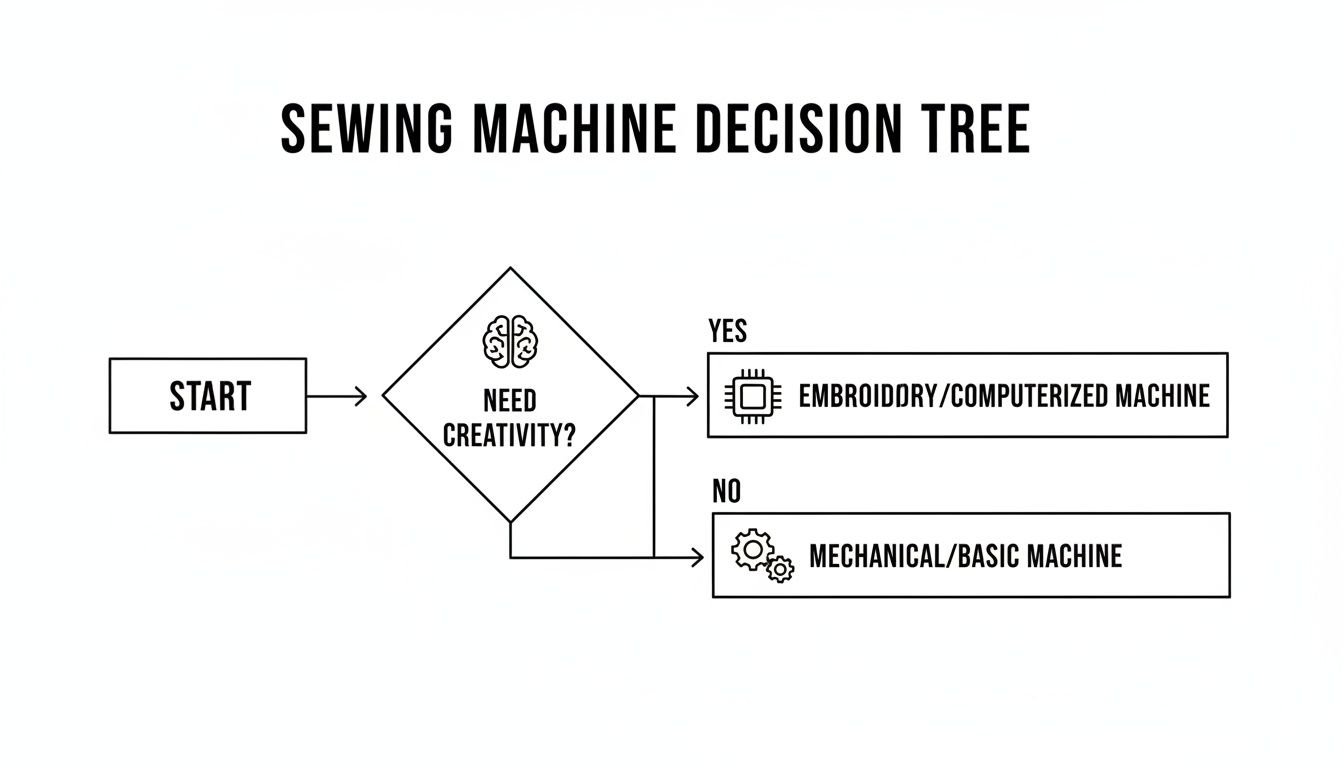
As you can see, sewers who want to push their creative boundaries with automated help are naturally guided toward computerized models. Those who just want to master the core functions of sewing will feel right at home with a mechanical machine.
When you're just starting out, the main thing is to build solid skills without getting bogged down by a complicated machine. The question is, what builds confidence faster: the hands-on simplicity of a mechanical model or the helpful features of a computerized one?
A mechanical machine is an incredible teacher. You turn physical dials and learn why you're making each adjustment. This helps you build a real, intuitive feel for how tension, stitch length, and fabric all work together—a fundamental skill that will stay with you forever. They're also built like tanks, which can be pretty forgiving when you're making those inevitable first mistakes.
On the other hand, a computerized machine can make your first few projects feel like a huge success, and that's incredibly motivating. Features like an automatic needle threader or a one-step buttonhole function take away some of the most common frustrations. This lets you focus on the basics, like steering the fabric and sewing a straight line, which often leads to quicker, more encouraging results.
Our Recommendation: For most beginners, a quality entry-level computerized machine is the smarter long-term investment. While a mechanical machine teaches you the ropes in a very raw way, the confidence you gain from early wins on an automated machine is what really keeps you coming back to the sewing table.
Quilters have a unique set of demands. They wrangle bulky projects, need absolute precision for piecing, and often get into detailed free-motion stitching. Their machine needs to offer control, consistency, and plenty of room to work.
A heavy-duty mechanical machine certainly has the muscle to punch through layers of fabric and batting. There's no denying its raw power.
But a computerized machine is what most modern quilters swear by, and for good reason. A few key features make it the clear winner here:
Our Recommendation: For any serious quilter, a computerized sewing machine is the way to go. The precision, control, and thoughtful features are tailor-made for the specific challenges of quilting, from the first block to the final binding.
If you're sewing your own wardrobe, versatility is the name of the game. You need a machine that can handle delicate silk one day and tough denim the next, with a whole library of stitches for construction, finishing, and maybe a little flair.
A powerful mechanical machine is fantastic for heavy fabrics and plowing through straight, strong seams on things like jackets or jeans. Its reliability is a huge plus.
In the end, though, a computerized machine offers the deep versatility that high-quality garment sewing demands. The massive library of built-in stitches is a huge advantage, especially with all the stretch stitches needed for today's knit fabrics. The real star of the show, however, is the one-step automatic buttonhole. It creates perfectly matched, professional-looking buttonholes every single time—a small detail that makes a handmade garment look truly polished.
Our Recommendation: Anyone dreaming of sewing their own clothes will get the most out of a computerized machine. The sheer variety of stitches and the automated precision tools are critical for getting a professional finish on different fabrics and styles. This is a key differentiator in the computerized sewing machines vs mechanical debate that makes it the best choice for clothing.
When you're trying to decide between a computerized and a mechanical sewing machine, the sticker price is only part of the story. The real value of a machine shows up over years of use—factoring in maintenance costs, what it allows you to create, and how well it holds up. Your investment should match your sewing ambitions, not just what's in your wallet today.
Mechanical machines usually have a much lower upfront cost. This makes them a fantastic starting point for beginners or anyone sewing on a tight budget. Their appeal is simple: they're built to last. With fewer electronics, there are fewer complex parts that can break, which often means smaller repair bills down the road.
A well-built mechanical machine, often with an all-metal frame, can give you decades of reliable service for all your core sewing tasks. If you're mainly focused on mending, straightforward garment making, or plowing through heavy-duty fabrics, a mechanical model is a high-value workhorse. The initial investment is small for a machine you can count on for years.
Computerized machines, on the other hand, ask for a higher initial investment but pay you back in efficiency and capability. Features that might seem like small luxuries—like an automatic thread cutter or a perfect one-step buttonhole—add up to a huge amount of saved time. That precision also means fewer costly mistakes, saving both your fabric and your sanity.
The idea of "value" really changes here. It's not just about how long the machine lasts, but about what it empowers you to do. The higher price of a computerized machine is an investment in your time, your results, and your ability to tackle projects that would be a real headache on a simpler machine.
There's a reason you see more and more advanced features on the market. The global sewing machine industry is expected to grow from roughly USD 4.65 billion in 2025 to about USD 6.20 billion by 2030, and automated, advanced machines are leading that charge. You can read more about this market growth to see how what people want is shaping the technology.
This trend really highlights the long-term value of computerized models. A great mechanical machine holds its value by being tough and dependable. A computerized machine pays for itself by helping you create better work, faster. Ultimately, the best choice depends on what you value more: the rugged, no-fuss simplicity of a mechanical workhorse or the sophisticated, time-saving power of a computerized creative partner.
Deciding between a computerized and a mechanical sewing machine really boils down to your own creative style. Once you've weighed the features, durability, and cost, it's time to get your hands on the real thing. Reading reviews and watching videos helps, but nothing beats sitting down at a machine and feeling how it works for you.
This is where a dedicated local sewing shop truly shines. Buying from a big-box store might feel easy, but their support ends the second you walk out the door. A specialty dealer, on the other hand, is invested in your entire sewing journey, offering so much more than just the initial purchase. Their staff can help translate your sewing dreams into a practical machine recommendation, so you get exactly what you need without paying for bells and whistles you'll never touch.
Where you buy your machine is almost as important as which one you choose. A trusted local shop provides a level of support that online stores and big retailers just can't replicate.
The right machine isn't just a tool; it's a creative partner for the long haul. When you build a relationship with a local dealer, you're also building a support system that will be there for you from your first stitch to your most complex project.
Top-tier brands like BERNINA are known for incredible engineering in both their mechanical and computerized machines, but finding your perfect match often takes a little expert insight. I always recommend visiting a local shop, asking tons of questions, and seeing which machine feels like it was made for you. That support makes all the difference.
Ready to find the machine that will bring your creative vision to life? Visit High Country Quilts in Colorado Springs to explore a wide range of BERNINA models, get expert advice, and join a vibrant community of fellow creators. Start your sewing journey with us today.
At High Country Quilts we care deeply about community. With our experiences in retail, we know that a store is not only a place to shop but also a place for the community to gather and share. During this busy...

Hi! We’re Adam and Renee Wheaton, the new owners of High Country Quilts! For more than 40 years, we’ve owned and operated vacuum and sewing businesses. Following in Renee’s father’s footsteps after he retired from All Discount Vacuum and Sewing in Colorado...


Leave a comment