

We Love Our Quilting Community
At High Country Quilts we care deeply about community. With our experiences in retail, we know that a store is not only a place to shop but also a place for the community to gather and share. During this busy...


You’re probably here with one of two thoughts.
Either you’ve outgrown a basic machine and your quilt blocks are starting to tell on it, or you’re ready to buy your first real quilting machine and don’t want to make an expensive mistake.
That’s a smart place to pause.
When quilters ask me about the Best sewing machine for quilting 2026, I don’t start with a list of model names. I start with a project. A table runner will tell you almost everything you need to know about a machine. Can it feed layered fabric smoothly? Can it keep points crisp? Can it handle quilting without tugging and bunching? Can it help you enjoy the process instead of fighting it?
A snowflake table runner is perfect for that test. It has contrast, intersecting seams, repeated units, and enough quilting space to reveal whether your machine feels steady in your hands. If your machine works well on this project, you’ll feel it immediately.
A winter table runner has a special kind of charm. You pull it out in December, place it across the table, and suddenly the whole room looks finished. Even better, it’s small enough for a beginner to complete, but detailed enough to teach the habits that matter in quilting.

This is also where machine quality starts to matter in a very real way. In the 2026 quilting market, mid-range machines priced between $400 and $1,000 have become a key category because they improve on budget models with stronger motors, smoother stitching, larger work areas, and quilting-focused versatility. Those machines make up about 30 to 40% of the quilting machine market, and 65% of quilters prioritize durability and motor strength over stitch count when choosing in that range, according to this quilting machine market overview.
That lines up with what I see at the cutting table. Beginners often think more stitches must mean a better machine. Quilters usually learn the opposite. A machine that holds a steady seam, handles layers calmly, and gives you room to move fabric is far more useful than a machine loaded with decorative options you’ll rarely touch.
A snowflake runner asks your machine to do several jobs well:
Practical rule: If a machine makes piecing feel predictable, you’ll sew more confidently and unpick less often.
That’s why I’d rather teach with a real project than hand you a sterile ranking list. You’ll see what features matter because your hands will notice them.
For this kind of project, the sweet spot is usually a machine that feels stable on the table, has enough harp space to support a small quilt, and doesn’t hesitate when it hits thicker seam joins. If you’re moving up from occasional mending into patchwork and free-motion quilting, that mid-range step is often the point where sewing starts feeling smoother and more enjoyable.
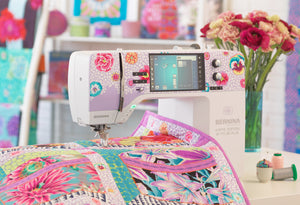
And if you already own a BERNINA, this is a beautiful way to learn what your machine can really do.
A snowflake runner is small enough to finish without feeling overwhelmed, but detailed enough to show you whether your machine and materials are working with you or against you. That is why this project is such a useful test for anyone shopping for the best sewing machine for quilting in 2026. Good supplies make the piecing clearer, the quilting calmer, and the whole experience more predictable.
Start with contrast. If the snowflake fabric and the background sit too close in value, the design fades and all that careful piecing gets lost. I tell beginners to lay the two fabrics on a table, step back a few feet, and squint. If you can still see the snowflake shape forming, you are on the right track.
Blue and white always feel wintry, but they are not your only option. Charcoal with silver looks crisp. Evergreen with cream feels traditional. Deep plum with icy gray gives the project a softer, evening-snow look. The color itself matters less than the light-dark relationship.
Print scale matters too. Large, busy prints can swallow the points of the snowflake the way loud wallpaper hides the shape of a window. Small prints, tone-on-tones, and subtle blenders let the piecing do the work.
A simple fabric pull usually includes:
If you are still learning how to combine scale and value, a coordinated fabric bundle from High Country Quilts can remove some guesswork and let you focus on sewing accuracy.
Thread and batting shape the feel of the project more than many new quilters expect. For piecing, a dependable cotton or cotton-blend thread in a neutral shade usually behaves well and keeps the focus on accurate seams. For quilting, use a matching thread if you want texture without drawing much attention to the stitching, or choose a slightly contrasting thread if you want the quilted snowflake paths to show.
Batting is worth a pause here because beginners often buy loft that is better suited to a bed quilt. A table runner usually looks and handles better with low-loft batting. It lies flat, feeds through the machine more easily, and does not fight you while quilting around tight shapes.
Your tools matter, but only a few are doing the heavy lifting:
Now for a BERNINA tip I share in class all the time. Use a patchwork foot that gives you a clear view of the fabric edge and the needle path. On snowflake blocks, a seam allowance that drifts even a little can soften the points and shift the whole design. The BERNINA Patchwork Foot #97D helps many quilters keep that quarter inch consistent, and on compatible machines the dual feed support can help layers stay aligned instead of creeping apart.
Your seam allowance should feel repeatable, not mysterious.
Before you cut anything, do four quick checks. Press the fabric so folds do not distort your measurements. Test your needle and thread on scraps from the same fabrics. Wind fresh bobbins before chain piecing starts. Set out a tray or small box for the cut units, because tiny pieces have a habit of wandering off just when you need the last one.
This kind of preparation may seem slow at first. In practice, it works like clearing the snow off a path before you walk it. The project goes more smoothly, and you can pay attention to what your machine is showing you about control, feeding, and stitch quality.
Cutting decides whether your snowflake points look crisp or a little sleepy. On a project like this table runner, every small inaccuracy travels forward into piecing, pressing, and final assembly. That is part of what makes the best sewing machine for quilting 2026 worth considering through a real project, not just a feature list. A precise machine can stitch beautifully, but it still needs accurately cut pieces to show what it can do.

Start by squaring up the fabric. If the first edge is off, every strip cut from it is off too. I tell new quilters to treat that first trim like setting the foundation for a cabin. If the base slants, the walls will not straighten themselves later.
Line up the ruler with the fabric grain and your mat markings, not only with the raw edge. Raw edges can stretch, bow, or wobble after washing and pressing. The ruler gives you the truer reference.
Keep your ruler hand flat, with pressure spread across the ruler instead of pressing in one fingertip spot. Lock your wrist and make one clean cut when you can. Several tiny corrective cuts often leave little bumps along the edge, and those bumps show up fast when you try to match units point to point.
One more classroom tip. Stand so your shoulder is roughly behind the cutter path. That body position gives you straighter cuts and better control than reaching across the mat from an awkward angle.
The chart below gives you a simple block-based plan you can adapt to your preferred runner length.
| Piece | Fabric | Cut Size | Quantity per Block | Total Quantity |
|---|---|---|---|---|
| Background squares | Background | 2 1/2" x 2 1/2" | 8 | 24 |
| Snowflake squares for HSTs | Light accent | 2 7/8" x 2 7/8" | 4 | 12 |
| Background squares for HSTs | Background | 2 7/8" x 2 7/8" | 4 | 12 |
| Center square | Light accent | 2 1/2" x 2 1/2" | 1 | 3 |
| Side rectangles | Background | 2 1/2" x 4 1/2" | 2 | 6 |
| Top and bottom rectangles | Background | 2 1/2" x 6 1/2" | 2 | 6 |
| Border strips | Border fabric | Cut to fit assembled top | as needed | as needed |
| Binding strips | Binding fabric | 2 1/4" wide strips | as needed | as needed |
| Backing | Backing fabric | Cut larger than quilt top | 1 | 1 |
| Batting | Batting | Cut larger than quilt top | 1 | 1 |
This layout assumes repeated snowflake blocks in a runner arrangement. If you decide your table needs a longer centerpiece, add another block first, then measure for borders, backing, and batting after the quilt top is assembled. That order prevents waste and gives you a better fit.
Neat cutting and neat sorting belong together. Once pieces are cut, separate them right away into labeled stacks, clips, or shallow trays. Keep the HST squares paired by fabric. Keep center squares in their own pile. Leave border strips aside until the center section is complete.
That small habit saves surprising amounts of time.
It also prevents a beginner mistake I see often at High Country Quilts. The pieces are cut correctly, but two nearly identical units get swapped, and the block loses its symmetry. Snowflakes are less forgiving than simple patchwork because the eye notices crooked angles quickly.
For a closer look at rotary cutting technique, this visual walkthrough helps many new quilters settle their hands and ruler placement:
A dull blade drags on the fabric instead of slicing through it cleanly. You may notice fuzzy threads, slight shifting, or the need to press harder with each cut. Replace the blade as soon as cutting starts to feel rough. Accuracy drops fast once the blade loses its edge.
Good cutting habits also make your machine look better later. When your squares are square and your HST pieces start at the right size, your BERNINA can do what it does best. Feed layers evenly, hold a steady seam, and help those snowflake points meet where they should.
Measure from the ruler lines, not from the fabric edge if the edge looks wavy. Fabric can lie. The ruler usually doesn’t.
Here, the table runner becomes recognizable. You’ll build the snowflake from small units, arrange them on the table, then stitch them into rows and finally into a complete block. Go slowly here. Precision during assembly is what gives the finished runner that crisp winter look.

Half-square triangles, often shortened to HSTs, form the angled arms of many snowflake designs. Pair one background square with one light accent square, right sides together. Draw a diagonal line on the back of the lighter square. Sew on both sides of that line with a scant quarter-inch seam, then cut on the line and press the units open.
Trim each HST carefully to the exact unfinished size your block needs. This trimming step matters. A slightly oversized HST is easier to correct than one cut too small.
If you’re new to the phrase scant quarter-inch seam, think of it as a seam just a hair narrower than a full quarter inch. Quilters use it because thread and pressing take up a little space. That tiny adjustment helps units finish at the correct size.
Once your HSTs are trimmed, place them on a flat surface with the center square and surrounding background pieces. Don’t trust your memory. A dry layout catches orientation mistakes before they become seam-ripper work.
A simple block layout check:
If the snowflake looks lopsided on the table, it will still look lopsided after stitching. Pause here and adjust.
At this stage, seam intersections begin to stack. That’s when fabric layers can shift if the machine feeds unevenly. In 2026 lab testing, the Singer Quantum Stylist 9960 was noted for a dual-feed system that delivered 99% even quilting on uneven piecing, a useful trait for snowflake blocks where many seams intersect and accurate points matter, according to Good Housekeeping’s sewing machine review testing.
That’s the practical difference between “nice feature” and “helpful feature.” When your machine feeds top and bottom layers more evenly, your points stay sharper and your rows need less coaxing.
If your rows don’t line up, check the unit size first, then the seam allowance, then the pressing. The machine usually tells the truth through the fabric.
Sew the units in each row from left to right, keeping the pieces in order. Some quilters like chain piecing here because it keeps the rhythm steady. Others prefer to sew one row at a time when learning. Either approach works if you stay organized.
Press row seams consistently. You can press seams open if that helps reduce bulk, or press to the side if you want seams to nest. For a beginner, pressing to the side is often easier to manage because nested seams can help intersections lock together.
When the rows are ready, pin at key intersections before joining them. Don’t pin every inch. Pin where accuracy matters most. Sew slowly across thicker seam joins and let the feed system do the work rather than pushing the fabric through.
A good beginner block does not need perfection. It needs enough accuracy that the snowflake reads clearly and the runner lies flat. If one point is slightly off but the overall block is square, keep going. You’re building skill with every repeated unit.
Make one block carefully, then the next two will come easier.
Your quilt top is built. Now it becomes a table runner you can use, wash, and bring out every winter. For many beginners, this part feels like the point where everything could shift out of place. With a careful setup, it is much more manageable than it looks.

Start on a surface large enough to let the runner lie fully open. Place the backing wrong side up, add the batting, then place the quilt top right side up. Smooth each layer on its own before securing all three together. Flat is the goal. If the backing is stretched tight, it can spring back later and create puckers.
A table runner is small enough to teach good habits without overwhelming you. That is part of why projects like this are so useful when you are comparing the best sewing machine for quilting 2026. You get to feel how a machine handles real quilting tasks, not just test stitches on a scrap.
A few checks make a big difference:
Use safety pins or a temporary basting method you already trust. The method matters less than the result. The layers need to stay put while the needle travels across them.
For a first snowflake runner, straight-line quilting is often the clearest path to a good finish. A walking foot helps the layers move together, and simple lines can look crisp against angular snowflake piecing. Stitch along the borders, echo the shape of each block, or mark a light grid if you want more structure.
Free-motion quilting is also possible here, especially if you want the runner to feel softer and more decorative. Curved lines, small loops, and gentle outlines around the snowflakes suit the design well. Keep the quilting open at first. Dense quilting adds control challenges and can flatten the clean geometry you worked hard to piece.
The machine matters more at this stage because you are guiding a layered project, not just joining two flat pieces. Extra throat space gives your hands more room to support the runner as it rolls and shifts. Steady speed control helps, too. On a project like this, a well-built quilting machine feels less like something you fight and more like a partner that holds a straight course while you steer.
If you notice drag, pause and reposition the bulk of the runner on the table. Do not let the weight of the quilt pull against the needle. A BERNINA often shines here because the stitching stays consistent when the project changes from flat piecing to loftier, layered quilting.
Quilting can pull the runner inward a bit, even with careful handling. Trim only after the quilting is finished.
Lay the runner flat with a long ruler and square one end first. Then trim the opposite end and both sides so they stay parallel. This step works like squaring a picture frame. If one side is off, the binding will advertise it.
Take your time here. Clean trimming is one of the quiet details that makes a handmade runner look polished.
Cut and join your binding strips, then press the strip in half lengthwise. Sew it to the front of the runner with an even seam allowance and miter the corners as you go. Fold it to the back and finish it by machine or by hand.
Machine-finished binding is a smart choice for a first project because it is durable and straightforward. Hand finishing gives a softer look if you enjoy slower stitching and want that traditional finish on the back.
If a corner feels bulky, trim a little seam allowance before the final fold. If the binding ripples, check whether it was stretched as you attached it. Binding should sit against the edge comfortably, like a frame around the quilt, not pull the runner out of shape.
A good quilting machine shows its value in the small moments. You start a line of quilting near a bulky seam, pivot around a point, then stitch a tight curve inside a snowflake arm. If the machine stays calm and predictable, you can focus on the design instead of correcting the machine. That is the reason shoppers comparing the best sewing machine for quilting in 2026 should look past feature lists and watch what happens in an actual project like this runner.
BERNINA machines tend to reward careful setup with very steady results. For a beginner, that matters because quilting adds more variables than piecing alone. You are guiding layers, not just fabric. The machine needs to feed cleanly, keep stitches consistent, and give you enough control that the project still feels manageable.
The BERNINA Stitch Regulator helps when your hand speed changes during free-motion quilting. Beginners often make longer stitches on straight stretches and tiny stitches in curves without meaning to. The regulator smooths that out, so echoed snowflake lines look more even and the whole runner has a more finished look.
The Free Hand System is another feature quilters tend to appreciate quickly. Using the knee lift to raise the presser foot keeps both hands on the runner, which makes repositioning much more controlled. On a smaller project like a table runner, that extra control feels a bit like having a third hand at the exact moment you need one.
Motor response matters too.
A snowflake runner may look simple on the table, but the machine feels every seam intersection, batting layer, and change in direction. A machine with steady power handles those transitions more gracefully, which helps your stitches stay neat when the project stops being flat and starts acting like a quilt.
A machine review often focuses on what is easy to notice first: decorative stitches, screen layout, included feet, or how the machine sounds during a short demo. Quilters usually care about something different after six months. They want to know whether the machine still feels accurate, whether service is available, and whether they can keep growing into it instead of outgrowing it.
That is where dealer support enters the picture in a practical way. Lessons, maintenance guidance, and help choosing the right foot or setting can save a beginner from a lot of avoidable frustration. At High Country Quilts, that support is part of why many BERNINA owners become more confident faster. They are not guessing through every problem alone.
Needle choice is one of the easiest fixes for ugly stitches, skipped stitches, and thread breakage. If you are unsure how needle numbers relate to fabric and thread, this guide to sewing machine needle sizes explains it in clear language.
A few habits make a noticeable difference on projects like this:
Here is the insider BERNINA tip I give students all the time. Save a small set of favorite settings once you find them. Needle type, thread, foot, tension adjustment, and stitch choice for a cotton table runner can become your own little recipe card inside the machine, depending on the model. The next winter project starts faster, and you spend less time trying to remember what worked.
A quality machine helps most when you learn its habits well. Then the machine stops feeling like equipment and starts feeling like a reliable quilting partner.
Your snowflake table runner is more than a holiday project. It’s proof that you can piece accurately, manage a quilt sandwich, and finish a useful quilted item with real polish. That’s a big step.
Set it on your table. Notice the points, the texture, and the way the quilting changes the surface. Then keep going. Make a second runner in a different palette. Turn the block into placemats. Try denser quilting. Or use this same project as your test piece when comparing machines for your next upgrade.
If you’re local, bring your runner into the shop and let another quilter admire it. If you’re learning from home, keep a photo of this finish. It’s the kind of project that reminds you you’re not just collecting fabric anymore. You’re building skill.
If you’re ready for your next project or you’re still deciding which machine fits your quilting goals, visit High Country Quilts to explore quilting supplies, compare machine options, or find your next class.
At High Country Quilts we care deeply about community. With our experiences in retail, we know that a store is not only a place to shop but also a place for the community to gather and share. During this busy...

Hi! We’re Adam and Renee Wheaton, the new owners of High Country Quilts! For more than 40 years, we’ve owned and operated vacuum and sewing businesses. Following in Renee’s father’s footsteps after he retired from All Discount Vacuum and Sewing in Colorado...


Leave a comment