

We Love Our Quilting Community
At High Country Quilts we care deeply about community. With our experiences in retail, we know that a store is not only a place to shop but also a place for the community to gather and share. During this busy...


Welcome to the world of sewing, right from your own home! Finding the best online sewing class isn't about finding a one-size-fits-all solution. It's about connecting with the right instructor, the right format, and a supportive community that clicks with what you want to achieve. This guide is your roadmap to navigating all the options out there, helping you invest your time and money wisely.
Choosing an online sewing class feels a lot like picking out fabric for a new project. You need something that doesn’t just catch your eye but truly fits your vision and skill level. The "best" class for you is the one that aligns perfectly with your personal creative journey.
The great news is, you have more choices than ever before. The sewing machine market has exploded, with online sales now making up 42% of the market. This boom is driven by a wave of new machine owners turning to online tutorials and virtual lessons to fuel their passion, creating a huge audience for great instruction. You can read more about this trend on Mordor Intelligence and see how it's shaping the creative learning space.
Before you even start looking at course catalogs, take a moment to think about what you actually want to accomplish. Are you a complete beginner who has never even threaded a needle? Or are you an experienced sewer looking to finally master tailoring?
Defining your goals is the most important first step. Your ideal class will look completely different depending on your answer. For example:
Finding the right starting point is everything. A class that meets you exactly where you are will build your confidence and keep you motivated, turning potential frustration into a rewarding experience.
The next piece of the puzzle is figuring out how you like to learn. Online education isn't a single experience; the structure of a class can dramatically change how well you absorb the material. Some people thrive with self-paced video lessons they can pause and re-watch a dozen times, while others need the accountability and direct feedback of a live, interactive session with an instructor.
So, what's out there? Here’s a quick rundown of the most common formats to help you identify your preferred learning style and find the right type of online sewing class for your goals.
| Class Format | Best For | Typical Cost Structure |
|---|---|---|
| Pre-Recorded Video Courses | Independent learners who want total flexibility to learn on their own schedule. | One-time purchase per course or bundle. |
| Live Online Workshops | Those who need real-time interaction, direct instructor feedback, and Q&A sessions. | Per-workshop or event fee. |
| Subscription Platforms | Sewers who want access to a massive library of classes on various topics for one monthly fee. | Monthly or annual subscription. |
| Community-Based Programs | Social learners who thrive on peer support, forums, and group feedback alongside lessons. | Often a subscription or one-time program fee. |
Think about which of these styles resonates most with you. Do you want to binge-watch a bunch of videos on a rainy weekend, or would you prefer a scheduled weekly class to keep you on track?
Each format has its own rhythm and benefits. Your task is to match your learning preferences and schedule with the right structure. Getting this right from the start sets you up for a successful and enjoyable sewing adventure.
Diving into the world of online sewing classes can feel like sorting through a massive bin of fabric scraps. It all looks promising, but how do you spot the high-quality pieces that will actually make your project shine? The difference between a good class and a great one isn't just about the final project—it’s in the details that truly support your learning.
Think of it this way: a good class gives you a recipe. A great class teaches you how to cook. It goes beyond the steps and explains the "why" behind each technique, building your skills and confidence so you can eventually create without needing a recipe at all. To find these gems, you have to look past the flashy marketing and dig into the core of the course.
Let’s start with the absolute basics. If you can’t see what the instructor is doing or hear them clearly, the class is a non-starter. Poor production quality is an immediate red flag and a sign that a course wasn't designed with the student's success in mind.
A truly excellent class invests in its presentation. This doesn't mean it needs Hollywood-level cinematography, but it absolutely must be clear and purposeful.
The video lesson is the main event, but the supporting documents are what turn a one-time class into a resource you can use for years. The best online sewing classes give you a full toolkit, not just a single tutorial. These materials help you prepare ahead of time and reference key info long after the project is done.
Look for a robust set of downloadable resources that includes:
An instructor’s teaching style is personal; what clicks for one person might not for another. That said, great teachers all share a few key traits: they're clear, patient, and genuinely excited to help you succeed. Before you commit, watch any free preview lessons or look up the instructor on YouTube to see if their communication style works for you.
The most crucial element is a supportive learning environment. A class with an active student community and a responsive instructor transforms a solitary activity into a shared experience, which is proven to boost learning outcomes.
This is where the power of community comes into play. Learning to sew can be isolating, and having a place to ask for help when you get stuck is vital. A great class fosters this connection, whether it’s through a private Facebook group, a dedicated course forum, or live Q&A sessions. An active community means you can get feedback from both the instructor and your fellow students, share your wins, and stay motivated.
Beyond just delivering content, the best online classes integrate modern teaching methods. To learn more, it's worth exploring key social learning concepts that show how interaction and collaboration can dramatically improve how we learn. When you spot a course that has these community features built in, it's a sure sign you've found one of the best sewing classes online.
When you start looking for the best online sewing classes, one of the first big questions isn't just what to learn, but how you'll learn it. You'll quickly find two main roads: subscription platforms and single, à la carte courses. Each offers a completely different experience, and the right one for you really comes down to your goals, budget, and how you like to learn.
Think of it like this: a subscription is an all-you-can-eat buffet. For one monthly price, you get a key to a massive library of classes on sewing and usually a bunch of other creative topics. It’s perfect if you love to explore and want to try your hand at different techniques without a big commitment.
A single course, on the other hand, is like ordering a specialty dish from a top chef. You pay a one-time fee for lifetime access to a class that dives deep into one specific skill, like making your first pair of jeans or finally mastering pattern adjustments. This is the way to go when you have a specific goal in mind and want a definitive resource you can come back to again and again.
Platforms like Skillshare, Creativebug, and Domestika have exploded in popularity, and for good reason. They pack a ton of variety and value into a small monthly fee, making them a fantastic starting point for new sewists.
The biggest plus is the sheer volume of content. You can bounce from beginner quilting to advanced dressmaking without ever having to pull out your credit card again. This model is all about experimentation. If you start a class and it’s not clicking, you can just move on to the next one—no harm, no foul.
But the buffet approach has its downsides. With thousands of options, it's easy to get lost in "choice paralysis." It can be tough to know where to begin, and the quality can be a bit of a mixed bag from one instructor to the next.
The secret to making a subscription work for you is to have a plan. Instead of just scrolling, pick a couple of specific skills you want to nail down each month. It'll keep you focused and prevent that "too many choices" overwhelm.
Buying a single course, either from an independent teacher or a marketplace like Udemy, offers a different kind of value. The upfront cost is usually higher, but you get lifetime access to an incredibly detailed resource on one specific topic.
This model is perfect for "destination" learning. When you're dead set on conquering a complex project like a tailored blazer, a single, in-depth course becomes your personal mentor. Instructors often build real communities around these classes, which means you get more direct support and interaction than you would on a massive subscription site.
The main hurdle is the initial cost and the commitment. You're putting all your eggs in one basket, so you have to do your homework. Watch preview videos, read every review, and really get a feel for the instructor's style before you buy. Many independent creators offer a wealth of information that showcases their expertise. For example, looking at a comprehensive course on becoming a UGC creator shows how a well-structured, deep-dive class can build a very specific skillset—that’s the hallmark of a great single-purchase course.
This decision tree gives you a quick visual on what quality markers to look for, no matter which model you choose.
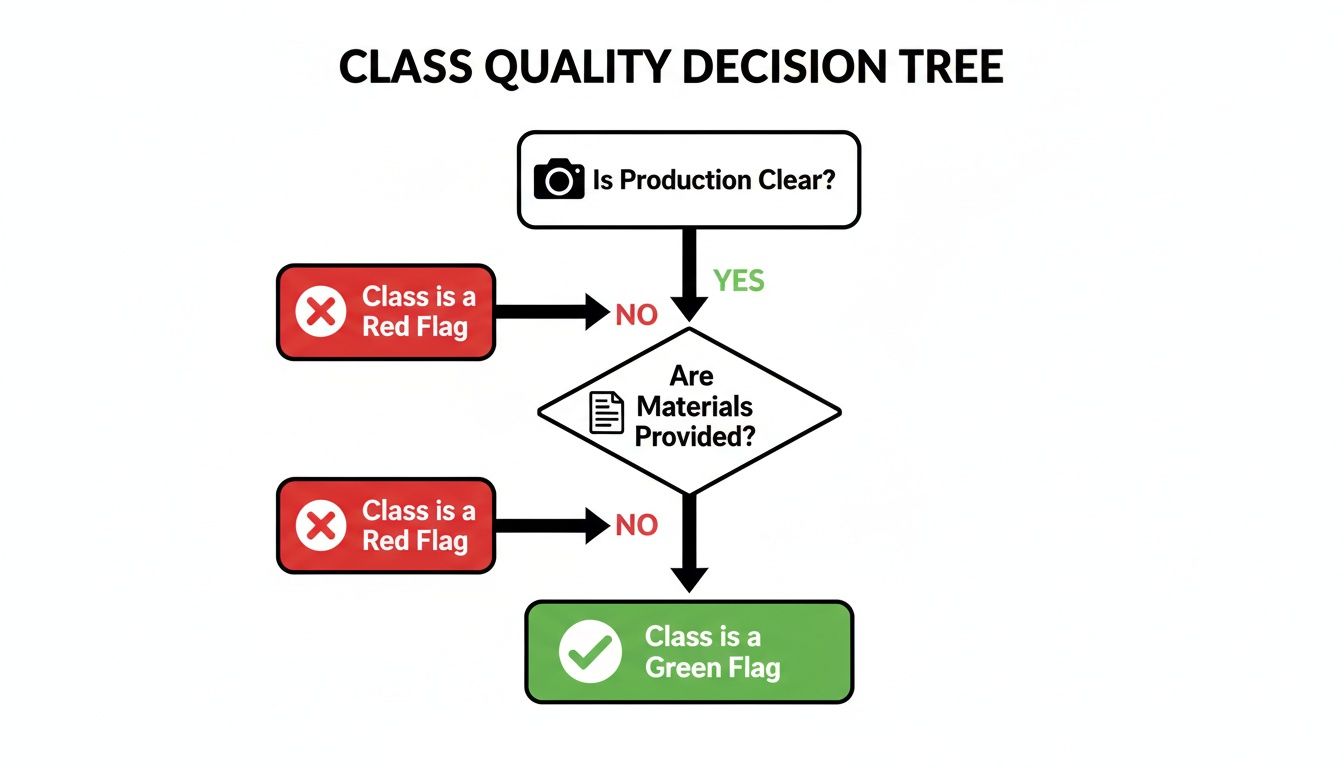
As the chart shows, things like clear video quality and having all the necessary materials listed upfront are non-negotiable green flags for any good course.
To help you sort it out, let’s put these two models head-to-head.
This direct comparison will help you decide which purchasing model is the right fit for your sewing journey.
| Feature | Subscription Platforms (e.g., Skillshare) | A La Carte Courses (e.g., Udemy) |
|---|---|---|
| Cost Structure | Low monthly/annual fee for all-access. | Higher one-time payment for a single class. |
| Content Access | Access ends when you cancel your subscription. | You get lifetime access to the content. |
| Course Depth | Varies; often broader, shorter classes. | Usually much more in-depth and comprehensive. |
| Best For | Explorers, hobbyists, and budget-conscious learners. | Goal-oriented learners mastering a specific skill. |
At the end of the day, there’s no wrong answer here. In fact, many serious sewists do both! They keep a subscription for everyday skill-building and a dose of inspiration, then invest in single courses for those big, milestone projects. Once you understand the pros and cons of each, you can confidently pick the path that will best support your creative journey.
Now that you know what to look for, let's dive into some of the best online sewing platforms out there. Finding the right one is all about matching a platform’s style to your own goals. After all, the best class is one that gets you excited to sit down at your machine and start creating.
Think of it this way: some platforms are like giant fabric superstores with a bit of everything, perfect for browsing and discovering new interests. Others are more like specialty boutiques, offering high-end, curated materials for a very specific project. We’ll look at options that cater to every stage of the sewing journey.
If you're the kind of person who loves to dabble in a bit of everything, Skillshare and Domestika are your creative playgrounds. Both work on a subscription model, giving you access to a massive library of classes on sewing and pretty much any other creative skill you can imagine.
Their real magic lies in the freedom to explore. For one monthly fee, you can try a class on bag making, experiment with embroidery, and then take a beginner's course on dressmaking. This makes them some of the best sewing classes online if you’re not quite ready to commit to a single, intensive topic.
Tilly and the Buttons is a perfect example of a brand that brilliantly combines patterns with matching online workshops. This integrated approach is a dream for anyone who wants to create a specific garment and needs an expert to hold their hand along the way.
The courses are famously clear, fun, and designed to build your confidence, all delivered with a friendly and encouraging vibe. When you buy a workshop, you’re getting a complete success package, not just a video tutorial.
An instructor-led, project-specific course removes all the guesswork. It’s like having a patient teacher sitting right next to you, guiding you through every tricky step from cutting the fabric to the final press.
This focused method is amazing for building your skills systematically. You’ll walk away from a Tilly and the Buttons workshop with a gorgeous handmade garment and the confidence to tackle similar projects all on your own.
When you're ready to level up to more complex garment construction, Closet Core Patterns is waiting. They offer a library of high-quality, in-depth workshops aimed at intermediate-to-advanced sewers who are serious about building a beautiful, wearable wardrobe.
These classes go way beyond the basics. Here, you'll find detailed courses on intimidating projects like making your own jeans, tailoring a blazer, or constructing a swimsuit. The instruction is meticulous, with fantastic production quality and crystal-clear explanations that break down every single step.
Here’s why this approach works so well for serious sewers:
Ultimately, choosing between these platforms comes down to what you want to achieve right now. Whether you're just exploring a new hobby or you're ready to master a professional-level skill, the perfect online class is out there waiting for you.
So, you've mastered sewing for yourself, but what if you could turn that passion into a real paycheck? Online sewing classes are the perfect springboard for exactly that. If you’ve ever dreamed of selling your creations or starting your own small business, the right courses can give you the specific commercial skills you need to leap from hobbyist to professional.
This is about more than just getting faster at the machine. It’s about learning the techniques the apparel industry actually uses. Think of it like the difference between a passionate home cook and a trained chef—you’re not just making something delicious, you're learning the systems and standards for consistency, quality, and scaling your work.
The biggest leap is a mental one. Professional sewing requires a different skillset than what you use for your own wardrobe. That slightly wonky seam on a dress for yourself has character; on a product for a customer, it’s a flaw. Precision and repeatability become your new best friends.
This is where specialized online classes come in. They focus on the exact skills you need to sell your work, which is why you can find some of the best sewing classes online geared specifically toward career growth.
They often cover key commercial techniques like:
This kind of focused training can plug you into a massive market. There are over 43 million household sewing machine users around the globe, and a surprising 16% of them are already selling what they make. That's a huge community of micro-entrepreneurs you could join. You can discover more insights about the home-sewing market to see just how big the opportunity is.
Once your technical skills are sharp, it’s time to build a business around them. Thankfully, many online platforms offer courses that go beyond the sewing machine to teach you the entrepreneurial side of things.
These business-focused classes will walk you through how to:
The most successful makers combine excellent craft with smart business strategy. Online courses provide a structured, low-cost way to learn both sides of the equation, setting you up for long-term success.
These skills aren't just for people making clothes. They're just as crucial for aspiring pattern designers, quilters, or anyone who wants to turn their craft into cash. The core principles of quality, consistency, and branding are universal. Plus, developing content around your craft can open up other interesting avenues—you might even be able to join a UGC creator agency by showcasing your unique sewing projects.
At the end of the day, online classes give you the power to build a sustainable business on your own terms. They provide the skills, confidence, and community you need to turn your creative passion into a rewarding side hustle or even a full-time career.

Okay, it's time to stop researching and start stitching. Finding the right online sewing class isn't about some complicated formula. The perfect class is simply the one that makes you want to pull out your machine and get to work.
Think of this as your final checklist. It’s designed to cut through the noise and help you pick a class that truly fits your goals and how you like to learn. Let's get you from "I'm not sure" to "I'm ready."
Before you do anything else, pick one clear thing you want to accomplish. Is it finally sewing a simple tote bag? Maybe you want to conquer your fear of buttonholes, or perhaps you're ready to tackle a pair of jeans. Having a specific project in mind makes your search so much easier and keeps you from getting overwhelmed by all the options.
Next, be honest about where you are right now. Are you a complete beginner who's still figuring out what a bobbin is? Or are you an intermediate sewist looking for a fresh challenge? Matching the class to your skill level is the single biggest factor in staying motivated and not getting frustrated.
The most powerful thing you can do is simply start. The only thing separating you from a new skill is the decision to try. Embrace the process, celebrate your progress, and trust that each stitch is a step forward.
Once you’ve narrowed it down to a few promising classes, run through these last checks. Figure out a budget that feels comfortable and decide if you prefer the variety of a subscription or the focused path of a single course.
Most importantly, always look for a free preview or watch the instructor's videos on YouTube. A teacher's communication style is a huge deal—you need to find someone whose vibe clicks with yours. This final step helps ensure you're investing in an experience you'll actually look forward to.
You're about to join a huge, vibrant community. The quilting industry alone is valued at nearly $5.0 billion, and a recent survey found that 18% of quilters are new, younger learners. That shows just how much demand there is for great online sewing education. You can read the full quilting trends survey for 2025 for more on that.
In a similar creative space, many brands and makers connect with their communities in exciting ways, which we explore in our guide on influencer gifting platforms.
Now, go pick your class and get that machine humming
Diving into the world of online sewing classes can feel a little uncertain at first. Let's walk through some of the most common questions that pop up, so you can feel totally confident when you find the perfect class and hit that "enroll" button.
Getting these practical details sorted out from the start is the key to a smooth, fun, and creative experience.
The price tag on online sewing classes can swing pretty widely, but it really boils down to a couple of common models. There’s something out there for just about every budget.
So, it really comes down to your learning style. Do you want to dabble in a bit of everything, or would you rather go deep and truly master one specific skill?
Nope! This is probably the biggest myth that holds people back from sewing. You absolutely do not need a complicated, expensive machine to get started.
Honestly, almost every beginner class out there is designed with basic machines in mind. All you really need is a reliable machine that can do a decent straight stitch and a zigzag stitch. Instructors know their audience and are fantastic at showing you how to get beautiful results with the simplest of tools. Don’t let your machine stop you from starting.
A common fear is getting stuck on a tricky step with no one there to help. This is where a course's support system becomes its most valuable feature. The best classes build a community to ensure you never feel like you're sewing alone.
This is the real test that separates a decent online class from a truly great one. The best courses have strong support systems built right in, so you're never left struggling on your own.
Keep an eye out for classes that offer one or more of these features:
These communities are gold because you’re not just getting help from the teacher; you're connecting with other students who might have just figured out the very thing you're stuck on. Some instructors even find success through specialized marketing; you can learn about similar strategies in our guide to finding the right influencer outreach service.
For many people, they're actually even better. Online classes give you incredible flexibility to learn on your own schedule. The real game-changer, though, is the ability to hit rewind and re-watch a tricky step as many times as you need until it clicks.
You might miss the hands-on correction of an in-person teacher, but a well-filmed class with multiple camera angles can give you a clearer, more detailed view than you'd ever get trying to peek over someone's shoulder in a crowded room. It's a personal preference, but the advantages of learning online are pretty powerful.
At High Country Quilts, we believe in empowering every sewer with the best tools and knowledge. Whether you're looking for a new BERNINA machine or the perfect fabric for your next project inspired by your online class, we're here to support your creative journey. Visit us at https://hcquilts.com to explore our selection and join our vibrant community.
At High Country Quilts we care deeply about community. With our experiences in retail, we know that a store is not only a place to shop but also a place for the community to gather and share. During this busy...

Hi! We’re Adam and Renee Wheaton, the new owners of High Country Quilts! For more than 40 years, we’ve owned and operated vacuum and sewing businesses. Following in Renee’s father’s footsteps after he retired from All Discount Vacuum and Sewing in Colorado...


Leave a comment