

We Love Our Quilting Community
At High Country Quilts we care deeply about community. With our experiences in retail, we know that a store is not only a place to shop but also a place for the community to gather and share. During this busy...


Choosing the right rotary cutter can completely change your quilting game, turning a tedious task into an act of precision and artistry. More often than not, the best rotary cutters for quilting boil down to two things: the blade size and how the handle feels in your hand.
For most quilters and most projects, a 45mm ergonomic cutter from a trusted name like OLFA or Fiskars is the sweet spot, giving you a great mix of cutting power and fine control. But the perfect tool for you? That's going to come down to your specific projects, your comfort, and what makes you feel safe.
Finding the perfect rotary cutter is a deeply personal quest. What feels like a dream tool for one quilter might be a nightmare for another. The decision really hinges on a few key factors: the size of the blade, the ergonomics of the handle, and the type of safety lock.
Someone who spends their days slicing long, straight strips for borders and sashing will need a very different cutter than a quilter who specializes in detailed appliqué with tight, fussy curves. The first step is to be honest about how you work.
Are you typically powering through eight layers of cotton at once for batch piecing? Or do you need nimble, pinpoint accuracy for tiny templates? Do your hands or wrists start to ache after a long cutting session? Answering these questions honestly will point you toward a cutter that feels less like a tool and more like an extension of your own hand.
The goal isn't just to find a cutter that works well—it's to find one that makes your process more comfortable and efficient. A tool that causes strain or feels awkward to use is only going to get in the way of your creativity.
This guide is designed to give you practical advice to sort through all the options. We'll look at the top models from the perspective of real-world quilting, moving beyond brand loyalty to focus on how each one actually performs.
To kick things off, here’s a quick look at our top recommendations for different kinds of quilters.
We've sorted through the best options to help you find a match for your specific quilting style. Whether you're a beginner just starting out or a seasoned pro cutting for hours on end, this table will point you in the right direction.
| Category | Recommended Model | Best For | Key Feature |
|---|---|---|---|
| All-Purpose Workhorse | OLFA 45mm RTY-2/DX | Everyday cutting, versatility, and reliability for most quilting tasks. | Ergonomic handle with a dual-action safety lock. |
| Beginner Friendly | Fiskars 45mm Comfort Loop | New quilters who prioritize safety and ease of use. | Blade guard retracts with a squeeze and locks easily. |
| Precision Cutting | Martelli 45mm Ergo 2000 | Quilters with arthritis or wrist pain needing maximum control. | Unique ergonomic design that reduces strain. |
| Heavy-Duty Cutting | OLFA 60mm RTY-3/DX | Slicing through multiple layers of thick fabric with ease. | Larger blade size for power and fewer passes. |
Think of this as your starting point. Now, let's dive deeper into what makes each of these cutters stand out.
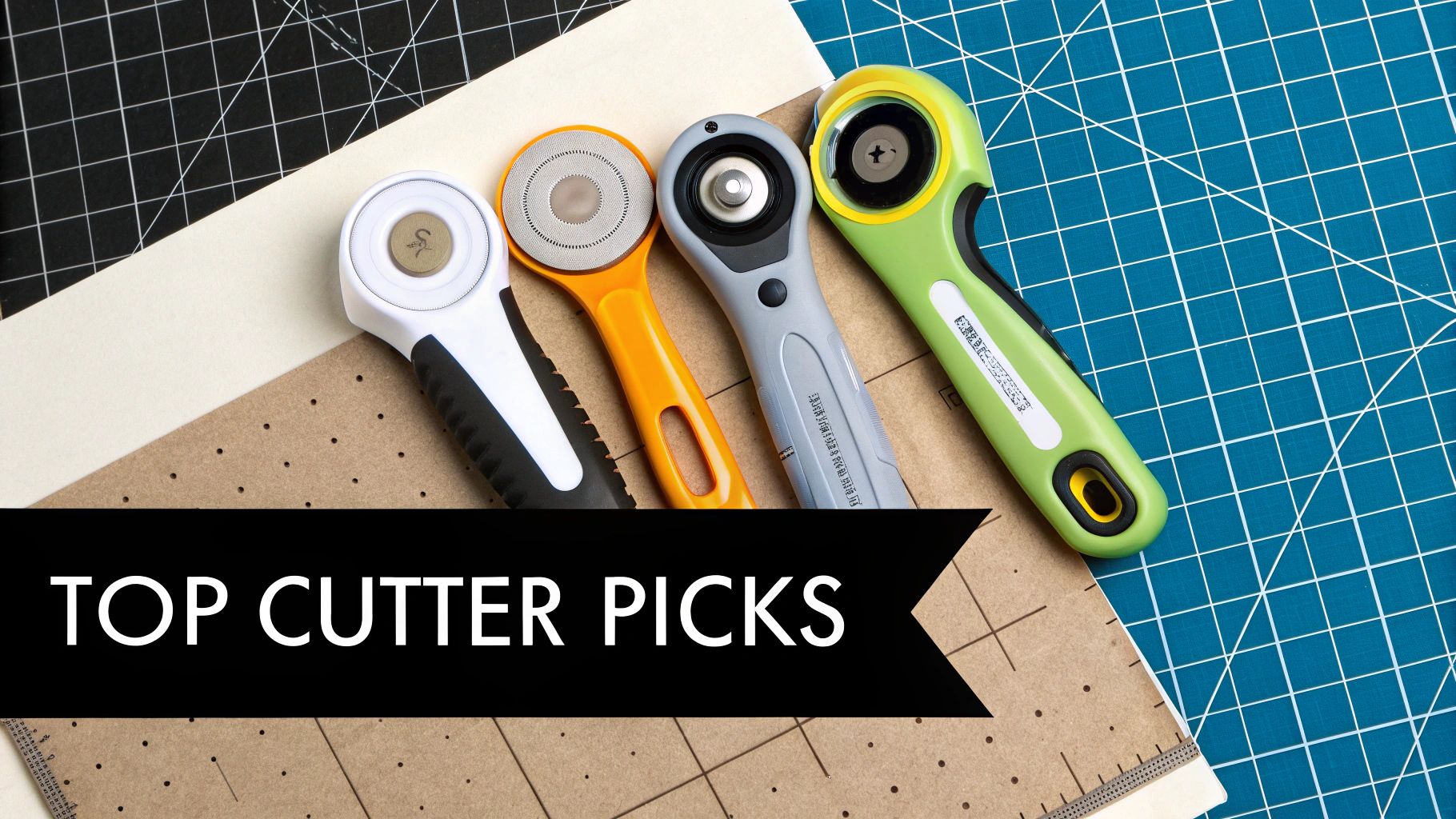
Before you can pick the right rotary cutter, it helps to know what makes one tick. No matter the brand, every cutter is built around three key parts: the handle, the blade, and the safety guard. How these pieces work together has a huge impact on your comfort, precision, and safety.
The handle is where ergonomics come into play. You’ll find two main types out there: the classic straight or "stick" handle and the more modern "comfort loop" designs that fit the curve of your hand. For anyone who spends hours at the cutting mat, the right handle can be the difference between finishing your project and calling it a day because of wrist strain.
Then there’s the safety guard, the little shield that stands between your fingers and that razor-sharp blade. Designs range from a simple manual slide you push back and forth to sophisticated pressure-activated guards that automatically pop out when you lift the cutter. A good, reliable safety mechanism isn't just a nice feature—it's essential.
The blade is the business end of the tool, and its size really defines what it's good for. While you can find blades in all sorts of diameters, most quilting jobs come down to one of three main sizes. Each one has a sweet spot for different kinds of cuts.
The 60mm Blade: Think of this as the heavy lifter. Its large diameter is perfect for powering through thick stacks of fabric—sometimes up to 12 layers of quilting cotton in one go. Because it doesn’t have to rotate as much, the blade stays sharp longer. This is your best friend for cutting long strips, squaring up big quilt tops, or tackling tough materials like denim or batting.
The 45mm Blade: This is the undisputed all-rounder, the one most quilters grab first. The 45mm blade hits that perfect sweet spot between power and agility, slicing through four to six layers of fabric with ease. It's the workhorse for everything from general piecing and trimming quilt blocks to cutting out pattern shapes.
The 28mm Blade: When you need finesse, you need the 28mm blade. Its small size gives you incredible control for navigating tight curves in appliqué work, nipping the corners off flying geese, or fussy cutting a specific motif from a scrap. It offers a level of precision that the bigger blades just can't touch.
Choosing the right blade size is all about matching the tool to the task. It’s like having a chef's knife for big chopping jobs and a paring knife for delicate work. You wouldn’t use one for the other and expect great results.
The growing variety of these specialized tools shows just how vital they've become in our craft rooms. As of 2025, the global rotary cutter market is worth around $500 million a year, and it’s only getting bigger. This growth is fueled by the boom in DIY hobbies like quilting, where having the right tool is everything. You can explore more about these market trends and see how top brands are innovating for crafters.
Picking a rotary cutter can feel like choosing between nearly identical tools, but I can tell you from experience, those small design differences make a huge impact on your quilting workflow. We’re going to look past the brand names and really dig into what sets models from OLFA, Fiskars, and Martelli apart, focusing on what actually matters when you’re hours deep into a project.
It really boils down to three things: how the handle feels in your hand, how the safety works, and how much of a headache it is to swap out a dull blade. A cutter might be great in one area but a total pain in another, which is why the "best" one is always a personal choice.
This infographic breaks down some of the most important features to keep in mind as you're weighing your options.
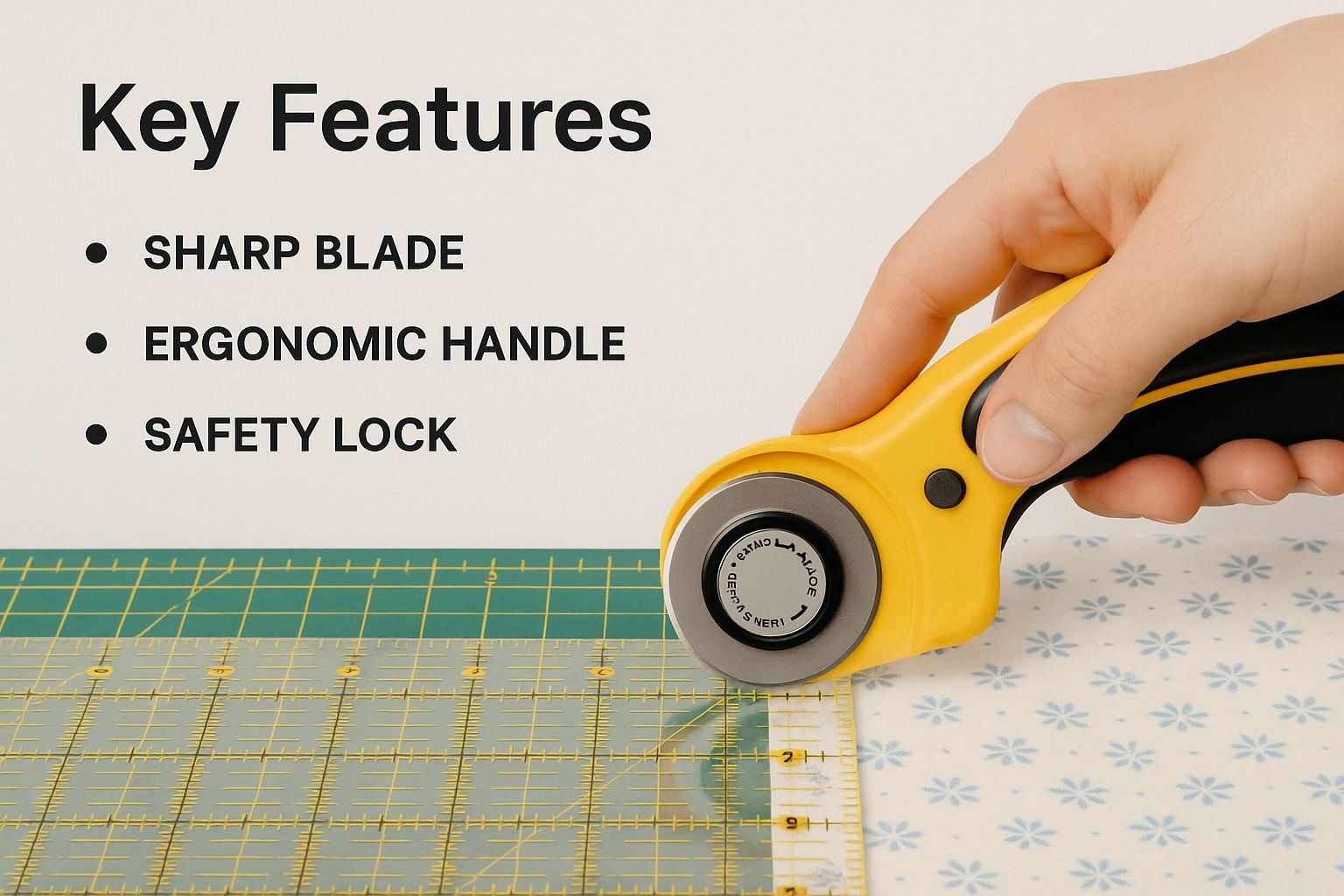
As you can see, it's all a balancing act between comfort, safety, and the simple, practical task of changing the blade. Getting this right makes all the difference in an efficient quilting session.
The handle is where you connect with the tool, and its shape is everything for comfort and control. The classic straight or "stick" handles, like what you’ll find on the OLFA Classic Stick models, are loved for their no-nonsense, ambidextrous design. You can just flip it over in your hand to switch from right to left-handed cutting—no need to take anything apart.
But for those of us who spend hours at the cutting mat, an ergonomic or "comfort loop" handle can be an absolute lifesaver. Tools like the Fiskars Comfort Loop are shaped to fit the natural curve of your hand, which helps you keep your wrist in a more neutral position. This design is a game-changer for reducing strain and fatigue, especially if you deal with arthritis or carpal tunnel.
For marathon cutting sessions, an ergonomic handle isn't a luxury; it's a necessity. The right handle shape allows you to cut longer and with greater precision by minimizing physical stress on your wrist and hand.
The Martelli Ergo 2000 takes this whole idea a step further with its unique angled handle. It's built to let you cut with a completely straight wrist, putting the pressure on your arm and shoulder instead. This moves the strain away from weaker joints, making it one of the best choices out there if you struggle with hand pain. The only catch? These highly specialized designs often take a bit more getting used to than a simple straight handle.
A solid safety mechanism is non-negotiable. Period. You’ll generally find two main systems: manual slides and pressure-activated guards.
Manual Safety: This is the simple slide or button you find on many classic OLFA cutters. You have to physically push it to expose the blade and push it back to cover it. It’s dead simple and reliable, but it puts the responsibility on you to remember to close it after every single cut.
Pressure-Activated Safety: Common on many ergonomic Fiskars models, this system is brilliant. The blade automatically pops out when you squeeze the handle and zips back in the second you let go. It’s fantastic for beginners or anyone cutting in a busy studio, since the blade is never left exposed by mistake.
The main gripe with some pressure-activated systems is that the lock can sometimes feel a bit loose or even close on you mid-cut if your grip falters. A manual lock, on the other hand, is either on or off—it stays put until you decide to move it. Your preference here really comes down to your cutting habits and whether you want total control or a built-in safety net.
Changing a blade shouldn't feel like you’re defusing a bomb. A finicky blade-change system is not only frustrating but can be genuinely dangerous. Some of the older models required you to juggle a nut, a washer, a spring, and the blade itself—a recipe for disaster.
Thankfully, modern designs have made this much, much easier. The Fiskars Ergo Control, for instance, has a quick-change system where you just unscrew a nut and the blade comes right out without any loose parts to chase. Many newer OLFA cutters have also streamlined this process. A simple blade change encourages you to work with a sharp blade more often, and that means cleaner cuts and less wasted fabric.
To help you see how these features stack up, I've put together a quick comparison of some of the leading models. This table highlights the key differences that will likely influence your final decision.
| Model | Handle Type | Safety Mechanism | Blade Change System | Ideal Use Case |
|---|---|---|---|---|
| OLFA Classic Stick | Straight/Ambidextrous | Manual Slide | Traditional (Nut & Washer) | Traditionalists & left-handers who need a simple, reliable tool. |
| Fiskars Comfort Loop | Ergonomic Loop | Pressure-Activated | Quick-Change (Screw) | Quilters seeking comfort for long sessions and automatic safety. |
| Martelli Ergo 2000 | Angled Ergonomic | Pressure-Activated | Quick-Change | Users with arthritis or wrist pain who need maximum strain reduction. |
Ultimately, looking at the cutters side-by-side like this makes it clear that the "best" choice really depends on what you value most—be it ambidextrous simplicity, ergonomic comfort, or a system designed to eliminate hand strain entirely.
Finding the best rotary cutter isn’t about chasing a single “perfect” tool. It’s really about matching the cutter to your specific projects, your hands, and how you work. The right tool for someone chain-cutting hundreds of squares for a quilt top is worlds apart from what an art quilter needs for tiny, curved appliqué pieces.
This demand for specialized gear is a big deal. Quilting is a massive part of the global textile market, which was valued at a cool $5.32 billion in 2024. Experts predict it will climb to $7.8 billion by 2031, fueled by passionate crafters like us who want better, more specific tools. You can actually see the data behind these quilt market trends and understand how our hobby shapes the industry.
More growth means more choices, so let's break down a few common scenarios to help you find the perfect fit.
If you're just starting out, that ultra-sharp blade can be pretty intimidating. Your first priority should be a cutter with safety features that are practically second nature, helping you build good habits from day one.
I always recommend looking for a model with a pressure-activated blade guard. Cutters like the Fiskars Comfort Loop only expose the blade when you're actively squeezing the handle. The second you let go, the guard snaps back into place. This single feature prevents so many accidental nicks and cuts, especially when your mind is focused on getting your seam allowances right.
Hours of cutting can take a toll on anyone's hands, but if you deal with arthritis or wrist pain, it can be a real barrier. An ergonomic handle stops being a "nice-to-have" and becomes essential for quilting comfortably.
This is where a tool like the Martelli Ergo 2000 truly shines. It was designed from the ground up to address this exact problem. Its unique angled handle lets you cut with a straight wrist, so you're using the strength of your arm and shoulder instead of stressing delicate hand and wrist joints. This simple change in mechanics dramatically cuts down on fatigue.
Don't fight through pain with the wrong tool. A great ergonomic cutter should feel like a natural extension of your arm, letting you get lost in the creative flow instead of wincing with every cut.
When you're fussy cutting a specific motif, tackling tight curves, or working on detailed appliqué, a standard 45mm blade can feel like you're trying to park a bus in a compact spot. For that kind of delicate work, you need a smaller blade for better control.
A 28mm rotary cutter is your best friend here. The smaller blade diameter lets you navigate sharp corners and tiny templates with incredible accuracy, so you don't accidentally slice past your lines. It gives you the finesse you need for those detailed pieces where every millimeter matters. It's an absolute must-have for any art quilter's toolkit.
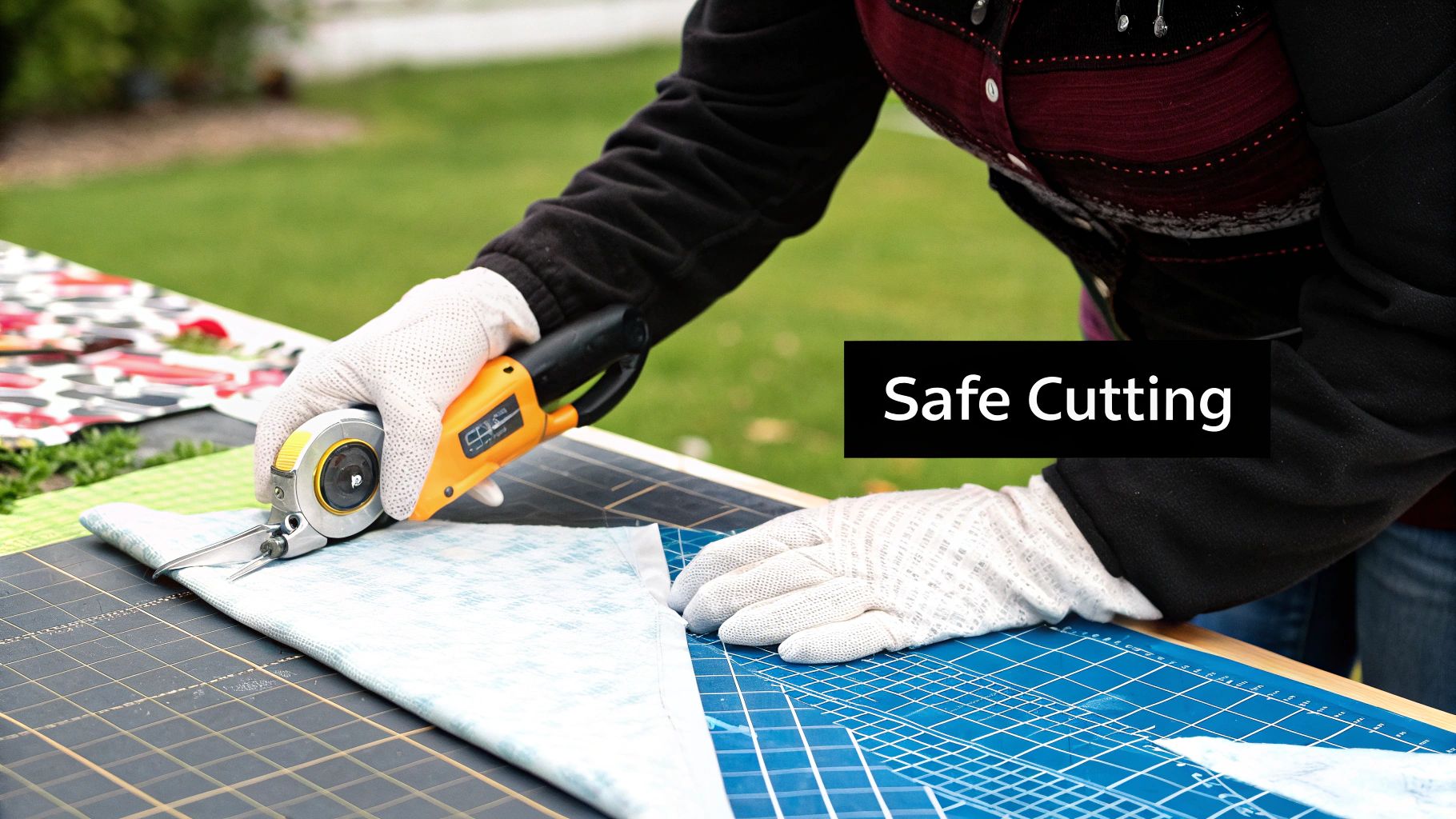
If you're a quilter who processes a ton of fabric or struggles with hand strength, you've probably eyed an electric rotary cutter. The idea of ditching the repetitive strain and speeding through cutting sessions is definitely appealing.
These powered tools can be a game-changer. They significantly reduce fatigue, keep your cutting speed steady for uniform results, and can power through 8–10 layers of fabric at once. But making the jump from a manual cutter isn't a simple decision; it brings up real questions about the cost, precision, and safety of a powered blade.
Electric models are a bigger investment, with most starting around $80, which is a considerable step up from their manual counterparts. They can also feel a bit clunky when you're trying to navigate a tight curve or a delicate appliqué piece. Plus, the safety rules change—an electric blade is always live when the power is on.
Before you add one to your cart, take a moment to think about your own quilting habits. How much fabric do you really cut each month? Do you often work with thick materials like batting or denim that could use the extra muscle? And practically speaking, where would a corded tool even fit into your current sewing setup?
Switching to an electric cutter can feel like upgrading a hand drill to a table saw: powerful yet demanding respect and caution.
Electric rotary cutters truly shine in high-volume situations. Think of a small Etsy shop churning out quilt kits or a quilter who regularly makes charity quilts by the dozen.
One small fabric shop in Atlanta, for instance, reported a 30% reduction in their fabric cutting time after switching to electric units. That translates directly to getting more done. For home quilters, the biggest win is often the ability to stack multiple layers of fabric and just let the motor do the heavy lifting.
Where do they make the most sense?
These are the kinds of tasks where that extra power really proves its worth.
On the other hand, trying to cut a tight curve with an electric cutter can feel like steering a barge down a narrow canal. They just don't have the nimbleness you need for detailed, intricate work.
The bulkier body gets in the way, and you lose that tactile feedback you get from a manual cutter. It's a trade-off between raw power and fine control.
| Drawback | Detail |
|---|---|
| High Cost | Electric models often start around $80, plus the cost of replacement blades. |
| Limited Maneuverability | The bulky design gets in the way when cutting intricate shapes. |
| Power Dependency | You're either tethered to a cord or need to keep a battery charged, which limits portability. |
You also have to consider the noise and the added maintenance that comes with a motorized tool.
Ultimately, the best way to know is to try one out if you can. See which tool actually fits your workflow and budget. And no matter what you choose, always put safety first. Follow the manufacturer's instructions and consider protective gloves—a powered blade deserves your full attention.
Despite the drawbacks, electric rotary cutters are a fast-growing tool in the quilting world. Market projections estimate about a 5% CAGR as more quilters and garment makers look for ways to boost their efficiency. You can learn more about these market insights to see where the industry is heading.
Even after years of quilting, we all run into questions about our tools. Getting the most out of your rotary cutter can make all the difference, from blade care to choosing the right tool for a specific task. Let's tackle some of the most common questions quilters have.
Honestly, there's no magic number of days or projects. The real answer depends entirely on what you’re cutting and how often you’re doing it. The best way to know is to stop tracking time and start listening to your fabric.
When a blade is dull, your fabric will tell you. You'll start noticing skipped threads, little uncut spots, or edges that look frayed instead of clean. Another tell-tale sign is when you find yourself pressing down harder to get a clean cut. That extra pressure not only tires out your hand but is also a recipe for a dangerous slip.
Want to make your blades last longer?
When you do buy replacements, you'll see standard steel and titanium-coated options. The titanium blades are a bit more of an investment upfront, but they typically last two to three times longer. If you're an avid quilter, they often pay for themselves over time.
For all my fellow lefties out there, using the right tool isn't just about comfort—it's about safety. Trying to make a right-handed cutter work is frustrating and risky. The blade ends up on the wrong side of the ruler, blocking your view and making it far too easy for the cutter to jump the track.
The good news is that many of the best rotary cutters are designed for both left- and right-handed quilters. You'll want to look for models that are either truly ambidextrous or can be easily converted.
A great ambidextrous cutter lets a left-hander work without making a single adjustment. The design ensures the blade is always snug against the ruler, no matter which hand you use, giving you a safe and clear line of sight.
Many of the classic "stick" style cutters are naturally ambidextrous by design. For the more ergonomic models, look for ones where you can unscrew the blade and reassemble it on the other side of the handle. Brands like OLFA and Fiskars have plenty of options that make this switch quick and painless.
Absolutely! A rotary cutter is a fantastic multi-purpose tool. It’s perfect for paper crafts, thin leather, and vinyl, often giving you a much cleaner edge than you could get with scissors.
But here’s the most important rule: dedicate specific blades to different materials. Think of it like your scissors—you wouldn’t dare use your prized fabric shears on paper, right? The same principle applies here.
Paper is a notorious blade-killer and will dull a sharp edge in a heartbeat. If you use that same blade on fabric afterward, you’re guaranteed to get ragged, inaccurate cuts. My advice? When a fabric blade starts to feel a little dull for cotton, take it out, label it with a permanent marker ("Paper" or "Crafts"), and give it a second life. This little habit keeps your fabric cuts pristine and saves you a ton of frustration.
At Famcut.com, we know that the right tools bring your creative vision to life. Dive into our handpicked selection of premium rotary cutters, beautiful fabrics, and sewing essentials to find everything you need for your next masterpiece. https://famcut.com
At High Country Quilts we care deeply about community. With our experiences in retail, we know that a store is not only a place to shop but also a place for the community to gather and share. During this busy...

Hi! We’re Adam and Renee Wheaton, the new owners of High Country Quilts! For more than 40 years, we’ve owned and operated vacuum and sewing businesses. Following in Renee’s father’s footsteps after he retired from All Discount Vacuum and Sewing in Colorado...


Leave a comment