
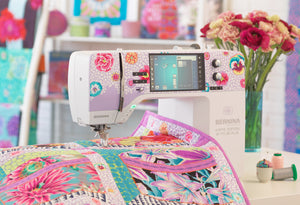

We Love Our Quilting Community
At High Country Quilts we care deeply about community. With our experiences in retail, we know that a store is not only a place to shop but also a place for the community to gather and share. During this busy...


Choosing your first (or next) longarm quilting machine is a huge milestone for any quilter. The "best" machine isn't about a specific brand; it’s about finding the one that gets out of your way and lets your creativity flow, whether that’s a BERNINA for its legendary Swiss precision, a Handi Quilter built for business-level output, or a versatile sit-down model perfect for intricate stitching.

This guide is built to go beyond the spec sheets. I want to help you figure out what "best" really means for your quilting. We’ll look at the features that truly make a difference, from the throat space needed for a king-sized quilt to the stitch regulators that promise perfect stitches every time.
The quilting world is growing, and so is the market for these amazing machines. It’s projected to reach between $0.6 billion and $1.1 billion by 2026. This growth isn’t just numbers; it’s a reflection of more people discovering quilting as a passion and even a side business. You can explore the full market projections to see just how fast the industry is expanding.
I'll walk you through real-world scenarios and compare the details that matter. By understanding the core differences, you can match a machine to your goals, whether you're quilting for yourself or launching a quilting business.
Here's what we'll cover:
To get started, let’s look at the two main styles of longarm machines. The choice you make here will define your entire quilting process.
| Feature | Frame-Based Longarm | Sit-Down Longarm |
|---|---|---|
| Workflow | You move the machine head over stationary fabric. | You move the fabric under a stationary needle. |
| Best For | Finishing large quilts quickly; sweeping, fluid designs. | Detailed, precise work; dense free-motion quilting. |
| Space Needs | Significant. Requires a large, dedicated frame (10-14 feet). | More compact. It fits on a heavy-duty table. |
| Learning Curve | You're learning a new skill—guiding the machine. | Feels familiar, much like a domestic sewing machine. |
By the end of this guide, you’ll have a clear path forward. You'll be ready to make a confident investment and, most importantly, start bringing your biggest creative ideas to life.

The very first fork in the road when buying a longarm is choosing between a frame and a sit-down model. This isn't just a minor preference—it completely changes how you work, how you interact with your quilt, and the kind of quilting you'll find yourself doing. One isn’t better than the other, but one will absolutely be better for you.
Frame-based longarms are what most of us picture. The machine head glides around while your quilt sandwich stays put, stretched nice and taut on a big frame. You move with the machine, guiding it across the fabric. It feels a bit like painting on a massive canvas.
A sit-down model, on the other hand, flips that concept. The machine stays still, and you move the fabric underneath the needle while sitting at a large, custom-fit table. If you've spent years piecing on a domestic machine, this motion will feel incredibly familiar and comfortable.
A frame system is all about scale. With frames running anywhere from 10 to 14 feet long, they are purpose-built to tackle big projects with incredible speed. If your main goal is to get through a stack of quilt tops, especially queen and king sizes, a frame is a total game-changer.
The workflow is perfect for broad, sweeping designs and pantographs. You almost dance with the machine, using your whole body to create fluid, edge-to-edge patterns. This is where a frame model truly shines, turning a huge quilt into a surprisingly manageable project.
For anyone even thinking about offering longarming services, a frame system is practically a must-have. Its ability to handle large quilts efficiently is what makes a quilting business profitable.
But all that capability needs space—a lot of it. A professional frame, like the HandiQuilter Studio3, is a serious piece of equipment. It's heavy and robust for a reason, and you'll likely want your dealer to help with assembly.
For quilters who either don't have a dedicated room for a giant frame or who simply prefer a more up-close quilting experience, sit-down longarms are a fantastic solution. These machines give you the generous throat space of a longarm—usually 16 to 20 inches—but with the familiar ergonomics of sitting down to sew.
This setup offers incredible fingertip control, which is ideal for very detailed work. Think micro-stippling, intricate ruler work, and dense, custom free-motion quilting. If you love the idea of "drawing" with your needle and having absolute command over every stitch, a sit-down machine is your best bet.
It’s no surprise this part of the market is booming. Stationary longarm machines are part of a segment projected to hit $500 million globally by 2033, growing at a 4.7% annual rate. This trend is fueled by quilters who want to create highly personalized, handcrafted quilts. You can dig into the numbers yourself by exploring these market dynamics in this detailed report.
Ultimately, your decision comes down to your quilting goals, your physical comfort, and the space you have available.
You're a great fit for a frame model if: you want to finish a lot of large quilts, you're excited by computerized pantographs, or you plan on starting a quilting business.
You should lean toward a sit-down model if: you love doing detailed, custom free-motion quilting, you have limited studio space, or you just prefer the familiar feeling of moving the fabric yourself.
Don't forget to think about your own body. A frame requires standing and walking, which some people love, while a sit-down machine lets you work while seated. The absolute best way to decide is to test drive both. Head to a local dealer like High Country Quilts and get your hands on each type—you'll know pretty quickly which one feels right.

Once you get past the impressive frames and brand names, you'll find the real value of a longarm is in its features. But the spec sheets can be overwhelming, and not everything listed will make a daily difference in your quilting. The trick is to know which features are just nice extras and which ones will genuinely change how you work.
You have to translate the technical jargon into what it means for your projects. It’s a process of separating marketing buzz from true utility, a bit like how other industries might use a detailed learning management system features comparison to vet creative software. By looking at a machine with that same critical eye, you can make sure you're investing in what you’ll actually use.
Let's dig into the features that have the biggest impact on your quilting, your skills, and your creative flow.
Throat size—the distance from the needle to the back of the machine's "harp"—is one of the first things people ask about, and for good reason. It sets the limit for your workable quilting area and determines how often you have to stop and roll the quilt forward.
For example, a machine with an 18-inch throat will realistically give you about 12-13 inches of usable quilting space. That's a great amount of room for detailed custom work and smaller quilts. But a machine with a 24-inch throat bumps that up to nearly 18-19 inches of working space. That extra real estate is a game-changer on king-sized quilts, meaning fewer passes and less time spent advancing the quilt.
If you're a hobbyist mainly making throw and queen-sized quilts, a 20-inch throat is often the perfect balance. But if you're running a business or exclusively tackling huge projects, a 24-inch or 26-inch throat is all about efficiency, drastically cutting down on quilt advancements.
Don't just think of a larger throat as being for bigger quilts. It makes working on any quilt easier and more efficient. It gives you room to breathe, see your overall design, handle rulers comfortably, and stitch larger motifs without interruption.
If there's one feature that delivers professional-looking results right out of the box, it's stitch regulation. A stitch regulator uses sensors to read how fast you're moving the machine head and instantly adjusts the motor speed to match.
What you get are perfectly even stitches, whether you’re speeding up on a long straight line or slowing down to navigate a tight curve. For a beginner, this is the ultimate confidence booster. It completely removes the fear of getting tiny, bunched-up stitches when you pause or long, sloppy ones when you move too quickly.
How Different Regulation Modes Work:
Top-tier systems like the BERNINA Stitch Regulator (BSR) are famous for their accuracy. They act as your safety net, freeing you to focus on your creative design instead of worrying about the mechanics of making a perfect stitch. For anyone serious about longarm quilting, a reliable stitch regulator is a must-have.
Don't get too caught up in the top speed, often advertised as stitches per minute (SPM). A machine might boast 2,500 SPM, but in reality, you'll almost never quilt that fast. What matters far more is the motor's power and control at the speeds you actually use.
A strong motor is what allows the machine to punch through thick seams, multiple layers, and dense batting without straining. You'll feel the difference when you quilt over complex piecing or use heavy-duty threads. You want a motor that delivers consistent torque, whether you’re crawling along for detailed work or moving briskly on an all-over design.
The true test of a great motor is its balance. It should have the high-speed capability to finish large quilts efficiently, but also the delicate, low-speed control needed for precision. When you test-drive a machine, pay close attention to how smoothly it runs at both the high and low ends of its speed range.
This is where longarm quilting meets modern technology. Computerized systems, like Handi Quilter’s Pro-Stitcher or BERNINA's Q-matic, connect your machine to a computer and tablet, allowing it to execute digital patterns (pantographs) with flawless accuracy.
Is a Computerized System Right for You?
Of course, automation isn't for everyone. Many quilters live for the hands-on, free-motion experience and have zero desire to let a computer take over. These systems also add a significant cost to the machine. The right choice comes down to your personal quilting goals and your budget.
Picking a longarm quilting machine feels a lot like choosing a creative partner. There's no single "best" machine out there. Instead, each brand has its own personality and engineering philosophy. Your goal is to find the one that just clicks with your quilting style, your space, and your ambitions.
Some brands build absolute workhorses designed for a high-volume quilting business. Others focus on crafting a precision instrument for the dedicated home quilter. It’s a vibrant market led by a few key players who are constantly innovating.
In fact, the entire longarm landscape is booming, particularly with computerized systems. The market grew from $1,036.6 million in 2021 and is on track to hit $1,260 million by 2025. This growth is fueled by the incredible automation that brands like Bernina, Handi Quilter, APQS, and Gammill are perfecting. You can see how these companies are shaping the industry in recent market reports.
So, let's get to know the personalities behind the biggest names in the business.
When you hear BERNINA, you think of Swiss precision and flawless stitch quality. Their entire approach is about creating a seamless, high-end ecosystem. The machine, software, and accessories are designed to work together in perfect harmony, which is a huge plus for anyone who wants technology to feel intuitive, not intimidating.
Their longarms are famous for thoughtful features like the BERNINA Stitch Regulator (BSR), which makes achieving perfect stitches almost effortless. They build machines for quilters who see the value in paying for a refined, user-friendly experience right out of the box.
The BERNINA experience isn't about raw, unbridled speed—it's about refined control. Think of it less as a finishing tool and more as a high-performance instrument for your creativity.
Handi Quilter has carved out a reputation for building tough, powerful machines that can take whatever you throw at them. Their philosophy is all about durability and performance, making them a favorite among quilters who are running a business or simply quilting non-stop.
Models like the Amara are known for their incredibly sturdy frames and strong motors that won't flinch, even after hours of continuous use. They also developed the Pro-Stitcher, one of the most popular computerized systems for quilters who need to efficiently produce beautiful edge-to-edge designs for customers. A Handi Quilter feels substantial and solid, giving you the stability you need for both intricate free-motion work and automated patterns.
American Professional Quilting Systems, or APQS, is loved for its straightforward, "keep it simple" approach. They build lifetime machines that are mechanically elegant, unbelievably reliable, and easy for the owner to maintain.
Many quilters are drawn to APQS because their machines are less reliant on complex electronics that could fail down the road. This appeals to anyone who wants a dependable partner they can understand inside and out. The fact that they offer a lifetime warranty tells you everything you need to know about their confidence in their build quality.
Gammill has long been a powerhouse in the professional longarm world. These machines are engineered from the ground up for commercial use, featuring heavy-duty construction and technology designed to maximize a business's productivity and creative output.
They are legendary for their buttery-smooth glide and advanced stitch regulation systems like the Vision 2.0. Gammill is the brand for quilters running a full-time business who need a machine that performs flawlessly, day in and day out. Their entire support network is structured around the needs of the professional user.
To help you see how these philosophies line up, we’ve put together a quick comparison. This isn't just about features; it's about finding the brand that thinks like you do.
| Brand | Core Philosophy | Ideal Quilter Profile | Standout Feature/Specialty |
|---|---|---|---|
| BERNINA | Swiss precision, user-friendly ecosystem, and integrated education. | The quality-focused hobbyist or artisan who loves advanced technology. | The BERNINA Stitch Regulator (BSR) and seamless software integration. |
| Handi Quilter | Robust performance, durability, and business-focused efficiency. | Aspiring professionals and high-volume hobbyists needing a workhorse. | Pro-Stitcher automation and strong, stable frame systems. |
| APQS | Lifetime reliability, simple mechanics, and user serviceability. | Quilters who value straightforward, dependable machines over complex electronics. | Uncomplicated design and a comprehensive lifetime warranty. |
| Gammill | Commercial-grade power, smooth operation, and professional features. | Full-time quilting business owners who require top-tier performance. | Exceptionally smooth machine movement and robust stitch regulation. |
Ultimately, specs on a screen can only tell you so much. The absolute best way to make a decision is to get your hands on these machines and take them for a spin. Visiting a local dealer, like High Country Quilts for BERNINA, lets you feel the difference for yourself. How a machine glides under your guidance is often the one thing that tells you you've found your perfect match.
All the specs and brand comparisons are just noise until you connect them to your own quilting. The "best" machine is simply the one that gets out of your way and feels like a natural part of your creative process. Let's figure out what that looks like by exploring three common quilter profiles.
See which one sounds the most like you. Once you do, you can stop getting lost in feature lists and start picturing the right machine for your future projects. This is less about buying a piece of equipment and more about making a smart investment in your creativity.
You've pushed your domestic machine to its limits and you're ready for something more. You're quilting regularly, making everything from baby quilts to large throws for family, and you're just plain tired of wrestling big projects through a tiny throat space. Your goal is to quilt more efficiently and try new things, all without the pressure of starting a business.
A powerful sit-down model or a smaller frame machine (like one on a 10-foot frame) is often the sweet spot. For this quilter, a few features are game-changers:
For the hobbyist, it’s not just about finishing quilts faster—it’s about enjoying the quilting part more. The right machine makes the whole process smoother and inspires you to take on new creative challenges.
This quilter isn't just making quilts; they're building a business. They plan to quilt for others, so their machine has to be a dependable workhorse that generates income. Here, the focus shifts squarely to efficiency, durability, and speed.
A large frame system is almost always the answer. The machine needs to support a high-volume workflow, handling a steady stream of client quilts of every size with perfect consistency.
For an aspiring professional, downtime is lost income. This makes a machine's durability and the availability of strong local dealer support from a shop like High Country Quilts just as important as its speed or throat size.
Key considerations for a business-focused quilter include:
This decision tree can help you see how your main focus—whether it’s precision for art quilts, volume for business, or versatility for your hobby—points you toward the right type of machine.

As you can see, a quilter focused on volume will naturally look at brands known for being workhorses. On the other hand, someone who prizes precision might zero in on machines celebrated for their stitch quality and refined engineering.
This quilter is a true artist who paints with thread. They live for creating intricate, one-of-a-kind pieces, executing complex ruler work, and generally pushing the boundaries of what a quilting machine can do. For them, the machine isn't just for finishing quilts; it's a tool for detailed artistic expression.
The Creative Explorer could be happy with either a sit-down or a frame model, but their final choice will come down to features that give them maximum control. They value precision far more than raw speed.
This artist will get the most from:
For the Creative Explorer, the best machine is the one that gives them the finest degree of control, allowing them to bring their most imaginative ideas to life without compromise.
Alright, you’ve done the hard work. You’ve waded through the features, compared the brands, and narrowed down your options. Now comes the exciting part: making the final decision and getting ready to bring your new longarm quilting machine home.
This last step isn't just about swiping a credit card. It’s about setting yourself up for success from day one. A smart purchase considers the whole picture—from the warranty that protects you to the local expert who will become your go-to resource.
It's natural to focus on the machine's price tag, but that's really just the starting point. To avoid any "now what?" moments after your machine is set up, it's wise to plan for the other items you'll need to hit the ground running.
A longarm is a major investment, so thinking about the total cost of ownership is key. Make sure your budget has a little room for:
I always tell new owners to set aside an extra 10-15% of the machine's cost for these initial supplies and accessories. It’s a small buffer that makes a huge difference, ensuring you can start quilting right away without any holdups.
I can't stress this enough: building a relationship with a local, authorized dealer like High Country Quilts is one of the smartest things you can do. Sure, you can find machines online, but a local dealer offers something an online cart never will—a long-term partnership.
They're the ones who will provide expert setup, give you personalized training so you feel comfortable, and be there for reliable service down the road. That peace of mind is priceless and absolutely crucial to your long-term success and enjoyment.
Nothing beats an in-person test drive. It's your chance to get a real feel for how the machine glides, how the motor sounds, and how intuitive the controls are. When you walk into the shop, go in with a plan to make the most of your time.
Key Questions to Ask Your Dealer:
Asking these questions helps you look beyond the machine and see the full ownership experience. It empowers you to pick not just the right machine, but the right partner for your quilting journey.
Ready to feel the difference a quality longarm can make? We invite you to visit High Country Quilts to test drive a BERNINA longarm. Get your questions answered by a team that genuinely wants to help you succeed. You can check out their machine selection and class schedule at https://hcquilts.com.
At High Country Quilts we care deeply about community. With our experiences in retail, we know that a store is not only a place to shop but also a place for the community to gather and share. During this busy...

Hi! We’re Adam and Renee Wheaton, the new owners of High Country Quilts! For more than 40 years, we’ve owned and operated vacuum and sewing businesses. Following in Renee’s father’s footsteps after he retired from All Discount Vacuum and Sewing in Colorado...


Leave a comment