

We Love Our Quilting Community
At High Country Quilts we care deeply about community. With our experiences in retail, we know that a store is not only a place to shop but also a place for the community to gather and share. During this busy...


A faux fur trapper hat tells you a lot about a sewing machine. Cotton forgives. Quilt sandwiches have structure. Faux fur does neither. It sheds, shifts, swallows seam allowances, and turns a confident piecer into someone who suddenly wonders whether their machine is about to protest at every bulky intersection.
That's why BERNINA vs Janome for quilting gets more interesting when you move beyond a spec sheet and put both brands into a difficult, tactile project. A faux fur hat asks for strong feeding, clean seam control, reliable needle penetration, and enough working room that you're not wrestling the project every few inches. It's a small item, but it exposes weaknesses fast.
As a sewing instructor, I've found that projects like this do more than teach technique. They show makers which machine features matter in real life and which ones only sound impressive in a brochure. If you've been quilting comfortably on woven cottons and want to branch into thicker, trickier materials without ending up with skipped stitches and lumpy seams, this is the kind of project that builds real confidence.
A warm trapper hat usually starts as a simple thought. You see one on a cold morning, or in a shop window, and think, I could make that. Then the practical worries show up. Faux fur is thick. The pile moves around. The layers at the ear flaps and crown can feel nothing like piecing a quilt block.
That hesitation is normal. Many quilters are comfortable with accurate seams on cotton, but faux fur brings a different set of problems. The fabric can creep under the presser foot, the pile can get trapped in the seam line, and a machine that behaves beautifully on ordinary quilting cotton may suddenly struggle when the bulk stacks up.
The good news is that this is a very teachable challenge. A trapper hat is small enough to stay manageable, but demanding enough to reveal how your machine handles pressure, drag, and thickness. It also rewards careful preparation. If you can cut it correctly, stabilize the layers, and sew with the right setup, the finished hat can look polished rather than crafty.
A faux fur hat asks your machine to do several things at once:
If you're still building core machine confidence, it helps to strengthen the basics before moving into specialty materials. A practical refresher like mastering basic stitches with Stitch Mingle can sharpen the control habits that make this kind of project much easier.
Faux fur feels intimidating until you stop treating it like quilting cotton. Different fabric, different rules.
The value of this comparison isn't deciding that one brand wins every category. It's learning which machine strengths matter for the kind of sewing you want to do next.
The supply list for this project is short, but each item matters. Faux fur magnifies weak choices. A dull needle, limp lining, or poor cutting tool can turn a satisfying afternoon sew into a cleanup job with a misshapen hat at the end.

For the outer layer, choose a dense faux fur with a stable backing. You want body and softness, but you don't want a backing so stretchy that the hat distorts while you sew. A luxe pile looks wonderful on a winter accessory, but it also creates bulk, so stable construction is more important than dramatic length.
For the lining, pick a fabric that adds warmth without fighting the fur. Good options include:
You'll also need a pattern. A simple trapper hat pattern works well, and if you draft your own, keep the seams straightforward. Curves are fine. Tiny segmented pieces are not. Faux fur prefers fewer seams.
Pro-Tip: Always buy a little extra faux fur. It allows for mistakes and ensures the pile direction is consistent across all your pattern pieces.
If you're choosing fabric for this project, it helps to start with options selected for warmth and structure. Explore our collection of premium Faux Fur Fabrics perfect for your winter projects.
This is not the time to sew with an older universal needle you found in a drawer. Faux fur and layered linings need sharper, stronger tools.
Use this checklist:
A stiletto or awl is also handy at the machine. It helps you guide fur away from the needle without putting your fingers too close to the action.
Not all faux fur behaves the same. Some varieties have a slippery knit-like backing that wants to stretch. Others have a firmer woven-style backing that holds shape better. For a trapper hat, stability matters more than drape. You want the ear flaps and crown to keep their form.
The lining also changes the feel of the finished hat. Flannel gives a traditional soft interior. Fleece adds loft and warmth. Quilted cotton creates a crisper edge and can echo a quilter's style beautifully if you use favorite scraps.
A small project like this rewards restraint. Rich outer texture, a practical lining, strong thread, and the right needle usually outperform an overcomplicated mix of novelty materials.
Halfway through a faux fur trapper hat, the project usually stops being cute and starts asking hard questions. Can your machine climb over a thick ear flap seam without deflecting the needle. Will it keep stitch length consistent when the pile changes the drag every few inches. That is the kind of test that reveals the actual difference between BERNINA and Janome.

BERNINA built its name on precise stitch formation and firm control under load. On a faux fur hat, that shows up at the exact moment many machines start to fuss. You are joining a curved crown, the nap is pushing in every direction, and one side of the seam is suddenly much thicker than the other. A good BERNINA tends to stay calm there.
From the teaching side, I see BERNINA shine most on demanding seams that combine bulk with frequent direction changes. The machine feels steady at low speed, and that matters more than raw power on a project like this. Faux fur punishes any machine that surges, hesitates, or loses stitch quality at the hump.
There is also the finish factor. If you care about topstitching around flaps, neat edge work, and accurate seam allowances on awkward curves, BERNINA usually gives the operator more confidence. For serious makers who move between quilting and trickier construction sewing, that level of control is a real reason to invest.
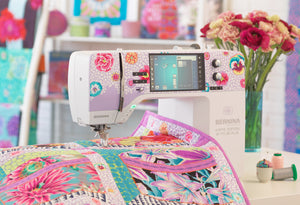
If you want a machine built around control and precision, the BERNINA 770 QE PLUS Kaffe Edition is a strong model to study closely.
Janome earns respect for a different reason. Many of these machines give you generous workspace, approachable controls, and very good feeding on the kinds of materials quilters use every week. If your sewing room is split between quilts, bindings, patchwork piecing, and occasional garment or accessory projects, that balance can make a lot of sense.
I often recommend Janome to students who want capability without quite as steep an entry price. On a faux fur hat, Janome can absolutely do the job, especially if the backing is stable and you prep the bulk carefully. The larger bed area also helps when you are rotating the hat body and keeping the flaps from bunching at the needle.
Its strength is versatility. Janome feels especially appealing for quilters who spend most of their time on cotton, batting, straight-line quilting, and larger projects where working room is part of the comfort.
For style inspiration before you sew your own winter version, it can help to browse warm bucket hat styles and study proportion, texture, and edge finish.
| Feature | BERNINA | Janome |
|---|---|---|
| Dense material handling | Usually more composed on thick, uneven seam intersections | Usually capable, but may need more careful pacing on the hardest spots |
| Machine feel | Very controlled and precise at slow speeds | Comfortable, approachable, and often roomy |
| Value position | Premium pricing | More budget-conscious overall |
| Best fit | Quilters who also sew bulky, technical, or fussy projects | Quilters who want space, versatility, and strong everyday performance |
For this trapper hat, BERNINA usually has the advantage on the toughest seam crossings. The machine tends to hold its line better when the layers shift from manageable to bulky in one rotation of the handwheel. That is exactly the kind of behavior advanced quilters notice and appreciate.
Janome still makes a smart case if quilting is your main focus and faux fur is an occasional adventure. You get a capable machine, a roomy sewing area, and good all-around value.
At High Country Quilts, I tell students to judge both brands with a real sample, not a flat cotton scrap. Fold the faux fur seam allowance. Add the lining. Sew the curve. The right machine reveals itself quickly when the project gets awkward.
A faux fur trapper hat can look homemade in the wrong way before it ever reaches the machine. I see this in class all the time at High Country Quilts. The fabric gets cut like fleece, the pile is chopped short at the edge, and every seam after that has to fight a problem that started on the cutting table.

Turn the faux fur wrong side up and work from the backing. Trace your pattern with a light hand, then use a sharp craft knife or razor blade to cut only the base fabric. Separate the piece gently with your fingers as you go so the long fibers stay intact.
That extra minute pays off at the seam.
Scissors tend to shear through the pile and leave a blunt edge. On a trapper hat, that shows most around the ear flaps and curved crown seams, where the fur should blend across the join instead of stopping abruptly. A knife keeps the edge soft, and the finished hat looks fuller.
A few habits make this part cleaner and more accurate:
For this project, pattern handling matters almost as much as the cut itself. Faux fur slides, curls, and hides markings. I like to use pattern weights instead of a lot of pins, then mark key match points with small clips in the seam allowance. That makes the curved sections easier to pair later, especially on the crown and side panels.
Machine choice still shows up here in a practical way. Quilters who sew on roomier machines often notice bulky pieces are easier to keep organized at the table and beside the machine. On a small project like a hat, that does not replace good cutting technique, but it does make the whole build feel less cramped once the fur shell starts taking shape.
Use your normal cutting tools for the lining. A rotary cutter, ruler, and mat are fine because you are cutting a stable fabric without pile. Double-check mirror-image pieces before you cut, particularly the ear flaps and side sections.
Take the cut fur pieces outside and give them a gentle shake. Loose fibers will release now instead of collecting around your feed dogs later. Then sort every piece right away so the nap direction stays consistent from shell assembly through final topstitching.
If you want a visual primer on handling faux fur before sewing, this quick demo is useful:
Feeling unsure? Our Beginner Sewing Workshops cover essential skills for handling all types of fabrics.
A polished faux fur seam starts at the cutting table. Once the pile is chopped, the machine can't put it back.
A faux fur trapper hat tests a machine in ways a flat cotton project never will. The pile shifts, the seam allowances get bulky fast, and the ear flaps create awkward curves that want to twist under the presser foot. Good results come from setup first, then steady sewing.

Start with a fresh heavy-duty needle. For this project, a size 100/16 or 110/18 is usually the right range. Pair it with a strong all-purpose or upholstery-weight thread so the seams can handle stress at the ear flaps and lower edge.
Set a longer stitch length, about 3.5 to 4.0 mm. Short stitches sink into the pile and can make the seam look weak, even when it is technically secure. Use a walking foot or integrated dual feed so the fur shell and lining feed at the same rate.
Clips usually work better than dense pinning here. As you secure the layers, sweep the fur inward with a bodkin, awl, or even a closed pair of scissors so less pile gets caught in the seam.
Sew the fur shell first while your hands and eyes are still fresh. Faux fur asks for more attention than the lining, and it rewards a deliberate sequence.
A practical order looks like this:
That cleanup step changes the finish more than many beginners expect. On a well-sewn hat, the seams should sink into the fur instead of reading like hard ridges.
This is one of the clearest places to feel the difference between the two brands in real use.
A BERNINA often feels more planted when the thickness changes suddenly, especially where multiple fur seams meet near the crown or flap base. The machine tends to hold a consistent stitch and cleaner line through those transitions. For instructors and frequent garment makers, that control is one reason the higher price can make sense.
A Janome can absolutely sew this hat well. Many Janome models have strong feeding and enough piercing power for faux fur and lining. In my experience, Janome machines often feel approachable and forgiving, while BERNINA machines usually give more fine control at the exact moments the project gets bulky and fussy.
That distinction matters on a trapper hat. Quilters often compare machines on piecing and free motion, but faux fur tells you quickly how a machine behaves under pressure.
Use your hands actively, but do not tug from the back. Let the feed system move the layers while you keep the nap clear of the needle path.
A few habits help every machine perform better:
If the presser foot starts climbing and the stitches shorten, stop and reset the layers. Forcing the seam usually creates a flat spot in the pile or a crooked join you will see every time the hat is worn.
If you'd like to feel that feed control before committing to a machine, schedule a test drive and bring a few bulky fabric layers with you. Testing on real materials tells you more than any brochure.
When both halves are built, place the fur shell inside the lining shell with right sides together. Match side seams, center points, and ear flaps carefully. If you're adding ties, tabs, or buckle components, sandwich them into the lower edge now so they're caught securely in the final seam.
Sew around the bottom edge, leaving an opening large enough to turn the hat right side out. Once turned, use your fingers or a blunt point turner to shape the curves and push the lining neatly into place. Then smooth the lower edge and topstitch around it to close the opening and give the hat a crisp, finished rim.
A trapper hat is easy to personalize without changing the core construction.
Try one of these variations:
Faux fur needs gentler care than most quilted accessories. Spot cleaning is the safest routine for everyday wear. Avoid the dryer, because high heat can damage or melt the fibers and ruin the surface texture.
Store the hat where the pile can stay uncrushed. If it gets flattened, a gentle shake and light finger-fluffing usually help restore the loft.
Good finishing isn't decoration. It's what makes a handmade project feel intentional the moment someone picks it up.
This project teaches more than hat construction. It teaches material handling, machine control, and the value of choosing tools that support the way you want to sew. If your work is moving from simple cotton piecing into denser fabrics, fussier seam stacks, or more ambitious makes, machine quality stops feeling optional.
Ready to take your sewing to the next level? Explore our full range of BERNINA sewing and quilting machines or sign up for our Advanced Skills Workshop to tackle your next dream project with expert guidance.
High Country Quilts is where Colorado Springs quilters and sewists can find expert guidance, thoughtful classes, and the support that makes a quality machine worth owning. Visit High Country Quilts to explore sewing and quilting resources, get help choosing the right BERNINA, and build skills for the projects you've been wanting to try.
At High Country Quilts we care deeply about community. With our experiences in retail, we know that a store is not only a place to shop but also a place for the community to gather and share. During this busy...

Hi! We’re Adam and Renee Wheaton, the new owners of High Country Quilts! For more than 40 years, we’ve owned and operated vacuum and sewing businesses. Following in Renee’s father’s footsteps after he retired from All Discount Vacuum and Sewing in Colorado...


Leave a comment