

We Love Our Quilting Community
At High Country Quilts we care deeply about community. With our experiences in retail, we know that a store is not only a place to shop but also a place for the community to gather and share. During this busy...


If you've ever admired a beautiful quilt, you've seen the intricate piecing of the top and perhaps the complementary fabric of the backing. But tucked away inside, there's an unseen layer that truly brings the quilt to life: the batting. This is the heart of your project.
Think of batting as the soul of your quilt. While the colorful top gets all the glory, the batting is the quiet workhorse that dictates warmth, weight, and overall character. It's the secret ingredient that makes a quilt either a light, airy wall hanging or a thick, cozy bedspread perfect for snuggling under on a cold winter night.
Choosing the right batting for quilts is just as important as picking your fabrics. In this guide, we'll pull back the curtain on batting, breaking down everything you need to know to make the perfect choice for every project you create.
The batting you choose has a huge impact on the finished quilt. It's not just stuffing; it's a design element that shapes the function and feel of your final piece.
Your batting selection directly influences:
Before we get too deep into batting, it helps to be clear on what makes a quilt a quilt. You can explore the distinction between a quilt and a duvet to better understand its unique three-layer construction.
This love for handmade, personalized decor is a big reason why quilting is more popular than ever. The global quilt market reached a value of $5.32 billion and is expected to grow significantly by 2034, showing just how much people appreciate a well-made quilt.
Choosing the right batting is like picking the perfect filling for a pie—it defines the final character, warmth, and texture of your quilt. The fiber you select will have the biggest impact on how your quilt feels, drapes, and holds up over time. It’s the heart of your quilt sandwich.
Let's dive into the most common options, starting with the one most quilters know and love: cotton.
Cotton is the tried-and-true workhorse of the quilting world for good reason. It’s a soft, breathable, natural fiber that’s just a joy to work with. If you’re ever unsure what to use, cotton is almost always a safe and beautiful bet.
One of cotton's most famous traits is its slight shrinkage, typically around 3-5%. This isn't a flaw; it's a feature! That little bit of shrinkage after the first wash is what creates that classic, crinkly, well-loved look that we all associate with heirloom quilts. It snuggles the fabric and stitches together beautifully.
The infographic below really drives home just how popular cotton is among quilters.
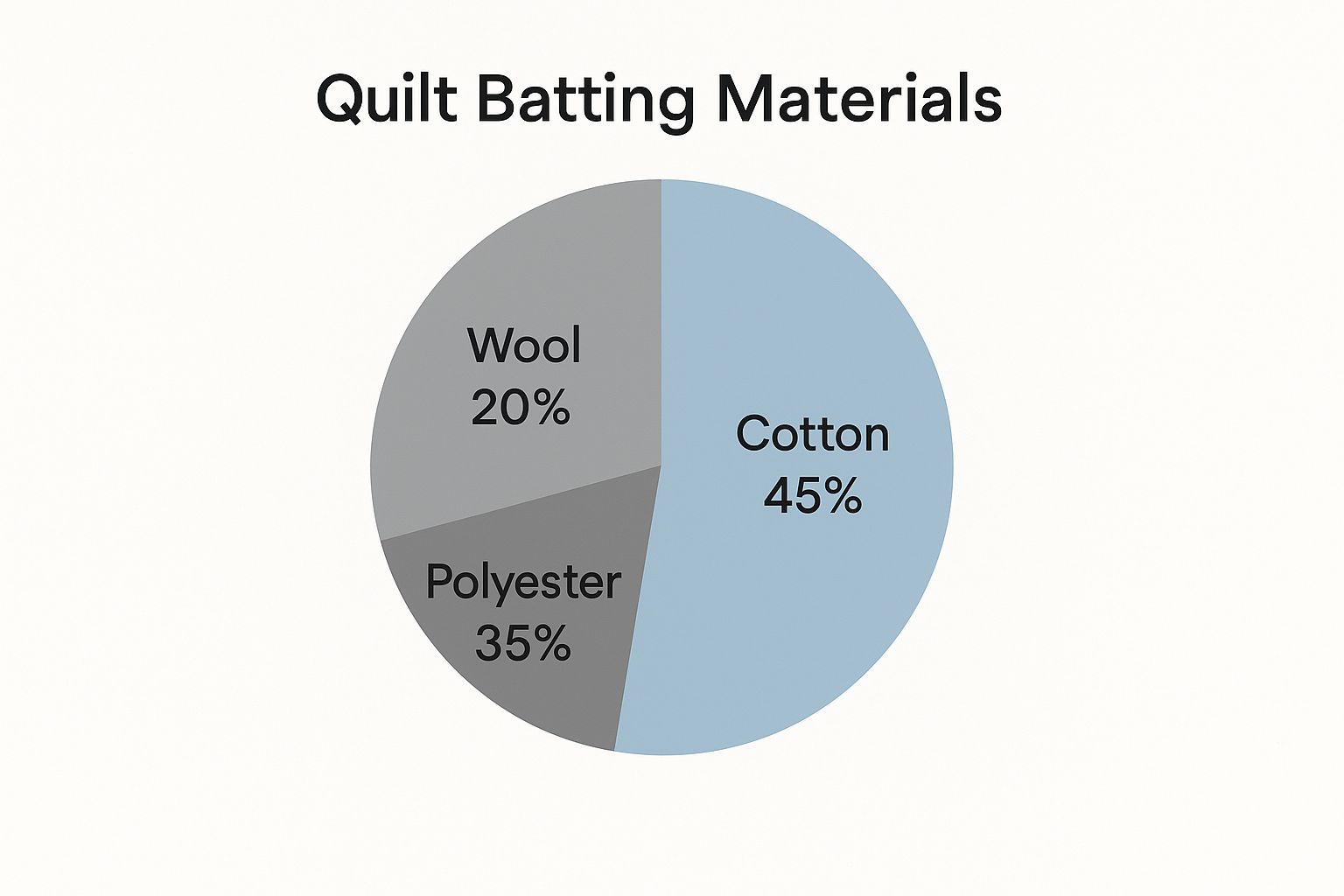
As you can see, cotton holds a commanding lead. It's the go-to choice for nearly half of all quilters, which speaks volumes about its reliability and timeless appeal.
This preference is reflected across the board. In the wider quilt market, cotton quilts make up a massive 42.7% of the material segment, showing how much people love natural fibers in their homes. This strong demand keeps the global textile industry buzzing, ensuring quilters have steady access to high-quality cotton. You can learn more about how quilt market trends influence material choices and availability.
Key Insight: Cotton batting gives quilts a comforting weight and a beautiful, soft drape that gets even better with age. It’s perfect for projects where you want a flatter, more traditional look that really lets your piecing and stitch work shine.
Cotton batting is an excellent choice for:
Next in line is polyester, a synthetic powerhouse known for being tough, affordable, and resilient. If you’re looking for a quilt that stays smooth and pristine, poly is your friend. It has virtually no shrinkage, so your quilt will keep its modern, unwrinkled look wash after wash.
Polyester is also surprisingly lightweight for the warmth it provides. This makes it a fantastic option for a big, cozy bed quilt that won't feel heavy or restrictive. Plus, it's naturally resistant to mold and mildew, which is a great practical bonus, especially in humid climates.
When you want to create something truly special, look no further than wool. Wool batting offers incredible warmth without the bulk, thanks to its natural loft and resilience. It resists creasing and springs back into shape, which makes your quilting stitches pop with amazing texture and definition.
Wool is a master insulator. The fibers create tiny air pockets that trap body heat, making it one of the warmest options out there—ideal for a quilt you’ll be snuggling under all winter. But it’s not just for warmth; wool is also breathable and wicks moisture away, keeping you comfortable.
To help you decide, let's lay out a quick side-by-side comparison of these popular fibers.
This table breaks down the core differences between the "big three" batting materials to help you match the right fiber to your project.
| Material | Key Characteristics | Best For | Shrinkage | Care Instructions |
|---|---|---|---|---|
| Cotton | Soft, breathable, natural fiber with a traditional feel and drape. | Traditional quilts, baby quilts, wall hangings, machine quilting. | 3-5% (creates a vintage, crinkled look). | Machine wash cold, tumble dry low. Can be pre-soaked to minimize shrinkage. |
| Polyester | Lightweight, durable, and affordable. Maintains a smooth, modern look. | Bed quilts, children's quilts, modern designs, projects needing high loft. | Little to none. | Machine wash and dry. Very low maintenance and resilient. |
| Wool | Exceptionally warm, lightweight, and lofty. Creates beautiful stitch definition. | Show quilts, winter quilts, hand quilting, projects needing warmth without weight. | Can shrink if not treated. Look for "pre-shrunk" or "washable" wool. | Wash on a gentle, cool cycle or hand wash. Air dry or tumble dry with no heat. |
Each material offers a distinct personality, and understanding their strengths is the key to a successful quilt.
Beyond the mainstays, you'll find other wonderful fibers like bamboo and silk. Bamboo batting, often blended with cotton for stability, is prized for its silky-soft feel and incredible drape. It's a more sustainable choice that’s also naturally antimicrobial.
Silk blends offer a similar luxurious feel but are even lighter, creating a quilt with a stunning, fluid drape. They’re a more premium option, but for an art quilt, a special throw, or a quilted garment, they are simply unmatched. Ultimately, every material gives you a unique way to bring your vision to life, making the choice of batting for quilts a fun and creative part of the process.
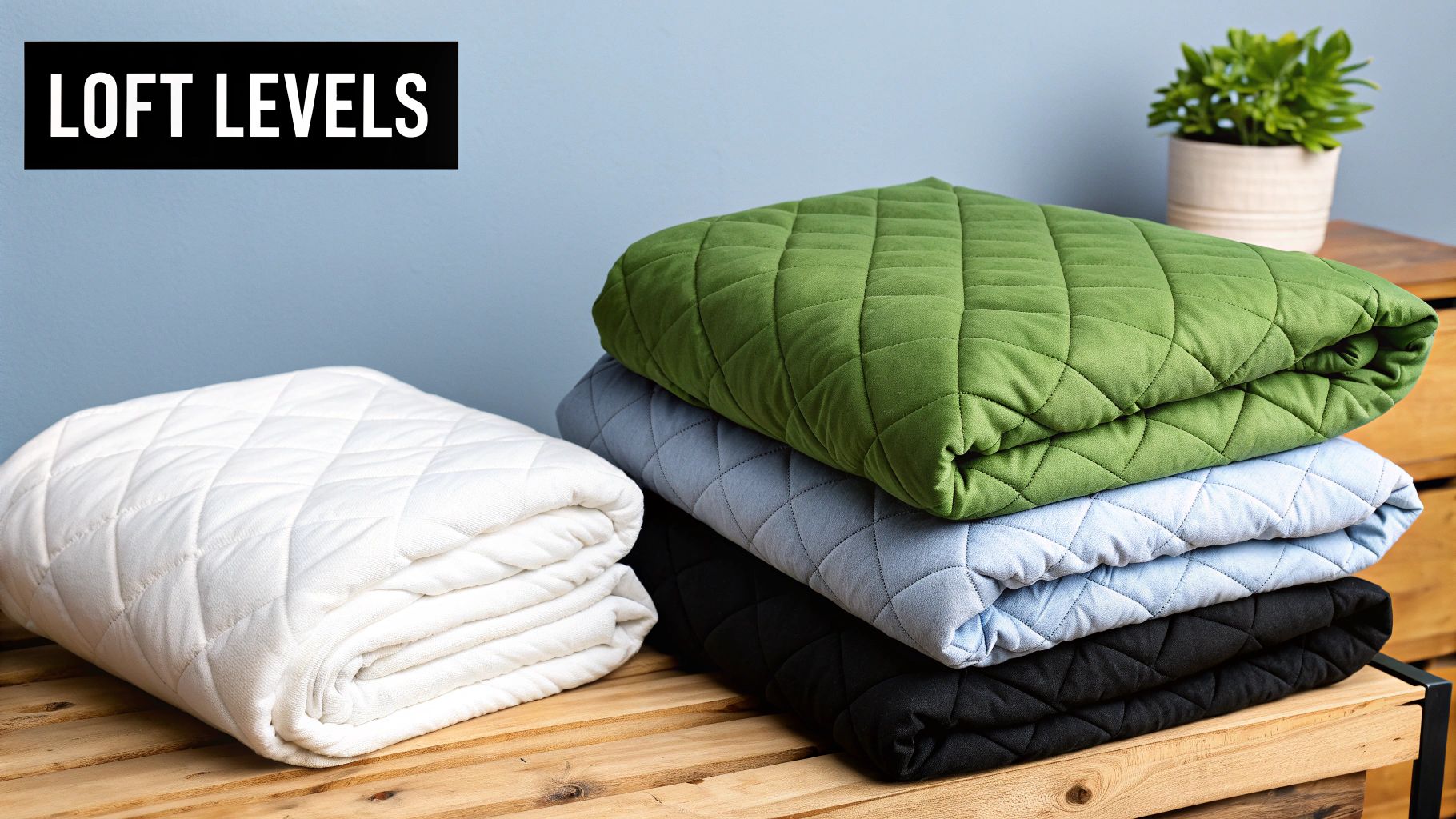
Beyond the fiber itself, the next big decision you'll make when choosing batting for quilts is about its loft. Think of loft as the batting's thickness—its "fluff factor." It's a simple idea, but it has a huge impact on your quilt's final texture, warmth, and overall personality.
Picking the right loft isn't about finding the "best" one. It's about matching the batting to your creative vision for the project. A low-loft batting keeps things thin and sleek, while a high-loft batting gives you that puffy, cloud-like quilt many people dream of. What you choose will either let your stitch work take center stage or create a plush, deeply textured surface.
Low-loft batting is the thinnest you can get, usually measuring around 1/8 inch thick. It creates a quilt with a flat, traditional drape that feels more like a classic coverlet than a puffy comforter. Because it's so thin, it's a dream to quilt through, whether you’re working by hand or on your home sewing machine.
This lack of puffiness is its main feature. Your intricate quilting stitches and beautiful piecing become the star of the show. The stitches lie flat against the fabric, creating crisp, clean lines that aren’t swallowed up by the batting.
Low-loft is my go-to choice for:
Medium-loft batting really is the sweet spot between definition and coziness. It’s a bit thicker than low-loft, typically around 1/4 to 3/8 inch, giving you more substance and warmth without getting too bulky. This makes it an incredibly popular and versatile choice for all kinds of projects.
It has just enough puff to give your quilting stitches a gentle, soft definition, helping them stand out without being overwhelming. This is often the default batting for quilts meant for everyday use—the ones that live on beds and couches, providing comfort and durability through years of use and washing.
Pro Tip: When in doubt, start with a medium loft. It’s a forgiving middle ground that works well for both machine and hand quilting, and it consistently delivers that classic, comfortable quilt feel.
This perfect balance makes it the reliable choice for functional quilts you actually want to live with.
When you want a quilt with that dramatic, cloud-like texture, high-loft batting is your answer. Measuring 1/2 inch or even thicker, this is the puffiest and warmest option available. It creates a thick, incredibly plush quilt that feels much more like a traditional comforter.
All that thickness can make high-loft batting a little tricky for dense machine quilting. It can be a real workout trying to push all that bulk through a standard machine. For this reason, it’s a fantastic choice for tied quilts or projects with minimal, large-scale quilting where the loft itself is the main attraction.
Choose high-loft batting when you’re making:
Ultimately, the loft you choose is a powerful tool in your quilter's toolkit, giving you complete control over the final look and feel of your masterpiece.
So, you’ve got a handle on the different materials and lofts. Now comes the big question: which one is right for your quilt? This can feel a little daunting, but it doesn't have to be. The secret is to stop thinking about abstract specs and start thinking about your specific project.
I like to think of it as playing detective. By asking just a few simple questions about your quilt's future, you can easily zero in on the perfect batting. This simple framework will help you make a confident choice every single time.
Before anything else, figure out how this quilt is going to be used. Its job in the world is the single biggest clue to what it needs on the inside.
A Delicate Baby Blanket: For a newborn, you’ll want something incredibly soft, breathable, and—most importantly—washable. A high-quality 100% cotton or a soft bamboo blend is a wonderful choice. These natural fibers are gentle on sensitive skin and can stand up to the frequent washing a baby quilt is bound to go through.
A Durable Bedspread: A quilt destined for a bed needs to be a real workhorse. It has to provide comfort, hold up to daily use, and survive regular trips to the laundry room. An 80/20 cotton/poly blend is a fantastic, reliable option here, giving you the cozy feel of cotton with the strength and low shrinkage of polyester.
A Decorative Wall Piece: If your quilt is going to be art, its main job is to hang beautifully and show off your stitching. A low-loft cotton or a silk blend is ideal. It helps the quilt hang flat and provides just enough body to define your quilting without adding extra bulk or weight.
It’s amazing how much a quilt’s function drives design. Globally, quilts designed for year-round use are a huge market, with the Asia Pacific region alone accounting for 22.5% of sales. It just goes to show that practicality is a major consideration for quilters everywhere. You can explore more about the adaptable quilt market at cognitivemarketresearch.com.
Next, close your eyes and picture the finished quilt. What’s its personality? The batting you choose is a key ingredient in achieving that final look and feel.
Are you dreaming of that crinkly, well-loved, vintage look? Go with 100% cotton batting. It shrinks just a little (3-5%) after the first wash, which creates that classic, slightly puckered texture that makes a quilt feel like a timeless heirloom.
On the other hand, if you’re going for a crisp, modern aesthetic, polyester batting is your friend. It has virtually no shrinkage, so your quilt top will stay smooth and flat, preserving the sharp lines of your piecing.
And for that big, puffy, cloud-like comforter you just want to sink into? You’ll want a high-loft wool or polyester batting. This will create deep, defined channels that really make the quilting pop and give the whole project an incredibly cozy, inviting feel.
Always consider the person who will be snuggling under your quilt. Their needs, especially when it comes to allergies or care, are a crucial part of the puzzle.
Key Consideration: Always think about allergies and care needs. A beautiful quilt that can't be used is a heartbreaking outcome.
Here’s what to keep in mind:
Finally, how are you planning to quilt this project? Your method—whether you’re working by hand or on a machine—can make one type of batting a dream and another a total nightmare.
For hand quilting, you need a batting that’s easy on your hands. A needle should glide through it with minimal effort. Low-loft cotton or wool are both fantastic choices. They’re soft and forgiving. The one thing to avoid is a batting with a scrim, as that tough stabilizing layer can be a real battle to stitch through by hand.
If you’re machine quilting, you have a lot more flexibility. A batting with a scrim, like an 80/20 blend, is actually a huge help. It adds stability and lets you place your quilting lines farther apart without the batting shifting or bunching up. For dense free-motion quilting, a low-loft batting is perfect because it won’t obscure your intricate stitchwork.
By walking through these four questions—purpose, aesthetic, user, and method—you build a clear roadmap. It takes the guesswork out of the equation and ensures the heart of your quilt is a perfect match for your vision.
To make things even simpler, here is a quick reference table to guide you. Think of this as a starting point to help you narrow down the best options for your next project.
| Quilt Project Type | Recommended Batting Material | Recommended Loft | Key Considerations |
|---|---|---|---|
| Baby Quilt | Cotton, Bamboo, Organic Cotton | Low | Must be washable, soft, and breathable. Natural fibers are gentle on skin. |
| Bed Quilt (Everyday Use) | 80/20 Cotton/Poly Blend, Polyester | Low to Medium | Durability and ease of care are key. Blends offer the best of both worlds. |
| Heirloom Quilt | 100% Cotton, Wool, Silk | Low to Medium | Choose materials that will age beautifully. Cotton for a classic puckered look. |
| Wall Hanging/Art Quilt | Cotton, Silk, Fusible Fleece | Low | Needs to hang flat without sagging. Stitch definition is important. |
| T-Shirt/Memory Quilt | Polyester, 80/20 Blend with Scrim | Low | Often heavy, so choose a lightweight batting. Scrim adds needed stability. |
| Hand-Quilted Project | 100% Cotton (no scrim), Wool | Low | Must be easy to needle. Avoid dense battings or those with a scrim. |
Remember, these are just guidelines! The wonderful thing about quilting is that you get to make the final call. Don't be afraid to experiment to find the combination you love most.
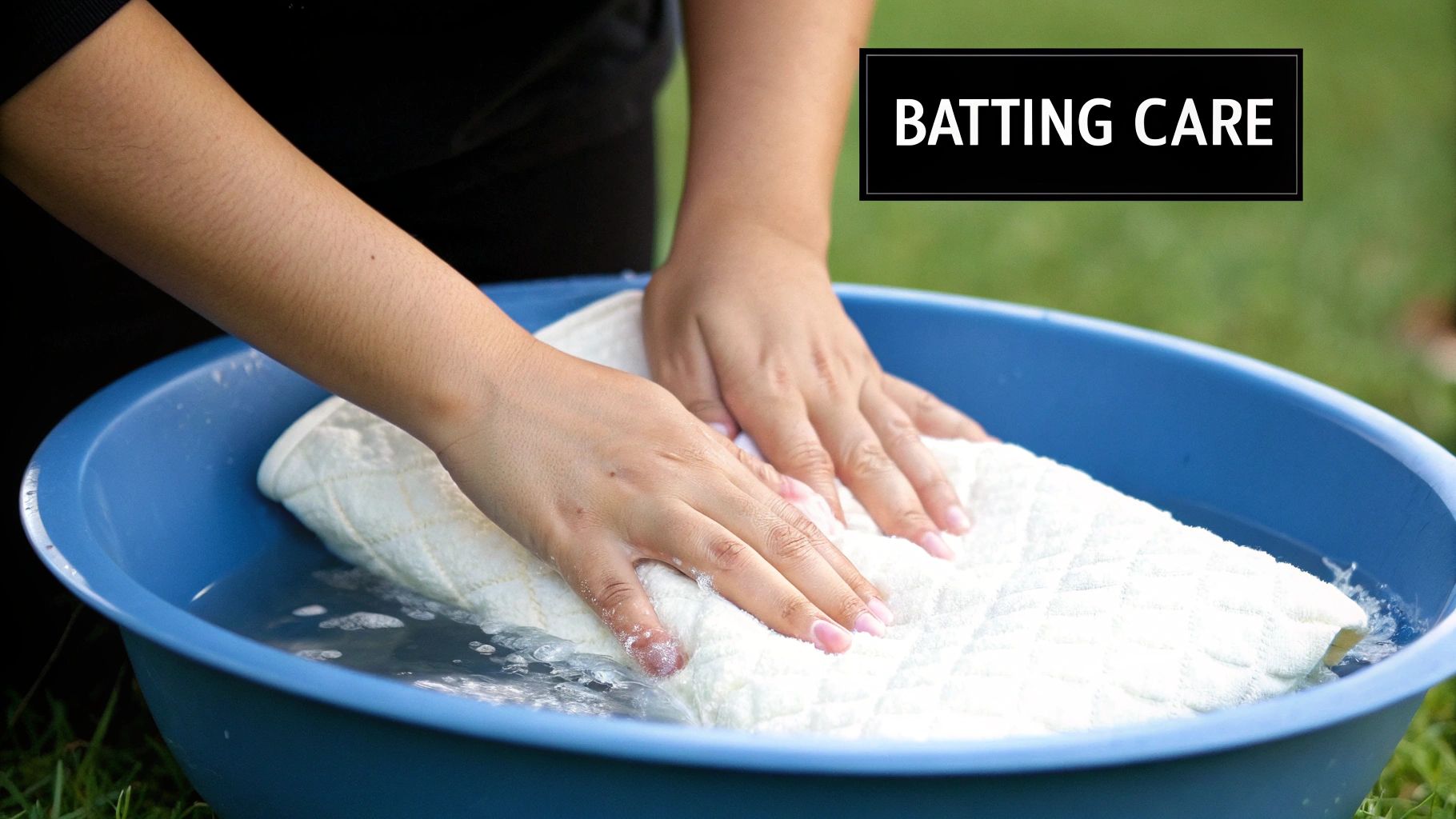
A beautiful quilt doesn't just happen at the sewing machine. The real magic starts before you even thread the needle. Taking a little time to prepare your batting properly is the secret to getting that smooth, pucker-free finish we all crave. And once your masterpiece is complete, knowing how to care for it will ensure it becomes a cherished heirloom for years to come.
The first big question that comes up is whether or not to pre-wash your batting. While it’s not always a must-do, your decision here can totally change the look of your finished quilt.
So, why bother pre-washing? The main reason is to get any potential shrinkage out of the way. This is a huge deal for 100% cotton batting, which can shrink up to 3-5% the first time it gets washed. If you love that cozy, slightly crinkled, vintage look on a finished quilt, then you can skip this step entirely. Letting the batting shrink after quilting is what creates that wonderful texture.
On the other hand, if you're going for a crisp, modern aesthetic and you’ve already pre-washed your fabrics, you absolutely should pre-wash your batting. This gets all three layers of your quilt sandwich on the same page, so they shrink together and you avoid any weird puckering or bunching.
Key Takeaway: Pre-washing cotton batting gives you control over the final texture. Skip it for a vintage crinkle; do it for a modern, flat finish.
What about other types? For polyester and wool battings, you can usually skip the pre-wash. They have very little, if any, shrinkage. But, it's always a good idea to glance at the manufacturer's instructions on the package just to be sure.
If you do decide to pre-wash, here's a safe way to do it:
With your batting prepped and ready, it's time to make your quilt sandwich: the backing, the batting, and your quilt top. The process of temporarily holding these layers together is called basting, and it's your best defense against the fabric shifting and creating dreaded puckers while you quilt.
The goal here is a perfectly smooth, taut surface. Start by laying your backing fabric (wrong-side up) on a large, flat surface and tape the edges down. Next, smooth your batting over the top, followed by your quilt top, making sure every single wrinkle is gone from each layer. Then, use your favorite method—safety pins, basting spray, or even long hand stitches—to secure all three layers together.
How you care for your quilt down the road really comes down to the batting for quilts you chose. Natural fibers and synthetics have different needs.
For quilts made with cotton or wool batting, a gentle cycle in the machine with cool water and a mild detergent is usually best. You can then tumble dry on low or lay it flat to air dry. When it comes to synthetics like polyester, knowing the right approach to cleaning is key; you can find great tips for caring for polyester batting to keep it in top shape. A little proper care goes a long way in keeping your quilt beautiful for a lifetime.
We’ve all been there. You finish a beautiful quilt top, put everything together perfectly, and then... something goes wrong with the batting. The good news is that most of these headaches are completely avoidable once you know what to look for.
One of the most frustrating problems is something called bearding. It’s exactly what it sounds like—pesky little fibers from your batting start poking through your fabric, making your quilt look fuzzy. This is especially noticeable on dark, solid fabrics where every little white speck stands out.
What causes this? Usually, the culprit is your needle. If it's too big or has a dull point, it basically punches a hole in the fabric instead of slipping between the threads. That little hole is all the invitation a fiber needs to escape.
A little planning goes a long way. Making the right choices before you even thread your needle can save you a world of frustration and ensure your quilt looks polished and professional.
To stop bearding in its tracks, start with a high-quality, tightly woven fabric for your quilt top and back. Then, and this is a big one, always start with a fresh, sharp needle. For most machine quilting, a size 75/11 or 80/12 quilting needle is a perfect starting point.
Another classic mistake is not paying attention to the manufacturer's recommended quilting distance. This is the absolute maximum space you can leave between your quilting lines. If you go wider, the batting can shift around, bunch up, or even come apart inside your quilt after a wash.
Crucial Tip: Look for the "quilt up to X inches apart" note on the batting package and treat it as law. Ignoring this can turn your beautiful quilt into a lumpy mess after its first trip to the laundry.
I see this all the time: a quilter grabs a super fluffy, high-loft batting but has a design with tons of dense, intricate stitching. While that plush batting is fantastic for a cuddly, tied quilt, fighting it through a sewing machine for dense quilting is a nightmare. It also compresses the batting so much that you lose the very puffiness you wanted in the first place.
Here’s how to sidestep those common mismatches:
Problem: Using a high-loft batting for dense machine quilting.
Problem: Ignoring the recommended quilting distance.
Problem: Batting fibers "bearding" through the fabric.
Even after you've picked your material and loft, a few nagging questions can pop up when you’re about to start a project. Let's tackle some of the most common things quilters ask about batting for quilts, so you can get back to your sewing machine with total confidence.
Think of this as a quick chat with a quilting friend, clearing up those little details that make a huge difference in how your quilt turns out.
You absolutely can! Layering batting is a fantastic trick quilters use to get just the right effect. Most often, it's about adding serious warmth or making your quilting stitches pop with incredible texture. You get to mix and match the best qualities of different fibers.
A go-to combination I love is pairing a thin, stable cotton batting with a fluffy polyester or wool batting on top. The cotton acts as a solid base, preventing any weird stretching, while that lofty second layer gives your stitches that beautiful, high-definition look.
If you decide to double up, just keep these tips in mind:
You’ve probably seen the word scrim on a batting label, usually with cotton or cotton blends, and wondered what it is. Scrim is simply a very thin, lightweight grid of stabilizer that's been needle-punched right into the batting. Its job is to add strength and stability.
Imagine a fine mesh embedded within the fibers, holding everything neatly together. This internal support keeps the batting from stretching or getting distorted as you quilt.
The real magic of scrim? It allows for much wider quilting distances—sometimes up to 8-10 inches apart! This means you can create more open, modern quilting designs without worrying about the batting bunching or coming apart in the wash. It’s a dream for machine quilters, but be warned: it can be a bit tough to needle by hand.
Good storage habits protect your batting scraps for future projects. Here's the most important rule: roll, don't fold. Folding creates creases that are a real headache to get out later—sometimes they're permanent.
The best way to store it is to gently roll your leftover batting. If you have a cardboard tube from wrapping paper, that's perfect for keeping the roll smooth and supported. Slide the whole thing into a big plastic bag to keep it safe from dust, moisture, and moths.
Find a cool, dry spot away from sunlight to stash your roll. Standing it up in the back of a closet or tucking it under a bed works perfectly to keep it safe, sound, and ready for its next life in a quilt.
At Famcut.com, we know that great quilts start with great materials. Dive into our huge selection of top-quality fabrics and quilting supplies to get everything you need for your next masterpiece. Find your inspiration at https://famcut.com.
At High Country Quilts we care deeply about community. With our experiences in retail, we know that a store is not only a place to shop but also a place for the community to gather and share. During this busy...

Hi! We’re Adam and Renee Wheaton, the new owners of High Country Quilts! For more than 40 years, we’ve owned and operated vacuum and sewing businesses. Following in Renee’s father’s footsteps after he retired from All Discount Vacuum and Sewing in Colorado...


Leave a comment