
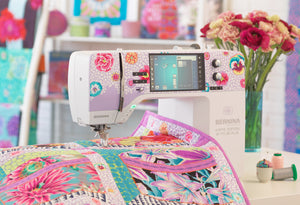

We Love Our Quilting Community
At High Country Quilts we care deeply about community. With our experiences in retail, we know that a store is not only a place to shop but also a place for the community to gather and share. During this busy...


If you're just starting out, the sheer number of "standard" baby quilt sizes can feel a bit overwhelming. But don't worry, it's simpler than it looks. Think of these dimensions less as strict rules and more as time-tested guidelines that ensure your beautiful creation is also perfectly practical.
Most baby quilt sizes are designed around how they'll be used. A tiny quilt for snuggling is going to be very different from one meant to cover a crib mattress or become a play space on the floor. Getting a handle on these common sizes is the first step to quilting a gift that's as useful as it is cherished.
When most people picture a baby quilt, they're thinking of a crib quilt. The typical size lands somewhere around 36 x 52 inches.
This dimension isn't random; it's designed to fit perfectly inside a standard crib. It's generous enough to keep a baby cozy during supervised naps and can easily transition with the child to a toddler bed later on. It’s a truly versatile size that gets years of love.
Of course, quilts aren't just for the crib! There are a few other key sizes you'll come across, each with its own special purpose.

As you can see, a quilt can be a constant companion for a baby, from a tiny lovey for comfort to a soft mat for playtime.
This isn’t just a cottage craft, either. The demand for handmade and high-quality baby items has made crib quilts a cornerstone of a growing market. In fact, the standard 36 x 52 inch crib quilt became popular in the U.S. early in the 20th century, a direct result of crib mattress sizes being standardized for safety. It's a tradition rooted in practicality.
Knowing these measurements is your starting point. And if you're planning for a quilt that will grow with the child, understanding standard toddler bed measurements is a great next step in your quilting journey.
Knowing the standard baby quilt dimensions is one thing, but figuring out which size to actually make is where the real art comes in. The numbers on a chart are a great starting point, but they don't tell the whole story. The magic really happens when you match the quilt's size to its purpose, creating a beautiful gift that’s also incredibly practical.

Think of it like picking the right tool for a job. A small, lightweight Stroller Quilt, which usually hovers around 30 x 40 inches, is perfectly designed for being on the move. Its compact size means it won't drag on the pavement or get tangled in stroller wheels, making it perfect for tucking around a baby in a car seat or buggy.
On the other hand, a bigger Play Mat Quilt—often 40 x 40 inches or even larger—serves a totally different need. It’s all about creating a generous, clean space for tummy time, those adorable milestone photos, or just a soft spot to play on the floor. Here, creating a comfy little island for baby is far more important than portability.
The best way to land on the right dimensions is to ask one simple question: "How is this quilt really going to be used?" Your answer will immediately point you in the right direction.
It's also worth thinking about the baby's environment. The ideal dimensions can vary quite a bit between different baby sleep spaces, since a standard crib needs a different size than a more compact bassinet or playpen.
Pro Tip: If you're making a quilt as a gift and aren't sure what the parents need, a Crib Quilt (around 36 x 52 inches) is almost always a safe and versatile bet. It’s large enough to double as a play mat on the floor but still fits perfectly in a standard crib, offering the best of both worlds.
So, you’ve picked a size for your baby quilt. But here's a little secret every seasoned quilter learns (sometimes the hard way): the size you piece is not the size you get. Think of it like baking a cake—the batter you pour into the pan isn't the same size as the finished, cooled cake.
This is where a bit of "quilter's math" comes into play. Getting a handle on these simple calculations is what separates a good quilt from a great one, and it saves you from that frustrating moment when your finished quilt comes up just a bit too short.
The first and most important rule in the quilter's handbook is the seam allowance. In the quilting world, the gold standard is a precise ¼-inch seam. Every time you join two pieces of fabric, a quarter-inch from each piece disappears into that seam.
That means for every single seam, you lose a total of ½ inch from your fabric's original cut size. It might not sound like a big deal, but it adds up surprisingly fast across an entire quilt. Imagine a crib quilt made of nine 12-inch blocks in a row. By the time you sew them all together, you've lost a significant amount of fabric in the seams. Forgetting this simple step is the number one reason a quilt doesn't end up the size the quilter planned.
Key Takeaway: Always add ½ inch to your desired finished block size before you cut. For a perfect 4-inch finished square, you need to start with a 4½-inch piece of fabric to account for that ¼-inch seam on all four sides.
Seams are just the beginning. A few other things can quietly shrink your quilt's dimensions, and they often catch new quilters by surprise.
Batting Loft and Quilting: The batting is the fluffy middle layer of your quilt, and its thickness is called loft. The puffier the batting, the more it "pulls" the quilt top and backing inward as you stitch everything together. This can shrink your final quilt by up to 5%! The style of your quilting matters, too—dense, intricate stitching will cause more shrinkage than simple, wide-apart lines.
Pre-washing Fabric: It's always a good idea to wash and dry your fabric before you start. This prevents colors from bleeding later and, crucially, gets most of the shrinkage out of the way. Cotton fabric can shrink by as much as an inch per yard, so you have to account for that before you even make your first cut.
The Binding: Don't forget the very last step! The binding is the fabric frame that encloses the raw edges of your quilt. It typically covers up about ¼ inch of the quilt's edge all the way around, on both the front and back. It’s a small detail, but it’s the finishing touch that affects the final measurement.
Getting these calculations right isn't just for looks—it’s a matter of safety. Precise baby quilt dimensions are critical. In fact, safety data shows that quilts oversized by just 4 inches can increase entanglement risks by 18%. If you're interested in the details, you can explore more data-driven insights about baby product safety to see why accuracy is so important. By mastering this simple math, you’re creating a quilt that is not only beautiful but also perfectly and safely sized for a little one.
Have you ever found the perfect quilt pattern, only to realize it’s written for a king-sized bed and you need it for a crib? Don’t toss that inspiration aside. Learning how to adapt a pattern is one of the most freeing skills you can develop as a quilter, letting you get the exact baby quilt dimensions you need.
This isn't about complicated, scary math. It's really about looking at how a quilt is built and then making a few simple tweaks. Once you get the hang of it, you can turn almost any design into the perfect size for your project, opening up a whole new world of creative freedom.
When it comes to resizing a quilt pattern, it almost always boils down to two main strategies. The first is super straightforward: just change how many blocks you make. The second gives you a bit more design control and involves changing the size of the blocks themselves.
Adjusting Block Count and Borders: This is easily the most common and simplest method. If a pattern for a big throw calls for a 10x10 grid of blocks, you could shrink it down to a 6x8 grid for a crib quilt. From there, you can add or remove borders to get the final size just right.
Resizing the Quilt Blocks: This approach is perfect when you want to keep the pattern’s original proportions, just in a smaller package. It takes a little more planning and calculation, but it puts you in complete control of the final dimensions.
For instance, if a design uses 12-inch finished blocks, you can rework the math to make 8-inch or 9-inch versions instead. This lets you keep the visual feel of the original design while hitting your target size with precision.
Let's walk through how this works with a classic nine-patch block. Say your goal is a 36 x 45-inch crib quilt, and you want to use nine-patch blocks that finish at 9 inches square.
A little quick math tells us you'd need a grid of 4 blocks wide by 5 blocks tall (because 4 x 9" = 36" and 5 x 9" = 45"). Simple enough!
The Simple Math: To get a 9-inch finished block, each of the nine small squares inside it needs to finish at 3 inches. When we add our standard ¼-inch seam allowance all around, that means you need to cut each of those small squares at 3.5 x 3.5 inches.
By starting with your desired finished block size and working backward, you can figure out the cutting measurements for any component. This same logic works for everything from simple squares to intricate star blocks. Once you master this skill, you'll start seeing patterns not as rigid rules, but as flexible blueprints for your next beautiful baby quilt.
A gorgeous, flat quilt all comes down to one thing: accurate cuts. This is the moment your baby quilt dimensions become real, and getting it right from the start makes every single step that follows—from piecing to binding—so much easier and more fun.

I always think of my fabric and tools like a chef’s ingredients. Precision is key. In the world of quilting, that means squaring up your fabric before you even think about making your first cut. Fabric almost never comes off the bolt perfectly straight, so taking a moment to create a true 90-degree corner is a non-negotiable step. It guarantees every strip and square you cut from it will be spot-on.
Your success really depends on having the right tools for the job. You can certainly get by with a pair of scissors and a basic ruler, but a few key items will make a world of difference in your precision and speed.
These three tools are designed to work together as a system. You'll line up the markings on your ruler with the grid on your mat, and your rotary cutter will run right along the ruler’s edge for a perfectly straight cut, every single time.
Pro Tip: When you're cutting, always hold your ruler down firmly with your non-dominant hand. I find that spreading my fingers wide gives me the most stability. Let the rotary cutter do the work; all you need is gentle, even pressure as you push it away from your body.
With your fabric squared up, you can now confidently cut the strips and shapes your pattern calls for. To cut strips, just align that perfectly squared edge of your fabric with one of the horizontal lines on your mat. Lay your ruler on top at the desired width, and zip your rotary cutter along the edge.
This careful prep work is what makes piecing a joy instead of a frustrating puzzle. When your cuts are accurate, your points will match up, your seams will nest together beautifully, and your finished quilt blocks will be exactly the right size. When you slow down and focus on these fundamentals, you’re not just cutting fabric—you’re setting yourself up for a professional-looking quilt that you can truly be proud of.
Let's be honest, figuring out the "right" size for a baby quilt can feel a little daunting. You pour your heart into every stitch, and you want it to be perfect. Think of this as a conversation with a seasoned quilter, where we’ll tackle all those questions buzzing in your head.
We'll clear up the confusion so you can get back to the fun part: creating something beautiful.

From safety to fabric math, getting these details right is what makes a quilt not just lovely, but truly useful. Let's dive in.
If you want to make one quilt that does it all, you can't go wrong with a classic Crib Quilt. Measuring around 36 x 52 inches, this size is the undisputed champion of versatility.
It’s big enough for tummy time on the floor, giving the baby a soft, clean spot to play. Later on, it’s the perfect cozy layer for a toddler bed. While it’s designed to fit a standard crib, just remember that for safe infant sleep, quilts and blankets should be kept out of the crib itself.
This generous size ensures it will be a cherished and functional heirloom for years, making it a safe bet if you're not sure exactly what the new parents need.
Ah, the age-old question! While every pattern is different, there are some solid starting points for a 36 x 52-inch crib quilt. My advice? Always buy a little extra. You'll thank yourself later.
Here’s a general guideline to get you started:
A Quilter's Golden Rule: Always buy a little more fabric than the pattern calls for. It's your insurance policy against pre-washing shrinkage, an accidental mis-cut, or that last-minute creative spark that changes your design.
Absolutely! This is a fantastic way to use a design you've fallen in love with. Scaling a pattern down isn't nearly as complicated as it sounds—it just requires a bit of planning.
The easiest method is to simply reduce the number of blocks or leave off a border or two. For instance, if a lap quilt pattern uses a 5x6 grid of blocks, you could shrink it to a 3x4 grid for a perfect baby quilt size. This keeps the block design intact while changing the overall dimensions.
Feeling more adventurous? You can recalculate the math for each piece to shrink the blocks themselves. This is more involved but keeps the quilt's original proportions. Whichever path you choose, always make a single test block before you cut all your fabric. It's the best way to be sure your new measurements work just right.
When a new baby is involved, safety is everything. This is one area where we need to be crystal clear.
The American Academy of Pediatrics recommends that a baby's crib be free of any soft bedding, including quilts and blankets, to reduce the risk of SIDS. So, for newborns, quilts are best used for supervised moments outside the crib.
That's why a Stroller Quilt (around 30 x 40 inches) or a Tummy Time Mat (around 36 x 36 inches) are such wonderful and safe choices. They're ideal for keeping baby cozy in a car seat or stroller, and they provide a clean surface for playtime on the floor—all under a watchful eye. Your beautiful quilt can be a comforting part of the baby's waking hours from day one.
At High Country Quilts, we believe that every stitch tells a story. Whether you're a seasoned quilter or just starting your creative journey, we have the fabrics, tools, and expertise to help you bring your vision to life. Visit our shop in Colorado Springs or explore our wide selection online to find everything you need for your next project.
Discover your next inspiration at https://hcquilts.com.
At High Country Quilts we care deeply about community. With our experiences in retail, we know that a store is not only a place to shop but also a place for the community to gather and share. During this busy...

Hi! We’re Adam and Renee Wheaton, the new owners of High Country Quilts! For more than 40 years, we’ve owned and operated vacuum and sewing businesses. Following in Renee’s father’s footsteps after he retired from All Discount Vacuum and Sewing in Colorado...


Leave a comment