

We Love Our Quilting Community
At High Country Quilts we care deeply about community. With our experiences in retail, we know that a store is not only a place to shop but also a place for the community to gather and share. During this busy...


The 9 patch quilt block is one of those timeless, fundamental patterns every quilter should know. At its heart, it’s a simple design: just nine squares of fabric sewn together into a three-by-three grid. But don't let that simplicity fool you.
It’s the perfect starting point if you're just dipping your toes into quilting, yet it’s also a versatile workhorse that seasoned quilters return to again and again for creating wonderfully complex designs.
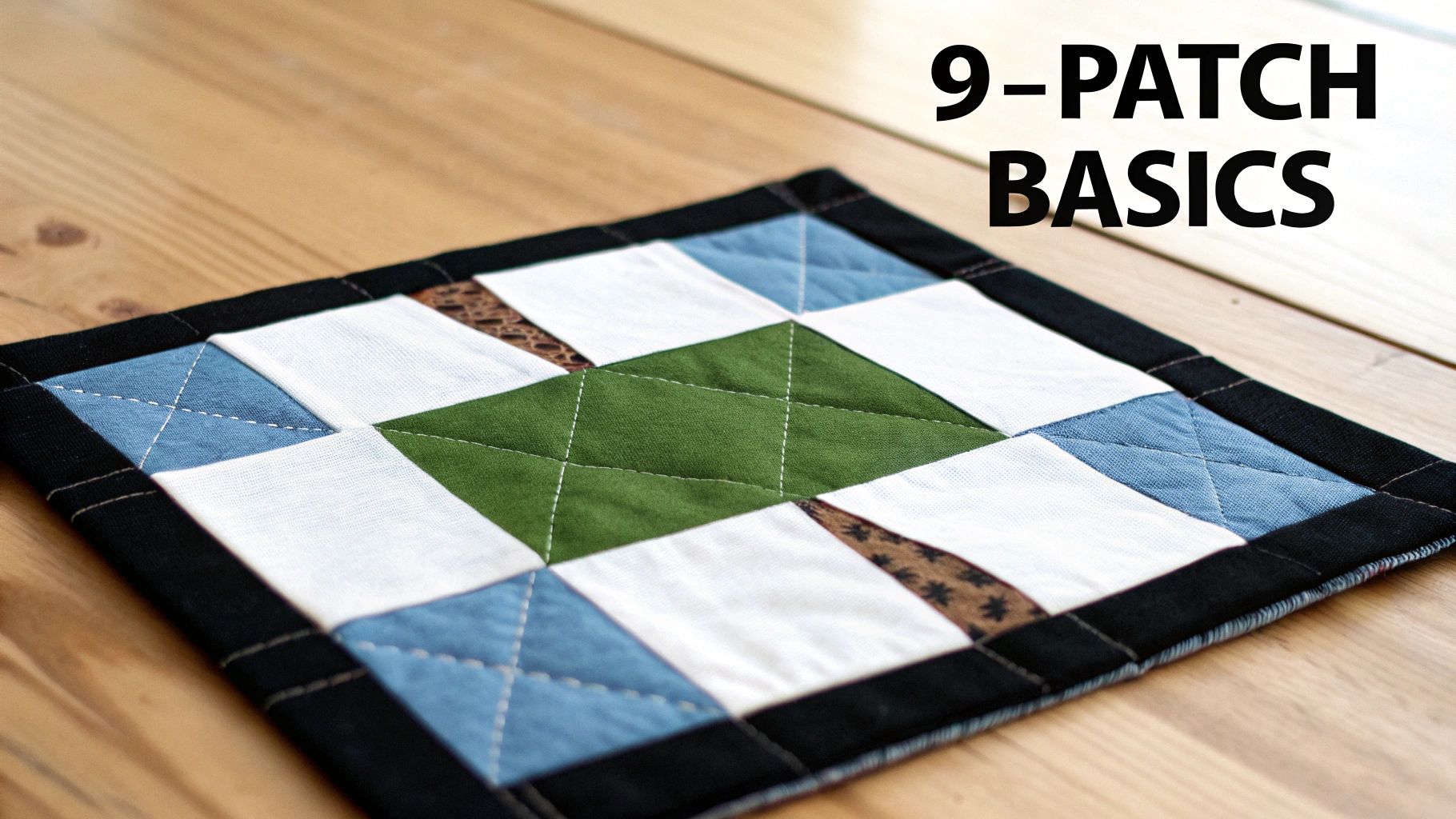
Learning the nine-patch is about more than just sewing nine squares together; it's about building a solid foundation of skills. When you master this block, you gain the confidence and the core techniques needed to take on just about any other pattern out there. It’s like learning your scales before you sit down to play a masterpiece.
Plus, it's the absolute best way to tackle that ever-growing scrap bin. We all have one! The nine-patch gives those precious leftover pieces a purpose, letting you blend a wild assortment of colors and prints into something truly beautiful and cohesive.
This block isn't some new fad—it's woven into the very fabric of quilting history. The nine-patch is one of the earliest patterns documented in America, with surviving examples from the early 1800s.
In fact, the Smithsonian's National Museum of American History has a beautiful Nine-patch Pieced Quilt dated between 1825-1850. It’s a wonderful example of the block's lasting appeal, alternating pieced blocks with solid squares. It's fascinating to explore the history of this foundational block and see how it has been used for centuries.
When you sit down to make a nine-patch, you're doing more than just stitching. You're taking part in a tradition that connects you to generations of makers who used this same simple pattern to create comfort and art.
The real magic of the nine-patch block is its ability to create stunning secondary patterns. When you arrange multiple blocks together, new and unexpected designs emerge at the points where the corners meet, transforming simple squares into a visually complex quilt top.
For anyone new to this craft, the nine-patch is an incredible teacher. It forces you to get the basics just right, offering hands-on practice in a few key areas:
Before you even think about making that first cut for your 9 patch quilt block, let's talk about setting yourself up for success. Getting your supplies in order is the first step, and trust me, having the right tools makes all the difference between a fun, relaxing project and a frustrating mess.
Think of a rotary cutter, a self-healing cutting mat, and a clear quilting ruler as your core trio. These aren't just fancy gadgets; they work together to give you those clean, straight cuts that are the foundation of a great quilt block. Trying to get that same precision with a pair of scissors is a recipe for wonky squares and a lot of headaches.
Another little game-changer is a quarter-inch seam foot for your sewing machine. This small accessory is a huge help, guiding your fabric so you sew a perfect quarter-inch seam every single time. That consistency is what makes your squares line up beautifully and your final block lay flat.
Okay, this is the fun part! But while it's tempting to just grab your favorite patterns, the real secret to a stunning nine-patch is contrast. You need to create a clear difference between your fabrics—think light against dark, or a busy print next to a solid.
This pop of contrast is what makes the nine-patch grid really stand out. If your fabrics are too close in value, the design can look muddy and the whole pattern just gets lost. Here's a quick pro-tip: snap a black-and-white photo of your fabric choices on your phone. If you can still easily tell them apart, you've got a winner.
Your fabric choices tell a story. Historically, the nine-patch block was a testament to resourcefulness, a way to make something beautiful and functional from practically nothing. This is what makes it such a perfect project for using up beloved scraps from your stash.
Fabric quality is also a big deal. I always recommend using 100% quilting cotton. It has a tight, stable weave that's a dream to work with—it doesn't stretch out of shape and it holds a press beautifully. While cheaper fabrics might be tempting, they often warp and won't hold up over time, and you want your quilt to last.
To get you started, here is a simple cutting guide for a standard 12-inch finished block.
This table shows exactly what you'll need to cut for a classic nine-patch. We're cutting all the squares at 4.5 inches, which includes the standard quarter-inch seam allowance on all sides. When sewn together, this will give you a perfect 12-inch block (measuring 12.5 inches before you sew it into the quilt top).
| Fabric Role | Fabric ID | Number of Squares to Cut | Cut Size (per square) |
|---|---|---|---|
| Corners & Center | Fabric A | 5 | 4.5" x 4.5" |
| Sides | Fabric B | 4 | 4.5" x 4.5" |
Remember, Fabric A should be your "light" or "dark" and Fabric B should be its opposite to create that essential contrast.
The nine-patch block has always been a scrap-buster at heart, and that tradition has deep roots. Back in the 1860s, during the Civil War, fabric was scarce. Women would save every tiny piece left over from making clothes or other projects. They'd piece these remnants into simple nine-patch blocks, turning would-be trash into warm, beautiful quilts.
This spirit of making do is a huge part of the 9 patch quilt block's charm. If you're interested in diving deeper, you can explore more about this thrifty quilting tradition at tortoisecrafts.co.uk. It's a great reminder of the history sewn into every block we make.
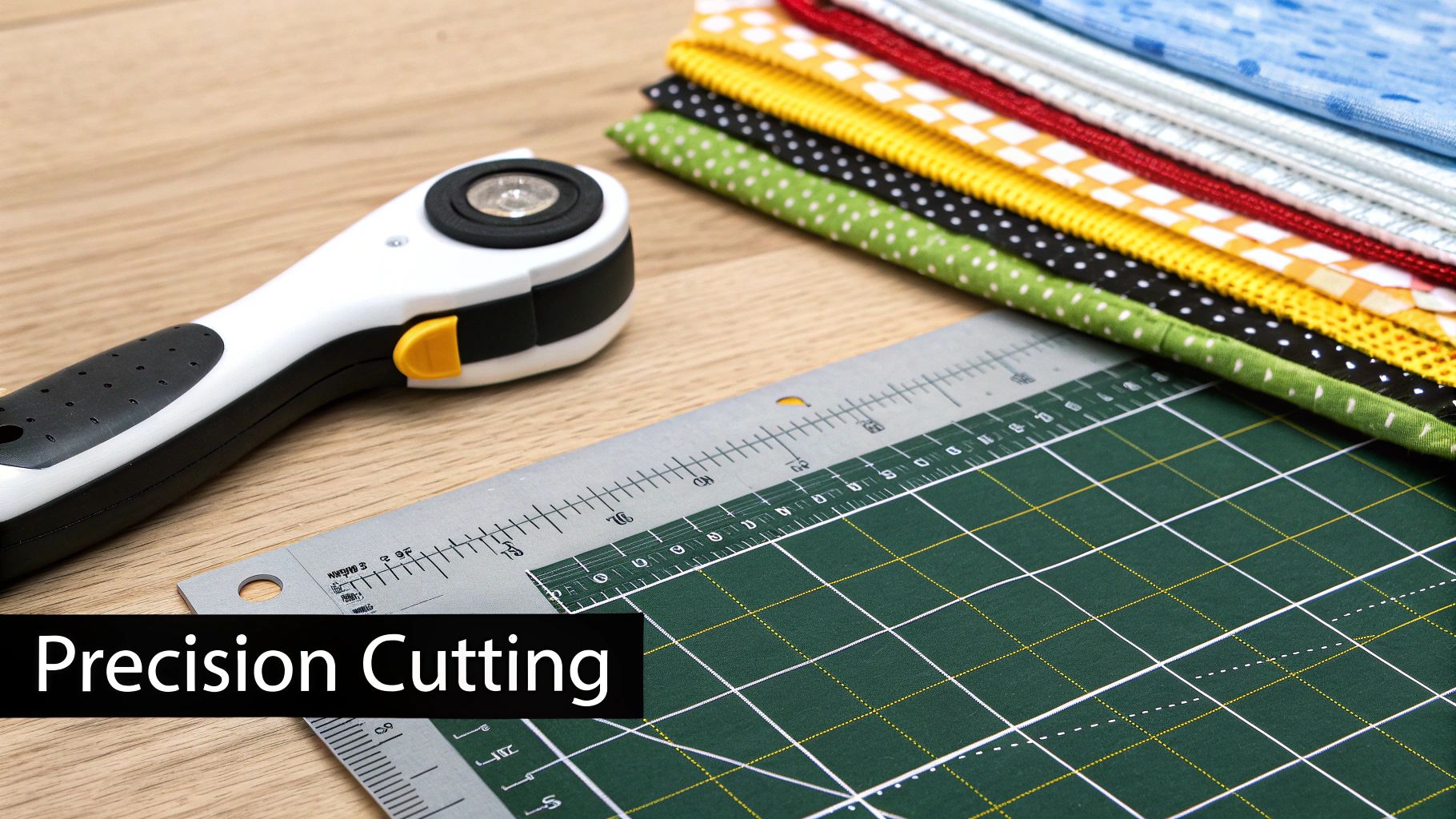
Every beautiful quilt starts not with a stitch, but with a cut. The precision you bring to your cutting mat right now is truly the bedrock of your entire 9 patch quilt block. If your squares are even a little bit off, you'll end up with mismatched seams and a block that just won't lay flat. So, let’s take our time and get this part right.
Your very first move isn't to start cutting strips. Instead, you need to create a perfectly straight edge on your fabric to work from. Unfold your yardage, give it a good press, and then fold it selvage to selvage. Once it's smooth, lay it on your cutting mat.
Now, grab your quilting ruler and align one of its horizontal lines with the folded edge of the fabric. With a firm hand, make a clean, decisive cut along the right side of the ruler with your rotary cutter. This initial trim gets rid of that wonky factory edge and gives you a true 90-degree angle to build from.
With that perfectly squared-up edge, you’re ready to cut your strips. For this block, we’re aiming for 4.5-inch squares. Rotate your fabric or your mat 90 degrees and measure 4.5 inches over from that fresh, straight edge.
Place your ruler so its 4.5-inch line is sitting directly on top of the cut edge. Hold the ruler down firmly—this is key—and cut your first strip. Stacking your fabric here can be a massive time-saver. You can safely stack two or even four layers for this step, provided your rotary blade is sharp and you apply firm, even pressure.
Insider Tip: Try to avoid a "sawing" motion with your rotary cutter. The best technique is a single, smooth, confident push away from your body. This prevents those little jagged edges and gives you a much cleaner, more accurate cut every single time.
Once you have your 4.5-inch strips, it's time to sub-cut them into squares. Open up a strip and lay it flat on the mat. First things first, trim off the selvage edge to create another clean, straight side to work from.
Now, rotate the strip so it's horizontal in front of you. Align the 4.5-inch mark on your ruler with that freshly trimmed end and make your cut. Just keep repeating this process—measure, align, and cut—to get all the precise 4.5-inch squares you need for your block.
This simple, scalable grid is exactly why the nine-patch has been a go-to teaching tool for centuries. Its straightforward math made it the perfect pattern for teaching sewing skills. In fact, historical records show girls as young as three or four were piecing these blocks long before they could even read. You can discover more about how this historical block was used to teach quilting.
By really focusing on these fundamental cutting skills, you're doing more than just making a 9 patch quilt block. You're building the muscle memory that will make every future quilting project that much better.
Alright, with all your squares cut and ready to go, we've arrived at the fun part—stitching it all together. This is where those little fabric squares finally start to look like the classic nine-patch block you’ve been aiming for. The best way to tackle this is to work in rows.
Think of it like assembling a tic-tac-toe board. We'll create the top, middle, and bottom rows first, and then join them.
Start with the squares for your top row. You'll have two corner pieces (Fabric A) and one side piece (Fabric B). Place the first corner square on top of the side square, making sure the "right sides" of the fabric are facing each other, and stitch along one edge. Now, add the second corner piece to the other side of that same side piece, again, right sides together. Voila! Row one is complete.
Just repeat that exact process for your middle and bottom rows, keeping your planned layout in mind.
Before you get too far, let's have a quick chat about the most important rule in patchwork: the quarter-inch seam allowance. Getting this right isn't just a suggestion—it's the key to making sure your corners match up perfectly and your block comes out the right size.
If your seam is off by even a tiny bit, that error gets magnified with every piece you add. A seam that's just a couple of threads too wide on each square can leave you with a final block that's noticeably wonky. My go-to tool for this is a quarter-inch presser foot. It has a little guide on the side that makes keeping your stitching straight and consistent almost foolproof.
A perfect quarter-inch seam is the secret sauce of quilting. It’s what magically turns a 4.5-inch cut square into a neat 4-inch finished unit inside your block. This precision is how all nine pieces fit together perfectly to create a 12.5-inch unfinished block.
Want to know a technique that will make you feel like a quilting rockstar? It's called chain piecing. Instead of sewing two squares, stopping, snipping the thread, and picking up the next pair, you just feed them through your machine one after the other without stopping.
Sew your first pair of squares, and just as they’re about to clear the presser foot, slide the next pair right up behind them. You’ll end up with what looks like a long string of fabric flags, all connected by a few threads.
I love this method for a few reasons:
After you've chained all the pairs for your rows, you just take your scissors and snip the little threads connecting them. Then you can chain-piece the third square onto each of your pairs.
You have three beautifully pieced rows ready to become a block. This is where your pressing direction really shines. Lay your top row over your middle row, with the right sides of the fabric facing each other.
You should feel the seams from each row bump up against each other and "nest" together snugly. It's a very satisfying little click. Pinning right at these intersections will keep anything from shifting while you sew. Stitch them together with that trusty quarter-inch seam.
Do the exact same thing to add the bottom row. Give the whole thing a final press, step back, and take a look. You did it—a perfect 9-patch quilt block.
After you’ve pieced your rows, we get to the part that really separates a good quilt block from a great one: the pressing. I know, it's not the most exciting step in making a 9 patch quilt block, but getting this right is the secret to a block that lays beautifully flat with crisp, professional points.
A common mistake I see beginners make is ironing their quilt pieces. Ironing is that back-and-forth, gliding motion we use on clothes. Unfortunately, that same motion can easily stretch and distort your fabric, especially along the bias of a seam.
Instead, we want to press. Pressing is just a simple up-and-down motion. Set the iron down, let the heat do its job for a second, and lift straight up. This small tweak in technique makes a world of difference in keeping your block square and true.
To get those perfect corners where all your squares meet, you need a smart pressing strategy. The whole idea is to create what we call nested seams. This little trick helps the bulky parts of the seams lock together perfectly, rather than creating a lumpy pile-up.
For a standard nine-patch, the game plan is straightforward:
When you bring your rows together to sew them, you’ll actually feel the seams from the top and middle rows "lock" into place. It’s a tactile guide that helps you line everything up without a fuss.
This diagram breaks down the assembly process.
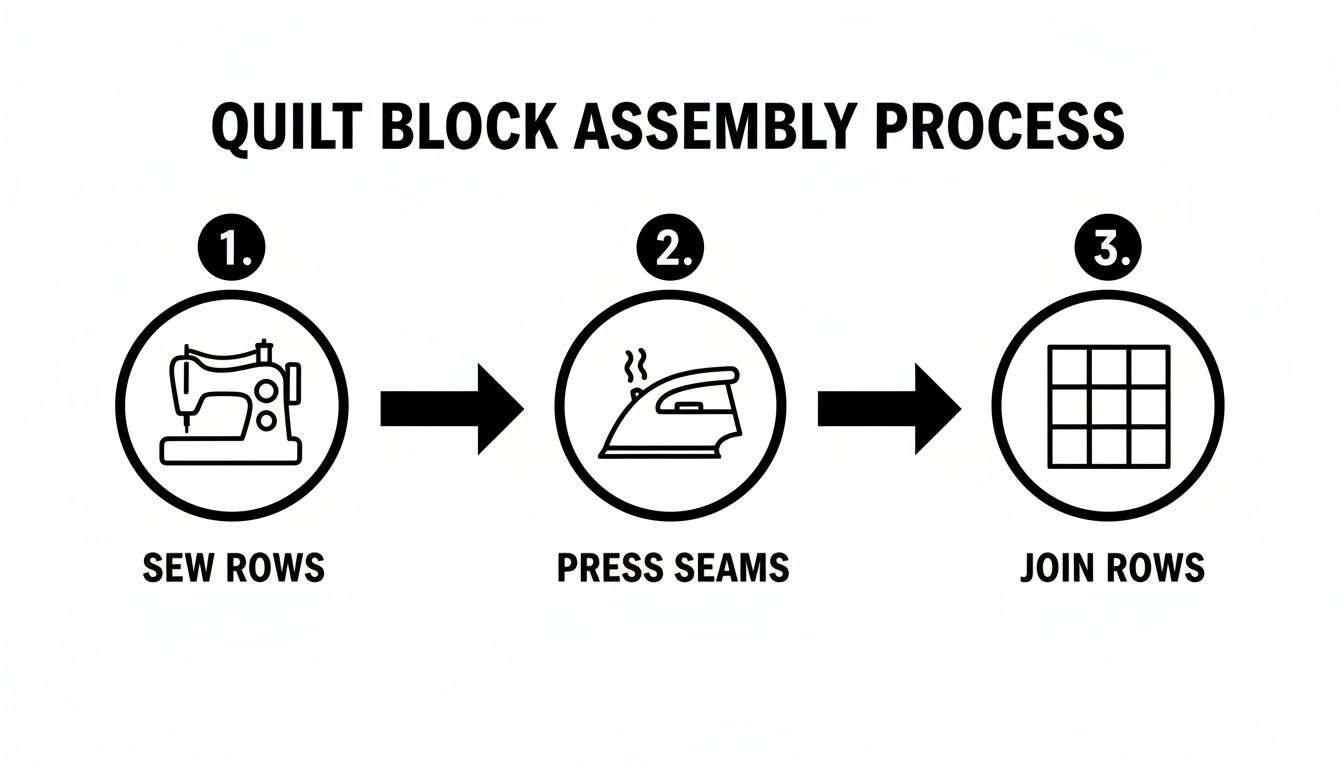
As you can see, that middle step—thoughtful pressing—is the critical link between sewing your strips and joining them into a perfect block.
Once the three rows are sewn together, it's time for the final press. My personal go-to is to press the two long seams connecting the rows open. While pressing them to one side is fine, pressing them open distributes the bulk more evenly, which really helps the entire block lay as flat as a pancake.
The best quilting advice I ever got was to stop treating pressing as a final step. Instead, make it part of your sewing rhythm. I keep my ironing board set up right next to my sewing machine, so I can stitch a seam, swivel my chair, press it, and get right back to sewing.
This "press as you go" habit makes the whole process smoother and much more accurate. Taking a few seconds to press each seam right after you sew it saves you from a massive headache later on. It's these small, consistent actions that add up to a stunning, professional-quality 9 patch quilt block. It might feel a bit tedious at first, but trust me, this is where the magic happens.
You've pieced and pressed, and your 9 patch quilt block is looking great! But before it can take its place in a quilt, there's one final, non-negotiable step: squaring it up.
This is the secret to getting all your blocks to play nicely together. Even with the most careful sewing, tiny variations creep in. Squaring up cleans up those raw edges and guarantees every single block is the exact same size, which is critical for a beautifully flat quilt top without puckers or wonky seams.
Our target here is a perfect 12.5-inch unfinished square. That extra half-inch gives you the quarter-inch seam allowance on all sides, so your block will measure exactly 12 inches when it's all sewn together in the finished quilt.
Lay your completed block on your cutting mat. You’ll need a square quilting ruler that’s at least 12.5 inches. The real magic comes from a little line printed on most of these rulers: the 45-degree diagonal line. This is your best friend for achieving a truly square block.
Start by placing the ruler on your block and lining up that 45-degree diagonal mark right on top of one of your block's diagonal seams. Slide the ruler around until the raw fabric edges on two sides are just outside the ruler's edge. Hold it down firmly and make your first two cuts.
Now, spin the block 180 degrees so the two sides you just trimmed are on the inside. This time, line up those freshly cut edges with the 12.5-inch lines on your ruler. Double-check that your diagonal line is still sitting pretty on the seam, then trim the last two sides.
This isn't just about making the edges neat. This two-step trimming process actually corrects any slight stretching or distortion that happened during sewing and pressing. It's the final quality check that ensures a professional result every time.
With a perfectly squared-up block, you're ready to go! What's next is up to you.
You've just mastered a fundamental skill in quilting, and the possibilities from here are endless.
Even a pattern as simple as the 9-patch can throw you a curveball. It happens to all of us! Let's walk through some of the questions I hear all the time so you can get your project sewn up without a hitch.
Figuring out your cutting measurements can feel a bit like quilt-math gymnastics, but there's an easy way to think about it. Just work backward. If you're aiming for a finished 9-inch block, each of your nine little squares needs to finish at 3 inches. Add your half-inch seam allowance (1/4 inch on each side), and you get your magic cutting number: 3.5-inch squares. Simple as that!
This is probably the most common frustration I see. You followed the instructions, but the block just isn't the right size. I can tell you from experience that 90% of the time, the culprit is a sneaky seam allowance. If your quarter-inch seam is even a tiny bit too generous, it will eat into your fabric and shrink the final block.
The best fix? A quarter-inch presser foot for your machine. It’s a game-changer for getting those seams perfectly consistent every single time.
So you've sewn your rows, but the points just aren't lining up. Don't tear your hair out! This is exactly why nesting your seams is so crucial. When you press the seams of each row in opposite directions, they should lock into place like puzzle pieces as you sew the rows together.
If things are still a little off, you can gently ease the fabric. This just means you give the shorter piece a tiny, gentle stretch to match the longer one as it goes under the needle. It can work wonders for minor mismatches.
We've all made a "wonky" block. Or ten. The point isn't to be perfect right out of the gate, but to figure out what went sideways. Think of it as a learning stitch—it makes your next block that much better.
And what if you run out of a specific fabric? I say, lean into it! The nine-patch has always been a "scrap buster" pattern. Tossing another coordinating fabric into the mix can add a ton of personality and make your quilt uniquely yours. It’s one of the things that makes the 9-patch quilt block such a timeless, forgiving classic.
Here at High Country Quilts, we've got all the tools, gorgeous fabrics, and friendly advice you need to bring your quilt to life. Check out our selection and maybe even join a class at https://hcquilts.com.
At High Country Quilts we care deeply about community. With our experiences in retail, we know that a store is not only a place to shop but also a place for the community to gather and share. During this busy...

Hi! We’re Adam and Renee Wheaton, the new owners of High Country Quilts! For more than 40 years, we’ve owned and operated vacuum and sewing businesses. Following in Renee’s father’s footsteps after he retired from All Discount Vacuum and Sewing in Colorado...


Leave a comment